자주권이라는 유령 — 한국은 무엇으로부터 독립했는가
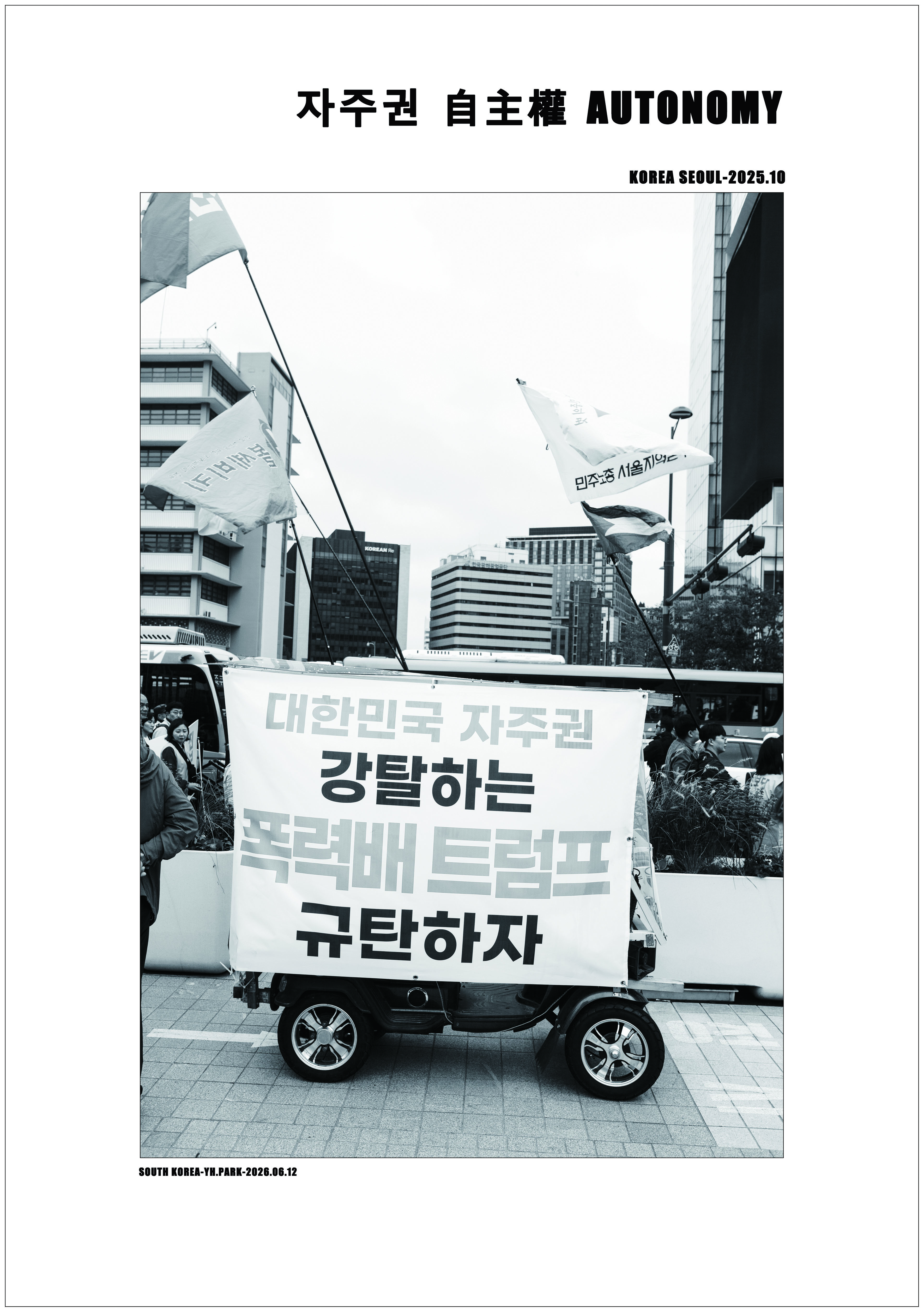
이 사진을 보며 내가 먼저 떠올린 것은 군사주권이 아니다.
오히려 그 반대다.
왜 대한민국에서는 아직도 자주권이라는 단어가 살아남아 있는가?
프랑스 사람은 자주권을 외치지 않는다.
영국 사람도 자주권을 외치지 않는다.
주권이 완성된 국가에서는 주권을 외칠 이유가 없기 때문이다.
자주권이라는 말이 계속 등장한다는 것은 역설적으로 그 주권이 아직 완성되지 않았음을 의미한다.
사진 속 깃발들은 바람에 흔들리고 있지만 사실 흔들리는 것은 깃발이 아니다.
대한민국이라는 국가 정체성 자체가 흔들리고 있는 것이다.
식민지는 끝났지만 식민성은 끝났는가
프란츠 파농은 식민지 해방 이후 가장 위험한 순간은 총독이 떠난 뒤라고 말했다.
총독은 사라지지만 총독의 언어는 남는다.
총독은 떠나지만 총독의 질서는 남는다.
총독은 죽지만 총독의 시선은 살아남는다.
한국 현대사는 해방 이후에도 끊임없이 외부 강대국의 전략 속에서 움직여 왔다.
미국, 소련, 중국, 일본.
민족의 운명이 민족 스스로 결정된 순간은 생각보다 많지 않았다.
따라서 사진 속 "자주권"이라는 단어는 단순한 군사지휘권의 문제가 아니다.
그것은 더 잔인한 질문이다.
푸코라면 이 사진을 어떻게 읽을까
푸코는 권력이 군대나 경찰보다 훨씬 깊은 곳에 있다고 보았다.
권력은 인간이 무엇을 생각할 수 있는가를 결정한다.
그래서 가장 강력한 지배는 총칼이 아니라 상상력의 지배다.
이 사진의 무서움은 여기 있다.
사람들은 자주권을 외치고 있지만 이미 자주권이라는 개념 자체가 국가주의 언어 속에 갇혀 있다.
왜 우리는 주권을 국가의 문제로만 생각하는가?
왜 노동의 주권은 말하지 않는가?
왜 자본으로부터의 주권은 말하지 않는가?
왜 플랫폼 기업에 의해 수집되는 데이터 주권은 말하지 않는가?
왜 AI 시대의 인지 주권은 말하지 않는가?
사진은 군사주권을 말하지만, 정작 우리가 잃고 있는 것은 훨씬 더 광대한 차원의 주권일 수 있다.
아감벤의 질문
조르조 아감벤은 현대 국가를 거대한 예외상태 기계라고 불렀다.
한국은 세계에서 가장 오래된 휴전국가다.
전쟁은 끝났지만 끝나지 않았다.
평화는 왔지만 완성되지 않았다.
국민들은 언제나 안보라는 이름으로 설명되는 특별한 현실 속에 살아왔다.
그런데 아감벤은 묻는다.
이 사진은 어쩌면 전작권을 요구하는 사진이 아니다.
70년 넘게 지속된 예외상태에 대한 피로의 기록이다.
사진 속 가장 중요한 것은 현수막이 아니다
대부분 사람들은 현수막을 읽는다.
그러나 좋은 사진은 글자를 읽지 않는다.
사진은 구조를 읽는다.
보라.
거대한 빌딩들이 사진 상단을 점령하고 있다.
금융 자본.
국가 권력.
행정 권력.
도시 권력.
그리고 그 아래에는 작은 전동차 하나가 놓여 있다.
마치 현대 사회에서 민중의 위치를 상징하는 듯하다.
국가는 거대해졌다.
기업은 더욱 거대해졌다.
알고리즘은 더욱 거대해졌다.
그러나 시민은 점점 작아졌다.
그래서 이 사진의 진짜 제목은 "자주권"이 아니다.
오히려
"왜 시민은 이렇게 작아졌는가"
이다.
사진의 균열
나는 이 사진을 보며 오히려 자주권 운동의 역설을 본다.
민중은 국가의 자주권을 외친다.
그러나 국가가 강해질수록 반드시 시민도 자유로워지는 것은 아니다.
20세기 역사는 그것을 수없이 증명했다.
강한 국가와 자유로운 시민은 같은 개념이 아니다.
그래서 이 사진이 던지는 가장 급진적인 질문은 이것이다.
그 순간 사진은 군사 문제를 넘어선다.
그것은 국가와 제국의 대립을 넘어서
인간과 권력의 문제,
시민과 체계의 문제,
존엄과 통치의 문제로 이동한다.
그리고 바로 그 지점에서 이 사진은 단순한 시위 기록이 아니라,
해방 이후 80년이 지나도록 아직 완성되지 못한 한국 현대성의 초상이 된다.
깃발은 바람에 흔들린다.
그러나 진짜 흔들리는 것은 깃발이 아니라,
우리가 당연하다고 믿어 온 "독립"이라는 신화일지도 모른다.
The Ghost of Sovereignty — From What Has Korea Truly Become Independent?
The first thing that comes to mind when looking at this photograph is not military sovereignty.
Rather, it is the opposite.
Why does the word "sovereignty" still survive in South Korea?
The French do not march through the streets demanding sovereignty.
The British do not raise banners calling for sovereignty.
In countries where sovereignty is fully internalized, there is little need to constantly invoke it.
The persistent appearance of the word itself suggests a paradox:
perhaps sovereignty remains unfinished.
The flags in this image appear to be trembling in the wind.
But perhaps it is not the flags that are trembling.
Perhaps it is the very identity of the Korean nation-state.
Colonialism Ended, But Did Coloniality End?
Frantz Fanon argued that the most dangerous moment comes not during colonial rule, but after the colonizer leaves.
The governor departs, but his language remains.
The empire collapses, but its order survives.
The ruler dies, but his gaze continues to inhabit the minds of the formerly colonized.
Modern Korean history has unfolded within the gravitational fields of larger powers:
America, Russia, China, and Japan.
Moments in which the Korean people alone determined their historical destiny have been fewer than nationalist narratives often admit.
Therefore, the word "sovereignty" in this photograph is not merely about military command.
It raises a more unsettling question:
How Would Foucault Read This Photograph?
Michel Foucault understood power as something deeper than armies, governments, or police forces.
Power determines what can be thought before it determines what can be done.
The most effective domination is not military occupation but the occupation of imagination.
This is where the photograph becomes disturbing.
People demand sovereignty, yet the concept itself remains trapped within the language of the nation-state.
Why is sovereignty discussed only in military terms?
Why is there so little discussion of labor sovereignty?
Why is economic sovereignty rarely addressed?
Why do we not speak of data sovereignty in an age of digital surveillance?
Why do we not discuss cognitive sovereignty in an era increasingly shaped by artificial intelligence?
The photograph appears to speak about military autonomy.
Yet what may actually be disappearing is a much broader field of human autonomy.
Agamben's Question
Giorgio Agamben described modern politics as a machine that perpetually reproduces states of exception.
South Korea remains one of the world's longest-standing armistice societies.
The war ended.
Yet it never fully ended.
Peace arrived.
Yet it never became complete.
For decades, citizens have lived within a reality explained through the language of security, emergency, and geopolitical necessity.
Agamben would ask:
From this perspective, the photograph may not be about wartime operational control at all.
It may instead be a visual record of exhaustion—a fatigue produced by living too long inside a permanent emergency.
The Most Important Element Is Not the Banner
Most viewers read the text.
Photographs, however, are not fundamentally about text.
They are about structures.
Look carefully.
Massive office towers dominate the upper portion of the frame.
Financial power.
Administrative power.
Corporate power.
Urban power.
Below them sits a small vehicle carrying a banner.
The composition itself becomes a political metaphor.
The state has grown larger.
Corporations have grown larger.
Algorithms have grown larger.
Yet the citizen has become increasingly small.
For that reason, the true title of this photograph may not be Sovereignty.
It may instead be:
"Why Has the Citizen Become So Small?"
The Contradiction Within Sovereignty
The image reveals a profound paradox.
People demand national sovereignty.
Yet history repeatedly demonstrates that a stronger state does not automatically produce freer citizens.
The twentieth century offered countless examples of powerful states that diminished human freedom.
A strong state and a free people are not identical concepts.
Thus the photograph ultimately asks a more radical question:
At that moment, the image transcends military politics.
It moves beyond the opposition between nation and empire.
It enters the terrain of humanity and power,
citizens and systems,
dignity and governance.
And at precisely that point, the photograph ceases to be a simple documentary record of a demonstration.
It becomes a portrait of an unfinished modernity—
a Korea that, eighty years after liberation, is still searching for the meaning of freedom.
The flags continue to tremble in the wind.
But perhaps what is really trembling is not the fabric of the flags.
Perhaps it is the myth of independence itself.