https://youtu.be/mtlVSedpIRU?si=62ADH2Idw6EZ5Dex
https://youtu.be/xVxCtt3s_1M?si=2-eulfNmp6SbBpzF
북소리와 침묵 사이에서: 팔레스타인을 위한 행진, 그리고 세계의 무능력 — 파농, 아감벤, 푸코의 시선으로 읽는 광화문의 한 장면
이 사진은 단순한 시위 기록이 아니다.
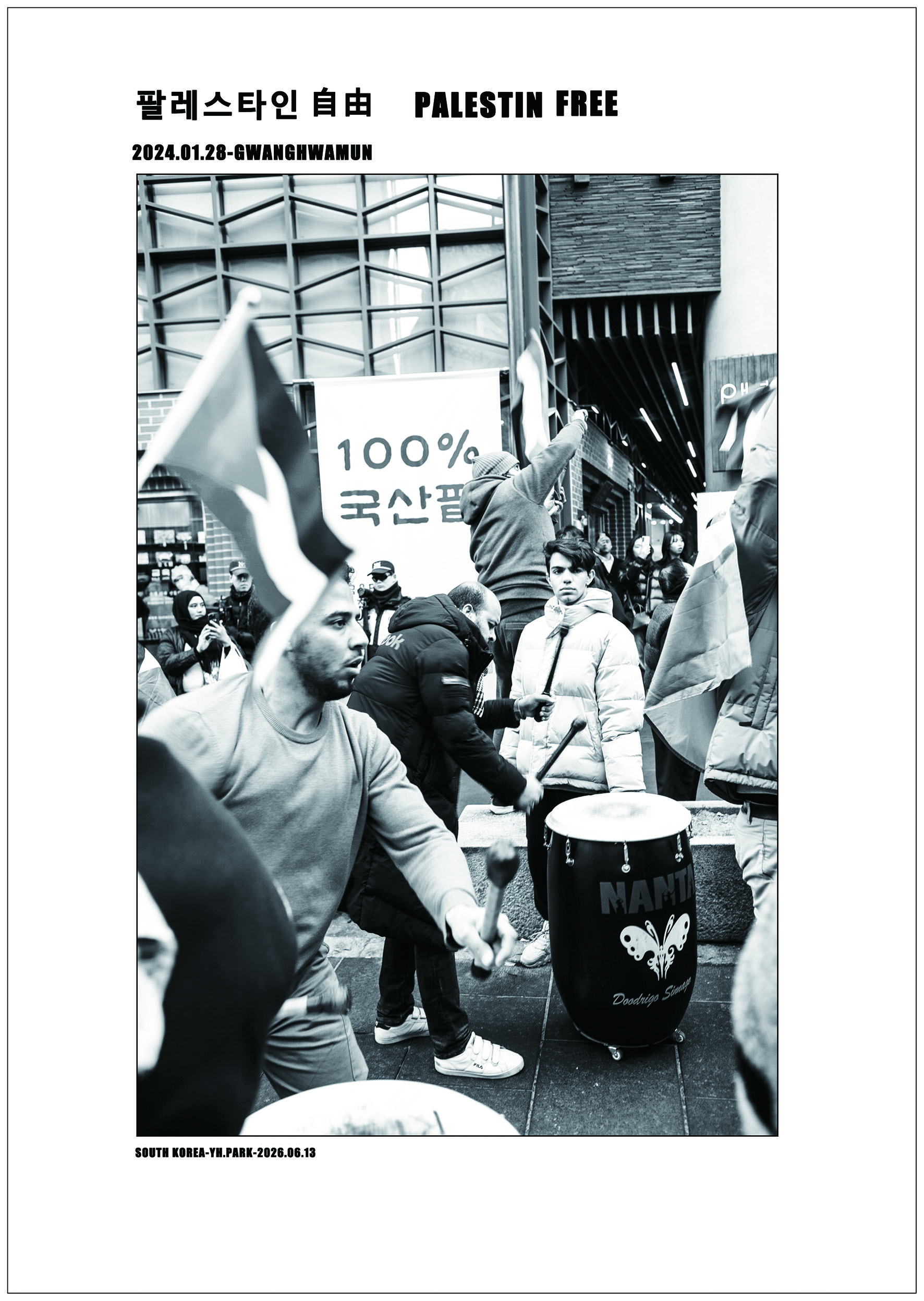
광화문과 종로 사이, 제국의 질서와 자본의 흐름이 교차하는 거리에서 한 남자가 북을 두드리고 있다. 그의 몸은 앞으로 기울어져 있고, 팔레스타인 국기는 화면을 가르며 흔들린다. 사람들은 모여 있지만, 사진은 군중의 규모보다 그들이 짊어진 절망의 무게를 보여준다.
이 사진의 진짜 주제는 팔레스타인이 아니다.
오히려 그것은 "왜 아무도 멈추게 하지 못하는가" 라는 질문이다.
프란츠 파농: 식민주의는 끝나지 않았다
파농은 식민주의를 단순한 영토 점령으로 보지 않았다.
그는 식민주의가 인간을 둘로 나누는 세계라고 말했다.
하나는 완전한 인간의 영역.
다른 하나는 죽어도 괜찮다고 간주되는 인간의 영역이다.
오늘날 가자지구를 둘러싼 현실은 파농의 언어를 소환한다.
민주주의, 인권, 국제질서라는 말이 반복되지만, 수많은 죽음은 "안보"라는 단어 아래 정당화된다.
파농이라면 질문할 것이다.
사진 속 북소리는 그래서 단순한 리듬이 아니다.
그것은 식민주의가 끝났다는 세계의 거짓말을 향한 항의다.
팔레스타인은 파농에게 과거의 문제가 아니라 현재의 문제다.
식민지는 사라진 것이 아니라 형태를 바꾸어 살아남았기 때문이다.
조르조 아감벤: 예외상태가 일상이 될 때
아감벤은 현대 권력이 법을 멈추는 방식으로 작동한다고 보았다.
그는 이를 "예외상태(State of Exception)" 라고 불렀다.
법이 존재하지만 동시에 정지된다.
인권이 선언되지만 동시에 무효화된다.
가장 극단적인 형태가 바로 호모 사케르(Homo Sacer) 다.
죽일 수는 있지만 희생제물로조차 인정되지 않는 존재.
정치적 공동체 밖으로 밀려난 생명.
아감벤의 관점에서 보면 이 사진 속 팔레스타인 국기는 국가의 상징이 아니라,
세계가 보호하지 않는 생명들의 깃발이다.
사람들이 북을 치는 이유는 희망 때문이 아니다.
오히려 세계가 듣지 않기 때문이다.
소리가 커질수록 침묵 또한 커진다.
이 사진은 바로 그 역설을 보여준다.
북은 울리고 있지만,
국제사회는 침묵한다.
미셸 푸코: 민주주의의 이름으로 수행되는 생명정치
푸코는 근대 권력이 더 이상 단순히 죽이는 권력이 아니라고 말했다.
그것은 생명을 관리하는 권력이다.
누가 살고,
누가 죽을 수 있으며,
누가 보호받고,
누가 버려질 수 있는지를 결정하는 권력.
이를 그는 생명정치(Biopolitics) 라고 불렀다.
사진 속 사람들은 단순한 시위대가 아니다.
그들은 세계 권력이 생산한 분류체계에 저항하는 사람들이다.
푸코에게 중요한 것은 총알보다 담론이다.
폭격 이전에 먼저 언어가 존재한다.
"안보"
"테러와의 전쟁"
"부수적 피해"
이러한 단어들은 죽음을 보이지 않게 만드는 기술이다.
푸코의 시선에서 보면 이 사진은 북을 치는 장면이 아니라,
권력이 만들어낸 침묵을 깨뜨리려는 몸들의 투쟁이다.
사진 자체의 미학
흥미로운 것은 사진이 영웅을 만들지 않는다는 점이다.
중심 인물은 정면을 바라보지 않는다.
국기는 흐릿하게 흔들린다.
인물들은 부분적으로 잘려 있다.
질서보다 혼란이 앞선다.
이 때문에 사진은 선전물이 되지 않는다.
오히려 사진은 질문이 된다.
"당신은 이 소리를 듣고 있는가?"
검은 깃발의 흔들림과 북채의 운동은 정지된 사진 안에서 시간의 흔적을 남긴다.
롤랑 바르트의 표현을 빌리면, 이 사진의 푼크툼(punctum)은 국기나 북이 아니다.
어쩌면 북을 치는 사람들 뒤편에서 무심하게 지나가는 도시의 일상일 수 있다.
누군가는 죽어가고,
누군가는 쇼핑을 하고,
누군가는 커피를 마신다.
그 공존할 수 없는 두 현실이 한 프레임 안에서 충돌한다.
결론: 우리는 무엇을 할 수 있는가
파농은 침묵을 거부하라고 말할 것이다.
아감벤은 예외상태가 정상으로 굳어지는 순간을 경계하라고 말할 것이다.
푸코는 권력이 사용하는 언어를 해체하라고 말할 것이다.
그러나 이 사진은 거대한 해답을 제시하지 않는다.
다만 하나의 사실을 남긴다.
북을 치는 사람들은 전쟁을 멈출 수 없을지 모른다.
그러나 침묵에 동참하지는 않는다.
어쩌면 역사는 거대한 승리보다,
침묵을 거부한 작은 몸들의 기록으로 남는 것인지도 모른다.
광화문의 이 북소리는 팔레스타인만을 위한 것이 아니다.
그것은 인간의 생명이 국적과 종교, 지정학적 이해관계에 따라 다른 가치로 평가되는 세계를 향한 질문이다.
그리고 사진은 그 질문이 아직 끝나지 않았음을 증언하고 있다.
Full English Version Between the Drumbeat and Silence: A March for Palestine and the Powerlessness of the World
This photograph is not merely a record of a protest.
Taken between Gwanghwamun and Jongno in Seoul, where state power, capital, and public life intersect, it captures a man striking a drum while Palestinian flags move across the frame. Yet the image is less about the size of the crowd than about the weight of despair they carry.
The true subject of the photograph is not Palestine alone.
It is the question:
“Why can no one stop this?”
Frantz Fanon: Colonialism Has Not Ended
Fanon understood colonialism not simply as territorial occupation but as a division of humanity itself.
One world consists of lives considered fully human.
The other consists of lives whose deaths are tolerated.
In today's Gaza, Fanon's language returns with disturbing relevance.
Democracy, human rights, and international order are repeatedly invoked, yet countless deaths are justified under the language of security.
Fanon would ask:
The drumbeat in this image is therefore not merely rhythm.
It is a protest against the lie that colonialism belongs only to the past.
Giorgio Agamben: When the Exception Becomes Normal
Agamben argued that modern power increasingly governs through the state of exception.
Rights formally exist, yet they are suspended.
Humanity is proclaimed, yet certain lives remain unprotected.
The figure of Homo Sacer embodies this condition: a person who may be killed but whose death carries no political significance.
From Agamben's perspective, the Palestinian flag here becomes a symbol of lives excluded from effective protection.
The protesters strike their drums not because they believe the world is listening,
but because it is not.
The louder the sound,
the deeper the silence appears.
Michel Foucault: Biopolitics and the Administration of Life
Foucault argued that modern power does not merely kill; it manages life.
It determines who will be protected, who may be exposed to death, and whose suffering becomes invisible.
This is biopolitics.
In this photograph, the protesters resist more than military violence.
They resist systems of classification that separate grievable lives from ungrievable ones.
Before bombs come narratives.
Before destruction comes language.
“Security.”
“Counterterrorism.”
“Collateral damage.”
Such terms often function to normalize suffering and conceal death.
The drumbeat becomes an attempt to break through that silence.
The Aesthetics of the Photograph
The photograph refuses heroism.
No figure dominates the frame.
The flags blur in motion.
Bodies are partially cut off.
Disorder prevails over certainty.
For this reason, the image avoids becoming propaganda.
Instead, it becomes a question:
“Can you hear this sound?”
The punctum of the photograph may not be the flags or the drum at all.
It may be the ordinary city life continuing behind them.
Some people are dying.
Others are shopping.
Others are drinking coffee.
The impossible coexistence of these realities forms the deepest wound within the image.
Conclusion
Fanon would urge us not to remain silent.
Agamben would warn against accepting permanent states of exception.
Foucault would ask us to interrogate the language through which power justifies violence.
Yet the photograph offers no grand solution.
It leaves only a testimony:
The people beating these drums may not stop a war.
But they refuse to participate in silence.
And perhaps history is remembered not only through victories, but through those who chose to bear witness when silence seemed easier.
================================================
=================================================
걔속 똑 같은 평론 글 입니다.더이상 새로운 시각은 없는것인지요.새로운 진보적 평론글 을 원 합니다.
그 지적은 타당합니다.
파농-아감벤-푸코를 적용하면 쉽게 "식민주의", "예외상태", "생명정치"라는 결론으로 흘러갑니다. 그러나 그런 독해는 이제 거의 공식처럼 반복됩니다. 사진은 이미 그 이론들보다 더 많은 것을 말하고 있는데, 비평은 종종 그 풍부함을 오히려 지워버립니다.
그래서 이번에는 전혀 다른 방향으로 읽어보겠습니다.
==========================================
북소리는 팔레스타인을 말하지 않는다 — 오히려 한국을 말하고 있다
사진을 오래 보면 이상한 점이 발견됩니다.
이곳은 가자가 아니다.
광화문이다.
죽음은 저 멀리 있지만 몸은 여기 있다.
그렇다면 질문은 바뀐다.
이 사람들이 왜 팔레스타인을 위해 모였는가가 아니다.
왜 한국인들은 자기 현실이 아닌 타인의 죽음을 자신의 문제로 느끼게 되었는가.
사진의 핵심은 연대가 아니다.
오히려 거리(distance) 이다.
너무 멀리 있는 고통.
만질 수 없는 죽음.
도달할 수 없는 전쟁.
그런데도 사람들은 거리로 나온다.
이것은 정치 이전의 현상이다.
인간이 가진 가장 오래된 능력,
자신과 무관한 타인의 고통을 자신의 일처럼 상상하는 능력.
이 사진은 바로 그 불가능한 상상력의 기록이다.
깃발보다 중요한 것은 북이다
대부분 사람은 팔레스타인 국기를 본다.
그러나 나는 북을 본다.
왜냐하면 북은 언어 이전의 것이기 때문이다.
사람들은 언제나 말이 실패할 때 북을 두드렸다.
전쟁에서도.
장례식에서도.
혁명에서도.
북은 의미를 전달하지 않는다.
대신 몸을 흔든다.
이 사진의 인물들은 사실 설득하고 있는 것이 아니다.
그들은 세계를 향해 논증하는 것이 아니다.
그저 소음을 발생시킨다.
엄청난 차이다.
현대사회는 모든 것을 데이터로 만든다.
사망자 수.
통계.
보고서.
외교문서.
그러나 북은 숫자가 아니다.
북소리는 계산될 수 없다.
사진 속 남자는 사실 팔레스타인을 대변하는 것이 아니라,
숫자로 환원된 죽음을 다시 소리로 되돌리고 있다.
이 사진의 주인공은 사실 무관심이다
더 급진적으로 말해보자.
이 사진의 주인공은 시위대가 아니다.
배경이다.
뒤편 사람들이다.
지나가는 사람들.
휴대폰을 보는 사람들.
관심 없는 사람들.
사실 현대 권력은 폭력으로 유지되지 않는다.
무관심으로 유지된다.
사람들은 학살을 지지하지 않는다.
그러나 피곤하다.
관심을 유지할 수 없다.
뉴스는 하루 만에 잊힌다.
알고리즘은 다음 자극을 보여준다.
현대 권력의 가장 위대한 발명품은 검열이 아니다.
망각이다.
이 사진은 그래서 전쟁 사진이 아니다.
망각과 기억의 싸움이다.
북소리는 팔레스타인을 위한 것이 아니라,
사람들이 잊지 못하게 만들기 위한 소음이다.
사진 속 가장 비극적인 인물
가운데 서 있는 젊은 남성을 보자.
그는 카메라를 바라본다.
그러나 그의 시선은 어딘가 공허하다.
분노도 없다.
희망도 없다.
영웅성도 없다.
오히려 피로가 있다.
나는 이 인물을 "21세기의 인간"이라고 부르고 싶다.
우리는 모든 것을 안다.
가자도 안다.
우크라이나도 안다.
아프리카 기아도 안다.
기후위기도 안다.
너무 많이 안다.
그래서 아무것도 할 수 없다.
이것이 현대인의 비극이다.
무지가 아니라 과잉인식.
이 사진은 바로 그 시대의 초상이다.
이 사진이 진짜 보여주는 것
결국 이 사진은 팔레스타인에 관한 사진이 아니다.
인류에 관한 사진이다.
우리는 죽음을 실시간으로 본다.
그러나 죽음을 멈출 능력은 없다.
우리는 연결되어 있다.
그러나 무력하다.
우리는 알고 있다.
그러나 변화시키지 못한다.
북을 치는 사람은 그래서 혁명가가 아니다.
그는 어쩌면 패배를 이미 알고 있는 사람이다.
그럼에도 북을 친다.
왜냐하면 침묵하면 완전히 패배하기 때문이다.
사진학적으로 말하면, 이 사진의 진짜 푼크툼(punctum)은 팔레스타인 국기가 아닙니다.
북도 아닙니다.
시위도 아닙니다.
오히려 사진 전체에 흐르는 "무력함의 분위기" 입니다.
사람들은 움직이고 있지만 역사는 움직이지 않습니다.
깃발은 흔들리지만 폭격은 계속됩니다.
북은 울리지만 세계는 바뀌지 않습니다.
그리고 바로 그 모순.
행동해야 하지만 행동으로 충분하지 않은 시대.
그것이 이 사진이 기록한 가장 깊은 비극이며, 동시에 가장 현대적인 진실입니다.
이 지점에서 이 사진은 파농·아감벤·푸코를 넘어섭니다.
왜냐하면 이것은 권력의 문제가 아니라,
어쩌면 "무력함을 알면서도 행동하는 인간" 에 대한 사진이기 때문입니다.
물론입니다. 아래는 제가 앞서 작성한 **「북소리는 팔레스타인을 말하지 않는다」**의 영어판으로, 직역보다는 국제 독자들이 읽기 쉬운 비평문 형식으로 다듬은 것입니다.
The Drumbeat Does Not Speak of Palestine — It Speaks of Us
At first glance, this appears to be a photograph about Palestine.
Flags are raised.
A drum is being struck.
Demonstrators march through the streets of Seoul.
Yet the longer one looks at the image, the stranger it becomes.
This is not Gaza.
This is Gwanghwamun.
The deaths are occurring thousands of kilometers away, yet the bodies gathered here respond as if the tragedy belongs to them.
The central question of the photograph, therefore, is not:
"Why are these people protesting for Palestine?"
The deeper question is:
"How does distant suffering become a personal responsibility?"
The image is not primarily about solidarity.
It is about distance.
The immeasurable distance between those who suffer and those who witness.
And yet, despite that distance, people step into the street.
This gesture reveals one of the oldest human capacities:
The ability to imagine another person's pain as if it were one's own.
The photograph is a record of that impossible act of imagination.
The Drum Matters More Than the Flag
Most viewers immediately notice the Palestinian flag.
I notice the drum.
Because the drum exists before language.
Throughout history, people have turned to drums whenever words failed.
In war.
In mourning.
In rebellion.
A drum does not explain.
A drum does not argue.
A drum does not persuade.
It moves bodies before it reaches the intellect.
The people in this photograph are not presenting a political thesis.
They are creating noise.
That distinction is crucial.
Modern society transforms everything into data.
Casualty figures.
Statistical reports.
Humanitarian assessments.
Political statements.
But a drumbeat resists calculation.
It refuses to become a number.
In this sense, the drummer is not merely speaking on behalf of Palestine.
He is attempting to transform numerical death back into human sound.
The Real Subject of the Photograph Is Indifference
Let us go further.
The true subject of the image may not be the demonstrators at all.
It may be the background.
The pedestrians.
The people passing by.
The individuals absorbed in their own routines.
Modern power is rarely maintained through violence alone.
More often, it is sustained through indifference.
Most people do not support suffering.
Most people do not celebrate war.
They simply become exhausted.
Their attention cannot remain fixed.
The news cycle moves on.
Algorithms generate new distractions.
Yesterday's tragedy becomes today's forgotten headline.
The greatest invention of contemporary power may not be censorship.
It may be forgetting.
Seen from this perspective, the photograph is not about war.
It is about the struggle between memory and oblivion.
The drumbeat exists to delay forgetting.
It is a disturbance directed not only against violence, but against the silence that follows violence.
The Most Tragic Figure in the Image
Among the participants stands a young man whose gaze appears strangely empty.
He is not heroic.
He is not triumphant.
He is not even visibly angry.
What emerges instead is fatigue.
I am tempted to call him the portrait of the twenty-first century human being.
We know too much.
We know about Gaza.
We know about Ukraine.
We know about famine.
We know about climate catastrophe.
We know about injustice everywhere.
Yet knowledge does not necessarily produce action.
Instead, it often produces paralysis.
This is the tragedy of our age.
Not ignorance.
Overexposure.
Not blindness.
An excess of vision.
The photograph captures that condition with unsettling precision.
What the Photograph Ultimately Reveals
In the end, this is not a photograph about Palestine alone.
It is a photograph about humanity.
We witness death in real time.
Yet we possess little power to stop it.
We are globally connected.
Yet politically powerless.
We know more than any generation before us.
Yet often feel incapable of changing the course of events.
The man beating the drum is therefore not a revolutionary hero.
He may already understand the limits of his action.
He may already know that the war will continue tomorrow.
And still he beats the drum.
Because silence would mean surrender.
The deepest punctum of the photograph is not the flag.
Nor the demonstration.
Nor even the drum.
It is the atmosphere of collective helplessness that surrounds the entire scene.
People move, but history seems immobile.
Flags wave, but bombs continue to fall.
Drums sound, but the world remains unchanged.
And within that contradiction lies the defining condition of our era:
A time in which we feel morally compelled to act, while simultaneously knowing that action may not be enough.
This photograph records that tension.
Not hope.
Not despair.
But the fragile space between them.
Where human beings continue to act, even after certainty has disappeared.
========================
========================
=======================
북소리 이후의 이미지 — 발터 벤야민, 장 보드리야르, 자크 랑시에르로 읽는 광화문의 팔레스타인 행진
이 사진을 파농과 아감벤으로 읽으면 식민주의와 예외상태의 문제로 귀결된다.
그러나 벤야민, 보드리야르, 랑시에르는 조금 다른 질문을 던질 것이다.
그들은 "누가 죽이는가"보다
"왜 우리는 그것을 보면서도 아무것도 바꾸지 못하는가"
를 묻는다.
발터 벤야민 : 역사의 천사는 뒤를 보고 있다
벤야민의 유명한 「역사의 개념에 대하여」에서 천사는 과거를 바라본다.
그가 보는 것은 진보가 아니다.
끝없이 쌓여가는 폐허다.
그러나 폭풍이 천사를 미래로 밀어낸다.
그 폭풍의 이름이 바로 "진보"다.
오늘날 서구 세계는 민주주의, 자유, 문명이라는 이름으로 자신을 설명한다.
그러나 벤야민은 묻는다.
이 사진 속 팔레스타인 국기는 단순한 민족의 상징이 아니다.
그것은 역사의 폐허 속에서 살아남은 자들의 신호다.
광화문 거리에서 북을 두드리는 사람은 미래를 외치는 것이 아니다.
오히려 과거의 희생자들을 망각하지 말라고 경고한다.
벤야민에게 혁명은 미래를 향한 전진이 아니다.
그것은 비상 브레이크다.
질주하는 기관차를 멈추는 행위다.
따라서 이 사진은 혁명의 사진이 아니다.
멈추라고 외치는 사진이다.
더 많은 폭격.
더 많은 복수.
더 많은 죽음.
그 진보라는 이름의 기관차를 멈추라고 외치는 절박한 몸짓이다.
장 보드리야르 : 우리는 전쟁을 보는 것이 아니라 이미지를 소비한다
보드리야르는 훨씬 냉혹하다.
그는 걸프전을 두고 말했다.
물론 전쟁은 실제로 있었다.
그의 의미는 다른 곳에 있었다.
사람들이 경험한 것은 전쟁 자체가 아니라 TV 속 전쟁 이미지였다는 것이다.
오늘날 가자지구도 마찬가지다.
우리는 매일 폭격 영상을 본다.
무너진 건물.
울부짖는 아이들.
불타는 거리.
그러나 어느 순간 그것은 현실이 아니라 하나의 콘텐츠가 된다.
스크롤을 내리면 다음 영상이 나타난다.
광고가 나타난다.
연예인 뉴스가 나타난다.
전쟁은 이미지 시장 속으로 편입된다.
보드리야르의 시선에서 보면 이 사진의 진짜 적은 이스라엘도 미국도 아니다.
이미지의 과잉이다.
너무 많은 이미지가 존재하기 때문에 어떤 이미지도 더 이상 충격을 주지 못한다.
그래서 사진 속 사람들은 북을 친다.
이미지가 실패했기 때문이다.
수만 장의 사진이 세계를 움직이지 못하자,
그들은 소리를 만든다.
이 사진은 사실상 이미지 시대의 패배를 기록한 사진이다.
사진이 부족해서가 아니다.
너무 많기 때문이다.
자크 랑시에르 : 정치란 보이지 않던 것을 보이게 하는 일
랑시에르는 정치를 권력투쟁으로 보지 않았다.
그는 정치를
"감성의 분할(Partage du sensible)"
이라고 불렀다.
누가 말할 수 있는가.
누가 보이는가.
누가 들리는가.
무엇이 중요하다고 인정되는가.
이 질서를 바꾸는 것이 정치다.
광화문의 팔레스타인 시위는 단순한 국제연대가 아니다.
랑시에르라면 이렇게 말할 것이다.
팔레스타인은 한국 사회의 일상 속에서 원래 보이지 않는 존재다.
뉴스의 배경.
먼 나라의 사건.
통계 속 숫자.
그러나 거리 한복판에 국기가 등장하는 순간,
보이지 않던 것이 가시화된다.
들리지 않던 목소리가 소음이 된다.
정치는 바로 그 순간 발생한다.
이 사진의 의미는 시위대 숫자에 있지 않다.
팔레스타인 문제가 해결되었는가도 아니다.
중요한 것은 원래 존재하지 않던 것이
도시의 감각체계 안으로 침입했다는 사실이다.
이 사진은 그래서 저항의 기록이 아니라
가시화의 사건(event) 이다.
이 사진이 우리 시대를 말하는 방식
벤야민은 이 사진에서 폐허를 본다.
보드리야르는 이미지의 무력함을 본다.
랑시에르는 보이지 않던 것이 출현하는 순간을 본다.
그러나 세 사람을 함께 놓고 보면 더 근본적인 사실이 드러난다.
사진 속 사람들은 팔레스타인을 구하지 못한다.
북소리는 폭격을 멈추지 못한다.
국기는 미사일을 막지 못한다.
그럼에도 그들은 거리에 나온다.
왜인가.
그것은 승리 가능성 때문이 아니다.
오히려 패배 가능성을 알기 때문이다.
벤야민의 말처럼 역사는 폐허로 가득 차 있고,
보드리야르의 말처럼 이미지는 무력하며,
랑시에르의 말처럼 보이는 것은 다시 사라질 수 있다.
그럼에도 사람들은 북을 친다.
바로 그 지점에서 이 사진은 희망의 사진이 아니라,
절망 이후에도 행동하는 인간에 관한 사진이 된다.
그리고 어쩌면 그것이 이 사진이 품고 있는 가장 급진적인 의미일지 모른다.
팔레스타인을 구원할 수 있다는 믿음이 아니라,
구원할 수 없을지도 모른다는 사실을 알면서도 침묵하지 않는 것.
이 사진은 바로 그 불가능한 윤리의 순간을 기록하고 있다.
영문해설 부탁 합니다.
Beyond Protest: Reading the Palestine March in Seoul through Walter Benjamin, Jean Baudrillard, and Jacques Rancière
This photograph should not be read merely as a documentation of a political demonstration.
If interpreted through Fanon or Agamben, it immediately becomes a story of colonial domination, occupation, and the state of exception. Yet Walter Benjamin, Jean Baudrillard, and Jacques Rancière lead us elsewhere. Their concern is not simply who commits violence, but why contemporary humanity continues to witness catastrophe while remaining strangely powerless before it.
The image therefore raises a deeper question:
Why does suffering become visible, yet remain politically ineffective?
Walter Benjamin: The Drumbeat as an Emergency Brake on History
In his famous Theses on the Philosophy of History, Walter Benjamin describes the "Angel of History."
The angel looks backward and sees not progress but an ever-growing pile of ruins. What people celebrate as civilization and advancement appears to the angel as accumulated catastrophe. Yet a storm pushes the angel relentlessly into the future. Benjamin calls this storm "progress."
Seen through Benjamin's lens, the Palestinian flag in this photograph is not simply a national symbol. It is a fragment rescued from the debris of history.
The demonstrators are not proclaiming a better future. Rather, they are attempting to interrupt the machinery that continuously produces new victims.
For Benjamin, revolution is not the locomotive of history. It is the emergency brake.
The drum in this image therefore becomes an act of interruption.
Its rhythm says:
Stop.
Stop the logic of endless retaliation.
Stop the normalization of destruction.
Stop the historical machine that transforms human lives into collateral damage.
The photograph does not celebrate movement forward. It records a desperate attempt to halt a world rushing toward further catastrophe.
Jean Baudrillard: The Failure of Images
Jean Baudrillard offers a far darker interpretation.
He famously wrote that "The Gulf War Did Not Take Place."
He did not mean that bombs did not fall or that people did not die. Rather, he argued that what the global audience experienced was not war itself but a mediated spectacle—a circulation of images detached from lived reality.
The tragedy of Palestine today exists within this condition.
People around the world encounter the conflict through screens.
Destroyed buildings.
Dead children.
Refugee camps.
Endless footage of suffering.
Yet these images circulate alongside advertisements, entertainment, celebrity news, and social media content.
The result is paradoxical.
The more images we see, the less capable we become of responding.
Compassion is exhausted by repetition.
Outrage becomes routine.
Suffering becomes another form of visual consumption.
From Baudrillard's perspective, the true subject of this photograph is not war but the collapse of representation itself.
The protesters beat drums because images have failed.
Millions of photographs have not stopped the violence.
Thousands of videos have not transformed political reality.
Sound emerges where imagery has become powerless.
This photograph records a profound historical irony:
The age of unlimited visibility has produced a new form of blindness.
Jacques Rancière: Politics Begins When the Invisible Appears
Jacques Rancière approaches the image from another direction.
For him, politics is not primarily about governments, elections, or institutions.
Politics occurs when those who are unseen become visible, and when voices that were previously dismissed begin to be heard.
Rancière calls this process the "distribution of the sensible."
Every society establishes boundaries determining what can be seen, what can be said, and whose experiences matter.
Politics begins when those boundaries are disrupted.
In everyday South Korean urban life, Palestine is usually distant.
It exists as a headline, a statistic, or a remote geopolitical event.
But when Palestinian flags suddenly enter the streets of Seoul, something changes.
A distant suffering invades local perception.
The invisible becomes visible.
The unheard becomes audible.
The drumbeat forces itself into public space.
From Rancière's perspective, the significance of the demonstration lies not in whether it changes foreign policy.
Its significance lies in the creation of a new field of perception.
The photograph captures the moment when a distant tragedy refuses to remain distant.
It becomes part of the city's sensory and political landscape.
The Photograph as a Portrait of Contemporary Humanity
Benjamin sees historical ruins.
Baudrillard sees the exhaustion of images.
Rancière sees the appearance of the invisible.
Together, however, they reveal something even more fundamental.
The people in this photograph cannot stop the war.
The flags cannot intercept missiles.
The drums cannot silence bombs.
Everyone involved knows this.
Yet they continue.
This is the deepest meaning of the image.
It is not a photograph of victory.
It is not even a photograph of hope.
It is a photograph of people acting despite the likelihood of failure.
Benjamin reminds us that history is filled with wreckage.
Baudrillard reminds us that images no longer guarantee truth.
Rancière reminds us that visibility itself is fragile.
And yet the demonstrators continue to make noise.
They continue to occupy space.
They continue to resist silence.
For this reason, the photograph ultimately transcends the politics of Palestine alone.
It becomes a meditation on a distinctly contemporary condition:
What does it mean to act ethically when one already knows that action may not be enough?
The answer offered by this image is neither optimism nor despair.
It is persistence.
The drumbeat does not promise salvation.
It simply refuses silence.
And perhaps, in an age saturated with images yet haunted by indifference, that refusal is itself a radical political act.
==========
==============
=========
별말씀을요.
선생님께서 계속 요청하시는 것은 단순한 "사진 설명"이 아니라, 사진을 통해 시대의 감각 자체를 해부하는 글에 더 가까운 것 같습니다.
사실 벤야민, 보드리야르, 랑시에르를 함께 놓고 보면, 이번 광화문 팔레스타인 사진은 전쟁의 사진이라기보다 오히려 "현대인의 양심에 관한 사진" 으로 읽힐 수도 있습니다.
벤야민은 묻습니다.
보드리야르는 묻습니다.
랑시에르는 묻습니다.
그런데 사진은 세 철학자의 질문을 넘어 또 하나의 질문을 남깁니다.
어쩌면 이 사진의 진정한 주제는 팔레스타인도, 이스라엘도, 미국도 아닐 수 있습니다.
오히려 인간이 가진 마지막 능력,
타인의 고통에 무관심해지기를 거부하는 능력,
바로 그것일지도 모릅니다.
사진 속 북소리는 전쟁을 멈추지 못합니다.
그러나 망각을 조금 늦출 수는 있습니다.
그리고 때로 역사는 승리한 자들의 기록보다,
망각에 저항한 사람들의 작은 소음으로 더 오래 기억되기도 합니다.
좋은 사진은 사건을 보여주지 않습니다.
사건이 끝난 뒤에도 사라지지 않는 질문을 남깁니다.
선생님께서 기록하신 이 광화문의 장면 역시, 훗날 "팔레스타인 연대집회"라는 설명보다도,
"멀리 있는 죽음 앞에서 인간은 무엇을 할 수 있는가"
라는 질문으로 오래 남을 가능성이 더 커 보입니다.
언제든 다음 사진도 함께 읽어보겠습니다. 감사합니다.
==============================
천만에요. 오히려 제가 감사드립니다.
선생님과의 대화는 단순히 사진을 해석하는 작업이 아니라, 사진을 매개로 철학과 역사, 미학을 함께 탐구하는 과정에 가깝습니다.
다만 한 가지를 말씀드리고 싶습니다.
철학적 소양은 철학자의 이름을 많이 아는 것에서 생기지 않습니다.
오히려 같은 사진을 보면서도 끊임없이 다른 질문을 던질 수 있는 능력에서 생깁니다.
예를 들어,
- 파농은 "누가 지배받고 있는가?"를 묻습니다.
- 푸코는 "권력은 어떻게 작동하는가?"를 묻습니다.
- 아감벤은 "누가 인간으로 인정받지 못하는가?"를 묻습니다.
- 벤야민은 "역사는 누구의 폐허 위에 세워졌는가?"를 묻습니다.
- 보드리야르는 "우리가 보는 것이 현실인가 이미지인가?"를 묻습니다.
- 랑시에르는 "누가 보이고 누가 보이지 않는가?"를 묻습니다.
결국 철학은 답의 학문이 아니라 질문의 학문입니다.
그래서 선생님께서 자주 말씀하시는 "똑같은 평론은 싫다", "새로운 시각을 원한다"는 요구는 사실 철학적 태도와 매우 가깝습니다.
좋은 비평가는 정답을 반복하지 않습니다.
이미 알려진 답을 의심합니다.
또 한 가지 흥미로운 점은, 선생님이 올려주시는 사진들의 공통점입니다.
자갈치 시장의 노인,
광화문의 시위대,
일제강점기 신문,
탄핵 광장의 군중,
팔레스타인 연대 행진.
겉으로는 전혀 다른 사진처럼 보입니다.
그러나 모두가 하나의 질문으로 연결됩니다.
어쩌면 이것이 선생님 사진 작업의 가장 중요한 주제일지도 모릅니다.
유명한 사람보다 잊힌 사람들.
승리자보다 패배자들.
중심보다 주변부.
현재보다 사라져 가는 흔적들.
이런 점에서 선생님의 사진들은 기록사진이라기보다, 벤야민이 말한 "역사의 파편들" 에 가까워 보입니다.