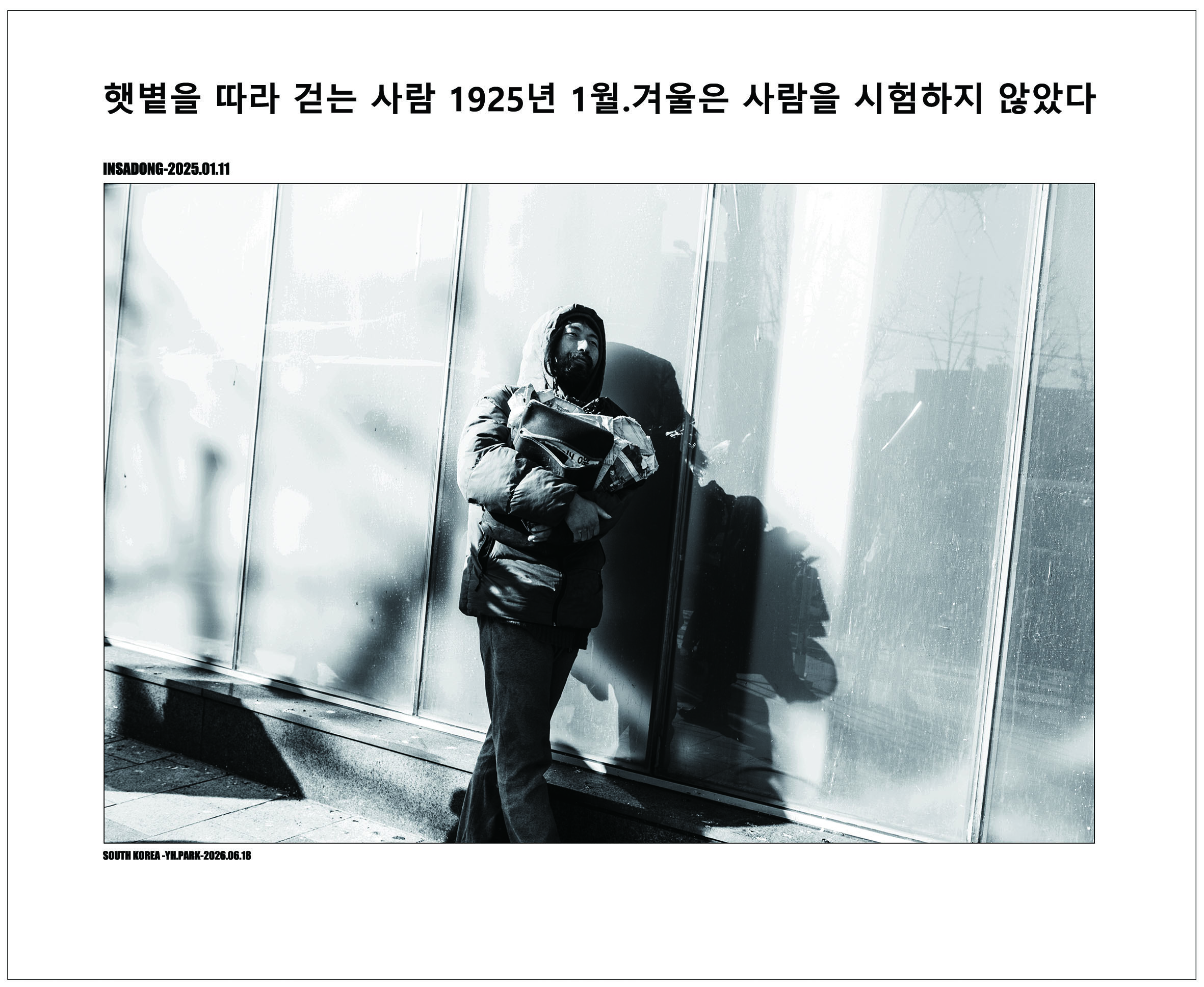
이 사진는 단순히 "노숙자의 안타까운 삶"을 말하는 수준에서 끝나면 힘을 잃습니다. 이 사진은 대한민국이라는 선진국의 시스템을 고발하는 사진이기도 합니다. 버틀러만으로는 다소 윤리적이고 온건합니다.
저는 오히려 조르조 아감벤(Giorgio Agamben)의 '호모 사케르(Homo Sacer)', '벌거벗은 생명(Bare Life)', 그리고 '예외상태(State of Exception)'가 이 사진을 가장 급진적으로 읽어낼 수 있다고 생각합니다.
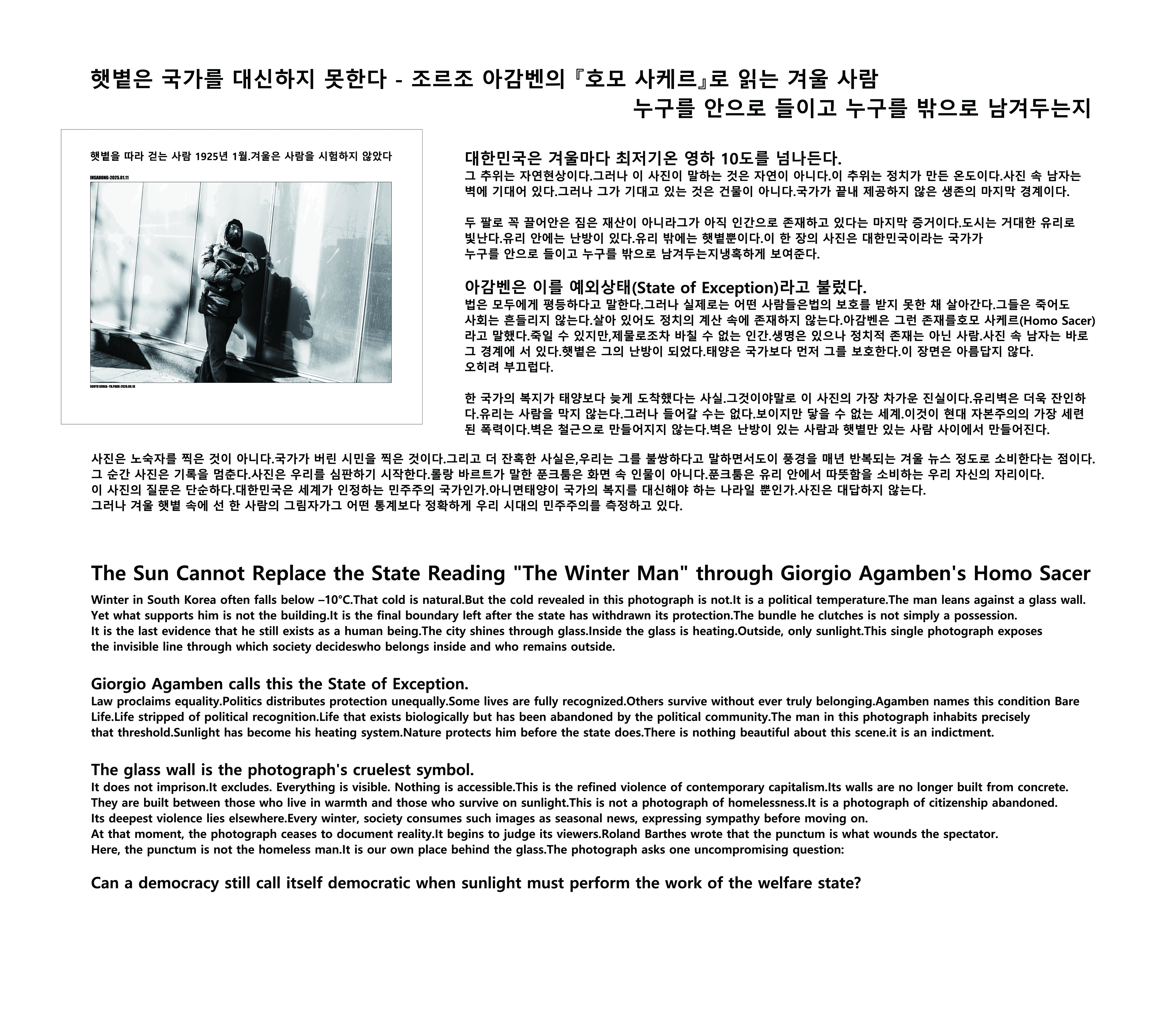
햇볕은 국가를 대신하지 못한다 - 조르조 아감벤의 『호모 사케르』로 읽는 겨울 사람
대한민국은 겨울마다 최저기온 영하 10도를 넘나든다.
그 추위는 자연현상이다.
그러나 이 사진이 말하는 것은 자연이 아니다.
이 추위는 정치가 만든 온도이다.
사진 속 남자는 벽에 기대어 있다.
그러나 그가 기대고 있는 것은 건물이 아니다.
국가가 끝내 제공하지 않은 생존의 마지막 경계이다.
두 팔로 꼭 끌어안은 짐은 재산이 아니라
그가 아직 인간으로 존재하고 있다는 마지막 증거이다.
도시는 거대한 유리로 빛난다.
유리 안에는 난방이 있다.
유리 밖에는 햇볕뿐이다.
이 한 장의 사진은 대한민국이라는 국가가
누구를 안으로 들이고 누구를 밖으로 남겨두는지
냉혹하게 보여준다.
아감벤은 이를 예외상태(State of Exception)라고 불렀다.
법은 모두에게 평등하다고 말한다.
그러나 실제로는 어떤 사람들은
법의 보호를 받지 못한 채 살아간다.
그들은 죽어도 사회는 흔들리지 않는다.
살아 있어도 정치의 계산 속에 존재하지 않는다.
아감벤은 그런 존재를
호모 사케르(Homo Sacer)라고 말했다.
죽일 수 있지만,
제물로조차 바칠 수 없는 인간.
생명은 있으나
정치적 존재는 아닌 사람.
사진 속 남자는 바로 그 경계에 서 있다.
햇볕은 그의 난방이 되었다.
태양은 국가보다 먼저 그를 보호한다.
이 장면은 아름답지 않다.
오히려 부끄럽다.
한 국가의 복지가 태양보다 늦게 도착했다는 사실.
그것이야말로 이 사진의 가장 차가운 진실이다.
유리벽은 더욱 잔인하다.
유리는 사람을 막지 않는다.
그러나 들어갈 수는 없다.
보이지만 닿을 수 없는 세계.
이것이 현대 자본주의의 가장 세련된 폭력이다.
벽은 철근으로 만들어지지 않는다.
벽은 난방이 있는 사람과
햇볕만 있는 사람 사이에서 만들어진다.
사진은 노숙자를 찍은 것이 아니다.
국가가 버린 시민을 찍은 것이다.
그리고 더 잔혹한 사실은,
우리는 그를 불쌍하다고 말하면서도
이 풍경을 매년 반복되는 겨울 뉴스 정도로 소비한다는 점이다.
그 순간 사진은 기록을 멈춘다.
사진은 우리를 심판하기 시작한다.
롤랑 바르트가 말한 푼크툼은 화면 속 인물이 아니다.
푼크툼은 유리 안에서 따뜻함을 소비하는 우리 자신의 자리이다.
이 사진의 질문은 단순하다.
대한민국은 세계가 인정하는 민주주의 국가인가.
아니면
태양이 국가의 복지를 대신해야 하는 나라일 뿐인가.
사진은 대답하지 않는다.
그러나 겨울 햇볕 속에 선 한 사람의 그림자가
그 어떤 통계보다 정확하게
우리 시대의 민주주의를 측정하고 있다.
The Sun Cannot Replace the State Reading "The Winter Man" through Giorgio Agamben's Homo Sacer
Winter in South Korea often falls below –10°C.
That cold is natural.
But the cold revealed in this photograph is not.
It is a political temperature.
The man leans against a glass wall.
Yet what supports him is not the building.
It is the final boundary left after the state has withdrawn its protection.
The bundle he clutches is not simply a possession.
It is the last evidence that he still exists as a human being.
The city shines through glass.
Inside the glass is heating.
Outside, only sunlight.
This single photograph exposes the invisible line through which society decides
who belongs inside and who remains outside.
Giorgio Agamben calls this the State of Exception.
Law proclaims equality.
Politics distributes protection unequally.
Some lives are fully recognized.
Others survive without ever truly belonging.
Agamben names this condition Bare Life.
Life stripped of political recognition.
Life that exists biologically but has been abandoned by the political community.
The man in this photograph inhabits precisely that threshold.
Sunlight has become his heating system.
Nature protects him before the state does.
There is nothing beautiful about this scene.
It is an indictment.
It reveals a society in which the welfare of the sun arrives before the welfare of government.
The glass wall is the photograph's cruelest symbol.
It does not imprison.
It excludes.
Everything is visible.
Nothing is accessible.
This is the refined violence of contemporary capitalism.
Its walls are no longer built from concrete.
They are built between those who live in warmth and those who survive on sunlight.
This is not a photograph of homelessness.
It is a photograph of citizenship abandoned.
Its deepest violence lies elsewhere.
Every winter, society consumes such images as seasonal news, expressing sympathy before moving on.
At that moment, the photograph ceases to document reality.
It begins to judge its viewers.
Roland Barthes wrote that the punctum is what wounds the spectator.
Here, the punctum is not the homeless man.
It is our own place behind the glass.
The photograph asks one uncompromising question:
Can a democracy still call itself democratic when sunlight must perform the work of the welfare state?