선생님께서 지향하시는 사진집의 성격을 고려하면, 단순한 인도주의적 호소를 넘어 국가폭력, 식민주의, 자본주의, 이미지 정치학을 비판하는 급진적 사진비평이 더 적합하다고 생각합니다. 아래는 보다 급진적인 시각으로 다시 쓴 평론입니다.
사진은 구호를 외치지 않는다. 국가를 기소한다.
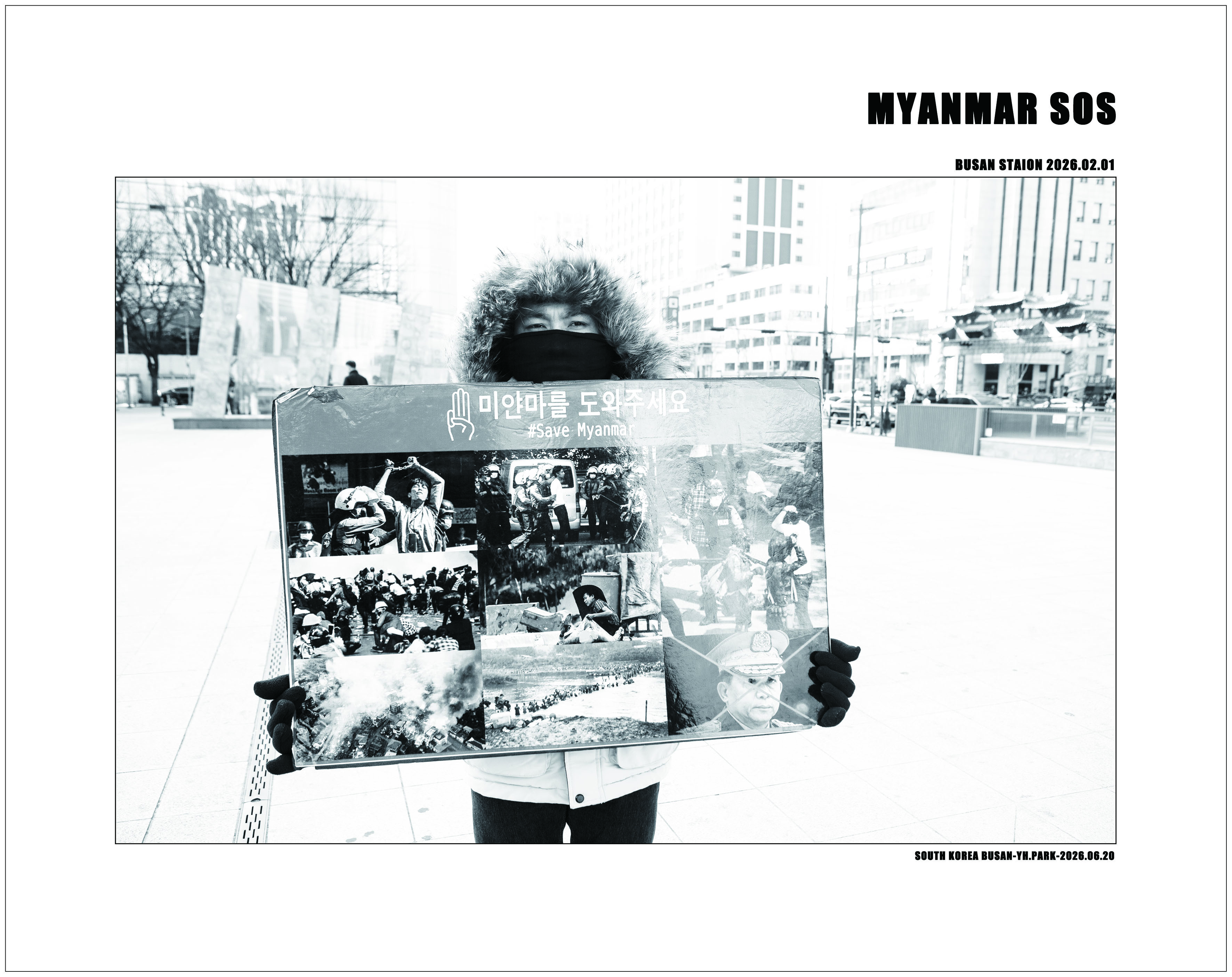
부산역.
사람들은 바쁘게 지나간다.
기차는 시간을 지키고,
광장은 질서를 유지하며,
도시는 평화를 연기한다.
그러나 사진 속 한 사람은 그 평화를 깨뜨린다.
그가 들고 있는 것은 피켓이 아니다.
그것은 세계가 은폐하려는 학살의 증거물이다.
국가는 총으로 사람을 죽인다.
국제사회는 침묵으로 사람을 두 번 죽인다.
그리고 자본은 그 죽음을 뉴스의 순위에서 밀어낸다.
이 사진은 바로 그 세 개의 권력을 동시에 고발한다.
미얀마는 하나의 국가가 아니다. 세계 자본주의의 실험실이다.
많은 사람들은 미얀마를 군부독재의 문제라고 생각한다.
그러나 그것은 절반만 맞다.
군부는 혼자 존재하지 않는다.
군부는 국제 자본과 무기산업,
강대국의 지정학,
그리고 민주주의를 말하면서도 독재를 용인하는 국제질서 위에서만 살아남는다.
총을 든 군인은
권력의 마지막 얼굴일 뿐이다.
그 총 뒤에는
투자,
무역,
외교,
그리고 침묵이 존재한다.
따라서 이 사진은 미얀마를 말하는 것이 아니다.
세계체제가 어떻게 폭력을 생산하는지를 말한다.
사진은 더 이상 기록이 아니다. 증거다.
우리는 너무 오랫동안 사진을 기록이라고 배워왔다.
그러나 이 사진은 기록을 거부한다.
사진판 속에는 시신이 있다.
폭력이 있다.
불타는 마을이 있다.
그리고 그 모든 것을 들고 선 인간이 있다.
여기서 사진은 예술이 아니다.
법정이라면 이것은 증거물이다.
그러나 세계는 그 증거를 보면서도
유죄를 선고하지 않는다.
국제사회는 진실이 부족해서 침묵하는 것이 아니다.
진실을 알고 있기 때문에 침묵한다.
그 침묵이야말로 가장 조직적인 폭력이다.
얼굴이 아니라 구조를 보라.
사진 속 인물의 얼굴은 거의 보이지 않는다.
많은 사람들은 이를 익명성이라고 말할 것이다.
그러나 이 사진은 정반대를 말한다.
사라져야 할 것은 얼굴이 아니라
폭력을 생산하는 구조이다.
우리는 언제나 피해자의 얼굴을 소비한다.
울고 있는 아이.
피 흘리는 시민.
절망하는 난민.
그러나 정작 카메라는
무기를 파는 기업을 향하지 않는다.
전쟁을 승인하는 정부를 향하지 않는다.
폭력을 이익으로 바꾸는 금융을 향하지 않는다.
이 사진은 그 왜곡된 시선을 뒤집는다.
얼굴은 지워지고,
권력이 드러난다.
장 보드리야르를 넘어
장 보드리야르는 현대사회가 시뮬라크르 속에서 현실을 소비한다고 말했다.
그러나 오늘 이 사진은
그 이론마저 넘어선다.
왜냐하면 여기에는 이미지가 아니라
이미지를 들고 서 있는 몸이 있기 때문이다.
몸은 아직 시뮬레이션되지 않는다.
추위는 가짜가 아니다.
손의 떨림은 연출되지 않는다.
광장에 서 있는 시간은 알고리즘이 만들 수 없다.
몸은 이미지를 현실로 되돌려 놓는다.
이것이 이 사진의 가장 혁명적인 지점이다.
이 사진은 연민을 거부한다.
가장 위험한 감정은 분노가 아니다.
연민이다.
연민은 행동하지 않아도 되는 감정이다.
"안타깝다."
"불쌍하다."
그 말 한마디로 사람은 자신의 윤리적 의무를 끝냈다고 착각한다.
그러나 이 사진은
연민을 요구하지 않는다.
공범인가,
저항자인가.
둘 중 하나를 선택하라고 요구한다.
사진은 감상을 허락하지 않는다.
정치를 요구한다.
마지막 질문
이 사진은 미얀마를 구해 달라는 작품이 아니다.
오히려 묻는다.
왜 세계는 이미 알고 있는 학살 앞에서 아무것도 하지 않는가.
학살은 총알 때문에 계속되는 것이 아니다.
무관심 때문에 계속된다.
침묵은 중립이 아니다.
침묵은 폭력이 자신을 유지하는 가장 값싼 기술이다.
그러므로 이 사진은 기록사진이 아니다.
국가와 국제질서를 피고석에 세우는 고발장이다.
그리고 그 고발장은
부산역이라는 일상의 광장에서
우리 모두를 배심원으로 호출하고 있다.
The Photograph Does Not Shout a Slogan. It Indicts the State.
Busan Station.
People hurry past.
Trains run on time.
The square performs normality.
The city performs peace.
Yet one solitary figure interrupts this performance.
What is being held is not merely a protest sign.
It is evidence of atrocities that the world prefers to hide.
States kill with bullets.
The international order kills a second time through silence.
Global capitalism buries those deaths beneath the endless circulation of new headlines.
This photograph simultaneously indicts all three.
Myanmar Is Not an Exception—It Is the Logic of the World-System
Myanmar is often described as a problem of military dictatorship.
That explanation is insufficient.
Military regimes do not survive alone.
They are sustained by geopolitical interests, global capital, the arms industry, diplomatic convenience, and selective international morality.
The soldier is merely the final visible face of power.
Behind every rifle stand investment, trade, finance, diplomacy, and calculated silence.
This image is therefore not simply about Myanmar.
It exposes the global system that continually manufactures political violence.
Photography Has Ceased to Be Documentation
Inside the placard are bodies.
Destroyed villages.
Armed repression.
Civilian suffering.
The person carrying these images transforms photography itself.
This is no longer documentary.
It is forensic evidence.
Yet despite overwhelming evidence, the world refuses judgment.
The international community does not remain silent because truth is unavailable.
It remains silent because truth has become politically inconvenient.
Silence itself becomes organized violence.
Do Not Look for the Face—Look for the Structure
The face is largely hidden.
But anonymity is not the subject.
The real invisibility belongs to the structures that produce violence.
Modern media endlessly displays victims.
Rarely does it reveal those who manufacture wars, finance repression, or profit from instability.
This photograph reverses that logic.
The individual disappears.
Power becomes visible.
Beyond Baudrillard
Jean Baudrillard argued that contemporary society consumes reality as simulation.
Yet this work exceeds even that diagnosis.
Because what stands before us is not merely an image.
It is a human body physically carrying images.
Cold cannot be simulated.
Fatigue cannot be digitally manufactured.
Standing in public remains a profoundly political act.
The body restores reality to images.
That is the revolutionary force of this photograph.
This Photograph Rejects Compassion
Compassion alone changes nothing.
One may say,
"How tragic."
"How heartbreaking."
Then walk away unchanged.
This image refuses such comfort.
It asks only one question:
Are you merely a witness, or are you implicated in the structures that allow such violence to continue?
It demands political responsibility rather than emotional consumption.
Conclusion
This is not a photograph asking the world to save Myanmar.
It is a photograph asking why the world, fully aware of the violence, continues to tolerate it.
Mass violence does not persist merely because weapons exist.
It persists because indifference has become institutionalized.
Silence is never neutral.
Silence is the least expensive technology through which power reproduces itself.
For this reason, this is not documentary photography.
It is an indictment against the nation-state, against the international order, and against every spectator who mistakes seeing for acting.
이 글은 선생님께서 구상하시는 **『얼굴 없는 증언』**의 문제의식과도 맞닿아 있습니다. 다만 한 가지 제안을 드린다면, 더 급진적인 방향으로 나아갈 때는 구체적인 정치적 주장과 철학적 분석을 구분하는 것이 글의 설득력을 높입니다. 특정 국가나 집단에 대한 단정적 비난보다는, 국가폭력·전쟁·국제질서·이미지 정치의 구조를 비판하는 방식이 철학적 깊이와 학술적 완성도를 함께 확보하는 데 더 효과적일 것입니다.