가자의 이미지와 현대 권력의 구조― 푸코, 아렌트, 아감벤, 버틀러를 통해 읽는 한 장의 사진
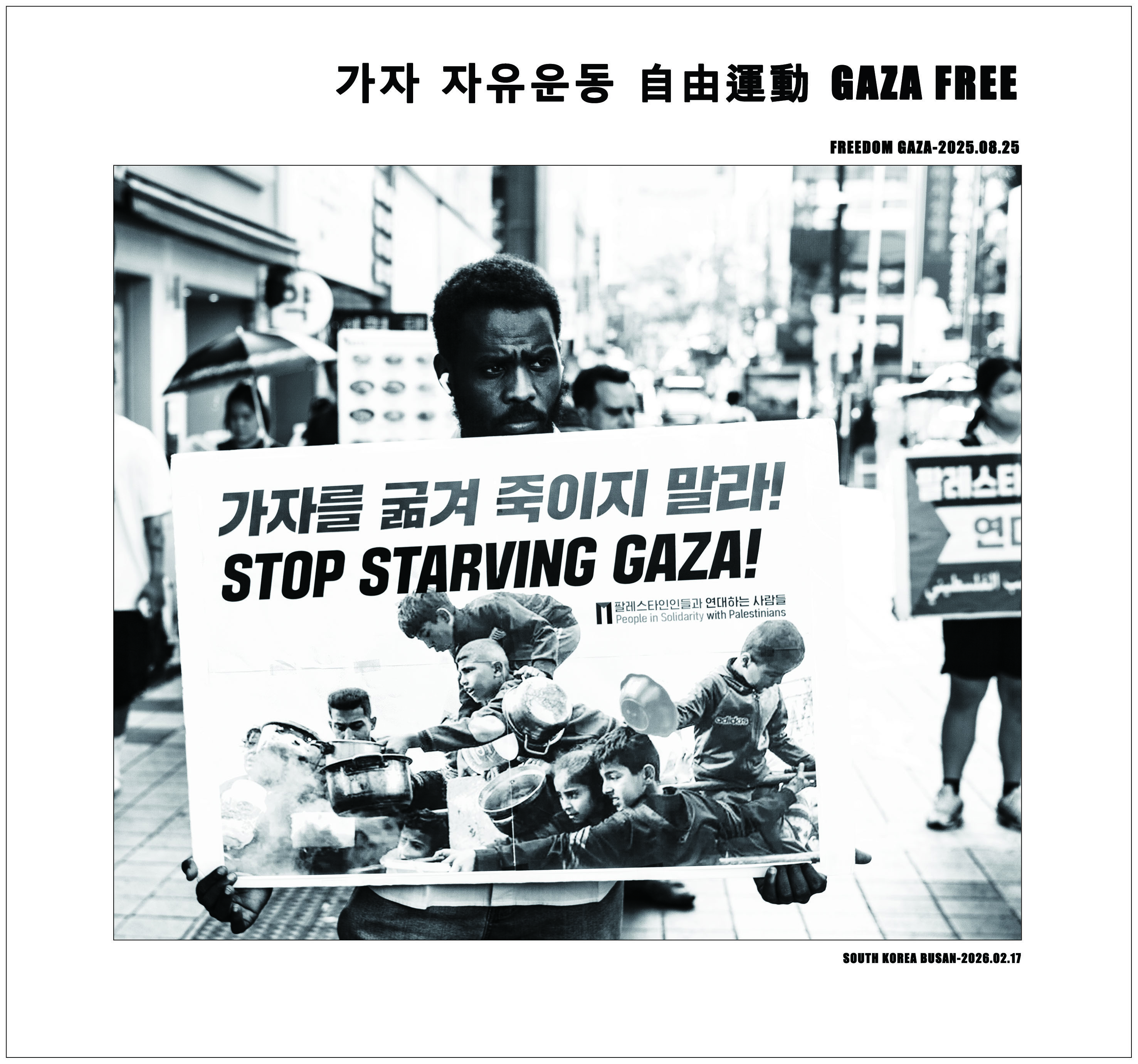
이 사진은 굶주림을 기록한 다큐멘터리가 아니다. 또한 연민을 요구하는 인도주의적 이미지도 아니다. 오히려 이 사진은 현대 권력이 생명을 어떻게 조직하고, 국제질서가 어떤 생명을 보호하며 어떤 생명을 방치하는가를 드러내는 정치철학적 텍스트이다.
사진 속 인물은 'STOP STARVING GAZA'라는 피켓을 들고 있다. 그러나 사진의 핵심은 구호가 아니다. 핵심은 왜 21세기 국제사회에서 이러한 구호가 여전히 필요하냐는 질문이다. 이 질문은 개인의 윤리보다 권력의 구조를 향한다.
푸코는 근대 권력을 생명을 관리하는 권력(Biopower) 으로 규정했다. 국가는 출생률, 위생, 의료, 식량, 질병을 관리하며 사회를 유지한다. 그러나 가자의 현실은 푸코의 논의를 한 단계 더 확장하게 만든다. 오늘날 권력은 생명을 단순히 관리하는 수준을 넘어 생존의 조건 자체를 통제한다. 식량, 식수, 의료, 전력, 이동의 자유가 제한될 때, 권력은 사람을 직접 죽이는 것이 아니라 살아갈 가능성 자체를 선별한다. 따라서 굶주림은 우연한 재난이 아니라 생명정치의 극단적 형태로 이해될 수 있다.
그러나 푸코의 생명정치만으로는 충분하지 않다. 조르조 아감벤은 이러한 공간을 '예외상태(State of Exception)'로 분석하였다. 예외상태란 법이 폐기되는 것이 아니라 법이 효력을 정지한 채 유지되는 상태이다. 국제법은 존재하고, 인권협약도 존재하며, 인도주의 원칙도 선언되어 있다. 그럼에도 보호는 중단된다. 법은 형식적으로 살아 있지만, 실제로는 적용되지 않는다. 사진이 보여주는 것은 단순한 전쟁이 아니라 법의 중지 속에서 유지되는 정치질서이다.
그러나 여기서 더 근본적인 질문은 왜 이러한 예외가 국제사회에서 반복되는가이다. 이 지점에서 한나 아렌트의 정치철학이 중요해진다. 아렌트는 『전체주의의 기원』에서 인간에게 가장 근본적인 권리는 '권리를 가질 권리(the right to have rights)'라고 말했다. 권리는 인간이라는 이유만으로 보장되지 않는다. 그것은 정치공동체 안에서 인정받을 때 비로소 현실성을 갖는다. 따라서 특정 집단이 정치적 보호의 바깥으로 밀려날 때, 그들은 인간으로서의 권리 이전에 권리를 주장할 수 있는 위치 자체를 상실한다. 이 사진은 바로 그 정치적 배제를 가시화한다.
주디스 버틀러는 이러한 구조를 '애도 가능한 생명(grievable life)'이라는 개념으로 더욱 발전시킨다. 모든 죽음이 동일한 윤리적 가치를 갖는 것은 아니다. 어떤 죽음은 세계적 비극으로 기억되고, 어떤 죽음은 통계자료 속 숫자로 소비된다. 이 차이는 감정의 문제가 아니라 정치의 문제이다. 사회가 어떤 생명을 공적으로 애도하는가는 곧 어떤 생명을 정치적으로 인정하는가를 의미하기 때문이다. 따라서 사진 속 굶주린 아이들은 단순한 희생자가 아니라, 현대 국제질서가 인정하는 생명의 경계를 드러내는 정치적 존재이다.
이 네 사상가는 서로 다른 언어를 사용하지만 하나의 결론으로 수렴한다.
푸코는 생명이 권력의 관리 대상이 되었음을 말한다.
아감벤은 그 관리가 예외상태를 통해 제도화됨을 보여준다.
아렌트는 그 과정에서 인간이 '권리를 가질 권리'를 상실한다고 분석한다.
버틀러는 결국 그러한 생명은 공적으로 애도되지 않는 존재가 된다고 지적한다.
따라서 이 사진은 잔혹성을 고발하는 이미지가 아니다.
그보다 훨씬 근본적으로, 현대 국제질서가 생명의 가치를 어떻게 차등화하는가를 드러내는 정치철학적 증거이다.
이 사진의 질문은 단순하지 않다.
'왜 사람들이 굶주리는가?'가 아니다.
더 급진적인 질문은 이것이다.
어떤 정치적 구조가 특정한 집단의 굶주림을 오랫동안 가능하게 만들었는가.
사진은 그 질문에 직접 답하지 않는다.
그러나 바로 그 침묵 속에서, 우리는 권력의 구조를 읽게 된다.
결국 이 사진은 가자를 기록한 것이 아니라, 현대 문명이 생명을 분류하고 권리를 배분하며 애도를 선택하는 방식을 기록한 하나의 정치철학적 아카이브이다.
The Image of Gaza and the Structure of Modern PowerA Reading through Michel Foucault, Hannah Arendt, Giorgio Agamben, and Judith Butler
This photograph is not merely a documentary record of starvation, nor is it an image intended to evoke humanitarian sympathy. Rather, it functions as a political-philosophical text that reveals how modern power organizes life and how the contemporary international order determines which lives are protected and which are abandoned.
The protester holds a placard reading, "STOP STARVING GAZA." Yet the central issue is not the slogan itself. The more fundamental question is why such a slogan remains necessary in the twenty-first century. This question concerns not individual morality but the structure of political power.
Michel Foucault defined modern political power as biopower—a form of power that governs populations through the administration of birth, health, medicine, food, sanitation, and life itself. The reality represented by Gaza, however, extends Foucault's analysis. Contemporary power no longer merely administers life; it increasingly governs the very conditions under which life can continue. When access to food, water, medical care, electricity, and mobility is restricted, power does not simply inflict death directly. Instead, it selectively distributes the conditions of survival. Starvation, therefore, should not be understood as an accidental humanitarian catastrophe but as an extreme manifestation of biopolitical governance.
Foucault's concept alone, however, is insufficient to explain this condition. Giorgio Agamben's theory of the state of exception offers a further analytical framework. For Agamben, the state of exception is not the disappearance of law but the suspension of its effective operation while its formal existence remains intact. International law continues to exist. Human rights conventions remain in force. Humanitarian principles continue to be affirmed. Yet effective protection is suspended. Law survives institutionally while losing its practical capacity to safeguard life. Consequently, this photograph documents not simply military conflict but a political order in which legality and the suspension of legal protection coexist.
This observation leads to a more fundamental question: why can such exceptional conditions persist within the contemporary international order? Hannah Arendt's political philosophy provides an essential response. In The Origins of Totalitarianism, Arendt argued that the most fundamental human right is the "right to have rights." Rights do not exist merely because one is human; they become effective only when recognized within a political community. Once individuals or populations are excluded from that community, they lose not only specific legal protections but also the political position from which rights themselves can be claimed. This photograph visualizes precisely such a condition of political exclusion.
Judith Butler develops this analysis further through the concept of grievable life. Not every death receives equal public recognition or moral significance. Some deaths become global tragedies, while others disappear into statistical abstraction. This distinction is not merely emotional; it is political. Public mourning reflects the political recognition of whose lives are considered worthy of collective concern. The starving children represented in this image are therefore not simply humanitarian victims. They reveal the boundaries through which the contemporary international order differentiates politically recognized lives from politically abandoned ones.
Although these four thinkers employ different conceptual vocabularies, their analyses converge toward a common conclusion.
Foucault demonstrates that life has become an object of political administration.
Agamben explains how that administration is institutionalized through the normalization of the state of exception.
Arendt reveals that such processes deprive individuals of the very "right to have rights."
Butler shows that lives deprived of political recognition ultimately become lives that are no longer publicly grievable.
Accordingly, this photograph should not be understood primarily as an emotional denunciation of cruelty.
More fundamentally, it constitutes political evidence of the mechanisms through which the contemporary international order differentiates the value of human life.
The central question posed by this photograph is therefore not, Why are people starving?
The more radical question is this:
What political structures make the prolonged starvation of particular populations possible?
The photograph does not provide a direct answer.
Its significance lies precisely in making visible the structures of power that usually remain invisible.
Ultimately, this image documents not only Gaza but the political logic through which modern civilization classifies lives, distributes rights, and determines whose suffering enters the sphere of public recognition.