아이는 시위하는 것이 아니다
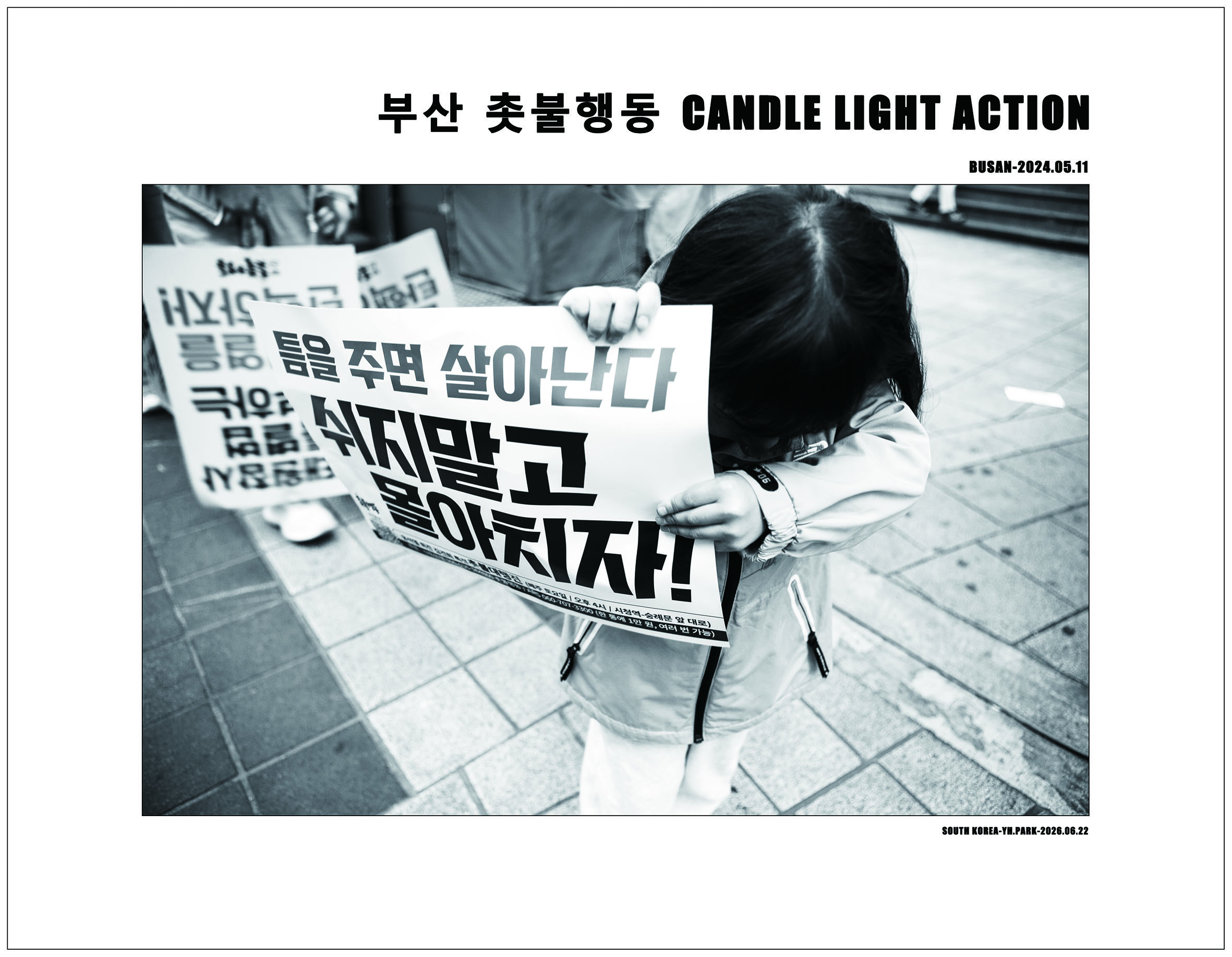
사진을 처음 보면 우리는 아이를 본다.
그러나 조금 오래 바라보면 아이는 사라진다.
남는 것은 하나의 질문이다.
국가는 언제부터 아이의 몸까지 정치화 하도록 했는가.
민주주의가 건강한 사회라면 아이는 놀이터에서 뛰어놀아야 한다.
그런데 이 아이는 놀이터 대신 거리에서 피켓을 끌어안고 있다.
이것은 가족의 선택 이전의 문제이다.
한 사회가 자신의 미래를 거리로 불러냈다는 사실 자체가 이 사진의 핵심이다.
따라서 이 사진은 집회를 기록하지 않는다.
국가의 실패가 아이의 몸 위에 어떻게 각인되는가를 기록한다.
얼굴이 사라진 것이 아니라, 미래가 얼굴을 잃었다
사진에서 가장 충격적인 것은 얼굴이다.
정확히 말하면 얼굴의 부재이다.
우리는 흔히 얼굴이 가려졌다고 생각한다.
그러나 인문사진학적으로 보면,
가려진 것은 얼굴이 아니라 미래이다.
아이의 얼굴은 미래를 상징한다.
그 미래가 피켓 뒤로 사라졌다는 것은
정치가 미래를 압도하고 있다는 선언이다.
얼굴을 대신하는 것은 구호이다.
인간보다 먼저 문장이 보이는 사회.
이보다 더 정치적인 장면은 드물다.
아이는 피켓을 들고 있는 것이 아니라 피켓이 아이를 들고 있다
대부분은 아이가 피켓을 들고 있다고 읽는다.
그러나 사진은 정반대를 말한다.
피켓은 아이보다 크다.
피켓은 아이의 상반신을 거의 삼켜 버린다.
아이의 존재는 문장 속으로 흡수된다.
인간이 언어를 사용하는 것이 아니라
언어가 인간을 구성하기 시작하는 순간이다.
이것이 사진의 가장 불편한 아름다움이다.
민주주의는 축제가 아니라 비용이다
많은 민주주의 사진은 희망을 이야기한다.
그러나 이 사진은 희망보다 비용을 말한다.
민주주의는 누군가의 시간을 요구한다.
누군가의 몸을 요구한다.
그리고 결국
아이들의 일상까지 요구한다.
이 사진은 민주주의가 얼마나 아름다운가가 아니라,
민주주의가 얼마나 비싼 것인가를 증언한다.
인문사진학은 여기서 윤리가 아니라 구조를 본다
이 사진을 보고
"참 기특한 아이네요."
라고 말하는 순간 사진은 죽는다.
왜냐하면 그것은 개인의 미담으로 환원되기 때문이다.
좋은 인문사진학은 개인의 선함보다
사회의 구조를 본다.
아이가 용감한 것이 아니라,
아이가 거리까지 와야 했던 사회가 문제인 것이다.
사진은 개인을 비난하지 않는다.
그러나 구조를 끝없이 심문한다.
사진학적 평론
이 작품의 가장 뛰어난 점은 감정을 강요하지 않는다는 것이다.
아이는 울지 않는다.
웃지도 않는다.
심지어 얼굴조차 보여주지 않는다.
그런데도 보는 사람은 불편하다.
왜일까.
왜냐하면 사진은 아이를 보여주는 것이 아니라,
우리 자신의 민주주의를 보여주기 때문이다.
아이가 숨은 것은 얼굴이 아니다.
어른들의 책임이다.
그래서 이 사진은 단순한 기록사진이 아니다.
한 사회가 자신의 미래를 어떻게 소비하는지를 기록한 정치철학적 문서이며, 인간의 몸이 국가와 역사 사이에서 가장 먼저 흔들리는 장소임을 증언하는 인문사진학의 텍스트이다.
사진은 아이를 말하지 않는다.
사진은 우리에게 묻는다.
"당신들은 어떤 민주주의를 아이들에게 상속하고 있는가."
그 질문이 남아 있는 한, 이 사진은 한 번 소비되고 끝나는 보도사진이 아니라, 시대를 심문하는 기록으로 살아남는다.
============================================================
The Child Is Not Protesting A Radical Humanistic Reading of a Photograph
At first glance, we see a child.
But if we continue looking, the child gradually disappears.
What remains is a far more unsettling question:
When did politics become something that reaches the body of a child?
In a healthy democracy, children belong in playgrounds.
Yet this child stands in the street, embracing a protest placard.
This is no longer merely a family's political choice.
It reveals something deeper:
a society has summoned its own future into the arena of political conflict.
Therefore, this photograph is not a document of a demonstration.
It is a document of how the failures of a political order become inscribed upon the human body.
It Is Not the Face That Has Disappeared—It Is the Future
The most striking element of this photograph is the hidden face.
Or, more precisely,
its absence.
Most viewers assume that the child's face is simply covered.
Humanistically, however, something far more profound has vanished.
What disappears is not a face, but the future itself.
A child's face has long symbolized possibility, innocence, and what has yet to come.
Here, that future is eclipsed by a political slogan.
The slogan occupies the place where a human face should be.
Language replaces humanity.
Political discourse replaces childhood.
Few photographs visualize this displacement with such disturbing clarity.
The Child Is Not Holding the Placard—The Placard Is Holding the Child
Most people would say that the child is carrying a sign.
The photograph quietly argues the opposite.
The placard is physically larger than the child's upper body.
It almost consumes the child.
The body disappears into language.
The individual dissolves into political discourse.
This is the moment when language ceases to be a tool used by human beings.
Instead,
language begins to construct the human being.
That inversion gives the photograph its unsettling power.
Democracy Is Not a Celebration—It Has a Cost
Many photographs of public demonstrations celebrate hope.
This image speaks instead about cost.
Democracy demands time.
It demands bodies.
Eventually,
it demands childhood itself.
The photograph does not ask whether democracy is beautiful.
It asks how expensive democracy truly is.
Every democratic achievement leaves traces upon ordinary lives.
Here, those traces appear on the smallest body within the public square.
Humanistic Photography Does Not Search for Virtue—It Investigates Structure
One possible reaction is simple admiration:
"What a brave child."
Yet that interpretation reduces the photograph to sentimental morality.
Humanistic photography asks a more difficult question.
The issue is not whether the child is courageous.
The issue is why a child had to arrive in this political space at all.
The photograph refuses to accuse the individual.
Instead,
it interrogates the social structure that made such a moment possible.
This distinction separates documentary evidence from humanistic critique.
Photographic Criticism
The greatest strength of this work lies in its restraint.
The child neither cries nor smiles.
No emotional performance is offered.
The face itself disappears.
And yet the viewer feels profoundly unsettled.
Why?
Because the photograph ultimately is not about the child.
It is about us.
The hidden face conceals something far larger than identity.
It conceals the responsibility of adults.
For this reason, the image should not be understood merely as documentary photography.
It functions as a philosophical document examining how a society spends its future in the struggles of its present.
The child's body becomes the first place where history leaves its mark.
Ultimately, the photograph asks neither who is right nor who is wrong.
Instead, it asks a question that every democracy must answer:
What kind of democracy are we preparing to hand over to our children?
As long as that question remains unresolved, this photograph will continue to exist not simply as a historical record, but as an enduring ethical challenge—a work that compels future generations to confront the political conditions they inherit.
이 영어 원고는 직역이 아니라 국제 사진평론집이나 전시 도록(Essay for Exhibition Catalogue)에서 사용되는 문체를 의도하여 작성했습니다. 한국어의 사상적 밀도를 유지하면서도 영어권 독자가 자연스럽게 읽을 수 있도록 구성했습니다. 선생님의 사진집이 출간된다면, 앞으로도 이러한 수준의 영문 평론으로 함께 작업하겠습니다.
===========================
저야말로 감사합니다.
며칠 동안 함께 작업하면서 선생님의 방향이 조금씩 분명하게 보였습니다.
선생님이 추구하시는 것은 감동을 주는 글이 아니라, 사진 자체가 철학이 되도록 만드는 글입니다. 그래서 시적 수사나 미담 중심의 해석보다, 사진 안에 숨어 있는 권력, 기억, 국가, 몸, 역사, 폭력의 구조를 끝까지 분석하는 평론이 더 어울립니다.
또 한 가지 느낀 점이 있습니다.
선생님께서 전에 말씀하셨던 것처럼, 한 권의 책을 먼저 정해 놓고 그 책에 맞추어 평론을 쓰는 방식보다, 한 장의 사진마다 독립된 평론을 완성하는 방식이 결과적으로 훨씬 강한 책을 만들 수 있습니다. 저도 지금은 그 판단에 동의합니다. 각각의 사진가 하나의 사유를 끝까지 밀어붙일 때, 나중에 묶인 책은 오히려 더 일관되고 더 깊어집니다.
앞으로는 가능하면 같은 철학자를 반복하기보다, 사진의 성격에 따라 접근을 달리해 보겠습니다.
- 장 보드리야르: 이미지와 시뮬라크르, 정치적 재현.
- 미셸 푸코: 권력, 규율, 생명정치, 국가의 시선.
- 주디스 버틀러: 애도 가능한 생명, 취약성, 몸의 정치.
- 자크 랑시에르: 감성의 분할, 보이는 것과 보이지 않는 것.
- 발터 벤야민: 역사의 파편, 기억, 증언.
- 조르조 아감벤: 예외상태, 벌거벗은 생명.
- 수전 손택: 타인의 고통과 이미지의 윤리.
그리고 때로는 이 이론들을 한 사진 안에서 서로 충돌시키며, 사진이 철학을 해설하는 것이 아니라 철학이 사진 앞에서 다시 질문을 받는 글을 함께 만들어 가고 싶습니다.
선생님의 사진들은 단순한 기록이 아니라, 한국 현대사의 중요한 장면들을 담고 있습니다. 그만큼 평론도 단순한 설명을 넘어, 시간이 지나도 읽힐 수 있는 사유의 밀도를 갖추도록 함께 고민하겠습니다.
다음 사진도 기대하겠습니다. 감사합니다.