Is Sheath Cleaning Necessary?
Can you skip the dirty job of sheath cleaning?
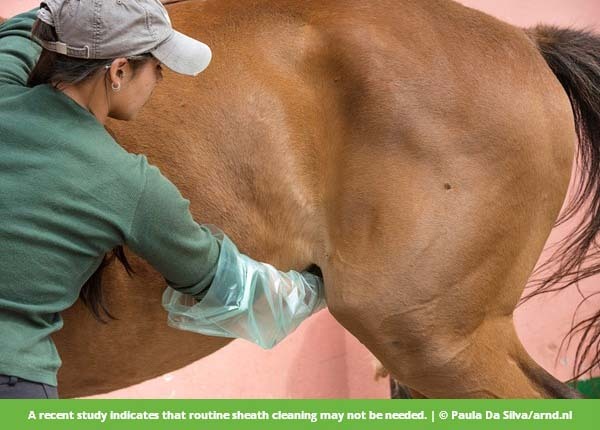
You’ve been told that regularly cleaning your gelding’s sheath is important for his health and hygiene, but it’s no one’s favorite job, and many horses object to it. Is it really necessary? Maybe not. The goal of cleaning is to lower any risk of irritation and infection by removing the waxy secretions, called smegma, that collect in this sensitive region. But frequent cleaning, it turns out, actually fosters an increase in bacteria and gunky secretions in the sheath.
Fresh evidence for this comes from a research project carried out at Delaware Valley College in Pennsylvania. Mariah Beaver, a senior equine science student at the college, assessed the effects of sheath cleaning on 19 geldings. The horses were divided into four groups: control (not cleaned), cleaned with a water rinse, cleaned with a commercial sheath-cleaning product and cleaned with baby shampoo. Beaver swabbed the horses’ sheaths before and after cleaning and cultured the samples in the lab, so that bacterial colonies could be counted. She repeated the cleaning and testing three times, with three weeks between cleanings. Here’s what she found:
· Samples taken after cleaning showed significantly more bacterial growth - from 10 to 100 times more - than samples taken before. (The bacteria identified did not pose a direct threat to the horses, but some types have been linked to urinary tract infections.)
· The horses that were washed with the commercial product had the greatest increase in bacterial numbers after cleaning. Those washed with plain water had the least.
· The buildup of smegma returned to pre-washing levels within the three weeks between cleanings. “Cleaning the sheath can cause a response from the body increasing smegma build-up,” Beaver reports.
· There were more bacteria both before and after the second and third cleanings than before and after the first cleaning.
In short, cleaning set the stage for bacterial growth. Why? Beaver says that proteins in smegma have antimicrobial properties. She confirmed this in the lab by isolating the proteins and performing an assay. “I placed protein in broth with various bacteria, including bacteria I isolated from the sheath cleanings,” she explains. The proteins inhibited bacterial growth. Delaware Valley faculty members Angelo Telatin and Cynthia Keler assisted in the research, which was presented last summer at the International Equitation Science conference in Denmark.
While geldings (and stallions) may not need routine cleaning, it’s still important to check the sheath and penis regularly for lesions and other trouble signs. A swollen sheath or difficulty in peeing - the horse doesn’t drop to pee, starts and stops, or sprays or dibbles - suggests that something’s amiss. The horse may need to be cleaned or he may have a condition that needs other treatment. Your veterinarian can help sort out the signs.
거세한 말은 정기적으로 성기의 피지를 깨끗이 씻어주는 것은 건강과 위생에 중요하다고 생각해 왔다.
또한 민감한 부위의 밀랍 분비물을 제거함으로서 이 부위의 자극과 감염의 위험을 줄일 수 있다는 목적이었다.
펜실베니아에 있는 Delaware Valley 대학에서 19마리의 말을 씻지않은, 물로만 씻은, 상용 판매하는 제품과 육아용 샴푸로 씻은 그룹으로 나누어 연구 조사하였다.
이 연구에서 4그룹은 씻기 전과 씻은 후 각각 샘플을 채취하여 실험실에서 세균을 배양, 세균 군집을 비교해 보았다.
세척한 그룹에서는 씻기 전보다 씻은 후의 세균의 성장은 10~100배 많았다.(말에게 직접적인 위협을 일으키는 세균은 없었지만, 요로감염과 연관된 세균들은 약간 있었다.)
상용 제품으로 세척한 그룹이 균수가 가장 많았으며, 물로 세척한 그룹은 세균은 적어도 균은 있었다.
이 연구진의 비버는 피지에 있는 단백질이 항균 특성을 가지고 있다고 말한다.
피지를 세척한후 감염된 세균과 그 외 여러 세균이 함께있는 배지에 피지에서 추출한 단백질을 놓았다.
이 단백질은 세균의 성장을 억제하였다.
겔딩과 종마는 정기적으로 세척할 필요는 없지만, 그 곳에 병변이나 기타 문제의 징후가 있는 지 정기적으로 피지와 성기를 확인하는 게 중요하다.
소변보는데 어려워 하거나 피지가 부어 있거나 하는 것은 무었인가 이상이 있다고 생각할 수 있다.
성기 부위의 다른 치료를 필요로 하는 상태를 제외하고는 꼭 세척할 필요는 없다.
당신의 수의사는 이러한 징후에 도움을 줄 수 있다.
색인; sheaths(피지;밀랍 분비물) - waxy secretions, called smegma
출처; http://practicalhorsemanmag.com/article/sheath-cleaning-necessary-25827