[공연리뷰]Chung/SPO Mahler Symphony No. 5 concert (May 23rd, 2014) - Review
작성자Poincare작성시간14.06.03조회수273 목록 댓글 9In the classical music world it is generally held that of all Mahler Symphonies the Fifth is the most difficult to play, if not to bring off. This is not an exaggerated statement about a notorious score that is full of instrumental excesses (Mahler originally had doubled the size of percussion, for instance), not the least of which are dizzying contrapuntal lines dispersed across the vast orchestral force, some of which sounding contrived and even redundant, particularly in II. and V., and the unorthodox structure of the symphony - Part I. (the first two movts.), Part II. (Scherzo), Part III. (Adagietto and Finale) – in which the composer experimented new compositional skills and musical ideas. In fact, in less confident hands much of Mahler’s first purely instrumental work since his First Symphony is prone to sound diffusive and derivative. To make things more intractable, throughout Part I. Mahler single-handedly conveys the feeling of world-weariness, unyielding despair and loss, elements which casual classical music fans will find bewilderingly bleak and unpleasant to take. Ironically though, Mahler juxtaposes the grueling two movements with a rustic, leisurely structured Scherzo followed by the celebrated Adagietto. The latter in particular, though hardly connected with the preceding materials musically and thematically, possesses visceral charm with unmistakably romantic flairs which some might call lovesick emotions! All in all, Mahler Fifth could be one hell of a nightmare posing all the formidable challenges on both the performers’ and audiences’ sides.
Naturally, some conductors have little clue how to effectively tackle and interpret the symphony. There have been proud exceptions; Tennstedt, Levine, Inbal, and Solti all demonstrated this giant symphonic opus can be handled with great insights and skills in equal measure. There are others, however, who came up with solutions big in abstract but short in concreteness. Indeed, no other work by Mahler is more at stake with how successfully every detail is shaped and delivered; mess with the opening trumpet motif and the chance for a gripping Mahler Fifth is gone, start the second movt. with low strings unsynchronized, unscrupulous and the element of the vehement and turmoil quickly vaporizes. Same goes to the beginning of the Scherzo where the tricky waltz rhythms are exchanged and progressed across a half dozen different instruments. Ditto the vexing Rondo Finale that presses the string players with the relentlessly (but understandably so) complicated counterpoints and contrapuntal lines. In my memory, I have never seen or heard an orchestra who got every note perfectly and exactly as per Mahler’s myriad instructions in the score.
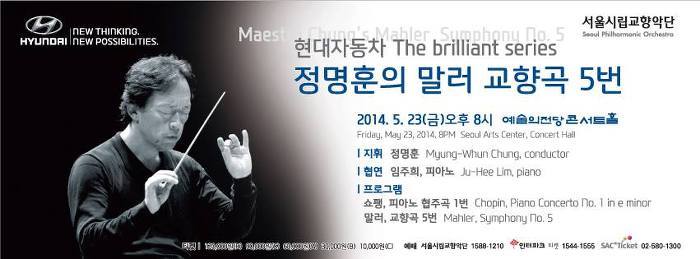
If maestro Myung-Whun Chung on the evening of May 23rd didn't quite scale the overarching greatness and grandiose statements of the Tennstedt, Levine, Inbal, and Solti, his Mahler Fifth registered most impressively in this department of taking care of the details. To be sure, for much of what went Chung’s reading was direct and unaffected, except in key places, such as the long morbid cello monologue and the climactic passage in II. where the brass section in unison engulfs out the heavy, bleak five descending notes with the mighty tam tam smashing in the background, the quiet central waltz interlude of Scherzo plucked pizzicatos in the string, the final coda in brass reprising the soaringly triumphant theme. Here and a few places elsewhere, adding to the dramatic effects Chung adopted flexible tempos, slowing down the speed quite a bit, but he did it all so lucidly and skillfully that the music didn’t sound out of place at all. In fact, Chung’s was one of the most structurally cogent accounts of this sprawling symphony I could recall hearing on records and in concerts.
The Seoul Philharmonic Orchestra played extremely well for most part, with the strings that are characteristically rich and scintillating in their tone, the rock solid and powerful brass, particularly the horn and trumpets who didn’t miss a single note throughout, the crisp and well-disciplined woodwinds, and the percussion section that boasted a powerful timpani whenever called for. If after two days’ of nonstop rehearsals, recording sessions and concerts the Friday evening’s concert showed some signs of fatigue, e.g. in the Scherzo, under the direction of Maestro Chung they made up for it with total dedication and commitment. Hopefully, they got enough recording materials, for all the excitement, thrill and drama of the live concerts could be carried over to the final production of the upcoming CD release by Deutsche Grammophon. In the meantime, we who were present at either one of the concerts will eagerly wait for the recording with our fingers crossed.
댓글
댓글 리스트-
작성자Poincare 작성자 본인 여부 작성자 작성시간 14.06.04 안녕하세요? 전 외국생활을 오래해서인지 영어로 쓰는게 편하네요. 이해하시길. 그리고 ..어쩐지 영어로 하는것이 좀더 객관적이고 공정한 평이 되는것 같구요.
-
답댓글 작성자BUNNY 작성시간 14.06.04 아..저도 왠지 영어로 읽으니 객관적인 것처럼 느껴져서요^^ 고급 영어의 세계로 초대된 느낌^^ 감사히 잘 읽겠습니다
-
작성자Poincare 작성자 본인 여부 작성자 작성시간 14.06.04 아이고...고마워요! 낼 마알러2번 공연오시면 차로 대접해드리죠.
-
답댓글 작성자BUNNY 작성시간 14.06.06 아...안타까워요^^ 담번에 꼭 인사나눴으면 좋겠어요^_^
-
작성자Poincare 작성자 본인 여부 작성자 작성시간 14.06.07 I am afraid my review is as much a cirtical view of the work itself as it is about the concert. In my opinion, Mahler Fifth is a vulnerable work, more so than the Seventh; the big savior is that it ends with a triumphant Rondo Finale that seems to erase whatever flaws it might have early on in the symphony. Good for Mahler and Mahler fans!