[Stem cell therapy for eye disease]
The team has already repaired the vision of a handful of patients with age-related macular degeneration using cells from the patients' own eyes.
With the help of a £4m donation, they are now planning to carry out the same operation using retinal cells grown from stem cells in the lab.
It is hoped the first patients would be treated within five years.
Age-related macular degeneration (AMD) affects around 25% of over-60s in the
There are two types - dry - which makes up 90% of cases, and wet, which makes up the other 10%.
It is caused by the failure of retinal pigment epithelial cells (RPE) - a layer of support cells under the retina, which processes light.
This leads to the degeneration of the macula - the central area of the retina - and gradually knocks out central vision.
|
|
Professor Pete Coffey |
There are treatments for wet AMD but not for dry AMD.
Mr. Lyndon Da Cruz, consultant ophthalmic surgeon at
The procedures have been successful but are associated with complications, take more than two hours and require two operations.
To make the procedure quicker, easier and more widely available, researchers at the
The hope is that this can be processed into a layer that can be injected into the patient's eye during a simple 45-minute operation.
Tests of the laboratory grown RPE cells in rats with AMD showed they restored vision.
Collaboration
A £4m donation from a
Professor Pete Coffey, director of the Project explained although they had successfully grown RPE cells in the laboratory, they now needed to make sure the cells were safe enough to be used in humans, which would take time.
STEM CELL TECHNOLOGY
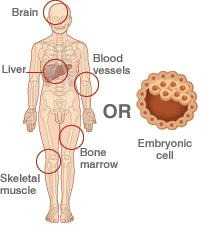
Key sources for stem cells are adult organs or embryonic cells.
"Using stem cells - which are far more adaptable - can only improve success of what has already been achieved and in addition establish this as a global therapy."
"The goal is within five years to have a cohort of patients to put the cells into," added Professor Coffey whose team is preparing the laboratory-derived cells for transplant
Mr Cruz added that if in 10 years the four by six mm transplant was not in global use something major would have failed in the research.
"We have the RPE, we have the evidence that doing this type of thing can restore vision. It's practicality issues rather than a big unknown."
More operations are also planned with the patients' own cells in those suffering from dry AMD to test the procedures effectiveness.
Professor Alistair Fielder, senior medical adviser for the eye research charity Fight for Sight, said: "The London Project represents a real chance to tackle this untreatable condition and bring hope to many."
degenerate: If you say that someone or something degenerates, you mean that they become worse in some way, for example weaker, lower in quality, or more dangerous.
Inactivity can make your joints stiff, and the bones may begin to degenerate.
a very serious humanitarian crisis which could degenerate into a catastrophe.
retina: Your retina is the area at the back of your eye. It receives the image that you see and then sends the image to your brain.
periphery: If something is on the periphery of an area, place, or thing, it is on the edge of it.[ FORMAL ]
Geographically, the
embryonic: An embryonic process, idea, organization, or organism is one at a very early stage in its development.[ FORMAL ]
embryonic plant cells.
transplant: A transplant is a medical operation in which a part of a person's body is replaced because it is diseased.
He was recovering from a heart transplant operation.
the controversy over the sale of human organs for transplant
restore: To restore a situation or practice means to cause it to exist again.
The army has recently been brought in to restore order.
untreated: If an injury or illness is left untreated, it is not given medical treatment.
If left untreated the condition may become chronic.
the consequences of untreated tuberculosis.
- Do you think that stem cell research for AMD is good?
- What do you think of stem cell research for other diseases?
- What is it that stem cells have that makes all this research promising?
- Do you think that some of the early releases of information get people to think the therapy already does work?
- Do you think it gives false hope to the people who would benefit from the research?
- Why do they use lab rats for testing in laboratories?
- What is the next step in the testing after the testing on the lab rats?
- Stem cell research is ongoing for other diseases like Parkinson's disease. Do you know of any others?
- Many countries are doing stem cell research on different diseases. Do you know of any ongoing research being done in
- What other stem cell are used beside embryonic stem cell lines?