일본 뎃포의 원형으로 짐작되는
독일의 고 화승총 '서펀틴 락'(serpentine lock)
화승을 붙잡아 맨 용두가 마치 뱀처럼 꼬부랑해서
뱀무늬(serpentine) 화승총으로 불렸던 놈입니다.
방아쇠로 심지불 화약을 터뜨린 최초의 화승총으로 여겨집니다.
화승줄이 닿는 화약접시 모양이나 전방을 향한 용두 방향이
포르투갈 아케부스를 모방복제한 일본 뎃포와 마찬가지 형식입니다.
그러나 방아쇠 부분은 아직 제대로된 틀을 갖추지 못하고,
용두와 연결된 긴 쇠꼬챙이를 잡아당겨 천천히 발화시키는 형태여서
방아쇠를 당기는 순간 발화됐던 뎃포와는 차이가 납니다.
정확한 발굴 연대는 밝혀지지 않았지만
일본 뎃포의 전수(1543년)시기보다 수십년 빠른
15세기 후반에서 16세기 초반경에 제작됐을 것으로 짐작됩니다.
영어해독이 가능하신 분은 아래에 퍼나른
원문(description)을 참조하십시오.
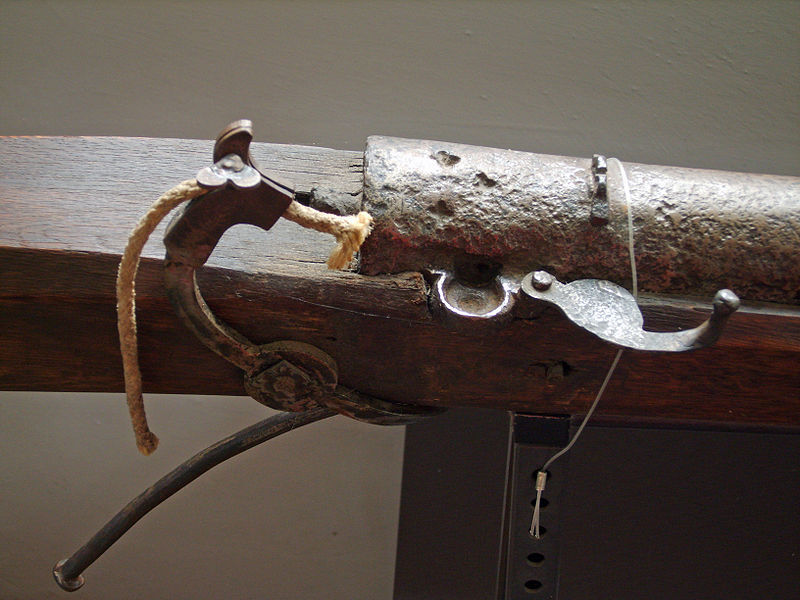
Early German musket with serpentine lock
The matchlock was the first mechanism, or "lock" invented to facilitate the firing of a hand-held firearm. This design removed the need to lower by hand a lit match into the weapon's flash pan and made it possible to have both hands free to keep a firm grip on the weapon at the moment of firing, and, more importantly, to keep both eyes on the target.
The classic European matchlock gun held a burning slow match in a clamp at the end of a small curved lever known as the serpentine. Upon the pulling of a lever (or in later models a trigger) protruding from the bottom of the gun and connected to the serpentine, the clamp dropped down, lowering the smoldering match into the flash pan and igniting the priming powder. T
he flash from the primer travelled through the touch hole igniting the main charge of propellant in the gun barrel. On release of the lever or trigger, the spring-loaded serpentine would move in reverse to clear the pan. For obvious safety reasons the match would be removed before reloading of the gun. Both ends of the match were usually kept alight in case one end should be accidentally extinguished.
Earlier types had only an "S"-shaped serpentine pinned to the stock either behind or in front of the flash pan (the so-called "serpentine lock"), one end of which was manipulated to bring the match into the pan.
Most matchlock mechanisms mounted the serpentine forward of the flash pan. The serpentine dipped backward, toward the firer, to ignite the priming. This is the reverse of the familiar forward-dipping hammer of the flintlock and later firearms.
A type of matchlock was developed called the snap matchlock, in which the serpentine was held in firing position by a weak spring, and released by pressing a button, pulling a trigger, or even pulling a short string passing into the mechanism. As the match was often extinguished after its relatively violent collision with the flash pan, this type fell out of favour with soldiers, but was often used in fine target weapons.
Various Japanese (samurai) Edo period matchlocks (tanegashima).An inherent weakness of the matchlock was the necessity of keeping the match constantly lit. Being the sole source of ignition for the powder, if the match was not lit when the gun needed to be fired, the mechanism was useless, and the weapon became little more than an expensive club. This was chiefly a problem in wet weather, when damp match cord was difficult to light and to keep burning.
Another drawback was the burning match itself. At night, the match would glow in the darkness, possibly revealing the carrier's position. The distinctive smell of burning match-cord was also a giveaway of a musketeer's position (this was used as a plot device by Akira Kurosawa in his movie Seven Samurai). It was also quite dangerous when soldiers were carelessly handling large quantities of gunpowder (for example, while refilling their powder horns) with lit matches present. This was one reason why soldiers in charge of transporting and guarding ammunition were amongst the first to be issued self-igniting guns like the wheellock and snaphance.
The matchlock was also uneconomical to keep ready for long periods of time. To maintain a single sentry on night guard duty with a matchlock, keeping both ends of his match lit, required a mile of match per year.
* 출처: http://en.wikipedia.org/wiki/Matchlock