

Like love, a border is real only if both sides believe in it. And on both sides of the Sino-Russian border, that belief is wavering.
클릭하세요
다음글은 오늘새벽에 new york times에서 읽은 내용 입니다.
이글은 국가간의 문제가 발생될수도 있으므로 읽기 만하고 펌해가지마세요
Why China Will Reclaim Siberia
( 중국이 시베리아를 자기땅이라고 주장할이유는)

Frank Jacobs, the author of "Strange Maps: An Atlas of Cartographic Curiosities," blogs at Big Think.
Updated January 13, 2015, 11:54 AM
 J
J
oe Burgess/The New York Times
“A land without people for apeople without land ."A land without people for a people without land.”At the turn of the 20th century,that slogan promoted Jewish migration to Palestine.it could be recycled today,justifying a Chinese takeover of Siberia. Of course,Russia's Asian hinterland isn't really empty (and neither was Palestine).But Siberia is an resource-rich and people-poor as China is the opposite.The weight of that logic scares the Kremlin.
Moscow recently restored the Imperial Arch in the Far Eastern frontier town of Blagoveshchensk, declaring: “The earth along the Amur was, is and always will be Russian.” But Russia's title to all of the land is only about 150 years old. (러시아가 시베리아를 차지한 것은겨우 150년 전 이라는내용.)
And the sprawl of highrises in Heihe, the Chinese boomtown on the south bank of the Amur, right across from Blagoveshchensk, casts doubt on the “always will be” part of the old czarist slogan.
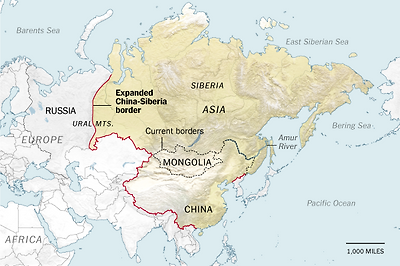
Siberia – the Asian part of Russia, east of the Ural Mountains – is immense.
It takes up three-quarters of Russia's land mass, the equivalent of the entire U.S. and India put together. It's hard to imagine such a vast area changing hands. But like love, a border is real only if both sides believe in it. And on both sides of the Sino-Russian border, that belief is wavering.
(우랄산맥의동쪽 시베리아가 미국과 인도를 합한것보다 땅의넓이가 크다는내용)
The border, all 2,738 miles of it, is the legacy of the Convention of Peking of 1860 and other unequal pacts between a strong, expanding Russia and a weakened China after the Second Opium War. (Other European powers similarly encroached upon China, but from the south. Hence the former British foothold in Hong Kong, for example.)
The 1.35 billion Chinese people south of the border outnumber Russia's 144 million almost 10 to 1. The discrepancy is even starker for Siberia on its own, home to barely 38 million people, and especially the border area, where only 6 million Russians face over 90 million Chinese. With intermarriage, trade and investment across that border, Siberians have realized that, for better or for worse, Beijing is a lot closer than Moscow.
(1860년 북경 조약에의해 러시아 땅이된 시베리아의 인구가 중국의 인구보다 매우 적다는내용 과 시베리아가 러시아 수도 모스크바 보다 중국 수도 북경이 훨씬 가깝다는내용)
The vast expanses of Siberia would provide not just room for China's huddled masses, now squeezed into the coastal half of their country by the mountains and deserts of western China. The land is already providing China, “the factory of the world,” with much of its raw materials, especially oil, gas and timber.
Increasingly, Chinese-owned factories in Siberia churn out finished goods, as if the region already were a part of the Middle Kingdom's economy.
One day, China might want the globe to match the reality. In fact, Beijing could use Russia's own strategy: hand out passports to sympathizers in contested areas, then move in militarily to "protect its citizens." The Kremlin has tried that in Transnistria, Abkhazia, South Ossetia and most recently the Crimea, all formally part of other post-Soviet states, but controlled by Moscow. And if Beijing chose to take Siberia by force, the only way Moscow could stop would be using nuclear weapons.
There is another path: Under Vladimir Putin, Russia is increasingly looking east for its future – building a Eurasian Union even wider than the one inaugurated recently in Astana, the capital of Kazakhstan, a staunch Moscow ally. Perhaps two existing blocs – the Eurasian one encompassing Russia, Belarus and Kazakhstan and the Shanghai Cooperation Organization – could unite China, Russia and most of the 'stans. Putin's critics fear that this economic integration would reduce Russia, especially Siberia, to a raw materials exporter beholden to Greater China. And as the Chinese learned from the humiliation of 1860, facts on the ground can become lines on the map.
(시베리아가 세계 최대 석유 천연가스생산지이며 중국이 1860년의수치를 어떻게 해결할지가 시베리아의미래를결정할것이다라는내용)Join Opinion on Facebook and follow updates on twitter.com/roomfordebate.

다음검색
스크랩 원문 :
아시아=조선
댓글
댓글 리스트-
작성자대부여 작성자 본인 여부 작성자 작성시간 15.05.20 시베리아를 조선시대때는 어떻게발음했을가요? 시베리아는 순 우리말일까요? 아니라면 이곳을 옛 날에는 무엇이라 불렀는지 알수 있을까요?
-
작성자마포대사 작성시간 15.05.20 사백령이라고 하지 않았나요?
-
작성자문 무 작성시간 15.05.20 위의 펌글의 내용 중에서 1860년대까지 그곳은 <중국 곧 조선의 영토였다>는 것은 진실이라 봅니다. 우랄산맥의 동쪽지방은 바로 조선의 영토였으며, 이곳에 만이(북적)들이 살았다고 하였는데, 옛 고전에서도 말하는 바, 똑같갔다고 봅니다. 이곳은 서백리아라고도 했다고 하는데, 이곳은 옛 중국(조선)의 땅이 맞다고 봅니다.