아래 링크된 기사로 학습합니다.
http://www.chinaknowledge.de/Literature/Daoists/hetuluoshu.html
http://en.wikipedia.org/wiki/Yellow_River_Map
http://www.taliscope.com/LoShu_en.html
아래 복사 본은 좌우 폭이 너무 넓어 보기 불편하니 링크된 주소로 접속해서 열람하는 것이 편리함
Hetu luoshu 河圖洛書 "The River Chart and the Inscription of the Luo"
|
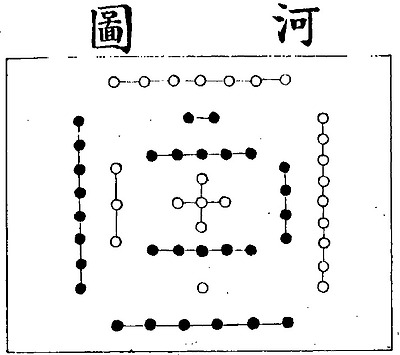
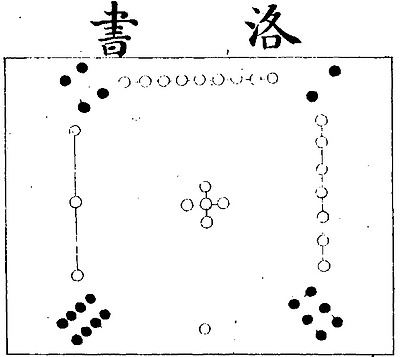
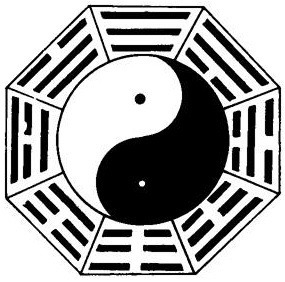
http://www.chinaknowledge.de/Literature/Daoists/hetuluoshu.html
The Yellow River Map, Scheme, or Diagram (河圖, with variants for the second character) is an ancient Chinese concept. It is related to the Lo Shu Square. The origins of the two from the rivers Luo and Heare part of Chinese mythology. The development of the two are part of Chinese philosophy. (Wu:52)
Contents
[hide]Geographical background[edit]

The Yellow River or Huang He is the second-longest river in Asia, following the Yangtze River, and the sixth-longest in the world. The Yellow River has an estimated length of 5,464 km (3,395 mi). It has been and remains an important factor for human habitability of northern China. Anciently, it was often referred to just as He or "the River", and thus the Yellow River Map, just as "River Map" or "River Plan". The Yellow River has changed its course, settling in new beds, with different outlets to the ocean, many times in the past, often accompanied by death and devastation to the human population. Flowing through the yellow loess soil deposited as a deep, packed dust across much of northern China, it gets its name from the yellow color of resulting suspended solids. The Lo, or Luo, River is a major tributary.
Mythological background[edit]
Myths of the Yellow River Map go back to earliest stages of the recorded history of Chinese culture.
Great Flood[edit]
The Great Flood of China (Chinese: 大洪水; pinyin: Da Hongshuǐ, or just 洪水), also known as the "Gun-Yu myth" (Yang:74) was a major flood event that continued for at least two generations, which resulted in great population displacements among other disasters, such as storms and famine: according to mythological and historical sources, it is traditionally dated to the third millennium BCE, during the reign of the Emperor Yao. Treated either historically or mythologically, the story of the Great Flood and the heroic attempts of the various human and other characters to control it and to abate the disaster is a narrative fundamental to Chinese culture. Among other things, the Great Flood of China is important to understanding the history of the founding of both the Xia Dynastyand the Zhou Dynasty, it is also one of the main flood motifs in Chinese mythology, and it is a major source ofallusion in Classical Chinese poetry. Various divine or heroic persons or beings contributed to control or in some cases worsen the flooding, including the mysterious bird-turtles of the Heavenly Questions of the Chuci. One of the main (if not the main) rivers involved according to tradition was the Yellow River, and one of the keys to the eventual successful efforts to control the flood waters is traditionally the Yellow River Map.
Fu Xi[edit]

Fu Xi, also known as Paoxi or Baoxi, is still actively worshiped in modern China. Modern accounts of Fu Xi tend to focus on the population of the world by human beings, in the aftermath of a great flood. Fu Xi is a culture hero, credited with various inventions or discoveries. Among them are the use of knots (known sometimes as quipu, especially in the context of South American studies, where this system of recording information by knotting strings also has been subject to binary mathematics analysis) to record information historically and the mathematically binary bagua system of the 8 (23 trigrams), which were later developed into 64 (26), in which the equivalent of 1 and 0 bits were represented by solid (yang) lines and broken (yin) lines. The classic literary source for this system appears with various philosophical and mystical material suitable for oracular work, in the world-famous Confucian classic Yi Jing (or, in many older sources, I Ching). Various random or semi-random procedures can be used to generate the trigrams or hexagrams of this system.
Yu[edit]
Yu is often known as Yu the Great, especially in English language sources. He succeeded Gun in flood control. Yu the Great (Chinese: 大禹; pinyin: Da Yǔ, c. 2200–2100 BCE), was a legendary ruler in ancient China famed for his introduction of flood control, inaugurating dynastic rule in China by founding the Xia Dynasty, and for his acclaimed upright moral character.
He Bo[edit]
The deity ("Count" or "Earl") of the Yellow River is He Bo (河伯). According to some accounts he was involved with the production of the Yellow River Map.
Houtu[edit]
Houtu is a he or her divinity (or neither), depending on source, although the image of Sacred Mother earth deity is common . Houtu is currently worshiped in Chinese popular religion, with her birthday on 18 March, lunar calendar. Sacrifice and prayer to Houtu is supposed to be efficacious for problems of weather, reproduction and family, wealth, and boating safety on the Yellow River. (Yang, et al:136–137) According to one account, when Yu "the Great" was attempting to channel the Yellow River and so to avoid its flooding, Yu began by trying to open it to the west (towards the mountains and away from the sea, thus completely the wrong way). Observing this, Houtu is said (in this version) to have created and studied the Yellow River Map, after which she sent her divine messenger birds to Yu "the Great" to tell him to open up the river to the east, instead. Yu's new dredging was a success, the flood waters drained into the eastern sea, and Yu's former dredging project toward an impossible western drainage was named "River Wrongly Opened". (Yang, et al:137) In this version of the story, Houtu and the Yellow River Map were key to the successful engineering solution to the flood problem.
Bagua[edit]

Bagua is a main concept in Chinese combinatoric philosophical thought: 8 figures of mythical origin and emblematic significance that are specifically said to be related to the Yellow River Map and the Luoshu Square. The origin of these concepts is prehistorical, been written about them since, evolving a complex body of literature, some of it more esoteric, and some less so. Derivation of the bagua has been conceived philosophically according to the taijior other system in which original unity, symbolized by the bottom circle first differentiates into yin and yang symbolized by solid versus dashed lines. 8 possible unique groupings of these lines into three-line sets are possible. These sets of 3 are known as "trigrams". Each trigram has its own proper name, in Chinese, and is also considered to possess or to symbolize various qualities of the natural, human, or heavenly worlds. Certain traditions suppose that the Yellow River Map and the Luo River Writing reveal all of these things to one who knows how to read them.
Historical evidence[edit]
The Yellow River Map is attested to in the Gu Ming section of the Book of Documents (one of the "new text" sections). Supposedly, the Yellow River Map was put on display during the Zhou dynasty; however, this has also been interpreted to mean a depiction of the 8 trigrams (bagua). (Wu:52–53, and note 14, 102) This incident is recorded to have been during the reign of King Kang of Zhou, about 1020–996 BCE or 1005–978 BCE.
Literature[edit]
The Yi Jing (also known as the Book of Changes, or I Ching) cites the Yellow River Map and the Lo Shu Square(or "script"). (Wu:52)
Interpretation[edit]
Wolfram Eberhard (sub "Square", 276) says that the River Plan is proven "beyond a reasonable doubt" to be amagic square. He connects it to the mingtang halls of worship, saying that they share a division into 9 fields: these in turn are correlated with the 9 "planets" (Sun, Moon, Mercury, Mars, Venus, Jupiter, Saturn, Rahu, andKetu), introduced from and according to Indian astronomy. Other sources emphasize these points for the Luo River Writing. Another interpretation of the River Diagram has to do with the 5 "elements" (wuxing) and the 5cardinal directions.
Tables[edit]
Wuxing[edit]
| fire (火) 7 (extinction) 2(generation) | ||
| wood (木) 8 (extinction) 3 (generation) | earth (土) 5 (generation) 10(extinction) | metal (金) 4 (generation) 9 (extinction) |
| 1 (generation) 6 (extinction) water (水) |
- Notes:
- Extinction is: 成數, which could also be translated as "completion".
- Generation is: 生數, which could also be translated as "birth".
- 10 is represented in the Chinese (as are the other numerals) with a (different) single character: 十.
Cardinal directions[edit]
Odd number order (1, 3, 5, 7, 9)[edit]
| x | 7(west, 西) | x |
| 3(south, 南) | 5(center, 中) | 9(north, 北) |
| x | 1(east, 東) | x |
Even number order (2, 4, 6, 8, 10)[edit]
| x | 2(west, 西) | x |
| 8(north, 北) | 10(center, 中) | 4(south, 南) |
| x | 6(east, 東) | x |
Places[edit]
Certain places in modern China use Hetu (河图) as part of their proper place names. These include 河图镇 (岳西县), 河图镇 (保山市), and 河图乡.
See also[edit]
- Loess Plateau, the highly erodable land through which the Yellow River finds its course.
- Longma, dragon-horse creature, mythological delivery beast of the Yellow River Map.
- Lo Shu Square, companion piece to the River Map (actually named the "Luo" (or "Lo") "Script" or "Writing").
- Luo River (Henan)
- Luo River (Shaanxi)
- Mount Buzhou, an important geographic feature, in relevant mythology.
References[edit]
- Christie, Anthony (1968). Chinese Mythology. Feltham: Hamlyn Publishing. ISBN 0600006379.
- Eberhard, Wolfram (2003 [1986 (German version 1983)]), A Dictionary of Chinese Symbols: Hidden Symbols in Chinese Life and Thought. London, New York: Routledge. ISBN 0-415-00228-1
- Wu, K. C. (1982). The Chinese Heritage. New York: Crown Publishers. ISBN 0-517-54475X.
- Yang, Lihui, et al. (2005). Handbook of Chinese Mythology. New York: Oxford University Press. ISBN 978-0-19-533263-6
Lo Shu: Definition, Nature and Histor
Lo Shu Square (simplified Chinese: 洛书; traditional Chinese: 洛書 ; literally: Luo (River) Book/Scroll) or the Nine Halls Diagram (simplified Chinese: 九宫图; traditional Chinese: 九宮圖), often in connection with the Ho Tu (河圖) figure and 8 trigrams, is the unique normal magic square of order three. Lo Shu is part of the legacy of the most ancient Chinese mathematical and divinatory (Yi Jing 易經) traditions, and is an important emblem in Feng Shui (風水, translate as "wind-water"), the art of geomancy concerned with the placement of objects in relation to the flow of qi (氣), 'natural energy'.
Actually, the first Chinese magic square is believed to have been created by Fuh-Hi, the mythical founder of Chinese civilization, who lived from 2858 to 2738 B.C. The scroll is a 3x3 magic square, where odd numbers are expressed as white dots, or yang symbols, and even numbers are expressed as black dots, or Yin symbols. The odd numbers are supposed to be symbols of heaven, while even numbers are symbols of the earth.
with true Chinese numbers |  Chinese Lo Shu square Image by Jenny Olive |  Modern Lo Shu square |
In the Chinese Lo Shu square above, we have added colour here to make the distinction between the odd and even numbers stand out more clearly. In fact the yellow blobs should be white, being Yang symbols or emblems of heaven, and the red blobs should be black, being Yin symbols or emblems of earth.
Feng Shui is a form of qi divination. The retention or dissipation of qi is believed to affect the health, wealth, energy level, luck and many other aspects of the occupants of the space. Color, shape and the physical location of each item in a space affects the flow of qi by slowing it down, redirecting it or accelerating it, which directly affects the energy level of the occupants.
The qi (Chinese 氣, Japanese 気, Korean 氣, prāna in indian (sanskrit प्राण)) is an active principle forming part of any living thing; literal translation is "air", "breath" or "spirit". Qi is a didactic concept in many Chinese, Korean and Japanese martial arts.
 Location of 7 chakras | Lo Shu is also connected to the Chakras and stimulate them. Chakra (derived from the Sanskrit cakraṃ चक्रं, wheel or disc. There are seven major chakras or energy centers, located within the subtle body, from the base of the spine to the top of the head, at major branchings of the human nervous system, beginning at the base of the spinal column and moving upward to the top of the skull and expressed life force energy (biophysical energy or prana of the human body). The seven major chakras are: Sahasrara, सहस्रार, Ajna, आज्ञा, Vishudda, विशुद्ध, Anahata, अनाहत, Manipura, मणिपूर, Svadhishthana, स्वाधिष्ठान and Muladhara, मूलाधार. Moreover placebo effect, there is a relationship between the positions and functions of the chakras and of the various organs of the endocrine system. |
The odd and even numbers alternate in the periphery of the Lo Shu pattern, the 4 even numbers are at the four corners, and the 5 odd numbers form a cross in the center of the square. The sums in each of the 3 rows, in each of the 3 columns, and in both diagonals, are all 15 [fifteen is the number of days in each of the 24 cycles of the Chinese solar year; Xia Li (夏曆) or "Yin Calendar" - Gregorian calendar is the "Yang Calendar"]. This pattern, in a certain way, was used by the people in controlling the river. Since 5 is in the center cell, the sum of any two other cells that are directly through the 5 from each other is 10 (the number of the Ho Tu). The even numbers are Yin, the feminine principle. The odd numbers are Yang, the male principle. The symbolism of the square Lo Shu interprets 5 elements: earth, fire, metal, water, and wood. Like the Ho Tu, the Lo Shu square is used as a mandalic representation important in Feng Shui. For Chinese, the magic square symbolizes the harmony of the universe. |  Bagua with name and nature (King Wen "Later Heaven" order) |
Mathematics of Lo Shu Magic Square
From any magic square of order 3, by pivoting the square, you can get three other magic squares by rotation and four other magic squares by symmetry. These eight magic squares are considered as equivalent, but the center cell in a 3×3 normal magic square must be 5.
|
|
|
| ||||||||||||||||||||||||||||||||||||
| Original | Rotate 90º | Rotate 180º | Rotate 270º | ||||||||||||||||||||||||||||||||||||
|
|
|
| ||||||||||||||||||||||||||||||||||||
| Vertical reflections of squares immediately above | |||||||||||||||||||||||||||||||||||||||
In these transformations of normal magic square of order 3, and in all cases:
- The number 5 is always at the center of the square, at the intersection of the 2 diagonals.
- The 5 odd numbers are always placed cross in the central 2 lines (vertical and horizontal) of the square.
- The 4 even numbers are always in the 4 outside corners of the square.
- The sums in each of the 3 rows, in each of the 3 columns, and in both diagonals, are all 15 (15 = magic constant).
Applet by Yasusi Kanada
The applet searches for a magic square. If you used this applet in its initial state, you can track the process by your eye in some extent. "Swapping rule" exchanges two integers in columns and "rotation rule" rotates three integers in three columns. If you change the option value, which is "medium speed (20 rps)" in its initial state, to "full speed", the computation will be done as quick as possible. The BEST is to use "slow speed" (3 rps) with "Swapping rule". [20 rps means that the rule is applied 20 times per second (rps = reductions per second). However, the real rps is less than 20]. You can start the computation again using the "restart" button. You probably find a different solution each time because random numbers are used, and the computation time is also different each time.
Moreover, the magic constant of a normal magic square depends only on n and has the value M = (n3 + n)/2. Here is the proof. Given an  normal magic square, suppose M is the number that each row, column and diagonal must add up to. Then since there are n rows the sum of all the numbers in the magic square must be
  . But the numbers being added are 1, 2, 3, ... n2, and so 1 + 2 + 3 + ... + n2 = . In summation notation,
  . Using the formula for this sum, we have
  , and then solving for M gives
  . Thus, a Lo Shu's
  normal magic square must have its rows, columns and diagonals adding to
  , a Albrecht Durer's
  to M = 34, a Benjamin Franklin's
  to M = 260, and so on.
Legend of turtle and worldwide diffusion
According to the Chinese book Yih King: Emperor Yu walked along the river Lo. Then he saw the magic square on the carapace of a turtle sacred. This square is called the diagram of the river Lo or Lo Shu.
Here is another version of the story of 'Lo Shu'. In the ancient time of China, there was a huge flood. The people tried to offer some sacrifice to the 'river god' of one of the flooding rivers, the 'Lo' river, to calm his anger. However, every time a turtle came from the river and walked around the sacrifice. The river god didn't accept the sacrifice until one time, a child noticed the curious figure on the turtle shell. Hence they realized the correct amount of sacrifice to make (15). Lo is name of a river and the word 'Shu' means "book".
According to Philip I.S. Lei - Hong Kong.
After several centuries, the 3x3 magic square made its way out of China and entered the Indian subcontinent. From India, it traveled on to Arabia and into medieval Europe. Since, magic squares have fascinated humanity throughout the ages, and have been around for over 4,120 years. They are found in a number of cultures, including Egypt and India, engraved on stone or metal and worn as talismans, the belief being that magic squares had astrological and divinatory qualities, their usage ensuring longevity and prevention of diseases. In the ninth century, Arabian astrologers used magic squares to interpret horoscopes.
The 3x3 magic square was used as part of rituals in India from vedic times, and continues to be used till date. The Kubera-Kolam is a floor painting used in India which is in the form of a magic square of order three. It is essentially the same as the Lo Shu Square, but with 19 added to each number, giving a magic constant of 72.
| 23 | 28 | 21 |
| 22 | 24 | 26 |
| 27 | 20 | 25 |
In Egypt, magic squares were used to represent the difference between order and chaos. Squares made up of two or four cells were said to represent chaos because they were incapable of forming magic squares. Magic squares 3x3 or larger were dedicated to the sun, moon, and planets in the form of talismans. The talismans were made by taking a magic square and placing it in a polygon with the number of sides of the polygon equal to the root of the square (i.e. a 3x3 magic square was placed in a triangle, a 5x5 was placed in a pentagon, etc...). These polygons were then placed in a circle, and in between the sides of the polygon and the circle were inscribed signs of the zodiac. Then, the "good" or "evil" name of the corresponding planet was written on the talisman. It is rumored that Pythagoreas, who traveled through Egypt at that time (500 B.C.), was greatly influenced by the Egyptian philosophy on magic squares and numbers.
Lo Shu and Cardinal Points
Lo Shu is often drawn in the form of a 9-squares chart with each square representing a direction in the compass (see diagram below) namely North, South, East, West, Northeast, Northwest, Southeast, Southwest and the center (total 9 locations). The south is always represented by the number 9, and the north by the number 1.
Lo Shu is also connected to the Bagua and the eight trigrams. The Bagua (Chinese: 八卦; pinyin: bā gua; Wade-Giles: pa kua; literally "eight symbols") are eight diagrams used in Taoist cosmology to represent a range of interrelated concepts. Each consists of three lines, each either "broken" or "unbroken," representing a yinline or a yang line, respectively. Due to their tripartite structure, they are often referred to as "trigrams" in English. The eight trigrams are: Qian 天, "Heaven", Xun 風, "Wind", Kan 水, "Water", Gen 山, "Mountain", Kun 地, "Earth", Zhen 雷, "Thunder", Li火, "Fire" and Dui 泽, "Lake".
| Wind Xun 風 Southeast ☴ | Fire Li 火 South ☲ | Earth Kun 地 Southwest ☷ | |||||||||
| East ☳ Zhen 雷 Thunder |
| ☱ West Dui 泽 Lake | |||||||||
| ☶ Gen 山 Northeast Mountain | ☵ Kan 水 North Water | ☰ Qian 天 Northwest Heaven |
It is important here to remind where does the Chinese Yin Yang symbols come from. The Chinese calendar divides the year cycle into 24 solar segments, including the Vernal Equinox, Autumnal Equinox, Summer Solstice and Winter Solstice, using the sunrise and Dipper positions; that is according to the sun positions on the tropical zodiac (Similar to western astrology). So, the proper origin of Yin Yang is the pattern of 24 solar segments.

Yin Yang - 24 solar segments
by Allen Tsai
 |  |
 |  |  |
Lo Shu Numbers and Their Meanings
The numbers in each square of the Lo Shu embrace a variety of meanings. Just to name a few:
Lo Shu | Representing Location | Representing Colour | Representing Element |
1 | North | White | Water |
2 | Southwest | Black | Earth |
3 | East | Pure Green | Wood |
4 | Southeast | Light Green | Wood |
5 | Central | Dull Yellow | Earth |
6 | Northwest | White | Metal |
7 | West | Red | Metal |
8 | Northeast | White | Earth |
9 | South | Purple | Fire |
The sum of each line (whether vertical, horizontal or diagonal) always equals fifteen. In other words, if you ignore the 5 in the center, you will notice that the number opposite each other all sums up to 10. (The River Map uses the difference while the Lo Shu Square uses the sum).
Similar to the River Map, the odd numbers (white dots) represents Yang and the even numbers (black dots) represents Yin. Apart from the 5 in the center, the Lo Shu numbers are arranged such that after every Yang number, a Yin number follows, and, after every Yin number comes a Yang number. In the I Ching, yin (陰) and yang (陽) are represented by broken and solid lines: yang is solid (—) and yin is broken (– –). These are then combined into trigrams, which are more yang or more yin depending on the number of broken and solid lines (e.g. ☰ is heavily yang, while ☷ is heavily yin)
Some examples of Yin and Yang:
The Yin and Yang must be balanced. Yin and Yang are complementary and inseparable. It seems impossible to imagine one without the other. So if at any moment Yin is too strong Yang will be in the future and seek balance. For example, in summer, Yang peaked, immediately after, Yin began to grow while Yang declines gradually. So in winter, the Yin peaked and Yang its lowest point. The fact of reaching the highest point, whether the Yin or Yang, marks the beginning of their decline. The Yin and Yang can be found everywhere, even in the human body. For example the upper body is Yang while the bottom is Yin, a muscle contraction is Yang while a muscle at rest is Yin, even spirit can be Yin and Yang. Indeed, the mind in sleep state is Yang and spirit in a state of sleep is Yin.
| Yin | Yang | |
| Number | Even 2, 4, 6, 8 | Odd 1, 3, 5, 7, 9 |
| Position | Bottom | Top |
| Time | Night | Day |
| Season | Autumn, Winter | Spring, Summer |
| Direction | North, West | South, East |
| Element | Water | Fire |
| Gender | Female | Male |
| Heat | Cold | Hot |
| Humidity | Wet | Dry |
| Brightness | Dark | Light |
| Color | Black | White |
| Planet | Moon | Sun |
| View | Invisible | Visible |
| Planet | Earth | Heaven |
LoShu, Sudokus and Bimagic Squares
This section is based on findings of Christian Boyer on his website multimagie.com.
From the 8 LoShu Squares, you can get two Sudokus (each 3x3 subsquare contains the nine integers from 1 to 9, and each row and each column contains the nine integers from 1 to 9):
Sudoku A |
Sudoku B |
These Sudokus have nice supplemental properties, i.e. if we move one or more columns from one side to the opposite side, they remain Sudokus: the new 3x3 sub-squares contains again all the integers from 1 to 9. Same result if we move rows from one side to the opposite side.
Now, construct a 9x9 square in which each cell use the two cells of Sudokus A and B with the formula:
9(A - 1) + B
Then you get a bimagic square constructed with the Tarry-Cazalas method. ALL the 9x9 bimagic squares constructed with the Tarry-Cazalas method are a combination of 2 Sudokus. By definition, a bimagic square is a magic square that remains magic if all the numbers it contains amounted to squares.
| 11 | 45 | 67 | 6 | 28 | 62 | 25 | 50 | 75 |
| 7 | 32 | 57 | 20 | 54 | 76 | 15 | 37 | 71 |
| 24 | 46 | 80 | 16 | 41 | 66 | 2 | 36 | 58 |
| 72 | 13 | 38 | 55 | 8 | 33 | 77 | 21 | 52 |
| 59 | 3 | 34 | 81 | 22 | 47 | 64 | 17 | 42 |
| 73 | 26 | 51 | 68 | 12 | 43 | 63 | 4 | 29 |
| 40 | 65 | 18 | 35 | 60 | 1 | 48 | 79 | 23 |
| 30 | 61 | 5 | 49 | 74 | 27 | 44 | 69 | 10 |
| 53 | 78 | 19 | 39 | 70 | 14 | 31 | 56 | 9 |
from Sudoku A and Sudoku B
This square is bimagic:
- consecutive integers from 1 to 81;
- same sum S1 = 369 for each of the 9 rows, 9 columns and 2 diagonals;
- after you have squared each number, the square remains magic, same sum S2 = 20 049 for the 9 rows, 9 columns and 2 diagonals.
And it has supplemental bimagic properties:
- again the same sum S1 = 369 for each of the nine 3x3 sub-squares (sum of the nine numbers in each sub-square);
- after you have squared each number, again the same sum S2 = 20 049 for each of the nine 3x3 sub-squares (sum of the nine squared numbers in each sub-square).
You can get another bimagic square using the other formula: 9(B - 1) + A
Of course, all couples of Sudokus do not give a bimagic square, and all bimagic squares (those not constructed by the Tarry-Cazalas method) are not coming from a couple of Sudokus.
Luo River: tributary of the Yellow River
The Luo River (Chinese: 洛河;) is a tributary of the Yellow River in China. It rises in the southeast flank of Huashan in Shaanxi province and flows east into Henan province, where it eventually joins the Yellow River at the city of Gongyi. The river's total length is 420 km. Although not a major river by most standards, it flows through an area of great archaeological significance in the early history of China. The Luo's main tributary is the Yi River, which joins it at Yanshi. During the era of the Three Kingdoms, Cao Zhi wrote a famous poem to the goddess of the Luo River as an indirect expression of love for a deceased lover.
The Yellow River or Huang He / Hwang Ho (Chinese: 黃 河) is the second-longest river in China (after the Yangtze River) and the sixth-longest in the world at 5,464 kilometers (3,398 mi). The Yellow River is called "the cradle of Chinese civilization", as its basin is the birthplace of the northern Chinese civilizations and was the most prosperous region in early Chinese history. Early Chinese literature refers to the Yellow River simply as He, or "River". The yellow color comes from loess suspended in the water.
REFERENCES
- Lo Shu Square, by Wikipedia.
- Feng Shui, Wikipedia.
- Qi, by Wikipedia.
- Chakra, Wikipedia.
- Yin and Yang, Wikipedia.
- Taijitu, Wikipedia.
- I Ching trigrams, Wikipedia.
- Luo River (Henan), by Wikipedia.
- Bagua concept, Wikipedia.
- Catherine Polet, The Feng Shui Concept
- Karen Rauch Carter, Feng Shui Palace
Bibliography:
- Andrews, W.S. "Magic Squares and Cubes", The Open Court Publishing Company, Chicago 1908.
- Falkner, Edward. "Games Ancient and Oriental and How To Play Them", Dover Publications, Inc., New York 1961.
- Kraitchik, Maurice. "Mathematical Recreations", Dover Publications, Inc., New York 1953.
- Stern, David. "Math Squared", Teachers College Press, New York 1980.
http://www.taliscope.com/LoShu_en.html