No Matter What Happens to US Economy WAR as BUSiness Continues Everywhere
Disaster Capitalism on the Battlefield and in the Boardroom

There is a new normal in America: our government may shut down, but our wars continue. Congress may not be able to pass a budget, but the U.S. military can still launch commando raids in Libya and Somalia, the Afghan War can still be prosecuted, Italy can be garrisoned by American troops (putting the “empire” back in Rome), Africa can be used as an imperial playground (as in the late nineteenth century “scramble for Africa,” but with the U.S. and China doing the scrambling this time around), and the military-industrial complex can still dominate the world’s arms trade.
In the halls of Congress and the Pentagon, it’s business as usual, if your definition of “business” is the power and profits you get from constantly preparing for and prosecuting wars around the world. “War is a racket,” General Smedley Butler famously declared in 1935, and even now it’s hard to disagree with a man who had two Congressional Medals of Honor to his credit and was intimately familiar with American imperialism.
War Is Politics, Right?
Once upon a time, as a serving officer in the U.S. Air Force, I was taught that Carl von Clausewitz had defined war as a continuation of politics by other means. This definition is, in fact, a simplification of his classic and complex book, On War, written after his experiences fighting Napoleon in the early nineteenth century.
The idea of war as a continuation of politics is both moderately interesting and dangerously misleading: interesting because it connects war to political processes and suggests that they should be fought for political goals; misleading because it suggests that war is essentially rational and so controllable. The fault here is not Clausewitz’s, but the American military’s for misreading and oversimplifying him.
Perhaps another “Carl” might lend a hand when it comes to helping Americans understand what war is really all about. I’m referring to Karl Marx, who admired Clausewitz, notably for his idea that combat is to war what a cash payment is to commerce. However seldom combat (or such payments) may happen, they are the culmination and so the ultimate arbiters of the process.
War, in other words, is settled by killing, a bloody transaction that echoes the exploitative exchanges of capitalism. Marx found this idea to be both suggestive and pregnant with meaning. So should we all.
Following Marx, Americans ought to think about war not just as an extreme exercise of politics, but also as a continuation of exploitative commerce by other means. Combat as commerce: there’s more in that than simple alliteration.
In the history of war, such commercial transactions took many forms, whether as territory conquered, spoils carted away, raw materials appropriated, or market share gained. Consider American wars. The War of 1812 is sometimes portrayed as a minor dust-up with Britain, involving the temporary occupation and burning of our capital, but it really was about crushing Indians on the frontier and grabbing their land. The Mexican-American War was another land grab, this time for the benefit of slaveholders. The Spanish-American War was a land grab for those seeking an American empire overseas, while World War I was for making the world “safe for democracy” — and for American business interests globally.
Even World War II, a war necessary to stop Hitler and Imperial Japan, witnessed the emergence of the U.S. as the arsenal of democracy, the world’s dominant power, and the new imperial stand-in for a bankrupt British Empire.
Korea? Vietnam? Lots of profit for the military-industrial complex and plenty of power for the Pentagon establishment. Iraq, the Middle East, current adventures in Africa? Oil, markets, natural resources, global dominance.
In societal calamities like war, there will always be winners and losers. But the clearest winners are often companies like Boeing and Dow Chemical, which provided B-52 bombers and Agent Orange, respectively, to the U.S. military in Vietnam. Such “arms merchants” — an older, more honest term than today’s “defense contractor” — don’t have to pursue the hard sell, not when war and preparations for it have become so permanently, inseparably intertwined with the American economy, foreign policy, and our nation’s identity as a rugged land of “warriors” and “heroes” (more on that in a moment).
War as Disaster Capitalism
Consider one more definition of war: not as politics or even as commerce, but as societal catastrophe. Thinking this way, we can apply Naomi Klein’s concepts of the “shock doctrine” and “disaster capitalism” to it. When such disasters occur, there are always those who seek to turn a profit.
Most Americans are, however, discouraged from thinking about war this way thanks to the power of what we call “patriotism” or, at an extreme, “superpatriotism” when it applies to us, and the significantly more negative “nationalism” or “ultra-nationalism” when it appears in other countries. During wars, we’re told to “support our troops,” to wave the flag, to put country first, to respect the patriotic ideal of selfless service and redemptive sacrifice (even if all but 1% of us are never expected to serve or sacrifice).
We’re discouraged from reflecting on the uncomfortable fact that, as “our” troops sacrifice and suffer, others in society are profiting big time. Such thoughts are considered unseemly and unpatriotic. Pay no attention to the war profiteers, who pass as perfectly respectable companies. After all, any price is worth paying (or profits worth offering up) to contain the enemy — not so long ago, the red menace, but in the twenty-first century, the murderous terrorist.
Forever war is forever profitable. Think of the Lockheed Martins of the world. In their commerce with the Pentagon, as well as the militaries of other nations, they ultimately seek cash payment for their weapons and a world in which such weaponry will be eternally needed. In the pursuit of security or victory, political leaders willingly pay their price.
Call it a Clausewitzian/Marxian feedback loop or the dialectic of Carl and Karl. It also represents the eternal marriage of combat and commerce. If it doesn’t catch all of what war is about, it should at least remind us of the degree to which war as disaster capitalism is driven by profit and power.
For a synthesis, we need only turn from Carl or Karl to Cal — President Calvin Coolidge, that is. “The business of America is business,” he declared in the Roaring Twenties. Almost a century later, the business of America is war, even if today’s presidents are too polite to mention that the business is booming.
America’s War Heroes as Commodities
Many young people today are, in fact, looking for a release from consumerism. In seeking new identities, quite a few turn to the military. And it provides. Recruits are hailed as warriors and warfighters, as heroes, and not just within the military either, but by society at large.
Yet in joining the military and being celebrated for that act, our troops paradoxically become yet another commodity, another consumable of the state. Indeed, they become consumed by war and its violence. Their compensation? To be packaged and marketed as the heroes of our militarized moment. Steven Gardiner, a cultural anthropologist and U.S. Army veteran, has written eloquently about what he calls the “heroic masochism” of militarized settings and their allure for America’s youth. Put succinctly, in seeking to escape a consumerism that has lost its meaning and find a release from dead-end jobs, many volunteers are transformed into celebrants of violence, seekers and givers of pain, a harsh reality Americans ignore as long as that violence is acted out overseas against our enemies and local populations.
Such “heroic” identities, tied so closely to violence in war, often prove poorly suited to peacetime settings. Frustration and demoralization devolve into domestic violence and suicide. In an American society with ever fewer meaningful peacetime jobs, exhibiting greater and greater polarization of wealth and opportunity, the decisions of some veterans to turn to or return to mind-numbing drugs of various sorts and soul-stirring violence is tragically predictable. That it stems from their exploitative commodification as so many heroic inflictors of violence in our name is a reality most Americans are content to forget.
You May Not Be Interested in War, but War Is Interested in You
As Russian revolutionary Leon Trotsky pithily observed, “You may not be interested in war, but war is interested in you.” If war is combat and commerce, calamity and commodity, it cannot be left to our political leaders alone — and certainly not to our generals. When it comes to war, however far from it we may seem to be, we’re all in our own ways customers and consumers. Some pay a high price. Many pay a little. A few gain a lot. Keep an eye on those few and you’ll end up with a keener appreciation of what war is actually all about.
No wonder our leaders tell us not to worry our little heads about our wars — just support those troops, go shopping, and keep waving that flag. If patriotism is famously the last refuge of the scoundrel, it’s also the first recourse of those seeking to mobilize customers for the latest bloodletting exercise in combat as commerce.
Just remember: in the grand bargain that is war, it’s their product and their profit. And that’s no bargain for America, or for that matter for the world.
William Astore, a TomDispatch regular, is a retired lieutenant colonel (USAF). He edits the blog contraryperspective.com and may be reached atwjastore@gmail.com.
Follow TomDispatch on Twitter and join us on Facebook or Tumblr. Check out the newest Dispatch book, Nick Turse’s The Changing Face of Empire: Special Ops, Drones, Proxy Fighters, Secret Bases, and Cyberwarfare.
Copyright 2013 William J. Astore
http://www.4thmedia.org/2013/10/23/the-business-of-america-is-war/
War Without End
The Iraq War in Context
By Michael Schwartz; 2008, Haymarket Books, 320 pp.
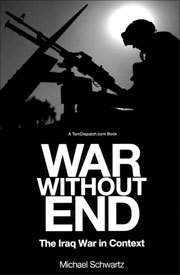
Michael Schwartz's illuminating new book, War Without End: The Iraq War in Context, provides a comprehensive overview of the ideological roots of the war and its social costs for the Iraqi people. He shows how neo-liberal policies and the privatization of state resources, backed by massive force, helped to exacerbate the suffering of Iraqis who increasingly turned to resistance against U.S. power and rule and remain disdainful of the occupation.
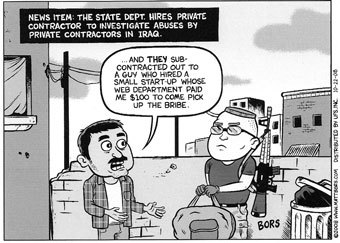
According to Schwartz, a professor of sociology at Stony Brook University, America's war aims were clear from the outset: to create a strategic base to control the Middle East's prized energy reserves and to usher in an economic transition from the "socialist dictatorship" of Saddam Hussein to an unfettered free-market capitalist state. In the aftermath of the invasion, Administrator L. Paul Bremer and his staff rapidly privatized state resources. They rewarded multinational corporations like Haliburton and Bechtel with major contracts to help rebuild the Iraq's infrastructure.
These policies confirmed for a large number of Iraqis that the U.S. had invaded for self-serving reasons. Furthermore, they caused a social and economic crisis of epic proportions, which gave strength to the insurgency. The dismantling of state industries caused the loss of thousands of jobs, which were replaced by foreign contractors. Local businesses were bankrupted by the flooding of the country with cheap imports and by a lack of regular electricity. Unemployment rates in the once prosperous nation skyrocketed to over 60 percent. Massive corruption in the rewarding of contracts and the dismissal of skilled local technicians resulted in gross inefficiency. This trend was typified by a failed $70 million Halliburton project to reconstruct an oil pipeline in Al Fatah, which came to resemble, as one observer put it, "some gargantuan heart-bypass operation gone night- marishly bad."
Most disconcerting was the decline in health and educational services. Schools damaged by the fighting were never properly repaired and lacked basic textbooks and school supplies. The U.S. military sometimes used schools as a staging base for military incursions. By 2007, UNICEF reported that only one-sixth of Iraqi children were being educated.
After dismantling the state health-care system, which had been among the best in the Arab world before Hussein's ascent to power, occupation officials promised to construct dozens of private clinics across the country. Most of these never materialized, resulting in a decline in accessibility of basic medicines and equipment. In the newly "liberated" Iraq, doctors would fill prescriptions that the pharmacies could not provide. Family members of patients even had to serve as nurses, and IVs and needles had to be reused. Over time, doctor shortages and the imposition of curfews in cities made the situation worse. The inability of occupation officials to provide clean water throughout the country and the overflow of raw sewage into city streets resulted in outbreaks of cholera and other diseases which the hospitals were ill-equipped to treat.
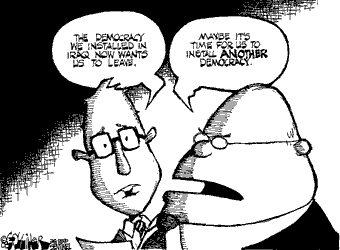
One of Schwartz's important contributions is to show how the failure of America's privatization and "nation-building" programs contributed to the rise of the insurgency in Iraq. Rather than being composed of "dead enders," in Donald Rumsfeld's now infamous words, or foreign jihadists or ex-Bathists, he demonstrates how resistance was in fact driven by "local factors that grew strength from deep grievances and a widespread hostility to the presence of foreign troops," as U.S. intelligence analysts concluded. In the early phases, many Iraqis staged demonstrations against the occupational authorities demanding basic social services and jobs. Rather than responding to their demands, the authorities instructed the military to greet any act of dissidence as suspicious and to shoot at any perceived threat. U.S. soldiers consequently fired on peaceful crowds and killed and wounded civilians, stoking popular anger. Many more innocent civilians were killed by fearful Marines at often poorly marked checkpoints throughout the country. The routine raiding of homes, designed in part to strike fear among the population, helped to further stoke popular anger and resentment, as did the prevalence of deplorable prison conditions and the revelations of torture. Meanwhile, the U.S. construction of a gaudy multi-billion dollar embassy made apparent America's ambitions to remain in Iraq indefinitely.
In order to try to maintain its grip on power, and in clear violation of international law, the U.S. adopted a doctrine of collective punishment designed to annihilate not only the insurgent fighters, but anyone who harbored and supported them. The consequence was the perpetration of many massacres, such as the notorious incident at Haditha where 24 civilians were killed. The doctrine of collective punishment was on display during the siege of Fallujah where the U.S. military killed thousands of people and turned the entire city into "a desolate world of skeletal buildings, tank-blasted homes, weeping power lines and severed palm trees," in the words of New York Times journalist Erik Eckholm. A Marine lieutenant proclaimed afterwards: "This is what happens if you shelter terrorists." As these comments reveal, the siege of Fallujah was intended as a warning to others that it would suffer the same fate if it defied U.S. power.
Much like the Vietnamese in an earlier failed U.S. colonial intervention, the Iraqis refused to bow to U.S. pressure and thus paid a high price in fighting for their sovereignty and independence. The backbone of the resistance took root in Sunni as well as some Shia cities like Sadr City, where local warlord Muqtada Sadr gained in prestige not only by defending Iraqi cities from attack, but also by seeking to provide basic social services that had been abandoned under the occupation. The resistance in Iraq, however, was never unified and became factionalized and ridden by sectarian tensions which culminated in full-scale civil war.
The war's ugliness was compounded by the tactics of many insurgent fighters—particularly the small number of Al Qaeda operatives in Iraq whose agenda was to expel the U.S. from Iraq and establish a caliphate through the Arab Middle East embodying the principles of Salafi Islam. They adopted terror techniques, such as suicide and car bombings directed against supposed colonial collaborators and Shia, which intensified public suffering. Criminal gangs seized on the violence and chaos to loot public resources and facilities and to extort money for ransom.


According to Schwartz, the United States bears a large share of the blame for creating a climate in which these trends emerged. In his view, the tactics of Al Qaeda in Iraq resemble those of the U.S. in Fallujah, with the aim of inducing civilians to withdraw their support for the enemy once they experienced the agony of punishment. Contrary to the false impression given by a majority of America's mainstream media, through the extensive air campaigns and search and destroy missions, U.S. forces and their proxies bear responsibility for the majority of both civilian and combat deaths, which studies place at well over one million. Schwartz estimates plausibly that the U.S. has been responsible for at least 57 percent of the killings, many of which he attributes to a hysterical use of firepower by U.S. troops in urban combat zones. The much vaunted "surge" strategy of President George W. Bush only worsened the carnage and further inflamed Iraqis, who continue to live in conditions of utter destitution. The U.S.-backed Maliki government and military, meanwhile, remain predominantly powerless outside Baghdad's Green Zone due to the growing strength of the sectarian militias who control many neigh- borhoods.
On the whole, while destined to create controversy, Schwartz has written a very powerful book on the U.S. occupation of Iraq and its devastating consequences for the country. He sheds great insight into the mindset of U.S. policy elites and military officials and documents the stark brutality of their programs. He demonstrates further that the rise of insurgency in Iraq was not irrational or driven exclusively by an Islamicist agenda or by hate, but was rather a product of the arrogance of U.S. occupying officials and the failure of U.S. state-building policies and neo-liberalism, which failed to guarantee basic social services and thereby helped to facilitate Iraq's social decay. Most of all, Schwartz reminds us of the true victims of war.
Z
Jeremy Kuzmarov is visiting assistant professor of history at Bucknell University.
http://www.zcommunications.org/war-without-end-by-jeremy-kuzmarov.html