CAFE

Hygine/Safety

Mexico’s Troubled Nuclear Plant/Safety concerns cloud S. Korea nuclear drive

작성자논둑길맨발로|작성시간13.05.29|조회수92 목록 댓글 0


South Korea's faked safety certificates: just another nuclear scandal

Blogpost by Justin McKeating - May 28, 2013 at 16:59 Add comment

Samcheok villagers participate in a demonstration to oppose the planned construction of a nuclear power plant in their community, in Samcheok, 192km from Seoul. Some of the demonstrators form the word "NO" including the nuclear energy symbol. 04/28/2013 © Jean Chung / Greenpeace

One of the defining factors of the nuclear industry is its refusal to learn the lessons of the past. It's built a lousy reputation for trust and transparency and public confidence in the industry has been massively dented by repeated scandals and accidents.

South Korea is a prime example.

Last year, the Seoul government closed two nuclear reactors because “thousands of substandard parts” for them “had been supplied with fake warranties for over 10 years.” The scandal saw engineers and suppliers sent to prison.

So, logically speaking, rigorous safety checks must have been put in place since then to prevent a repeat incident, right? Wrong.

Two more nuclear reactors in South Korea were shutdown on Tuesday and the scheduled start of two others was delayed. Why? Because an anonymous whistleblower revealed that “control cables had been supplied to [the] four reactors with faked certificates even though the part had failed to pass a safety test.”

These control cables are used to send electronic signals to a reactor’s control system in the event of an accident. Clearly then, they need to be in good order.

But someone, or some people, certified them as safe even though these vital components had failed safety tests. This is terrifying and it took an anonymous whistleblower to bring it to light.

After last year’s substandard parts scandal, the South Korean government and nuclear authorities should have been making more stringent safety checks. What else is waiting to be discovered?

But this, it seems, is business as usual for the nuclear industry. We see these types of scandals time and time again. For 60 years nuclear power has had our money, resources and safety in its hands and we’ve had little in return but empty promises, lies and scandal.

This is why Greenpeace says reactor designers and builders and other players in the nuclear industry, not just the operators, should be made responsible for their mistakes. Right now, governments have a protection scheme that shields the nuclear industry from responsibility – a responsibility that many companies simply disregard.

Sign our petition to stop this.

It’s time to switch off nuclear power and look to renewables. The wind and solar energy industries don’t deceive us or treat our safety in such a casual way. Let's put our faith in an Energy Revolution instead.

(Image: Samcheok villagers participate in a demonstration to oppose the planned construction of a nuclear power plant in their community, in Samcheok, 192km from Seoul. 04/28/2013 © Jean Chung / Greenpeace)


http://www.greenpeace.org/international/en/news/Blogs/nuclear-reaction/south-koreas-faked-safety-certificates-just-a/blog/45328/


South Korea Shuts More Nuclear Reactors Over Fake Certificates

SEOUL — South Korea said on Tuesday it was suspending the operations of two nuclear power reactors and extended a shutdown of a third to replace cables that were supplied using fake certificates, threatening power shortages in Asia's fourth-biggest economy.

Reuters
World Twitter Logo.

Connect With Us on Twitter

Follow @nytimesworld for international breaking news and headlines.

Twitter List: Reporters and Editors

The government warned there could be "unprecedented" electricity shortages and rolling blackouts this summer due to the nuclear shutdowns. South Korea previously halted the operations of some of its 23 reactors last November after a scandal emerged over parts being supplied using fake documents.

The Asian country is heavily dependent on oil, gas and coal imports, but usually gets about a third of its electricity from nuclear power generation.

"This is a separate case from the last investigation," said Kim Kyun-seop, president & CEO of Korea Hydro and Nuclear Power Co Ltd, which runs nuclear reactors in South Korea and is owned by state-run utility Korea Electric Power Corp.

The new case relates to forged documents on cables worth 6 billion won ($5.35 million) provided in 2008, Kim and energy ministry officials said, declining to identify the cable producers.

The reactors, which each have a capacity of 1,000 megawatts (MW), would remain closed for about four months, the government said.

Of the three reactors, two are in Kori, about 320 km southeast of the capital Seoul, and one is in Wolsong, about 280 km from Seoul, the Nuclear Safety and Security Commission said.

A fourth newly built nuclear power reactor, also in Wolsong, which is waiting for operational approval, would also have its cable replaced, the statement added.

The emergence of a new scandal will be damaging for authorities and South Korean President Park Geun-hye pledged at a cabinet meeting a thorough investigation.

The energy ministry said it would ask the international nuclear safety eval‎uation body Tuv Sud to include the latest case in a review of safety at all reactors, which started this week.


UNPRECEDENTED POWER SHORTAGE


The nuclear problems could increase the risk of power shortages in the hot Korean summer when power demand is seasonally high for air conditioning.

The energy ministry warned the worst shortages could occur in August, and it would consider various measures including rolling blackouts and spreading out holidays to curb demand.

"We expect unprecedented supply shortage this summer as we have to meet power demand while three reactors are halted," said Han Jin-hyun, Vice Minister for Trade, Industry and Energy.

He added power saving measures would be unveiled this Friday.

The energy ministry sees power supply this summer at about 77,000 MW, less than 80,000 MW projected before the closure and short of demand projection of 79,000 MW.

Last year, South Korea was forced to take power saving measures to avoid blackouts after it closed two reactors to replace parts supplied with fake certificates and extended the shutdown of another reactor where microscopic cracks were found.

($1 = 1122.3250 Korean won)

(Additional reporting by Se Young Lee; Editing by Ed Davies)


http://www.nytimes.com/reuters/2013/05/28/world/asia/28reuters-nuclear-korea.html?_r=0


South Korea shuts more nuclear reactors over fake certificates

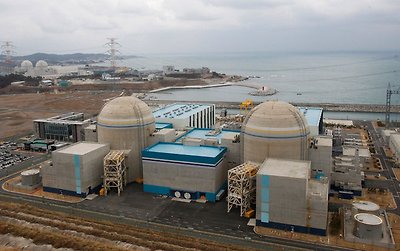
The Kori nuclear power plant in Busan, southeast of Seoul, is seen in this picture released by the plant to Reuters on April 14, 2011. REUTERS/Kori Nuclear Power Plant/Handout

By Meeyoung Cho

SEOUL (Reuters) - South Korea said on Tuesday it was suspending the operations of two nuclear power reactors and extended a shutdown of a third to replace cables that were supplied using fake certificates, threatening power shortages in Asia's fourth-biggest economy.

The government warned there could be "unprecedented" electricity shortages and rolling blackouts this summer due to the nuclear shutdowns. South Korea previously halted the operations of some of its 23 reactors last November after a scandal emerged over parts being supplied using fake documents.

The Asian country is heavily dependent on oil, gas and coal imports, but usually gets about a third of its electricity from nuclear power generation.

"This is a separate case from the last investigation," said Kim Kyun-seop, president & CEO of Korea Hydro and Nuclear Power Co Ltd, which runs nuclear reactors in South Korea and is owned by state-run utility Korea Electric Power Corp.

The new case relates to forged documents on cables worth 6 billion won ($5.35 million) provided in 2008, Kim and energy ministry officials said, declining to identify the cable producers.

The reactors, which each have a capacity of 1,000 megawatts (MW), would remain closed for about four months, the government said.

Of the three reactors, two are in Kori, about 320 km southeast of the capital Seoul, and one is in Wolsong, about 280 km from Seoul, the Nuclear Safety and Security Commission said.

A fourth newly built nuclear power reactor, also in Wolsong, which is waiting for operational approval, would also have its cable replaced, the statement added.

The emergence of a new scandal will be damaging for authorities and South Korean President Park Geun-hye pledged at a cabinet meeting a thorough investigation.

The energy ministry said it would ask the international nuclear safety eval‎uation body Tuv Sud to include the latest case in a review of safety at all reactors, which started this week.

UNPRECEDENTED POWER SHORTAGE

The nuclear problems could increase the risk of power shortages in the hot Korean summer when power demand is seasonally high for air conditioning.

The energy ministry warned the worst shortages could occur in August, and it would consider various measures including rolling blackouts and spreading out holidays to curb demand.

"We expect unprecedented supply shortage this summer as we have to meet power demand while three reactors are halted," said Han Jin-hyun, Vice Minister for Trade, Industry and Energy.

He added power saving measures would be unveiled this Friday.

The energy ministry sees power supply this summer at about 77,000 MW, less than 80,000 MW projected before the closure and short of demand projection of 79,000 MW.

Last year, South Korea was forced to take power saving measures to avoid blackouts after it closed two reactors to replace parts supplied with fake certificates and extended the shutdown of another reactor where microscopic cracks were found.

($1 = 1122.3250 Korean won)

(Additional reporting by Se Young Lee; Editing by Ed Davies)


http://news.yahoo.com/south-korea-shuts-more-nuclear-reactors-over-fake-081406744.html


South Korea Halting Operations at Reactors Over Faked Certificates

Ahn Young-Joon/Associated Press

A series of forced shutdowns and other problems has raised questions about whether nuclear plants can supply South Korea’s power needs.

SEOUL, South Korea — South Korea said on Tuesday that it was turning off two nuclear power reactors and delaying the scheduled start of operations at another two after its inspectors discovered that the reactors used components whose safety certificates had been fabricated.

World Twitter Logo.

Connect With Us on Twitter

Follow @nytimesworld for international breaking news and headlines.

Twitter List: Reporters and Editors

South Korea’s nuclear power industry has been plagued by a series of forced shutdowns, corruption scandals and mechanical failures in recent years, undermining public confidence in atomic energy even as the country’s dependence on it for electricity is expected to grow.

An anonymous whistle-blower led government investigators to uncover the latest problem, in which control cables that had failed to pass a safety test were given fake certificates and supplied to four reactors, the country’s Nuclear Safety and Security Commission said on Tuesday. The control cable is used to send electronic signals to a reactor’s control system in the event of an accident.

The commission halted operations at two reactors on Tuesday so the problematic cables could be replaced. The planned start-up of two other reactors — one under a routine maintenance shutdown and the other a newly built reactor waiting for operational approval — will be delayed for the same reason.

South Korea has 23 reactors, and Tuesday’s decision means that 10 reactors are temporarily offline for safety concerns, maintenance and other reasons, raising the risk of power shortages in the summer, when electricity consumption peaks.

The two reactors shut down on Tuesday are on the southeastern coast of South Korea, and each has a capacity of 1,000 megawatts. The recurring scandals have damaged the reputation of South Korea’s nuclear power industry, which supplies one-third of the country’s electricity needs and aspires to become a global exporter of reactors.

Despite increasing public concern, however, the government remained determined to push ahead with its aggressive nuclear power program; by 2030, the country plans to add 16 more reactors.

Last year, South Korea was forced to shut down two reactors when it was revealed that thousands of substandard parts had been supplied with fake warranties for over 10 years. The country resorted to various power-saving measures to avoid blackouts. Several nuclear power engineers and parts suppliers were later jailed for involvement in the scandal.


Updated: 02/27/2013 12:15 | By Agence France-Presse

Safety concerns cloud S. Korea nuclear drive

South Korea has big plans to become a major nuclear energy player, but they are unfolding at a time when the global industry is under intense scrutiny after the 2011 Fukushima disaster.


Safety concerns cloud S. Korea nuclear drive

Safety concerns cloud S. Korea nuclear drive

And its ambitions have not been helped by a series of domestic scandals and forced reactor shutdowns in 2012 that rattled public confidence and exposed a glaring lack of regulatory transparency.

Around $400 billion is riding on South Korea's ability to sell its technology to potential clients as it aims to take on the United States, France and Russia and grab a 20 percent share of the nuclear energy market.

With around half of the world's 430 reactors due for retirement by 2030, according to the International Atomic Energy Agency, the next 15 years or so offer the prospect of a sales bonanza.

Spearheading South Korea's global drive is its ARP-1400 reactor. It won a $20 billion deal in 2009 to build four of them in the United Arab Emirates and it aims to export another 80, worth around $400 billion, by 2030.

It is also planning a domestic energy expansion that would see it build 16 new reactors by 2030. South Korea currently operates 23 nuclear power reactors which meet more than 35 percent of the country's electricity needs.

"Our reactors are safe," Lee Young-Il insisted as he guided a group around an ARP-1400 nearing completion at the Gori nuclear power complex.

"We also have an excellent record of operating the reactors with a comparatively low annual rate of forced outage," said Lee, who heads the complex where South Korea's first commercial reactor came on line in 1978.

But the Fukushima disaster in Japan forced a number of countries to rethink their energy strategy, as public concern placed an even greater emphasis than before on reactor safety.

A survey commissioned by the Economics Ministry and published in November showed only 35 percent of South Koreans considered nuclear power to be safe, sharply down from 71 percent in January 2010.

"You are never free from worry as long as your country depends heavily on nuclear energy," Yangyi Won-Young, head of Nuclear-Free Korea, a coalition of civic groups, told AFP.

"Our nuclear power plants are vulnerable to natural disasters because of lax safety regulations which have been applied to construction, operation and parts," Yangyi said.

In the wake of the earthquake and tsunami-triggered meltdown at the Fukushima Daiichi nuclear plant in Japan, the state-run Korea Hydro and Nuclear Power Co (KHNP) launched a $1.0 billion-dollar safety upgrade due to be completed by 2015.

The project involves building higher seawalls around the country's four nuclear power complexes, and equipping plants and reactors -- including the ARP-1400 -- with advanced watertight doors and ventilation systems, as well as new quake sensors.

But the upgrade coincided with a series of shutdowns and scandals in 2012 that triggered a warning from the International Energy Agency (IEA) in November about the need to rebuild public trust.

In May, five senior KHNP engineers were charged with trying to cover up a potentially dangerous power failure at the country's oldest Gori-1 reactor.

Later in the year, the government shut down two reactors at the Yeonggwang nuclear complex to replace components provided with fake quality certificates.

And a third reactor was taken offline at Yeonggwang when cracks were found on control rod tubes during maintenance work.

"Recent incidents at Korean nuclear facilities should serve as a timely reminder to the government that the nuclear regulatory authority must maintain an enhanced profile... and be able to take independent decisions," the IEA said in a report on South Korea's energy policies.

The South has been criticised in the past for a lack of transparency in the nuclear sector -- largely attributed to the regulatory bodies' mixed supervisory and promotional roles.

President Park Geun-Hye, who took office this week, looks set to further muddy the waters with her proposal for the nominally independent Nuclear Safety and Security Commission.

Park wants to affiliate the commission with a newly created super-ministry in charge of policies on science research, information communication technology and atomic energy development.

Scientists, environmentalists and a number of politicians -- including some from Park's ruling party -- say the move would undermine the watchdog's independence and weaken its safety management authority.

"The Republic of Korea is going to be the only country across the globe where regulators and basically developers or promoters might be working all together under the same roof," said Suh Kune-Yull, a nuclear engineering professor at Seoul National University.

"A conflict of interest is inevitable," Suh said.


http://news.xin.msn.com/en/regional/safety-concerns-cloud-s-korea-nuclear-drive-2


CounterPunch by email for only $35 per year.
Aging Laguna Verde Reactor a Dangerous Fiasco

Mexico’s Troubled Nuclear Plant

by TALLI NAUMAN

With Latin American countries still turned off to nuclear power two years after Japan’s monumental Fukushima meltdowns dispersed radioactive fallout across the ocean to them, events inside a similar facility in Mexico have fueled mounting skepticism over the potential for developing the energy technology.

Fissures, leaks, shutdowns, government secrecy, a failed upgrade, alleged bid-rigging and contract fraud at Mexico’s lone atomic power station, the state-run Laguna Verde Nuclear Plant, were vetted during the 9th Regional Congress on Radiation Protection and Safety held in Rio de Janeiro in April.

The audience of Latin American experts eager to share the information at the professional association forum starred scientists from Argentina and Brazil, which also have nuclear power plants, as well as from Venezuela, Chile and Cuba, which had made tentative moves toward establishing atomic energy stations before the Fukushima catastrophe stymied aspirations.

The irregularities at Laguna Verde came to light thanks to a courageous group of anonymous high-level employees inside the power plant and to the public information requests by their spokesperson, Mexico’s National Autonomous University Physics Professor Bernardo Salas Mar, a former plant employee and valiant whistleblower.

Some of Salas Mar’s most recent research was accepted at the International Radiation Protection Association congress in Brazil, but his university did not provide him with travel expenses to attend in person.

Salas faces high-level attempts to have him fired as a result of his persistent efforts to make public his discoveries of dangerous faults and cover-ups at the Laguna Verde plant. But Salas’ achievements speak for themselves. Were it not for his ceaseless hammering on the doors of the 10-year-old Federal Information Access Institute (IFAI), perhaps no one ever would have known about the latest incidents at Laguna Verde until it was too late.

Based on his freedom-of-information requests to the institute, Salas and Laguna Verde’s own technicians revealed in an April 19 letter to President Enrique Peña Nieto that Mexico has been defrauded to the tune of more than a half-billion dollars by the international companies that won the bid for the federal contract to uprate the two reactors at the plant located near the Caribbean port of Veracruz.

“Uprating” is industry jargon for boosting the capacity of nuclear reactors so they can generate more electricity.

The letter to the President alleges the Federal Electricity Commission purposely botched the bid letting by omitting the usual requirement for a contractor to abide by the Review Standard for Extended Power Uprates. Apparently the CFD did this to favor the Spanish company Iberdrola Ingenería and the French company Alstom Mexico, which lacked the capability to carry out the changes to the nuclear steam supply system according to standard specifications.

Employees in key positions at Laguna Verde had alerted the two previous presidential administrations to the issue as far back as 2006, communicating their “worry over the capacity-boosting work contemplated for this nuclear plant, considering it to be unreliable, risky and overpriced,” according to the letter. Still Iberdrola and Alstom got the $605-million contract to increase the plant’s power output by 20 percent.

Iberdrola announced the successful conclusion of the five-year, $605-million modernization project in February, noting that it overhauled equipment dating back to 1990, in the project that created more than 2,000 jobs.

The president of Alstom in Mexico, Cintia Angulo, was arrested a week after the announcement of the upgrade conclusion on charges of giving false testimony in an unrelated French case of non-payment.

However, the more spectacular fraud for both firms will prove to be the Mexican uprate contract, which not only failed to accomplish the goal of boosting Laguna Verde’s power output, but also left the reactors in worse condition than before, Salas and employees charge.

The Federal Electricity Commission responded to Salas’ inquiries, saying that Reactor Unit 2 would be operating at 100 percent of planned output in April and Unit 1 would be at 100 percent in May.

Nonetheless, after further information requests, Salas revealed that the National Nuclear Safety Commission has denied both reactors the licenses to operate at higher output in the aftermath of the contract, due precisely to the fact that the guidelines for the nuclear steam supply system were not followed.

Employees say the failure to follow the guidelines during the uprate cracked the jet pumps that inject the water to the core of the General Electric boiling water reactors, the same kind that melted down due to a generator system crash at Fukushima.

“The situation of the reactors is not serious yet, but operating with fissures could cause a major problem to the extent that it could endanger national security. (Remember Fukushima and Chernobyl.)” the letter to President Peña Nieto says. The employees consider it “risky and inacceptable for both reactors to continue operating with the fissures that have been encountered.”

Simultaneous suspension of operations at both reactors in September 2012 and related confusing news releases, some blaming the pump fissures, caused alarm in the communities around the installation.

Authorities first said a diesel generator breakdown was at fault for the interruption in service of one reactor, while fuel-cell restocking was the reason for a stoppage at the other.

The next day they said a clogged seawater intake was part of the reason for removing both reactors from service. An escape of hydrogen gas from a condenser was posited. And finally, officials stated to the public that the fissures in both reactors’ water pumps were to blame.

Government secrecy about details surrounding the event accentuated longstanding worries in the population near the plant. The fear of accidents and serious concerns over the ongoing situation was highlighted by an NGO’s court appeal arguing that people should be exempted from paying their light bills due to the fact that their civil rights had been violated by the lack of safety measures and accountability at Laguna Verde.

In response to Salas’ information requests, the Energy Secretariat, in charge of the Federal Electricity Commission (CFE) and the National Nuclear Safety Commission (CNSNS), said it didn’t have the answers to his questions.

Its commissions presented incongruous replies. The vagueness of the answers provided by the Federal Electricity Commission prompted the researcher to appeal to the IFAI to require revised responses.

After his second round of questioning, he was able to deduce that the cooling water intake channel had indeed filled with sediment and it had been dredged, so it did not present a hazard and did not cause the reactor operations’ interruption.

He also then could determine that the hydrogen had been released from the ductwork into the cooling water of the main generator, during the month of August. While the amount of gas was unknown, the escape was not to the atmosphere, and neither presented a danger nor was cause for halting operations.

The CSNSNS responded that the diesel generator failed when a piston stuck due to lack of lubrication resulting from a bearing problem on Sept. 12. The event did not endanger life and limb, according to Salas.

Simultaneous reloading of fuel cells at both reactors was the most likely reason for the concurrent stalling, Salas concluded after the numerous freedom-of-information requests.

While the main present dangers appear to be the fractures in the cores’ water pumps, a Jan. 11, 2013 scram (emergency reactor shutdown) remains to be inspected under the looking glass of the IFAI.

The institute created by decree in 2002 has provided important tools for shedding light on the machinations of the nuclear plant, among other formerly opaque federal operations.

Yet, as this case underscores, IFAI should strengthen its own processes in order to avoid the kind of inconsistent and self-belying responses that ensnared this most recent of many investigations into the lack of security at Laguna Verde.

Even so, that won’t protect the population from the specter of accidents or deteriorating health and safety in the advent of air and water pollution from the facility, which is located on a part of the coast with only poorly maintained roads to offer escape routes.

If Peña Nieto and company are to be more responsive to community needs than their predecessors, one way to show good intentions would be to comply with demands for conducting an emergency public evacuation drill, something that never has been done in the history of the 17-year-old nuclear plant. Another would be to take the irresponsible parties to court to establish accountability.


TALLI NAUMAN is an environmental analyst for the Americas Program . She is a founder and co-director of the independent international media project Journalism to Raise Environmental Awareness, initiated in 1994 with support from the John D. and Catherine T. MacArthur Foundation.


http://www.counterpunch.org/2013/05/28/mexicos-troubled-nuclear-plant/


Reject Nuclear Power – Here’s Why

 40
 6 5
 
 107
radiation4

Citizens do not want nuclear power1. They know it is both far too dangerous and far too expensive.

Politicians want nuclear power because they know it puts Power in their hands. This is exactly paralleled by politicians embracing nuclear weapons. They think it gives them power and this is what they want above all else.

Citizens do not want nuclear weapons because they know they are insanely dangerous and what they want is to live without the threat of sudden and complete annihilation hanging over them and their children at all times. As we will see there is a close relationship between the weapons and the power in every sense of the word.

Politicians have different agendas to the people on these issues. The remedy is for us to wise up, get organised and then instruct them to do what we want – or join the job market.

The main objections to nuclear power are outlined below under the following headings:

  • Nuclear power stations are prohibitively dangerous
  • Nuclear power stations are prohibitively expensive
  • Nuclear power stations use the same technology as that required to manufacture nuclear weapons
  • The resulting nuclear waste will be dangerous for thousands of years
  • Plant and waste deposit storage are vulnerable to terrorist attack
  • Nuclear power stations epitomise the centralisation of power
  • Poor countries are made dependent on rich ones
  • These plants draw funds away from the development of sustainable energy
  • The uranium fuel will become increasingly scarce.
  • The support of nuclear power by government results from special pleading lobbying by the industry.

These aspects are briefly expanded upon below.


Nuclear power stations are prohibitively dangerous


There have now been four grave nuclear reactor accidents: Windscale in Britain in 1957 (the one that is never mentioned), Three Mile Island in the United States in 1979, Chernobyl in the Soviet Union in 1986, and now Fukushima. Each accident was unique, and each was supposed to be impossible.

A recent book, Chernobyl: Consequences of the Catastrophe for People and the Environment, concludes that, based on records now available, some 985,000 people died between 1986 and 2004, mainly of cancer, as a result of the Chernobyl accident.

Alice Slater, New York representative of the Nuclear Age Peace Foundation, comments:

“The tragic news uncovered by comprehensive new research that almost one million people died in the toxic aftermath of Chernobyl should be a wake-up call to people all over the world to petition their governments to put a halt to the current industry-driven ’nuclear renaissance.’ Aided by a corrupt IAEA, the world has been subjected to a massive cover-up and deception about the true damages caused by Chernobyl.”

At Fukushima we have the worst industrial disaster ever. Three simultaneous ongoing complete meltdowns have proven impossible to stop or contain since they started almost 2 years ago. These meltdowns are still pouring radiation pollution across the Japanese landscape.

International experts agree that there will continue to be disastrous failures at nuclear power stations and that this cannot be avoided2.

As Edward Teller, the great nuclear physicist, said, ‘If you [try to] construct something foolproof, there will always be a fool greater than the proof,’


 Nuclear power stations are prohibitively expensive


Nuclear power stations are so expensive that they are never built without substantial contribution to their costs from citizens in the form of subsidies.

The UK government has said it will not subsidies new nuclear power stations. However this seems to refer to the most overt form of subsidies and not to ‘hidden ‘ subsidies.

Nuclear power stations are so dangerous that no insurance company will undertake to pay the total costs of a disaster or a terrorist attack. So in order to get them built the government has to limit liability. This is a subsidy.

The cost of decommissioning will be an enormous sum and the final total is unknown.

Any limitation to liability for decommissioning costs will be a subsidy. If the industry does not pay the total costs of disposing of nuclear waste and ensuring it is safe for thousand of years then this is a subsidy. The industry does not pay the total costs of all research into nuclear energy .This is a subsidy.


 Nuclear power stations use the same technology as that required to manufacture nuclear weapons


Any country which purifies uranium for use in nuclear power stations can also use its purification plant to manufacture weapons grade fissile material.

Already nuclear power development has been used repeatedly as a cover for developing nuclear weapons. Of the 10 nations which have developed nuclear weapons ‘six did so with political cover and/or technical support from their supposedly peaceful nuclear program – India, Pakistan, Israel, South Africa, North Korea and France’ 3.


 The resulting nuclear waste will be dangerous for thousands for years


Since nuclear waste will be dangerous for thousands of years4 we are dumping our energy problems on future generations instead of using the benign methods of creating energy which are available to us.

The currently favoured ‘solution’ of burying the waste in bedrock and sealing off access for ever is desperate and irresponsible.


 The plants and waste deposit storage are vulnerable to terrorist attack


Because of their destructive potential nuclear power stations are a major target for terrorists. The 9/11 atrocity would be tiny by comparison. If a large plane were flown into a nuclear power station the disaster would be immeasurably worse than Chernobyl.

John Large, an international expert on nuclear power, has said that if a plane was flown into the nuclear waste storage tanks at Sellafield the whole of the English Midlands could be catastrophically contaminated.

Safety studies of Sellafield carried out for local authorities tell us that a direct hit by a passenger jet on the Sellafield nuclear reprocessing plant would contaminate Britain with two and a half times more radioactivity than the amount that escaped during the Chernobyl disaster5.

The studies also inform us that up to 2,646lb of the highly radioactive and long-lasting isotope caesium-137 would be released into the atmosphere, contaminating Britain, Ireland, continental Europe and beyond, making swathes of the country uninhabitable and causing more than two million cancers.

In the light of the twin towers atrocity this is a completely unacceptable risk.


They epitomise the centralisation of power


There is a burgeoning awareness among citizens that they are more free and more in control of their lives if facilities and decision-making occur at local level; that Big Government should only control those matters which cannot be dealt with locally. Nuclear power is the ultimate way of centralising power, putting it in the hands of experts, multi-national corporations and Big Government. In complete contrast to this, benign methods of supplying power such as wind and water turbines, solar energy, and heat pumps can be in the control of local communities and even, for some provisions, households.


 Poor countries are made dependent on rich ones


Poor countries do not have the knowledge and facilities to design, build, maintain and run their own nuclear power stations. This puts them at the mercy of the rich and more technically advanced states if they go down the nuclear power route.

Technically less advanced countries with nuclear power stations increases the safety risks. As Professor Peter Bradford writes

‘A world more reliant on nuclear power would involve many plants in countries that have little experience with nuclear energy, no regulatory background in the field, and some questionable records on quality control, safety and corruption’6.

By adopting benign forms of power supply the UK could help to promote the people-friendly way forward.


These plants draw funds away from the development of sustainable energy


Research undertaken and funds spent on nuclear power are highly detrimental to bringing forward sustainable energy supplies.

Each nuclear power plant costs around £5 billion to build. With such sums available we could quickly realise our sustainable energy potential. As Friends of the Earth tell us ‘With some of the windiest weather in Europe and almost 8.000 miles of coastline, the UK is a power house waiting to be switched on7.


The uranium fuel will become increasingly scarce.


The quantity of available uranium is limited and will reduce. The price will go up. If the world adopts nuclear power as a major source of energy there will be uranium wars just as there are now oil wars. There are unlikely to be wars fought over sustainable locally generated, solar, wind or wave power.

Thomas Neff, a research affiliate at MIT’s Center for International Studies writes

‘..shortage of uranium and of processing facilities worldwide leaves a gap between the potential increase in demand for nuclear energy and the ability to supply fuel for it’8

The support of nuclear power by government results from special pleading lobbying by the industry.


The adoption of nuclear power is favoured by the government but in a referendum would be rejected by citizens as being too dangerous and too expensive. A major reason that government favours this form seems to be due to vast amounts of money and effort being put into lobbying by the power companies. Their profits are huge so they have the funds for lobbying whereas the NGOs and citizens at large who are against nuclear power and have overwhelming arguments do not make the same impact because they lack the funds for effective lobbying.

This is one tendency which we are trying to help counter by this article!


Notes

1 ‘Nuclear power ‘gets little public support worldwide’ – http://www.bbc.co.uk/news/science-environment-15864806

2. Charles Perrow, ‘Normal Accidents’, Basic Books, 1984.

3. Article ‘Nuclear power and nuclear weapons are two sides of the same coin’ – article republished from Chain Reaction #115, August 2012 by Jim Green – the national nuclear campaigner with Friends of the Earth, Australia.

4.http://www.foe.co.uk/resource/briefings/nuclear_power_answer_climate_change.pdf

5. http://www.telegraph.co.uk/news/worldnews/northamerica/usa/1359081/Passenger-jet-hit-on-Sellafield-would-dwarf-Chernobyl-fall-out.html

A report by The Independent’s Technology Correspondent, Robert Uhlig,
Published: 12:01AM BST 11 Oct 2001) was headed Passenger jet hit on Sellafield ‘would dwarf Chernobyl fall-out’

6.’ Nuclear Power – Costly and Dangerous’ By Peter A. Bradford, an adjunct professor at the Vermont Law School and former commissioner of the U.S. Nuclear Regulatory Commission

7. http://www.foe.co.uk/resource/factsheets/renewable_energy.pdf

8.  http://web.mit.edu/newsoffice/2007/fuel-supply.html


 40
 6 5
 
 107
Articles by: Jim McCluskey

Related content:


http://www.globalresearch.ca/reject-nuclear-power-heres-why/5321374


다음검색
현재 게시글 추가 기능 열기

댓글

댓글 리스트
맨위로

카페 검색

카페 검색어 입력폼