https://twitter.com/i/status/1591102098938023939
본 그대로 바이든 연설 도중 환경단체들이 괴성을 지르고 잇습니다.

지난 5일 암스테르잠 Schiphol 공항에서 벌어진....개인 제트기 이륙방해 시위입니다.
Extinction Rebellion 와 그린피스 회원 500여명이 사람 몇명 움직이면서 이렇게 엄청난 공해를 내 품어도 되느냐??......항의 한 것입니다.
아래는 콘솔시움 뉴스에서 뽑은 것입니다.
경제가 무한 성장 할 수 잇다는 전제에 대한 냉소는 오래전 부터 잇엇지요.
이미 1972년 로마클럽 연구물은 ...지구 자원의 유한함과 경제성장의 한계를 이야기 해 왓습니다.
그 이후 이런 연구는 어떻게 진화되어 왓쓰며...
시간이 한참 지난 지금에 와서 되 돌아 보아 그들의 주장은 얼마나 합리적인 것이엇냐??.......를 짚어 본 것입니다.
전 지구가 미국과 같은 소비를 한다면,,,화성 정도의 자원 식민지가 필요하다고 합니다.
미국과 같은 풍요로운 소비는(요즘은 이런것 조차도 어렵습니다)는 극단적으로 예외적인 현상이고
전 세계가 미국과 같은 풍요를 이루기 이전에 이미 지구는 아작이 난다는 것이지요.
이런 관렴적인 주장은 과연 얼마만큼의 과학성을 갖는 것일까??
또는 이런주장의 반대 주장은 역설적으로 또 얼마나 과학적인 것일까??
다른소린 과학자도 아니고 .. 그렇다고 하여 특별한 판단을 할 수 잇을 만큼의 막대한 지식과 정보를 갖고 잇는 것도 아닙니다.
그런데 한가지는 알고 잇지요.
자본주의 방식은 절대 아니라는 것이지요.
자본주의는 욕망을 위해 소비를 합니다..
그리고 욕망은 한계를 갖고 잇지 않습니다..
끊임 없이 만들고 버리는 체체가 자본주의입니다....
자본주의 시장은 ...경제학에서 씨불기는 개소리완 정 반대로
가장 비 효율적이고 비 생산적이고 가장 절대 만족이 적은 낭비 체체입니다..
자본주의 효율과 생산성은 이윤과 탐욕에 기준한 것이지....만족에 기준한 것이 아닙니다.
이런 체체로는 특정지역, 특정 계급, 특정 국가의 풍요는 체워 줄 수 잇을지 모르겟지만
그것은 어차피 잠시 잠간일 뿐이고..보편적인 지속가능한 풍요는 절대 만들지 못 합니다.
다른소린 사회주의 말고....다른 대안은 듣지고 보지도 못 햇습니다.
혹여 누군가 다른 대안이 잇다면...다른소리를 일깨워 주시기 바랍니다..
지금 세계는 그 어느때 보다도 사회주의가 절실하게 필요한 때 입니다..
그런데 현실은 정 반대로 가장 자본주의적입니다.
우리는 가장 필요할때 가장 필요한 것을 잃어 버렷습니다.
다른소리의 아노미는 이런 것입니다..
https://consortiumnews.com/2022/11/09/cop27-limits-to-growth-inconvenient-truth-of-our-times/
COP27: Limits to Growth — Inconvenient Truth of Our Times
The main fears of the Club of Rome’s 1972 study have been reaffirmed, the authors say. But there is still a scenario allowing for widespread increases in human wellbeing within the planet’s resource boundaries.
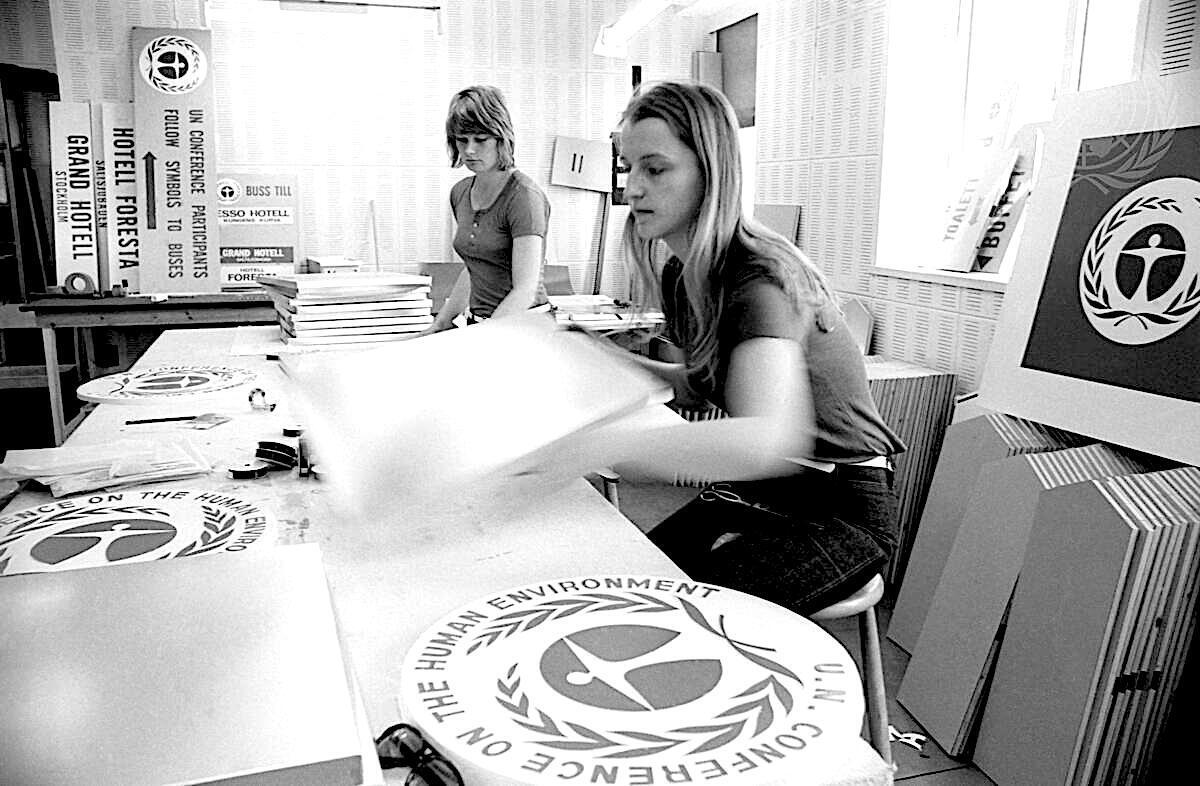
Preparing posters and signs for U.N. Conference on the Human Environment in Stockholm, June 5-16, 1972. (U.N. Photo/Yutaka Nagata)
By Hezri A Adnan and Jomo Kwame Sundaram
in Kuala Lumpur
Inter Press Service
Ahead of the first United Nations environmental summit in Stockholm in 1972, a group of scientists prepared The Limits to Growth report for the Club of Rome. It showed planet Earth’s finite natural resources cannot support ever-growing human consumption.
Limits used integrated computer modeling to investigate 12 planetary scenarios of economic growth and their long-term consequences for the environment and natural resources.
Emphasizing material limits to growth, it triggered a major debate. Authored by Donella H. Meadows, Dennis L. Meadows, Jørgen Randers and William W. Behrens III, Limits is arguably even more influential today.
Within Limits
Limits considered population, food production, industrialization, pollution and non-renewable resource use trends from 1900 to 2100.
It conceded, “Any human activity that does not require a large flow of irreplaceable resources or produce severe environmental degradation might continue to grow indefinitely.”
Most projected scenarios saw growth ending this century. Ominously, Limits warned of likely ecological and societal collapses if anthropocene challenges are not adequately addressed soon enough.
Failure would mean less food and energy supplies, more pollution and lower living standards, even triggering population collapses.
But Limits was never meant to be a definitive forecast, and should not be judged as such. Instead, it sought to highlight major resource threats due to growing human consumption.
Off-Limits?
Gaya Herrington, director of sustainability services at the auditing firm KPMG, has shown that three of Limits’ four major scenarios anticipated what is now trending. Two lead to major collapses by mid-century. She concluded, “humanity is on a path to having limits to growth imposed on itself rather than consciously choosing its own.”
Limits stressed the urgent need for radical transformation to achieve “sustainable development.” The “international community” embraced this, in principle, at the 1992 Earth Summit in Rio de Janeiro, two decades after Stockholm.
With accelerating resource depletion – as current demographic, industrial, pollution and food trends continue – the planet’s growth limits will be reached within the next half-century. The Earth’s “carrying capacity” is unavoidably shrinking.
Limits declared that only a “transition from growth to…a desirable, sustainable state of global equilibrium” can save the environment and humanity.
The report maintained it was still possible to create conditions for a much more sustainable future while meeting everyone’s basic material needs. As Gandhi said, “The world has enough for everyone’s need, but not enough for everyone’s greed.”
No other environmental work then, or since, has so directly challenged mainstream growth beliefs. Unsurprisingly, it attracted strong opposition.
The 1972 study was long dismissed by many as neo-Malthusian prophecy of doom, underestimating the potential for human adaptation through technological progress.
Many other criticisms have been made. Limits was faulted for focusing too much on resource limits, but not enough on environmental damage. Economists have criticized it for not explicitly incorporating either prices or socioeconomic dynamics.
Beyond Limits
In Beyond the Limits (1993), the two Meadows and Randers argued that resource use had exceeded the world environment’s carrying capacity.
Using climate change data, they highlighted the likelihood of collapse, going well beyond the earlier focus on the rapid carbon dioxide build-up in the atmosphere.
In another sequel, Limits to Growth: The 30-Year Update (2004), they elaborated their original argument with new data, calling for stronger actions to avoid unsustainable excess.
Dennis Meadows stresses other studies confirm and elaborate Limits’ concerns. Various growth trends peak around 2020, suggesting likely slowdowns thereafter, culminating in environmental and economic collapse by mid-century.
Limits’ early 1970s’ computer modeling has been overtaken by enhanced simulation capabilities. Many earlier recommendations need revision, but the main fears have been reaffirmed.
Limitless?
Two key Limits’ arguments deserve reiteration. First, its critique of technological hubris, which has deterred more serious concern about the threats, thus undermining environmental, economic and other mitigation efforts.
As Limits argued, environmental crisis and collapse are due to socioeconomic, technological and environmental transformations for wealth accumulation, now threatening Earth’s resources and ecology.
Conventional profit-prioritizing systems and technologies have changed, e.g., with resource efficiency innovation. Such efforts help postpone the inevitable, but cannot extend the planet’s natural limits.
Of course, innovative new technologies are needed to address old and new problems. But these have to be deployed to enhance sustainability, rather than profit.
The Limits’ critique is ultimately of “growth” in contemporary society. It goes much further than recent debates over measuring growth, recognizing greater output typically involves more resource use.
While not necessarily increasing exponentially, growth cannot be unlimited, due to its inherent resource and ecological requirements, even with materials-saving innovations.
This Earth for All
Thankfully, Limits’ fourth scenario – involving significant, but realistic transformations – allows widespread increases in human wellbeing within the planet’s resources.
This scenario has inspired Earth for All – the Club of Rome’s Transformational Economics Commission’s 2022 report – which more than updates Limits after half a century.
Its subtitle – “A Survival Guide for Humanity” – emphasizes the threat’s urgency, scale and scope.
It argues that ensuring the wellbeing of all is still possible, but requires urgent fundamental changes. Major efforts are needed to eradicate poverty, reduce inequality, empower women and transform food and energy systems.
[Related: It Doesn’t Trickle Down]
The comprehensive report proposes specific strategies. All five need significant investments, including much public spending. This requires more progressive taxation, especially of wealth. Curbing wasteful consumption is also necessary.
More liquidity – e.g., via “monetary financing” and International Monetary Fund issue of more special drawing rights — and addressing government debt burdens can ensure more policy and fiscal space for developing country governments.
Many food systems are broken. They currently involve unhealthy and unsustainable production and consumption, generating much waste. All this must be reformed accordingly.
Market regulation for the public good is crucial. Better regulation – of markets for goods (especially food) and services, even technology, finance, labour and land – is necessary to better conserve the environment.
Limited Choice
The report includes a modeling exercise for two scenarios. “Too Little Too Late” is the current trajectory, offering too few needed changes.
With growing inequalities, social trust erodes, as people and countries compete more intensely for resources. Without sufficient “collective action,” planetary boundaries will be crossed. For the most vulnerable, prospects are grim.
In the second “Giant Leap” scenario, the five needed shifts are achieved, improving wellbeing all around. Everybody can live with dignity, health and security. Ecological deterioration is sufficiently reversed, as institutions serve the common good and ensure justice for all.
Broad-based sustainable gains in wellbeing need pro-active governance reshaping societies and markets. This needs sufficient political will and popular pressure for needed reforms.
But as the world moves ever closer to many limits, the scenario looming is terrifying: ecosystem destruction, gross inequalities and vulnerabilities, and social and political tensions.
While regimes tend to bend to public pressure, if only to survive, existing discourses and mobilization are not conducive to generating the popular political demands needed for the changes.
Jomo Kwame Sundaram, a former economics professor, was United Nations assistant secretary-general for economic development and received the Wassily Leontief Prize for Advancing the Frontiers of Economic Thought.
Adnan A Hezri is an environmental policy analyst and fellow of the Academy of Sciences, Malaysia. He is author of The Sustainability Shift: Reshaping Malaysia’s Future.