아래는 가디언에서 카피한 20년도 넘은 기사입니다.
조지부시 할아버지인 프리스콧 부시의 나찌 부역 관계의 소문을 입체보도한 내용입니다.
조지 부시 재선을 앞두고 프리스콧 부시의 나찌 부역이 정치쟁점화 되던 시기 입니다.
우리가 이런 내용의 하나 하나를 다 알 필요는 없습니다..
시험에 나오는 것도 아니고, 논물을 쓸것도 아닌데
우리나라 친일파가 누구인지도 알지 못 하는 마당에..
다만, 친일파들이 참 나쁜놈들이엇다는 ....감성은 갖어야 하는 것 처럼.
그들에 대해서도 그렇습니다.
그들이 말하는 그 자유, 민주주의 라는 허울이,,쩍팔이 놈들의 대동아공영권의 허울과 눈꼽만큼도 다르지 않다는 것과
진실앞에서 분노 할 수 잇는 감성을 유지 하자는 것이지요..
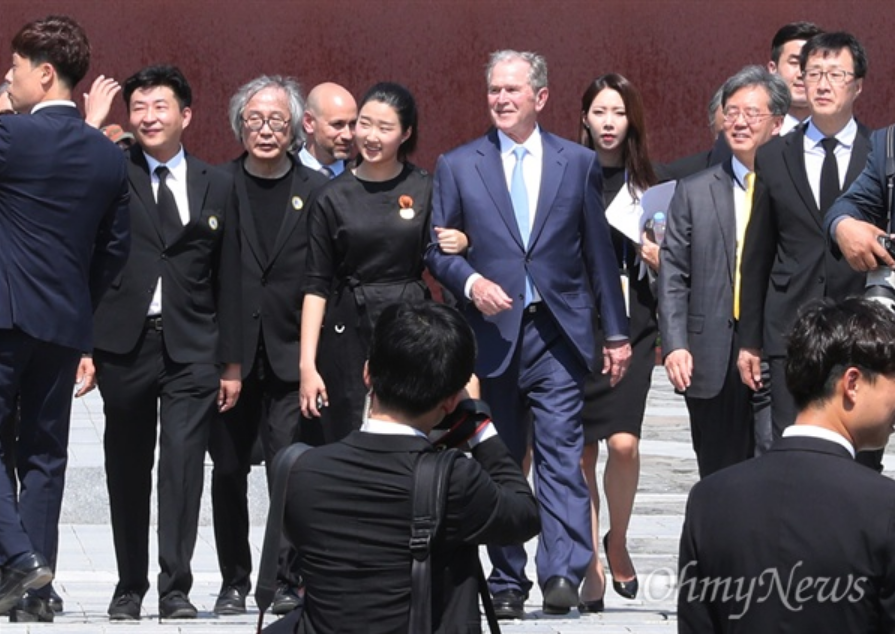
에유.....이게 대체 몹니까??
미친개들 발작질도 아니고.....
프리스콧 부시는 ...나찌와 꿍꿍하여 돈만 챙겻지만, 나찌 학살에 관여하진 않앗쟎어
그 손자는 100만이 넘는 사람을 학살하는 제노사이드를 실행햇고
민주주의의 화신 노무현의 식솔들과 그 미친개들은 그 인종청소자와 저리도 행복한 행진을 연출 하고 잇다면..
이건 아니쟎어..
다른소린, 노무현과 그 추종자들이 정말로 싫습니다....
정말로 소름이 끼치도록 싫어요..
https://www.theguardian.com/world/2004/sep/25/usa.secondworldwar
How Bush's grandfather helped Hitler's rise to power
Rumours of a link between the US first family and the Nazi war machine have circulated for decades. Now the Guardian can reveal how repercussions of events that culminated in action under the Trading with the Enemy Act are still being felt by today's president
Ben Aris in Berlin and Duncan Campbell in Washington
Sat 25 Sep 2004 23.59 BST
George Bush's grandfather, the late US senator Prescott Bush, was a director and shareholder of companies that profited from their involvement with the financial backers of Nazi Germany.
The Guardian has obtained confirmation from newly discovered files in the US National Archives that a firm of which Prescott Bush was a director was involved with the financial architects of Nazism.
His business dealings, which continued until his company's assets were seized in 1942 under the Trading with the Enemy Act, has led more than 60 years later to a civil action for damages(손해배상 민사소송...우리로 치면 위안부들이나 징용 징병 피해자들의 소송같은 것) being brought in Germany against the Bush family by two former slave labourers at Auschwitz and to a hum of pre-election controversy.
The evidence has also prompted one former US Nazi war crimes prosecutor to argue that the late senator's action should have been grounds for prosecution for giving aid and comfort to the enemy.
The debate over Prescott Bush's behaviour has been bubbling under the surface for some time. There has been a steady internet chatter about the "Bush/Nazi" connection, much of it inaccurate and unfair. But the new documents, many of which were only declassified last year, show that even after America had entered the war and when there was already significant information about the Nazis' plans and policies, he worked for and profited from companies closely involved with the very German businesses that financed Hitler's rise to power. It has also been suggested that the money he made from these dealings helped to establish the Bush family fortune and set up its political dynasty.
이런것이 비단 조지부시 가문만의 일도 아니고, 미국의 역사가 자체가 그래요...
미국의 독립전쟁을 이끌엇던 자들이 거의다(죄다) 노예주들 이엇거나 노예거래 변호사들 또는 어떤 형태던 노예거래를 통해 부를 축적한 년놈들이고, 이런식의 부와 권력의 형성은 이후에도 지금까지 내여오는 미국 지배계급의 방식입니다.
그들의 부와 권력은 거의 항상 누군가의 재산과 생명의 강탈에서 나옵니다....인디언이 그랫고 맥시코가 그랫고 필리핀이 일본도 좆 같겟지만 일본도 그중 하나라고 생각 할 수 잇습니다..
이들의 부의 이면을 뒤집어 보면,,,,항상 백인 우월 주의와 비 기독교인을 기독교인화 시켜야 하는 예수의 신앙와, 민주주의가 잇습니다.
히틀어의 파시즘과 레벤스타움의 정신적인 배경은 미국입니다..
히틀러는 자신의 역작 나의 투쟁에서 ...자신의 정신과 사상의 아이디어가 미국임을 분명하게 하엿습니다.
미국의 확창주의와 백인들의 지배, 그리고 통일된 사상(기독교 대신 아리안 민족주의)가 ..히틀러가 꿈 꾸던 레벤스타움 이엿습니다.
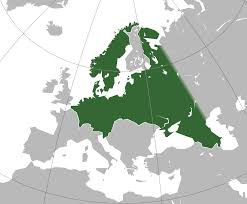
히틀러가 꿈 꿧던 레벤스타움
파시즘과 민주주의는 같은 것이라고 햇지요??
이해가 안 되면 그냥 암기하세요
Remarkably, little of Bush's dealings with Germany has received public scrutiny, partly because of the secret status of the documentation involving him.
((루스벨트의 뉴딜과 나찌즘은 차이가 없다고 햇지요?....루스벨트는 그 어떤 미국의 나찌 부역자들에 대한 조사나 처벌을 하지 않앗습니다....그들이 그리도 나찌에 우호적인 이유가 비단 전후 동서냉전시대를 대비한 지정학적 이유 말고도,,,미국의 민주주의와 나찌즘의 유사성에 기인 합니다.....루스밸트의 인종주의와 나찌의 아이안족 왓다주의 는 완벽하게 같습니다....히트러의 우생학은 루스밸트의 우생학을 고대로 복사한 것입니다...루스벨트의 행정부과 자본가들의 관계는 나찌와 독일 산업자본가들의 관계와 완벽하게 같습니다.............동병 상련,,,, 미국의 일본에 대한 관대함도 마찬가지 입니다....그들은 일본 인민들은 무차별 폭격과 원자탄을 통해 원없이 죽엿지만 그들의 지배자들은 고대로 남겨 두엇습니다......바로 자신들의 건국의 아버지들의 모습과 그들을 같은 수준에서 본 것이지요..
그들은 이런 파시즘과 인종주의를 명백한 운명(MANIFEST DESTINY) 란 기독교적 광기와 민주주의라는 허울로 뒤집어 쒸웟지요..
인민들에겐 애국을 강제 하엿고 그들의 희생의 댓가를 그들은 돈과 권력으로 챙겻습니다...
자유와 민주주의가 그렇게 퇴화되엇습니다..
히들러의 파시즘은 전쟁의 패배로 소멸되엇지만, 민주주의는 전쟁의 승리로 찬란하게 번영하게 되엇습니다..지형이동만 한 것이지요))
But now the multibillion dollar legal action for damages by two Holocaust survivors against the Bush family, and the imminent publication of three books on the subject are threatening to make Prescott Bush's business history an uncomfortable issue for his grandson, George W, as he seeks re-election.
While there is no suggestion that Prescott Bush was sympathetic to the Nazi cause, the documents reveal that the firm he worked for, Brown Brothers Harriman (BBH), acted as a US base for the German industrialist, Fritz Thyssen, who helped finance Hitler in the 1930s before falling out with him at the end of the decade. The Guardian has seen evidence that shows Bush was the director of the New York-based Union Banking Corporation (UBC) that represented Thyssen's US interests and he continued to work for the bank after America entered the war.
Bush was also on the board of at least one of the companies that formed part of a multinational network of front companies to allow Thyssen to move assets around the world.
Thyssen owned the largest steel and coal company in Germany and grew rich from Hitler's efforts to re-arm between the two world wars. One of the pillars in Thyssen's international corporate web, UBC, worked exclusively for, and was owned by, a Thyssen-controlled bank in the Netherlands. More tantalising are Bush's links to the Consolidated Silesian Steel Company (CSSC), based in mineral rich Silesia on the German-Polish border. During the war, the company made use of Nazi slave labour from the concentration camps, including Auschwitz.(이 노예노동자들이 부시가문을 상대로 손해배상 소송을 낸 겁니다) The ownership of CSSC changed hands several times in the 1930s, but documents from the US National Archive declassified last year link Bush to CSSC, although it is not clear if he and UBC were still involved in the company when Thyssen's American assets were seized in 1942.
Three sets of archives spell out Prescott Bush's involvement. All three are readily available, thanks to the efficient US archive system and a helpful and dedicated staff at both the Library of Congress in Washington and the National Archives at the University of Maryland.--여러분도 미국갈일 잇거덩 가서 연람해 보세요...이런것은 디지털화 되지 않앗는 가??
The first set of files, the Harriman papers in the Library of Congress, show that Prescott Bush was a director and shareholder of a number of companies involved with Thyssen.
The second set of papers, which are in the National Archives, are contained in vesting order number 248 which records the seizure of the company assets. What these files show is that on October 20 1942 the alien property custodian seized the assets of the UBC, of which Prescott Bush was a director. Having gone through the books of the bank, further seizures were made against two affiliates, the Holland-American Trading Corporation and the Seamless Steel Equipment Corporation. By November, the Silesian-American Company, another of Prescott Bush's ventures, had also been seized.
이렇게 몰수된 재산을 한국에서는 소송을 통해 법과 양심만으로 판단한다는 법관들의 판결을 통해 되 찾아 갓습니다.
자유 민주주의 체제가 본래 파시즘이라고 햇지요??
The third set of documents, also at the National Archives, are contained in the files on IG Farben, who was prosecuted for war crimes.
A report issued by the Office of Alien Property Custodian in 1942 stated of the companies that "since 1939, these (steel and mining) properties have been in possession of and have been operated by the German government and have undoubtedly been of considerable assistance to that country's war effort".
Prescott Bush, a 6ft 4in charmer with a rich singing voice, was the founder of the Bush political dynasty and was once considered a potential presidential candidate himself. Like his son, George, and grandson, George W,(미국 건국의 아버지들이 어떻게 노예 제도를 통해 부를 축척하엿고 그 부를 이용 권력이 되엇는지...그 과정과 완벽하게 같습니다) he went to Yale where he was, again like his descendants, a member of the secretive and influential Skull and Bones student society. He was an artillery captain in the first world war and married Dorothy Walker, the daughter of George Herbert Walker, in 1921.
In 1924, his father-in-law, a well-known St Louis investment banker, helped set him up in business in New York with Averill Harriman, the wealthy son of railroad magnate E H Harriman in New York, who had gone into banking.
One of the first jobs Walker gave Bush was to manage UBC. Bush was a founding member of the bank and the incorporation documents, which list him as one of seven directors, show he owned one share in UBC worth $125.
The bank was set up by Harriman and Bush's father-in-law to provide a US bank for the Thyssens, Germany's most powerful industrial family.
August Thyssen, the founder of the dynasty had been a major contributor to Germany's first world war effort and in the 1920s, he and his sons Fritz and Heinrich established a network of overseas banks and companies so their assets and money could be whisked offshore if threatened again.
By the time Fritz Thyssen inherited the business empire in 1926, Germany's economic recovery was faltering. After hearing Adolf Hitler speak, Thyssen became mesmerised by the young firebrand. He joined the Nazi party in December 1931 and admits backing Hitler in his autobiography, I Paid Hitler, when the National Socialists were still a radical fringe party. He stepped in several times to bail out the struggling party: in 1928 Thyssen had bought the Barlow Palace on Briennerstrasse, in Munich, which Hitler converted into the Brown House, the headquarters of the Nazi party. The money came from another Thyssen overseas institution, the Bank voor Handel en Scheepvarrt in Rotterdam.
By the late 1930s, Brown Brothers Harriman, which claimed to be the world's largest private investment bank, and UBC had bought and shipped millions of dollars of gold, fuel, steel, coal and US treasury bonds to Germany, both feeding and financing Hitler's build-up to war.
Between 1931 and 1933 UBC bought more than $8m worth of gold, of which $3m was shipped abroad. According to documents seen by the Guardian, after UBC was set up it transferred $2m to BBH accounts and between 1924 and 1940 the assets of UBC hovered around $3m, dropping to $1m only on a few occasions.
In 1941, Thyssen fled Germany after falling out with Hitler but he was captured in France and detained for the remainder of the war.
There was nothing illegal in doing business with the Thyssens throughout the 1930s and many of America's best-known business names invested heavily in the German economic recovery. However, everything changed after Germany invaded Poland in 1939. Even then it could be argued that BBH was within its rights continuing business relations with the Thyssens until the end of 1941 as the US was still technically neutral until the attack on Pearl Harbor. The trouble started on July 30 1942 when the New York Herald-Tribune ran an article entitled "Hitler's Angel Has $3m in US Bank". UBC's huge gold purchases had raised suspicions that the bank was in fact a "secret nest egg" hidden in New York for Thyssen and other Nazi bigwigs. The Alien Property Commission (APC) launched an investigation.
There is no dispute over the fact that the US government seized a string of assets controlled by BBH - including UBC and SAC - in the autumn of 1942 under the Trading with the Enemy act. What is in dispute is if Harriman, Walker and Bush did more than own these companies on paper.--전두환이가 내 재산은 29만원이다....라고 나발 거린것으로 생각하세요.
Erwin May, a treasury attache and officer for the department of investigation in the APC, was assigned to look into UBC's business. The first fact to emerge was that Roland Harriman, Prescott Bush and the other directors didn't actually own their shares in UBC but merely held them on behalf of Bank voor Handel. Strangely, no one seemed to know who owned the Rotterdam-based bank, including UBC's president.---재산을 숨기는 것도 재주라고 햇습니다...한국의 재벌들의 재산 은닉술은 다
미국에서 배운 겁니다....서울대 출신들 좋은 해골을 빌려
May wrote in his report of August 16 1941: "Union Banking Corporation, incorporated August 4 1924, is wholly owned by the Bank voor Handel en Scheepvaart N.V of Rotterdam, the Netherlands. My investigation has produced no evidence as to the ownership of the Dutch bank. Mr Cornelis [sic] Lievense, president of UBC, claims no knowledge as to the ownership of the Bank voor Handel but believes it possible that Baron Heinrich Thyssen, brother of Fritz Thyssen, may own a substantial interest."
May cleared the bank of holding a golden nest egg for the Nazi leaders but went on to describe a network of companies spreading out from UBC across Europe, America and Canada, and how money from voor Handel travelled to these companies through UBC.
By September May had traced the origins of the non-American board members and found that Dutchman HJ Kouwenhoven - who met with Harriman in 1924 to set up UBC - had several other jobs: in addition to being the managing director of voor Handel he was also the director of the August Thyssen bank in Berlin and a director of Fritz Thyssen's Union Steel Works, the holding company that controlled Thyssen's steel and coal mine empire in Germany.
Within a few weeks, Homer Jones, the chief of the APC investigation and research division sent a memo to the executive committee of APC recommending the US government vest UBC and its assets. Jones named the directors of the bank in the memo, including Prescott Bush's name, and wrote: "Said stock is held by the above named individuals, however, solely as nominees for the Bank voor Handel, Rotterdam, Holland, which is owned by one or more of the Thyssen family, nationals of Germany and Hungary. The 4,000 shares hereinbefore set out are therefore beneficially owned and help for the interests of enemy nationals, and are vestible by the APC," according to the memo from the National Archives seen by the Guardian.
Jones recommended that the assets be liquidated for the benefit of the government, but instead UBC was maintained intact and eventually returned to the American shareholders after the war. Some claim that Bush sold his share in UBC after the war for $1.5m - a huge amount of money at the time - but there is no documentary evidence to support this claim. No further action was ever taken nor was the investigation continued, despite the fact UBC was caught red-handed operating a American shell company for the Thyssen family eight months after America had entered the war and that this was the bank that had partly financed Hitler's rise to power.
The most tantalising part of the story remains shrouded in mystery: the connection, if any, between Prescott Bush, Thyssen, Consolidated Silesian Steel Company (CSSC) and Auschwitz.
Thyssen's partner in United Steel Works, which had coal mines and steel plants across the region, was Friedrich Flick, another steel magnate who also owned part of IG Farben, the powerful German chemical company.
Flick's plants in Poland made heavy use of slave labour from the concentration camps in Poland. According to a New York Times article published in March 18 1934 Flick owned two-thirds of CSSC while "American interests" held the rest.
미국은 신장 위그르 자치구의 위그리 인종들에 대한 중국당국의 탄압과 집단 켐프의 강제노역을 인권침해라며 ....참 맹렬하게 공격 하엿습니다......그런 주장이 사실이 아닌 것은 UN조사단에 의해 밝혀졋습니다...
그런것 과는 별론으로........도대체 미국이 그런 말을 할 자격이나 잇냐는 것입니다..
예수와 민주주의 이름으로 자행된 그 숫자가 얼마나 되는지 알수 조차 없는 미국 원주민들의 인종 청소는 말 할 것도 없고
아우수비취 유태인 수용소의 강제 노역을 통해 얻은 이익을 미국 기업가들이 처 먹엇고...그런자가 미 합중국 대통령 까지 되려 하엿고
자신은 이루지 못 햇지만, 그의 아들과 손자가 차레로 합중국 대통령이 되어.....100만이 넘는 이락크 인민들을 도륙질을 내 버렷습니다.
이들이 말하는 그 자유, 민주주의, 인권 이란것은 도대체 뭐냐는 것이지요??
The US National Archive documents show that BBH's involvement with CSSC was more than simply holding the shares in the mid-1930s. Bush's friend and fellow "bonesman" Knight Woolley, another partner at BBH, wrote to Averill Harriman in January 1933 warning of problems with CSSC after the Poles started their drive to nationalise the plant. "The Consolidated Silesian Steel Company situation has become increasingly complicated, and I have accordingly brought in Sullivan and Cromwell, in order to be sure that our interests are protected," wrote Knight. "After studying the situation Foster Dulles is insisting that their man in Berlin get into the picture and obtain the information which the directors here should have. You will recall that Foster is a director and he is particularly anxious to be certain that there is no liability attaching to the American directors."
But the ownership of the CSSC between 1939 when the Germans invaded Poland and 1942 when the US government vested UBC and SAC is not clear.
"SAC held coal mines and definitely owned CSSC between 1934 and 1935, but when SAC was vested there was no trace of CSSC. All concrete evidence of its ownership disappears after 1935 and there are only a few traces in 1938 and 1939," says Eva Schweitzer, the journalist and author whose book, America and the Holocaust, is published next month.
Silesia was quickly made part of the German Reich after the invasion, but while Polish factories were seized by the Nazis, those belonging to the still neutral Americans (and some other nationals) were treated more carefully as Hitler was still hoping to persuade the US to at least sit out the war as a neutral country. Schweitzer says American interests were dealt with on a case-by-case basis. The Nazis bought some out, but not others.
The two Holocaust survivors suing the US government and the Bush family for a total of $40bn in compensation claim both materially benefited from Auschwitz slave labour during the second world war.
Kurt Julius Goldstein, 87, and Peter Gingold, 85, began a class action(집단소동) in America in 2001, but the case was thrown out by Judge Rosemary Collier on the grounds that the government cannot be held liable under the principle of "state sovereignty".(국가주권의 원칙-외부 간섭을 받지 않는다는 국제법상의 원칙)
Jan Lissmann, one of the lawyers for the survivors, said: "President Bush withdrew President Bill Clinton's signature from the treaty [that founded the court] not only to protect Americans, but also to protect himself and his family."
Lissmann argues that genocide-related cases are covered by international law, which does hold governments accountable for their actions. He claims the ruling was invalid as no hearing took place.
In their claims, Mr Goldstein and Mr Gingold, honorary chairman of the League of Anti-fascists, suggest the Americans were aware of what was happening at Auschwitz and should have bombed the camp.
The lawyers also filed a motion in The Hague asking for an opinion on whether state sovereignty is a valid reason for refusing to hear their case. A ruling is expected within a month.
The petition to The Hague states: "From April 1944 on, the American Air Force could have destroyed the camp with air raids, as well as the railway bridges and railway lines from Hungary to Auschwitz. The murder of about 400,000 Hungarian Holocaust victims could have been prevented."
The case is built around a January 22 1944 executive order signed by President Franklin Roosevelt calling on the government to take all measures to rescue the European Jews. The lawyers claim the order was ignored because of pressure brought by a group of big American companies, including BBH, where Prescott Bush was a director.
AI 개요
MS 세인트루이스호는
1939년 5월 독일 함부르크를 출발해 쿠바를 향해 가던 중, 쿠바 정부로부터 입국을 거부당하고 미국과 캐나다의 입국도 거부당한 여객선입니다. 이 배는 주로 나치를 피해 도망치던 937명의 유대인 난민들을 태우고 있었으며, 결국 유럽으로 돌아갔다가 일부는 재차 나치 통치하에 놓이게 되는 비극을 겪었습니다.
- 배경: 1939년 5월 13일, 함부르크-아메리칸 해운 소속 여객선인 MS 세인트루이스호가 함부르크를 출항하여 937명의 유대인 난민들을 태우고 쿠바 하바나를 향했습니다.
- 입국 거부: 하바나에 도착했으나 쿠바 정부가 승객들의 비자를 무효화하면서 입국을 거부했습니다. 이후 미국과 캐나다도 입국을 허용하지 않았습니다.
- 유럽 귀환: 결국 배는 유럽으로 돌아가게 되었고, 6월 17일 벨기에 안트베르펜에 도착했습니다.
- 비극: 이 중 상당수의 난민들은 나치 독일이 서유럽을 침공하면서 다시 독일의 지배하에 놓이게 되었고, 그중 254명이 홀로코스트에서 희생되었습니다. 이 사건은 흔히 '세인트루이스호 사건' 또는 '유대인 난민의 수난'으로 불리며, 당시 유럽 난민에 대한 각국의 비인도적인 태도를 상징하는 사건으로 남아있습니다.
홀로코스트에서 자유로울 서방 국가들은 없습니다.....당연히 미국도 그중 한 나라입니다.
Lissmann said: "If we have a positive ruling from the court it will cause [president] Bush huge problems and make him personally liable to pay compensation."
The US government and the Bush family deny all the claims against them.
In addition to Eva Schweitzer's book, two other books are about to be published that raise the subject of Prescott Bush's business history. The author of the second book, to be published next year, John Loftus, is a former US attorney who prosecuted Nazi war criminals in the 70s. Now living in St Petersburg, Florida and earning his living as a security commentator for Fox News and ABC radio, Loftus is working on a novel which uses some of the material he has uncovered on Bush. Loftus stressed that what Prescott Bush was involved in was just what many other American and British businessmen were doing at the time.
"You can't blame Bush for what his grandfather did any more than you can blame Jack Kennedy(존f 케네디--케네디의 아버지는 투식 투기질로 때돈을 벌엇고....같은 방식으로 케네디 가문을 만듬) for what his father did - bought Nazi stocks - but what is important is the cover-up, how it could have gone on so successfully for half a century, and does that have implications for us today?" he said.
"This was the mechanism by which Hitler was funded to come to power, this was the mechanism by which the Third Reich's defence industry was re-armed, this was the mechanism by which Nazi profits were repatriated back to the American owners, this was the mechanism by which investigations into the financial laundering of the Third Reich were blunted," ---이 메카니즘이 자유 민주주의 입니다......우리가 그리도 갖고 싶어 뼈 빠지게 싸웟던......자유 민주주의와 파시즘은 동전의 표리 관계.)said Loftus, who is vice-chairman of the Holocaust Museum in St Petersburg.
"The Union Banking Corporation was a holding company for the Nazis, for Fritz Thyssen," said Loftus. "At various times, the Bush family has tried to spin it, saying they were owned by a Dutch bank and it wasn't until the Nazis took over Holland that they realised that now the Nazis controlled the apparent company and that is why the Bush supporters claim when the war was over they got their money back. Both the American treasury investigations and the intelligence investigations in Europe completely bely that, it's absolute horseshit. They always knew who the ultimate beneficiaries were."
"There is no one left alive who could be prosecuted but they did get away with it," said Loftus. "As a former federal prosecutor, I would make a case for Prescott Bush, his father-in-law (George Walker) and Averill Harriman [to be prosecuted] for giving aid and comfort to the enemy. They remained on the boards of these companies knowing that they were of financial benefit to the nation of Germany."
Loftus said Prescott Bush must have been aware of what was happening in Germany at the time. "My take on him was that he was a not terribly successful in-law who did what Herbert Walker told him to. Walker and Harriman were the two evil geniuses, they didn't care about the Nazis any more than they cared about their investments with the Bolsheviks."
What is also at issue is how much money Bush made from his involvement. His supporters suggest that he had one token share. Loftus disputes this, citing sources in "the banking and intelligence communities" and suggesting that the Bush family, through George Herbert Walker and Prescott, got $1.5m out of the involvement. There is, however, no paper trail to this sum.
The third person going into print on the subject is John Buchanan, 54, a Miami-based magazine journalist who started examining the files while working on a screenplay. Last year, Buchanan published his findings in the venerable but small-circulation New Hampshire Gazette under the headline "Documents in National Archives Prove George Bush's Grandfather Traded With the Nazis - Even After Pearl Harbor". He expands on this in his book to be published next month - Fixing America: Breaking the Stranglehold of Corporate Rule, Big Media and the Religious Right.
In the article, Buchanan, who has worked mainly in the trade and music press with a spell as a muckraking reporter in Miami, claimed that "the essential facts have appeared on the internet and in relatively obscure books but were dismissed by the media and Bush family as undocumented diatribes".(그래서 기록이 중요합니다....적어 두세요..그래야 나중에 똥지라도 쓸 수 잇습니다)
Buchanan suffers from hypermania, a form of manic depression, and when he found himself rebuffed in his initial efforts to interest the media, he responded with a series of threats against the journalists and media outlets that had spurned him. The threats, contained in e-mails, suggested that he would expose the journalists as "traitors to the truth".
Unsurprisingly, he soon had difficulty getting his calls returned. Most seriously, he faced aggravated stalking charges in Miami, in connection with a man with whom he had fallen out over the best way to publicise his findings. The charges were dropped last month.
Buchanan said he regretted his behaviour had damaged his credibility but his main aim was to secure publicity for the story. Both Loftus and Schweitzer say Buchanan has come up with previously undisclosed documentation.
The Bush family have largely responded with no comment to any reference to Prescott Bush. Brown Brothers Harriman also declined to comment.
The Bush family recently approved a flattering biography of Prescott Bush entitled Duty, Honour, Country by Mickey Herskowitz. The publishers, Rutledge Hill Press, promised the book would "deal honestly with Prescott Bush's alleged business relationships with Nazi industrialists and other accusations".
In fact, the allegations are dealt with in less than two pages. The book refers to the Herald-Tribune story by saying that "a person of less established ethics would have panicked ... Bush and his partners at Brown Brothers Harriman informed the government regulators that the account, opened in the late 1930s, was 'an unpaid courtesy for a client' ... Prescott Bush acted quickly and openly on behalf of the firm, served well by a reputation that had never been compromised. He made available all records and all documents. Viewed six decades later in the era of serial corporate scandals and shattered careers, he received what can be viewed as the ultimate clean bill."
The Prescott Bush story has been condemned by both conservatives and some liberals as having nothing to do with the current president. It has also been suggested that Prescott Bush had little to do with Averill Harriman and that the two men opposed each other politically.
However, documents from the Harriman papers include a flattering wartime profile of Harriman in the New York Journal American and next to it in the files is a letter to the financial editor of that paper from Prescott Bush congratulating the paper for running the profile. He added that Harriman's "performance and his whole attitude has been a source of inspiration and pride to his partners and his friends".
The Anti-Defamation League in the US is supportive of Prescott Bush and the Bush family. In a statement last year they said that "rumours about the alleged Nazi 'ties' of the late Prescott Bush ... have circulated widely through the internet in recent years. These charges are untenable and politically motivated ... Prescott Bush was neither a Nazi nor a Nazi sympathiser."
However, one of the country's oldest Jewish publications, the Jewish Advocate, has aired the controversy in detail.
More than 60 years after Prescott Bush came briefly under scrutiny at the time of a faraway war, his grandson is facing a different kind of scrutiny but one underpinned by the same perception that, for some people, war can be a profitable business.
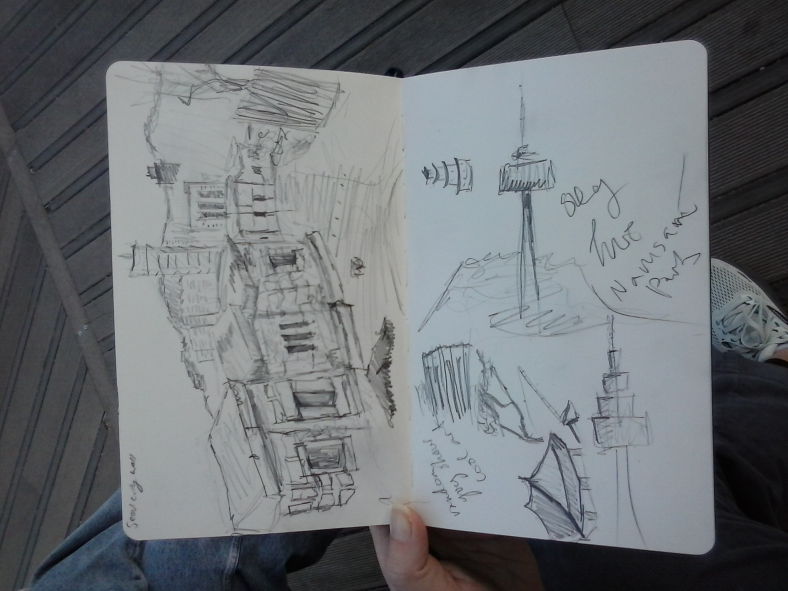
남산,,,시청..
택사스 오스틴에서 온 자매....27살, 25살.
트럼프 이야기가 나오자....바로 피식 피식 웃습니다.
야나들은 조시워싱턴이 노예 소유자 엿고, 상속인이 없어서 할 수 없이 풀어주엇다...는 것을 이야기 합니다.
1619프로젝..정확히 알고 잇고,
학교에서 가르치는 역사와 진실과는 많이 다르다는 것을 이야기 합니다.
시간이 된다면...많은 이야기를 나눠 보고 싶엇는데..
다른소린 집에 와야 할 이유 잇습니다..
요즘 젊은 사람들에겐...영어를 한다, 못한다 따위는 이미 촛점이 아닙니다..
원만하면 소통 합니다.
다른소리가 늘 가는 편의점의 한 알바 아가씨는 얼마나 영어를 잘 하는지...눈 감고 들으면 원어민 같습니다.
문제는...그 찬란한 영어로 무얼 이야기 할 수 잇냐는 것이지요..
저런 아가씨들과 ...한국 음식이야기나 하고 보네기 솔까 아깝쟎어..