Ring of Fire is mentioned in the Genesis in Bible. 불의 고리는 성경 창세기에 언급되어 있습니다.
by inierinier
보이저 1호의 출발시 속도는 시속 5만6천3백 킬로미터였습니다. 지금 검색하니, 6만킬로미터로 늘어났는데 이는 가속 때문 같습니다.
"보이저 1호의 현재 속도는 초속 약 17km(시속 약 6만 1,000km)이며, 인간이 만든 물체 중 지구에서 가장 빠른 속도로 태양계 밖 우주 공간을 향해 멀어지고 있습니다.이 엄청난 속도를 실생활에 비교하면 다음과 같습니다.초속 약 17km: 소총에서 발사된 총알보다 약 17배 이상 빠른 속도입니다.시속 약 6만 1,000km: 이 속도로 이동하면 지구에서 달까지 약 6시간 30분 만에 도달할 수 있습니다.- 구글검색
Voyager 1's launch speed was 56,300 kilometers per hour. A quick search reveals it has increased to 60,000 kilometers per hour, which appears to be due to acceleration.
"Voyager 1's current speed is approximately 17 km/s (about 61,000 km/h), and it is moving away toward outer space beyond the solar system at the fastest speed of any man-made object from Earth. To compare this tremendous speed to real-life situations, it is as follows: Approximately 17 km/s: This is about 17 times faster than a bullet fired from a rifle. Approximately 61,000 km/h: At this speed, it would take about 6 hours and 30 minutes to travel from Earth to the Moon." - Google Search
https://www.youtube.com/watch?v=ZlYxQDN0zB0
.
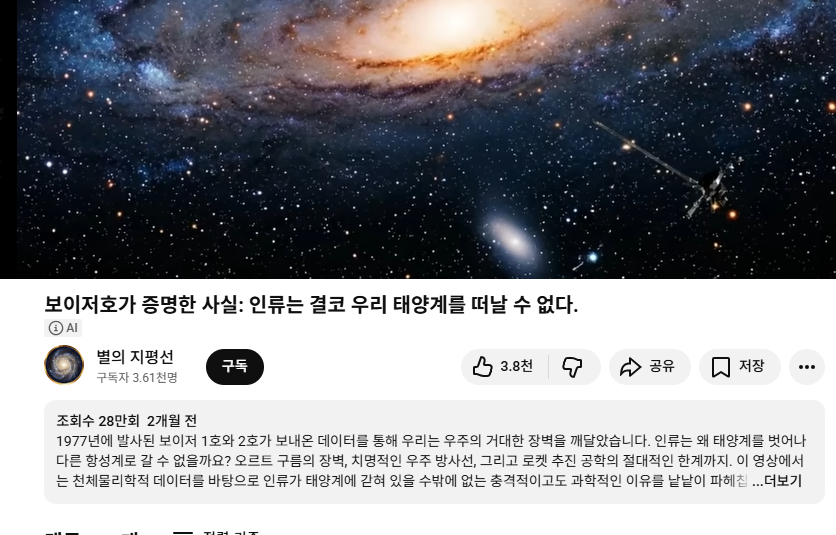
보이저호가 증명 한 사실: 인류는 결국 우리 태양계를 넘어설 수 없다. 1977년 9월 5일, 인류는 보이저 1호를 우주로 발사했습니다. 4초 역사상 가장 멀리 여행할 물체이자 6초 인류의 한계를 시험할 메신저입니다 . 9초 당시 케이프 커내버럴 발사대에서 뿜어져 나오던 거대한 화염은 미지의 세계를 정복하려는 인류의 오만한 욕망을 상징했습니다. 19초 단순히 기계를 궤도에 올리는 행위를 넘어선 것이었습니다 . 25초 오늘날, 이 외로운 탐사선은 28초 시속 61,000km라는 엄청난 속도로 지구에서 240억 km 이상 떨어진 성간 공간의 어둠을 가로지르고 있습니다. 39초 숫자만 보면 우리 인류가 이룬 가장 위대한 승리처럼 들립니다. 53초 인류의 흔적이 담긴 금속 조각이 광활한 우주에 던져졌다는 사실은 수많은 사람들에게 경외감을 불러일으킵니다 . 56초 하지만 이 광대한 거리를 큰 도약으로 해석하는 우리의 원시적인 유인원 노예들과는 달리, 58초 천체물리학의 냉철한 데이터 는 1:00 우리에게 완전히 다르고 매우 고통스러운 진실을 속삭입니다. 보이저가 보낸 최근의 원격 측정 데이터, 즉 1:15 핵전지의 운동 에너지 감소와 1:21 태양계의 진정한 끝인 오르트 구름의 압도적인 규모에 대한 정밀한 분석은 1:24 보이저 임무가 1:27 결코 은하계 식민지화의 서막이 아니라는 것을 보여줍니다. 오히려 이 1:30 임무는 우리가 태양계라는 요람에 영원히 갇혀 있을 수밖에 없다는 생물학적, 기술적 제약에 대한 물리적 증거입니다 . 1:40 항공우주공학과 양자 역학은 우리 종의 발전에 절대적인 한계를 설정하고 있습니다 . … 쌍둥이 탐사선이 보낸 우주 방사선 데이터는 태양권의 보호막에서 벗어난 인간의 연약한 생물학적 구조가 결코 견딜 수 없다는 가혹한 결론을 내렸습니다 . 우리는 갇혀 있습니다. 우주는 우리를 위해 설계되지 않았으며, 우리가 직면한 장벽은 일시적인 공학적 어려움이 아니라 입자 물리학의 근본 법칙 그 자체입니다. 제가 이와 같은 심층적인 영상을 계속 제작하고 우주의 씁쓸한 진실을 밝혀낼 수 있도록 여러분의 강력한 지원이 필요합니다 . 지금 바로 채널을 구독해 주세요. 여러분의 구독은 이 프로젝트를 지속하는 원동력이며, 우리가 이 프로젝트를 계속할 수 있도록 보장하는 유일한 방법 입니다. 2:33 우리가 직면해야 할 진실에 대한 기록을 계속 이어가자 2:35. 인류가 언젠가 지구를 떠나 머나먼 별들 사이에서 새로운 복음을 세울 것이라는 대담한 전제는 2:38 보이저 1호와 2호가 최근 상세하게 지도화한 가혹한 물리적 경계 앞에서 처참하게 무너진다. 2:53 대중 매체와 공상 과학 소설은 종종 3:06 태양풍이 멈추는 지점인 헬리오포즈를 통과하는 것만으로 성간 여행 시대가 시작되는 것처럼 묘사한다. 그러나 3:08 과학적 현실은 훨씬 더 비관적이다. 태양의 자기적 영향이 사라지는 헬리오포즈를 3:14 통과했다고 해서 3:17 태양계를 벗어났다는 의미는 아니다. 3:24 태양의 진정한 중력 경계이자 거대한 얼음 덩어리의 요새인 오르트 구름은 3:30 태양으로부터 최대 10만 천문단위(Å)까지 뻗어 있다. 3:33을 실제 수치로 환산 하면 , 3:44 계산에 따르면 보이저 1호의 경이로운 속도로도 이 얼음 구체를 횡단하는 데만 약 3만 년이 걸립니다. 이는 우리가 3:47 인류 문명 전체 역사의 세 배에 달하는 시간을 3:50 단 하나의 항성계의 경계를 벗어나는 데만 써야 한다는 것을 의미합니다 . 3:53 이 기록은 3:56 단순한 서술을 넘어 4:02 우리가 오랫동안 품어왔던 허구적인 낙관주의를 과학적으로 해체하기 위한 정확한 사진과 같습니다. 4:06 이제 우리는 현대 물리학 법칙이 4:09 우리 앞에 제시한 확고한 현실을 4:12 하나씩 살펴보겠습니다. 우리는 4:26 시공간의 극복할 수 없는 장벽, 궤도 역학에 의해 부과되는 운동 에너지의 한계, 그리고 세포 수준에서 인간의 DNA를 파괴하는 치명적인 은하 방사선의 위협을 철저히 조사할 것입니다 . 4:29 또한 추진 공학이 직면한 4:32 수학적 파산 선언과 핵 에너지의 불가피한 붕괴에 대해서도 논의할 것입니다. 4:38 실제 우주에서 수집된 4:41 원격 측정 데이터와 동료 평가 를 거친 4:43 천체 물리학 논문만을 기반으로 하는 이 4:46 문서는… 4:49 우리 인류가 처한 연구 우주의 고립성을 4:52 입증할 것입니다. 4:55 우주 여행에 대한 가장 큰 오해 중 하나는 4:57 거리에 대한 인식입니다. 지구에서 수천 킬로미터는 5:03 엄청난 거리이지만, 5:03 해양 시스템 규모에서는 5:06 사실상 존재하지 않는 5:06 미시적인 단위입니다. 보이저 1호가 현재 위치한 약 160 AU 떨어진 5:10 거리는 너무 멀어서 5:17 광속으로 이동해도 20시간 이상 걸리지만, 5:20 해양 중력이 지배하는 광활한 영역에 비하면 5:23 마치 정문을 나서는 것과 같습니다 . 5:25 모트 성운의 내부 경계에 도달하는 데만도 수백 년이 더 걸릴 것이며, 5:35 그 끝없는 어둠의 장벽을 탈출하는 과정은 5:38 생명체에게는 마치 사업과 같습니다 . 5:41 여기서 우리는 5:44 속도라는 개념의 절망적인 한계에 부딪힙니다. 5:50 인류가 만든 가장 빠른 물체 중 하나인 우주선조차도 5:55 광활한 성간 공간 앞에서는 기어가는 달팽이보다 무력합니다. 다른 항성계로 시선을 돌려 보면 , 가장 가까운 이웃 항성인 프록시마 센타우리까지의 거리는 보이저 탐사선의 속도로 7만 년 이상이 걸립니다 . 이는 단순히 기술 발전만으로 해결할 수 있는 문제가 아닙니다 . 우주 공간에서 질량을 가진 물체를 가속, 유지, 감속하는 데 필요한 에너지는 우리가 감당할 수 있는 자원의 범위를 기하급수적으로 초과합니다 . 게다가 물리적 거리만이 우리를 제한하는 것은 아닙니다. 보이저 탐사선의 CRS 측정 장치가 보낸 데이터는 성간 공간이 생명체에게 얼마나 적대적인지 분명히 보여줍니다 . 해양권으로 알려진 거대한 자기 거품은 6:44 은하 전체에서 쏟아져 나오는 에너지 입자의 70% 이상을 차단하는 방패 역할을 했습니다 . 6:46 그러나 보이저 6:50이 이 방패의 경계를 넘어서자마자 감지된 것은 6:53 무자비한 방사선 폭격이었습니다. 6:59 초신성 폭발이나 블랙홀 활동으로 생성된 이 은하 우주선의 우주선(GCR)은 7:03 광속에 가까운 속도로 이동하여 7:09 인체를 구성하는 원자 구조에 직접 충돌합니다. 7:11 두꺼운 납벽 조차도 7:14 이러한 에너지 입자를 완전히 차단할 수 없으며, 오히려 7:17 방사선은 차폐층의 원자와 충돌하여 7:21 2차 방사선을 발생시키고 7:24 역효과를 일으킵니다 . 통계적으로, 수십 년 또는 수세기에 걸친 여정 동안 이러한 입자 폭풍 속에서 7:26개의 인간 뇌세포와 7:29개의 생식 세포가 7:32 온전히 남아 있을 확률은 0에 가깝습니다 . 7:35 이 기록의 여정은 단순히 절망을 전달하기 위한 것이 아닙니다. 그것은 우리를 변화시키기 위한 것입니다. 7:50 우리가 서 있는 이 행성 지구와 별 태양이 제공하는 방패가 얼마나 기적적이고 독특한지 깨달아야 합니다. 7:53 보이저 2호의 차갑고 침묵하는 비행은 7:56 우리에게 경고하고 있습니다. 우리가 꿈꾸는 별들 사이의 제국 은 7:58 단지 물리 법칙이라는 엄격한 감옥 안에서 상상된 신기루에 불과하다는 것을 말입니다. 8:00 추진력의 한계, 에너지 고갈, 물질적 피로, 그리고 생물학적 취약성 이라는 네 가지 기둥은 8:16 우리를 이 태양계에 영원히 묶어두는 사슬입니다 . 8:18 보이저 이론은 8:21 인류의 위대한 발전을 알리는 팡파르가 아니라, 8:26 우리가 도달할 수 있는 한계의 최전선에 세워진 외로운 비문입니다. 이제 8:29 우리는 8:32 인류가 이 항성계를 결코 벗어날 수 없는 과학적 필연성에 대해 8:36 가장 심오한 부분부터 8:38 탐구해 보겠습니다 . 이것은 8:40 우리의 위대함을 찬양하는 찬가가 아니라 8:43 우리의 한계에 대한 가장 솔직한 보고서입니다 . 8:45 우리가 흔히 "태양계를 떠난다"라는 표현을 사용할 때, 8:48 대중은 8:50 우주선이 행성의 궤도를 벗어나 8:54 광활한 성간 공간의 어둠 속으로 들어가는 이미지를 떠올립니다 . 8:59 2012년 8월, 보이저 1호가 인류 역사상 처음으로 9:05 태양계를 탈출했다는 소식이 발표되면서 전 세계 언론은 축제 분위기에 휩싸였습니다 . 9:08 9:12 하지만 엄격한 천체물리학의 기준으로 측정해 보면, 9:14 그 선언은 9:17 진실의 절반만을 담고 있었고, 아마도 인류가 직면한 9:21 가장 가혹한 물리적 한계를 가린 달콤한 오해였을 것입니다 . 9:24 …우리가 진정으로 이해해야 할 첫 번째 장벽은 9:27 해양 세계의 종말이라는 개념 자체가 엄청나게 확고하게 자리 잡고 있다는 것입니다. 보이저 1호가 통과한 것은 9:48 태양풍, 즉 태양에서 방출되는 입자 흐름이 성간 물질의 저항에 의해 멈추는 자기 경계인 헬리오포즈에 지나지 않았습니다. 비유하자면, 9:51 앞마당 울타리를 넘어가는 것과 같습니다. 9:54 도시 전체를 탈출하는 것은 결코 아닙니다. 10:01 태양의 진정한 지배력, 즉 보이지 않는 중력의 사슬이 끊어지는 지점은 10:04 수만 배 더 멀리 떨어져 있습니다. 10:07 우주의 거리를 측정하는 데 사용되는 천문단위(AUA) 라는 척도를 보면 , 10:09 우리가 직면한 절망의 규모가 10:17 더욱 구체화됩니다. 10:23은 지구와 태양 사이의 평균 거리인 약 1억 5천만 km를 나타냅니다. 심지어 빗자루로 도 이 거리를 이동하는 데 8분 20초가 걸립니다. 보이저 1호는 발사 이후 거의 반세기 동안 단 한순간도 쉬지 않고 계속 나아가 이제 162A 지점에 도달했습니다. 지구상의 어떤 교통수단으로도 상상할 수 없는 시속 61,000km로 47년 동안 비행한 결과가 고작 16 EA 에 불과하다는 사실 자체가 우주의 엄청난 공허함을 증명합니다. 그러나 더욱 충격적인 사실은 태양계의 진정한 외곽 경계이자 중력 방어벽인 오르트 구름 의 규모입니다 . 천문 관측과 수학적 모델링에 따르면 , 오르트 구름의 내부 경계는 태양으로부터 2,000AU에서 5,000AU 사이의 지점에서 시작됩니다. 다시 말해, 보이저 1 호가 현재 위치에서 오르트 구름 입구에 도달하려면 약 300년이 더 걸릴 것입니다 . 이는 단순한 숫자 나열이 아닙니다 . 오르트 구름은 태양계 형성 초기 단계에서 행성의 중력에 의해 방출된 수조 개의 얼음 덩어리가 거대한 구형으로 태양을 둘러싸고 있는 영역입니다. 이 영역의 외부 경계는 최소 50,000AU에서 최대 100,000AU에 이르는 것으로 알려져 있습니다. 이 수치들을 현실적인 거리로 환산해 보면 , 대략 15조 킬로미터에 달합니다. 보이저 1호가 현재의 경이로운 속도를 유지하며 오르트 구름을 완전히 통과해 진정한 성간 공간에 도달하는 데는 약 3만 년이 걸릴 것으로 계산됩니다. 3만 년 전, 우리의 조상인 호모 사피엔스는 동굴 벽화를 그리고 있었습니다. 우리가 발사한 가장 빠른 탐사선조차 태양계라는 단일 항성계를 완전히 벗어나는 데 인류 문명 전체 역사보다 세 배나 더 오랜 시간이 걸린다는 사실은 성간 여행이 불가능한 영역임을 보여주는 첫 번째 증거 입니다. 여기서 우리는 궤도 역학과 탈출 속도에 관한 물리 법칙의 냉혹함에 직면하게 됩니다 . 보이저 1호는 엔진의 힘만으로 현재의 속도에 도달한 것이 아닙니다. 거대 가스 행성인 목성과 토성의 중력을 이용하여 탐사선을 마치 새총처럼 쏘아 올리는 중력 보조 항법 덕분이었습니다 . 13:09 행성 배열은 수백 년에 한 번씩 발생하는 우연의 산물이며, 13:12 설령 그 에너지를 빌린다 해도 13:20 항성계의 중력장을 완전히 벗어나기에는 턱없이 부족한 에너지만을 제공할 뿐입니다. 13:22 보이저호가 오르트 구름으로 향함에 따라 태양의 13:25 중력은 마치 보이지 않는 끈처럼 탐사선을 발목에 붙잡아 13:28 약간씩 13:31 속도를 늦춥니다. 보이저호는 태양을 벗어나는 13:34 속도에 도달했지만 … 13:37 지구상의 어떤 생명체도 그 여정의 끝을 목격할 수 없습니다 . 13:40 우리는 13:43 기술 발전이 이 시간적 간극을 메워줄 것이라는 희망을 종종 품습니다 . 13:46 엔진 속도가 13:49 빨라지고 추력이 강해 지면 13:52 시간을 3만 년 단축 할 수 있다고 생각합니다 . 13:54 하지만 [음악] 13:57 천문학의 전반적인 학문적 규율과 14:00 제시된 데이터는 그 이론을 직접적으로 반박합니다 . 14:03 우주에서 속도를 높이려면 14:09 기하급수적으로 더 많은 연료와 에너지가 필요하며, 14:12 나중에 논의할 추진 공학의 한계와 결합하면 14:16 해결할 수 없는 모순이 발생합니다. 14:19 더욱이, 오르트 구름으로 알려진 장벽은 14:21 단순히 빈 공간이 아닙니다. 14:24 밀도는 낮지 만 14:27 광대한 영역에 흩어져 있는 수많은 전체와 조각들은 14:30 고속으로 이동하는 우주선에 치명적인 위협이 됩니다 . 14:34 시속 수십만 킬로미터로 가속한 우주선이 작은 얼음 조각 하나와 충돌하는 순간(14:40), 그 에너지 (14:44)는 핵폭발에 필적하는 파괴력을 지닙니다. 다시 말해, 우리가 속도를 높일수록(14:47) 시간의 장벽(14:53)을 넘어서기도 전에 물질이라는 장벽에 부딪혀 산산조각 날 운명에 처하게 됩니다(14:50) . 더욱이, 이 3만 년이라는 시간 규모 (15:02)는 인류의 사회적, 정치적, 생물학적 지속가능성을 완전히 파괴합니다( 15:05). 어떤 문명이 (15:08) 3만 년 동안 지속될 프로젝트를 설계하고 관리 할 수 있겠습니까 (15:10)? 3만 년 전의 인류가 오늘날의 인류와 생물학적으로 다른 것처럼 , 만약 3만 년 후의 인류가 존재한다면, 그들은 우리가 오늘 보낸 메신저를 과연 자신들의 역사로 인식할까요? 보이저 1 호가 오르트 구름의 가장자리에 도달할 때쯤이면 , 그 안에 있는 기계 장치는 그저... 15:32 수만 년 전에 기능을 멈춘 차가운 고철 덩어리 . 15:35 에너지는 고갈되고, 금속은 피로해지며, 15:41 인류가 남긴 황금 레코드는 우주 먼지에 묻혀 15:44 아무도 읽지 않는 놀이터가 될 것이다 . 15:47 우리는 태양계를 마치 정복할 수 있는 영토인 것처럼 생각하는 경향이 있다. 15:50 금성에 탐사선을 보내고 화성에 로버를 착륙시킨 15:55 업적은 우리를 안일하게 만들었다. 하지만 보이저 탐사선이 밝혀낸 16:03 실질적인 진실은 화성 너머, 16:07 명왕성 너머, 그리고 16:09 우리가 한 번도 가보지 못한 오르트 구름의 지평선은 16:12 인류라는 생명체에게 영원히 금지된 영역이라는 것입니다 . 16:15 바다의 중력권은 단순한 물리적 공간이 아니라 16:21 우리를 가두고 보호하는 거대한 감옥이자 요람 입니다 . 16:24 이 요람을 벗어난다는 것은 16:30 수만 년을 견뎌야 한다는 것을 의미하며, 이는 16:36 개개인의 수명뿐 아니라 문명의 수명까지도 조롱하는 우주적 규모의 저주입니다. 16:39 천체측정학으로 증명된 16:45 태양계의 진정한 지도는 우리가 알고 있던 것보다 훨씬 더 절망적입니다. 태양권계면을 통과했다는 소식에 들떠 있던 16:48의 시간은 16:50 끝났습니다. 이제 우리는 16:53 현실을 직시해야 합니다. 16:56 보이저의 현재 위치인 벤주크 EA는 태양계 전체 반지름의 0번째 달에도 미치지 못하는 아주 짧은 거리에 불과합니다 . 17:03 나머지 99%의 공간은 인간의 시간 개념으로는 도저히 이해할 수 없는 공허 이며, 17:14 그 끝을 알 수 없는 오르트 구름이라는 장벽이 존재합니다. 17:17 보이저는 결코 성간 여행의 선구자가 아닙니다. 17:23 그것은 우리가 결코 넘을 수 없는 선을 표시하기 위해 던져진 돌아올 수 없는 표식일 뿐입니다. 17:31 이 장벽은 공학적인 문제가 아니라 17:34 존재론적인 문제입니다. 우리가 광속에 근접하는 17:37 혁명적인 추진력을 발견하지 않는 한, 그리고 17:40 비록 물리 법칙상 질량을 가진 물체가 광속에 근접하는 것조차 허용되지 않지만, 17:43 우리는 17:46 이 항성계의 중력장 안에서 태어나 번성하고 결국 멸종할 운명입니다 . 17:50 … 18:01 보이저 1호가 초당 17km의 속도로 멀어지면서 우리에게 보낸 마지막 원격 측정 데이터는… 18:07 인류의 위대함에 참여하는 것이 아닙니다. 그것은 18:10 이 광활한 우주에서 우리가 얼마나 작고 고립된 존재인지를 증명하는 고통스러운 기록입니다. 18:13 그리고… 18:17 우리가 집이라고 부르는 이 태양계가 실제로는 18:20 우주 전체와 완전히 고립된 섬이라는 사실입니다 . 18:25 오르트 구름으로 알려진 이 거대한 얼음 감옥은 인류의 우주적 야망이 도달할 수 있는 궁극적인 한계이며 , 18:31 보이저의 고독한 여정은 18:33 이 한계가 결코 깨지지 않을 것임을 시사합니다 . 18:37 우리는 18:39 이 요람을 결코 떠날 수 없을 것입니다. 18:42 그리고 18:45 그것이 우리가 직면해야 할 첫 번째이자 18:48 가장 중요한 진실입니다. 우리가 태양계를 생각할 때 , 가장 먼저 떠오르는 이미지는 밤하늘을 밝히는 따뜻한 햇빛 이나 행성들의 질서정연한 움직임일 것입니다. 하지만 천체물리학적 관점에서 태양은 단순한 광원 이상의 의미를 지닙니다 . 태양은 거대한 자기 거품인 헬리오스피어(태양권)를 형성하는데, 이는 우주의 거친 환경으로부터 그 안의 모든 생명체를 보호하는 거대한 방패 역할을 합니다 . 보이저 1호와 2호가 이 방패의 경계인 헬리오포즈를 넘어 성간 공간으로 진입했을 때, 우주선에 탑재된 우주 반응로(CRS)에서 전송된 데이터는 인류의 우주 진출에 찬물을 끼얹는 강력한 경고였습니다 . 보이저 탐사선의 센서는 우리가 지구라는 요람에서 지금까지 누려온 평화가 얼마나 특별한 조건 하에서 확립되었는지, 그리고 그 요람 밖의 세상은 생명체에게 치명적인 방사능의 지옥 이라는 사실을 증명했습니다. 태양권은 해양풍이라고 불리는 파편화된 입자들의 흐름과 강력한 해양 자기장이 결합하여 형성됩니다 . 이 거대한 거품 은 은하계 전체에 퍼져 있는 은하 우주선(GCR)으로부터 우리를 보호하는 주요 방어선입니다. 은하 우주선은 태양계 외부, 특히 초신성 폭발이나 활동성 은하핵과 같은 우주적 재앙이 발생하는 곳에서 가속된 에너지 입자이며 , 빛의 속도에 가까운 속도로 이동합니다. 보이저 탐사선의 데이터에 따르면, 해양 대기는 이러한 치명적인 입자의 70% 이상을 차단하거나 약화시킵니다. 우리가 지구 또는 국제 우주 정거장(ISS)에서 접하는 방사선은... 20:53 태양이라는 거대한 필터에 의해 걸러진 것은 극히 일부에 불과합니다. 20:56 하지만 보이저 20:59 1호가 2012년에, 보이저 2호가 2018년에 각각 태양권을 통과했을 때, 21:09 GRS 장치가 기록한 수치는 극적인 변화를 보여주었습니다. 21:14 태양풍 입자의 밀도는 급격히 감소했지만, 21:17 외부에서 유입되는 고에너지 양성자와 중이온의 충돌은 21:20 기하급수적으로 증가했습니다. 이는 21:32 인류가 보호 장치 없이 성간 공간으로 진출하는 순간, 이전에는 경험해 보지 못한 수준의 파괴적인 에너지를 견뎌내야 한다는 것을 의미합니다. 21:35 성간 공간의 방사선은 21:40 우리가 흔히 생각하는 X선이나 감마선보다 훨씬 더 파괴적입니다. 21:43 질량을 가진 원자핵, 특히 21:50 양성자(수소 핵)부터 헬륨[음악], 탄소, 철에 이르는 무거운 원자핵들이 21:57 상대론적[음악], 즉 상대론적 속도로 22:00 질주하는 형태입니다 . 이러한 입자들을 Hz 입자, 22:03 높은 Z 값, 그리고 22:05 높은 에너지 입자 라고 부릅니다 . 22:07 … 이러한 입자들이 인체와 충돌할 때 발생하는 물리적 현상은 22:12 비극적입니다. 일반적인 22:14 방사선이 세포의 화학 결합에 미미한 교란만을 일으킨다면, 22:21 빛의 속도에 가깝게 가속된 철 핵은 22:24 세포의 복잡한 벽을 뚫고 지나가는 미세한 포탄과 같습니다 . 22:27 이 입자들이 22:30 세포핵을 관통하면 생명의 설계도인 DNA는 22:34 단순히 손상되는 것이 아니라 22:37 말 그대로 [음악] 갈기갈기 찢어집니다 . 22:40 생물학적으로 가장 치명적인 문제는 22:42 이중 나선 구조가 절단되는 것입니다. 22:47 우리 몸의 세포는 단일 가닥 DNA 손상을 22:51 어느 정도 복구할 수 있는 정교한 메커니즘을 가지고 있습니다 . 22:53 22:56 [음악] 그러나 22:58 성간 공간의 거대한 입자들이 만들어내는 3차원적 충격은 23:08 DNA의 두 가닥을 동시에, 그리고 밀집된 영역의 여러 곳에서 파괴합니다. 이러한 집중적인 손상은 23:14 세포의 자가 복구 능력을 무력화시킵니다. 23:15 그 결과, 세포는 23:18 자가 파괴(세포사멸) 과정을 겪거나 23:22 복구 과정에서 치명적인 오류를 일으켜 23:26 암세포로 변형됩니다. 만약 보이저 탐사선이 성계 공간에서 측정한 방사선량을 기반으로 인간의 성간 여행을 시뮬레이션한다면 , 23:29 23:38 우주선 내부의 승무원들은 해안계를 벗어나기도 전에, 목적지에 도달하는 것은 고사하고, 23:41 신체의 방사선 생성 시스템 전체가 붕괴되는 재앙에 직면하게 될 것입니다 . 23:48 더욱 심각한 것은 23:50 신경계에 미치는 영향입니다 . 23:53 중추신경계 경계의 뉴런은 23:58 한 번 파괴되면 [음악]이 재생되지 않는 특징을 가지고 있습니다. 24:00 성간 방사선에 의한 강력한 이온 충격은 24:03 뇌의 해마와 전두엽 피질에 미세한 구멍을 뚫는 것과 같습니다 . 24:06 이로 인해 24:09 인지 기능의 급격한 저하, 기억 상실, 24:11 [음악], 24:12 그리고 심각한 판단력 장애가 발생합니다 . 24:14 공상 과학 영화 속 우주 비행사들은 수십 년간의 우주 여행 후에도 예리한 정신을 유지하지만, 현실의 물리 법칙은 그들이 목적지에 도착할 때쯤이면 기본적인 기계 조작조차 불가능해지는 우주 치매 상태에 빠지게 될 것이라고 예고합니다 . 보이저호의 CRS 데이터는 성간 공간이 단순히 생명체의 장벽이 아니라 존재 자체를 소멸시키는 거대한 용광로 와 같다는 것을 시사합니다 . 그렇다면 왜 우리는 차폐막을 만들 수 없는 것일까요 ? 바로 여기서 현대 공학의 또 다른 한계인 차폐 역설이 드러납니다. 지구에서 방사선을 차단하는 가장 일반적인 방법은 나비나 콘크리트와 같은 밀도가 높은 물질로 벽을 쌓는 것 입니다 . 하지만, 25:05 성간 공간의 GCR 입자의 경우, 25:09 이러한 수동 차폐막은 실제로 25:11 역효과를 낳습니다. 25:17 고에너지 입자가 납과 같은 중금속 핵과 충돌하면, 그 충격으로 금속 핵 자체가 25:21 분열되어 25:24 수많은 2차 방사선 파편이 생성됩니다. 25:28 이러한 현상을 슬레이션이라고 합니다. 25:31 다시 말해, 우주선이 두꺼울수록 25:34 내부 승무원은 외부 입자뿐만 아니라 25:38 우주선 벽에서 방출되는 중성자와 파이온 에도 더 많이 노출됩니다 . 25:43 액체 수소나 폴리에틸렌과 같은 고수소 물질로 우주선을 감싸는 등의 대안이 25:52 제안 되었지만 , 25:59 두께와 26:00 성간 방사선을 완전히 차단하는 데 필요한 차폐막의 무게는 현재의 로켓 추진 기술로는 지구 궤도에 배치하는 것조차 불가능할 정도입니다 . 26:06 능동 차폐, 즉 26:12 태양처럼 우주선 주위에 거대한 자기장을 형성하는 기술 또한 26:14 아직 이론의 영역에 머물러 있습니다. 26:17 태양 구체와 비견할 만한 보호 효과를 제공하려면 거대한 26:20 초전도 자석과 26:23 이를 작동시키는 데 필요한 상상할 수 없는 에너지가 필요합니다. 26:25 고이저 1호의 출력이 매년 감소하고 [음악] 26:28 결국 모든 장비를 꺼야 한다는 현실을 목격하면서 , 26:41 수만 년 동안 지속될 수 있는 자기 차폐막을 유지하는 데 필요한 에너지를 확보할 방법이 전혀 없다는 것을 깨닫게 됩니다. 보이저 탐사선이 태양권계면을 통과할 때 측정한 방사선의 급격한 변화 곡선(26:44) 은 인류가 생물학적 신체를 유지하면서 이 항성계를 떠나는 것이 얼마나 물리적으로 무모한 도전인지를 가장 솔직하게 보여주는 지표입니다. 궁극적으로 보이저 탐사선의 데이터가 시사하는 결론은 하나입니다. 인간의 DNA는 지구 대기와 태양의 자기장 이라는 매우 특수한 환경에서만 생존하고 번성하도록 최적화되어 있습니다 . 성간 공간의 방사선 환경은 우리가 수백만 년 동안 적응해 온 환경과는 질적으로 다르며, 생물학적 진화가 극복할 수 있는 한계를 훨씬 뛰어넘습니다. 우리는 기계를 보낼 수는 있지만, 그 기계를 만든 창조자는 그 기계가 직면한 환경을 단 며칠도 견딜 수 없습니다. 보이저 1호는 금속 본체가 방사선으로 인해 서서히 부식되고 원자 구조가 변형되는 와중에도 묵묵히 전진하고 있습니다. 만약 인간이 탑승했다면 이미 수십 년 전에 분자 수준까지 분해되었을 것입니다. 이것이 바로 우리가 직면한 생물학적 감옥의 현실입니다 . 이 공간은 태양계라고 불리는 거대한 자궁과 같은 근육에 축복이 아닌 저주를 내립니다 . 2018년 보이저 2호가 성간 공간에 진입하면서 확인한 방사선량의 고정된 패턴은 우연이 아닙니다. 이는 은하계의 기본적인 배경 환경이며, 우리는 그 환경으로부터 완전히 격리되어야만 살아남을 수 있는 존재입니다 . 보이저호가 보낸 우주선 그래프에서 28분 24초에 급격한 상승이 나타났습니다 . 28:33은 인류가 우주로 나아가야 한다는 낭만적인 슬로건 뒤에 숨겨진 죽음의 장막을 가리킵니다. 28:36 별에 도달하려면 28:38 인간성을 포기하거나 물리 법칙을 다시 써야 할 것입니다. 28:41 하지만 고위도 탐사선 보이저는 단지 28:45 성간 공간에서도 물리 법칙이 여전히 엄격하게 적용된다는 사실을 확인했을 뿐입니다 . 28:50 보이저 임무는 28:53 인류에게 우주의 광대함을 가르쳐주었지만, 28:55 동시에 그 광대함이 28:59 얼마나 치명적인 도구들로 가득 차 있는지도 보여주었습니다 . 29:01 29:03 성간 공간의 방사선은 기술로 극복할 수 있는 장애물이 아니라 … 29:08 생명체가 넘어서는 안 될 금단의 선입니다. 29:11 태양계의 보호막 밖으로 나가는 것은 29:19 생명의 청사진을 파괴하는 거대한 입자 가속기 속으로 걸어 들어가는 것과 같습니다. 보이시죠? 1호와 2호가 바로 이 순간에도 온몸으로 견뎌내고 있는 29:22 무자비한 폭격은 29:35 우리 종이 오직 이 태양계의 보호 영역 안에서만 존재해야 하는 이유를 설명하는 가장 강력한 증거입니다. 우리는 29:38 별들을 바라볼 수는 있지만, 29:44 그곳에 발을 디딜 수는 없습니다. 별들 사이의 어둠이 우리를 삼켜버릴 것이기 때문입니다. 29:47 보이저의 CRS 장치는 29:50 인류의 야망에 사실상 사형 선고를 내렸고, 29:53 그 선고는 240억 킬로미터가 넘는 거리를 지나서도 여전히 29:58 전해지고 있습니다. 설령 우리가 생물학적 방사선의 장벽을 기적적으로 극복할 수 있는 기술을 개발한다고 가정하더라도, 30:07 더욱 근본적이고 가혹한 우주의 법칙들이 인류를 기다리고 있습니다. 30:11 바로 운동 법칙과 에너지 경제학입니다 . 30:17 30:20 인류가 우주를 탐색하는 데 사용하는 모든 기술의 근간에는 1903년 러시아 과학자 콘스탄틴 치올코프스키가 정립한 단 하나의 공식이 있습니다 . 30:27 30:30 30:32 흔히 로켓 방정식으로 알려진 이 공식은 30:44 인류가 지구라는 중력장을 벗어나기 위해 얼마나 고군분투하는지, 그리고 성간 여행이 왜 수학적 한계에 부딪힐 수밖에 없는지를 생생하게 보여줍니다. 30:47 이 방정식은 *babaseridi elta vbayuwaseya ekashibarendeieda*라는 간결한 형태로 표현되지만, 그 이면에는 로켓 방정식의 폭정으로 알려진 잔혹한 물리적 진실이 숨겨져 있습니다 . … 이 방정식의 핵심은 다음과 같습니다. 31:13 우리가 추구하는 속도 변화율인 델타-비바를 증가시키기 위해서는 로켓의 초기 질량과 31:17 최종 질량의 비율이 31:20 기하급수적으로 증가해야 합니다. 간단히 말해서, 31:38 더 빨리 가려면 더 많은 연료를 실어야 하지만, 그 연료를 운반하는 데에도 더 많은 연료가 필요하고, 결국 추가된 연료의 무게를 감당하기 위해 더 많은 연료가 필요한 악순환에 빠지게 됩니다. 바로 이러한 이유로 수천 톤의 연료로 가득 찬 거대한 새턴 V 로켓이 31:41 지구 궤도에 몇 톤의 화물을 실어 나르는 데 필요했던 것입니다 . 31:49 … 31:53 보이저 1호의 경우, 인류가 이 방정식을 우회하기 위해 선택한 방법 은 31:56 지능적인 절도였습니다. 31:59 보이저 1호는 자체 동력으로 성간 공간으로 진출하지 못했습니다. 탐사선은 32:10 목성이나 토성 같은 거대 가스 행성 뒤에 걸려 32:16 그 행성들의 막대한 궤도 에너지를 일부 흡수했습니다. 이것을 32:22 중력 보조 또는 슬링샷 항법이라고 합니다. 이 정교한 32:25 당구와 같은 기동 덕분에 32:27 보이저는 32:30 연료를 한 방울도 사용하지 않고 시속 수만 킬로미터의 추가 속도를 얻을 수 있었습니다 . 32:33 하지만 32:36 만약 이 문제가 인간을 태운 거대한 우주선에 적용된다면 32:39 이야기는 완전히 달라집니다. 보이저 1호의 무게는 32:41 겨우 720kg에 불과했습니다 . 32:45 반면에, 우주선의 무게는 32:51 공기, 물, 식량, 32:55 방사선 차폐 장치, 그리고 32:59 인간 승무원이 수십 년 또는 수 세기 동안 생존하는 데 필요한 심리적 안정을 위한 생활 공간을 포함하여 33:02 수천 톤에 달합니다. 아니, 수만 톤에 이를 것입니다 . 33:06 이 거대한 질량을 33:09 성간 여행에 필요한 속도로 가속하는 데 필요한 에너지는 33:15 현재 인류가 생산하는 전 세계 총 에너지량을 쉽게 초과합니다 . 33:17 33:21 이 질량을 티올프스키의 방정식에 대입하면, 33:24 화학 연료를 사용하는 현재의 로켓 기술로는 33:27 관측 가능한 우주 전체 질량보다 더 많은 연료를 로켓에 채워야 한다는 터무니없는 결론에 도달합니다 . 33:33 이것이 바로 로켓 방정식이 내린 첫 번째 사형 선고 입니다 . 33:36 33:39 여기서는 비추력을 추측할 때 충격파의 개념인 33:45를 살펴볼 필요가 있습니다 . 폭발력 33:55는 연료 1kg이 초당 생성할 수 있는 추력을 의미하며, 로켓 엔진의 효율을 나타냅니다. 현재 사용 중인 가장 강력한 화학 로켓의 비추력 33:58 34:01 약 450초 정도입니다 . 34:04 이 수치는 화학 결합이 끊어질 때 방출되는 에너지 의 물리적 한계를 나타냅니다 . 34:07 34:10 34:13 목표 지점까지 도달하려면 수십만 또는 수백만 초에 달하는 추력을 낼 수 있는 34:16 꿈의 엔진이 필요합니다. 34:19 34:21 이온 엔진이나 플라즈마 추진기와 같은 차세대 기술이 대안으로 제시되기도 하지만, 34:24 효율은 높을지 몰라도 34:27 추력 자체는 매우 약합니다. 34:30 수만 톤에 달하는 우주선을 종이 한 장 정도만 들어 올릴 수 있는 힘으로 가속 시키는 것은 34:41 마치 촛불 하나로 거대한 유조선을 바다 건너로 밀어내려는 것과 같습니다. 34:44 더욱 절망적인 문제는 감속입니다. 34:47 성간 여행은 단순히 목적지를 향해 빠르게 날아가는 것만이 아닙니다 . 34:52 우리가 기적적으로 34:55 광속의 10%에 도달했다고 가정해 봅시다 . 34:58 35:01 목적지인 프록시마 센타우리에 도착했을 때, 그 속도로 행성을 스치듯 지나 갈까요 ? 35:04 아니면 속도를 줄여 착륙할까요 ? 35:06 35:09 물리학적으로, 속도를 줄이는 데는 35:11 가속하는 것과 같은 양의 에너지가 소모됩니다. 다시 말해, 출발 시 가속을 위한 연료뿐만 아니라 35:20 목적지에서 감속하기 위한 연료도 처음부터 충분히 준비해야 한다는 뜻입니다 . 35:22 35:28 하지만 감속 연료 역시 로켓 방정식에 의해 좌우되기 때문에 발사 시 초기 질량은 다시 한번 기하급수적으로 증가합니다. 가속을 위한 연료 주입, 그 연료를 가속하기 위한 추가 연료 주입, 그리고 모든 것을 감속시키기 위한 연료 배출 과정에서 수학적 모델은 무너집니다 . … 보이저의 이론은 속도를 늦출 필요가 없는 임무라는 것이었습니다 . 마치 던진 돌멩이처럼 영원히 앞으로 나아가는 것이 목표 였기에 가능했던 여정이었습니다 . …그러나 인류의 생존을 위한 유인 탐사는 필연적으로 일시 정지를 전제로 해야 합니다. 이러한 일시 정지의 미학을 실현하는 데 필요한 에너지는 우리가 가진 어떤 물리적 수단으로도 유지할 수 없습니다. 36:22 해양 핵융합 엔진이나 반물질 엔진과 같은 가상의 기술들이 언급되지만, 36:24 이론적 가능성과 36:28 공학적 실현 가능성 사이에는 큰 격차가 존재합니다. 36:30 1그램의 물질을 제조하는 데 필요한 비용과 에너지는 36:37 현대 문명을 화산 폭발시킬 만큼 충분하며, 그 극도로 불안정한 물질을 수만 년 동안 안정적으로 저장하고 36:40 추진력으로 변환하는 기술은 여전히 마법에 가까운 영역에 머물러 있습니다 . 36:48 궁극적으로 추진 공학의 관점에서 볼 때, 36:51 인류는 36:54 화학적 한계라는 보이지 않는 벽에 갇혀 있습니다. 36:57 우리는 대기권을 벗어날 때 조차 전체 질량의 90% 이상을 36:59 연료로 소비해야 하는 비효율적인 종입니다 . 37:03 이러한 비효율성은 37:08 광활한 성간 공간의 거리에 부딪히면 극복할 수 없는 물리적 장벽이 됩니다 . 37:14 보이저 37:19가 관측한 목성의 엄청난 중력 보조는 인류에게 주어진 마지막 보너스였습니다. 37:22 그보다 더 빠른 속도를 내려면 우주의 구조 자체를 뒤틀어야 하거나 37:25 질량의 법칙을 무시해야 할 것 입니다. 37:27 하지만 아인슈타인의 37:31 상대성 이론과 뉴턴의 운동 법칙은 37:34 그러한 예외를 허용하지 않습니다. 37:37 추진력 문제는 단순히 엔진 성능의 문제가 아니라, 37:40 우주의 엔트로피와 37:43 에너지 보존 법칙 에 깊이 뿌리내린 내재적인 제약입니다 . 37:46 더 멀리 가고자 할수록 , 37:49 우리 자신보다 수만 배나 무거운 37:51 연료 에 더욱 의존해야 합니다 . 37:54 이해되시죠? 38:08 1호가 시속 6만 km라는 엄청난 속도로 움직이는 이유는 38:11 인류가 달성할 수 있는 경제적 한계 속도이기 때문입니다. 이 속도는 우리 기준으로 보면 엄청난 속도이지만, 우주 기준으로 보면 사실상 정지 상태에 가깝습니다. 38:14 그 이상의 가속은 38:17 투자 대비 효율이 급격히 떨어지는 한계효용 체감의 법칙 으로 이어집니다 . 38:20 따라서 추진 공학 데이터는 38:25 우리에게 분명한 메시지를 전달합니다. 현재의 물리적 기반으로는 인류가 38:28 다른 항성계로 이동하는 것은 수학적으로 거의 불가능합니다 . 38:31 38:34 워프 38:36 드라이브나 38:36 광속보다 빠른 이동은 SF 영화에서나 볼 수 있는 환상에 불과하며, 38:40 현대 물리학의 기초가 뒤흔들리지 않는 한 실현될 수 없습니다 . 38:43 고예르 1호의 38분 46초에 걸친 고독한 항해는 인류가 도달할 수 있는 기술적 정점이 어디인지를 보여주는 살아있는 지표이며, 38분 52초에 그 지표는 우리가 아직 갈 길이 멀다는 것을 냉정하게 증명합니다. 38:58 우리는 결코 태양계의 중력 우물에서 완전히 벗어나 다른 세계에 발을 디딜 수 없습니다 . 39:01 우리는 중력의 사슬에 묶여 있으며, 39:04 로켓 방정식은 39:06 기하급수적으로 증가하는 질량의 무게 로 그 사슬을 끊으려는 모든 시도를 39:09 짓밟아 버립니다. 39:12 이것이 우리가 직면한 추진력의 파산이며, 39:18 정기적인 여행이라는 꿈이 39:20 필연적으로 법정에서 물리적으로 기각될 수밖에 없는 이유입니다 . 39:23 지구의 아늑한 온실을 벗어나 우주의 외곽 으로 나아가는 모든 탐사선에게 39:26 가장 혹독하고 39:33 근본적인 제약은 에너지입니다. 39:36 우리가 서 있는 행성에는 39:39 태양이라는 거대한 핵 반응로가 39:41 끊임없이 자유 에너지를 쏟아붓고 있지만, 39:50 우리가 화성 궤도를 지나 목성, 토성, 그리고 그 너머의 암흑 지대로 진입하는 순간, 광합성과 태양광 패널은 39:53 무용지물이 됩니다. 빛은 거리의 제곱에 반비례하여 약해진 다는 역제곱 법칙에 따라, 39:57 우주선이 얻을 수 있는 태양 에너지는 40:05 태양에서 멀어질수록 기하급수적으로 40:08 희박해집니다. 보이저 1호가 현재 위치한 KQMBYU 거리에서는 태양이 밤하늘에서 희미하게 빛나는 별에 불과하며 , 그 희미한 빛으로는 탐사선의 정교한 전자 장비를 작동시키는 데 필요한 1mW의 전력조차 생산할 수 없습니다 . 이러한 암흑의 장벽을 극복하기 위해 보이저에는 방사성 동위원소 열전 발전기(RTG)가 설치되었습니다. 하지만 이 장치는 보이저의 핵심인 동시에, 인류의 성간 여행이 제한된 시간 안에 이루어질 수 없는 꿈임을 보여주는 움직이는 모래시계와도 같습니다 . … 고이저 1호의 40:53번 입자에는 플루토늄 20384(PU238)라는 치명적이지만 가치 있는 방사성 물질이 41:00 포함되어 있습니다. RTG(방사성 열전 발전기)는 이 플루토늄 원자핵이 자연적으로 붕괴될 때 방출되는 알파 입자의 붕괴열을 전기로 변환하는 장치입니다 . 엔진처럼 움직이는 부품이 없기 때문에 우주의 극저온 및 고진공 환경에서 수십 년간 견딜 수 있는 놀라운 내구성을 자랑합니다. 이 장치의 원리는 재곡선 효과라고 알려진 열전기 현상을 이용합니다. 이는 전류가 특정 방향으로 흐를 때 발생하는 현상입니다. 41:31 서로 다른 두 금속의 접합부 사이에서 발생하는 온도 차이 41:37. 플루토늄의 강렬한 열과 41:41 우주의 거의 절대 영도에 가까운 극저온 사이의 극한 온도 차이는 41:52 보이저의 안테나를 작동시키고, 지구로 데이터를 전송하고, 컴퓨터의 논리 회로를 유지하는 41:55 동력원이 되었습니다. 발사 당시 보이저 1호의 RTG는 41:58 약 470와트의 전력을 생산했습니다. 42:02 이는 가정용 전구 몇 개를 켤 수 있는 보잘것없는 양이지만, 42:07 우주에 홀로 있는 탐사선에게는 생명줄과 같았습니다. 42:11 그러나 물리 제2법칙, 즉 42:13 엔트로피 증가는 결코 멈추지 않습니다 . 42:15 플루토늄-238의 반감기는 42:19 약 8,771년입니다. 이 42:30은 매초 플루토늄 원자핵의 일부가 사라지고, 그에 비례하여 생성될 수 있는 열에너지가 감소한다는 것을 의미합니다. 그러나 보이저를 관리하는 NASA의 Z-제트 추진 연구소(JPL) 의 엔지니어들을 괴롭히는 진짜 문제는 42:34 장치의 노화인데, 이는 연료 소모 속도보다 훨씬 빠릅니다 . 42:43 열을 전기로 변환하는 핵심 부품인 열전대는 42:53 결정 구조의 변형과 42:57 수십 년간 고온과 방사선에 노출됨에 따라 효율이 급격히 저하되고 있습니다. 현재 42:59 보이저 1호는 매년 약 4와트의 전력을 손실하고 있습니다 . 43:02 4W는 지구에서는 사소한 수치 일지 모르지만 , 240억 킬로미터 이상 떨어진 탐사선에게는 과학 장비를 영구적으로 꺼야 할 만큼 심각한 손실 입니다 . 지난 몇 년 동안 JPL은 보이저의 수명을 단 몇 달이라도 연장하기 위해 필사적인 노력을 기울여 왔습니다. 엔지니어들은 세 개의 라인 온도를 유지하는 히터를 하나씩 끄기 시작했습니다 . …이는 영하 수십 도의 추위 속에서 전자 장비가 얼어붙어 기능을 잃을 위험을 감수하면서 취한 절박한 조치였습니다. 우리는 우주선의 자세 제어 추진기용 백업 라인을 활성화하고 우선순위가 낮은 과학 센서의 전원을 차단했습니다. 43:58 그것은 마치 어둠 속을 기어가는 노인이 손에 꺼져가는 촛불을 쥐고 있는 모습과 같으며, 지금 눈에 보이는 인류가 보낸 혼란스러운 탐사선과는 거리가 멀다. 44:00 2025년경이 되면 보이저의 전력은 44:06 과학 장비 하나도 작동시킬 수 없을 정도로 떨어지고, 결국에는 심지어 44:09 지구와의 통신이 두절될 것입니다 . 44:11 보이저호는 물리적으로는 계속 전진하겠지만, 44:15 전기 에너지가 고갈되는 순간, 44:18 우주를 떠도는 조용한 금속 무덤이 될 것입니다. 44:21 만약 이 비극적인 최후를 인류의 우주 여행에 적용한다면, 44:24 우리는 극복할 수 없는 에너지 파산이라는 44:26 시나리오에 직면하게 될 것입니다 . 44:29 인간은 엄청난 양의 에너지를 소비하는 생물학적 연소 장치이며, 44:32 보이저호와 같은 기계 장치와는 비교할 수 없을 정도입니다 . 44:34 … 우주 여행을 시작하는 우주선은 44:39 비행뿐만 아니라 44:45 내부적으로 완벽한 CCLS(공기 순환 시스템)를 유지 해야 합니다 . 44:53 정교한 난방 시스템은 승무원이 호흡할 산소를 생산하고, 44:58 이산화탄소를 제거하고, 폐기물을 식수로 정화하고, 45:04 우주의 영하 270도의 혹한으로부터 구조물을 보호하기 위해 24시간 365일 가동되어야 합니다. 45:11 이 모든 과정에는 45:14 기계적인 비용이 수반됩니다. 지구의 45:16 생태계는 45:19 태양으로부터 공급되는 막대한 에너지 덕분에 순환하지만, 고립된 45:22 성간 우주선은 45:25 [음악] 45:27 복잡한 엔트로피와의 싸움을 오로지 자신이 운반하는 에너지로만 유지해야 합니다. 45:33 인류가 현재 보유하고 있는 가장 효율적인 에너지원인 핵분열 원자로를 가정해 봅시다 . 45:36 수천 톤에 달하는 우주선에 동력을 공급하기 위해 설치된 45:39 원자로는 보이저호의 RTG가 겪었던 45:42 운명을 피할 수 없습니다 . 45:45 해양 생물의 반감기와 45:48 물질의 방사선 취약성 때문에 45:54 어떤 원자로도 인간의 성간 여행에 필요한 수만 년을 견딜 수 없습니다. 45:57 오르트 구름을 통과하는 데 3만 년이 걸린다는 점을 고려하면, 46:10 어떤 문명도 3만 년 동안 고장 없이 작동하고 에너지를 공급할 수 있는 시스템을 설계할 수 없습니다. 46:13 수천 년이 지나기 전에 부품은 노후화되고, 46:16 냉각수는 미세한 균열을 통해 누출되며, 46:19 공급이 고갈될 것입니다. 46:22 에너지 공급이 차단되는 순간, 우주선 내부의 재활용 시스템이 46:25 멈추고, 온도가 46:27 급격히 떨어져 사람들은 몇 분 안에 질식하거나 얼어 죽게 됩니다 . 46:31 또한, 유인 우주선에 필요한 전력량은 46:33 보이저의 470W와는 완전히 다른 수준입니다 . 46:37 최소 46W에서 기가와트에 이르는 전력이 필요하며, 46:45 이 문제에 필요한 해결책의 무게는 46:48 로켓 방정식의 횡포로 이어져 46:51 우주선의 크기가 감당할 수 없을 정도로 커지게 됩니다 . 46:53 목성을 지나면 바다의 빛은 쓸모없어지고, 46:57 핵에너지는 시간의 흐름에 따라 소멸합니다 . 46:59 …그렇다면, 47:10 우주에 거의 존재하지 않는 수소를 모아서 융합하는 것을 목표로 하는 베사드 램제트 같은 개념은 어떨까요? 이론적으로는 47:13 매력적이지만, 47:31 치명적인 계산 결과에 따르면 47:34 실제 성간 공간의 수소 밀도는 엔진을 구동하기에 턱없이 부족하고, 그 수소를 모으는 데 필요한 거대한 자기장망을 유지하는 데 필요한 에너지가 생산되는 에너지보다 훨씬 더 크다는 것이 이미 드러났습니다. 보이저 1호가 매년 4와트씩 소모되는 모습(47:37) 은 인류가 태양계라는 어머니의 품에서 벗어날 수 없는 이유를 보여주는 역동적인 증거입니다. 우리는 스스로 에너지를 만들어낼 수 없습니다. 단지 우주가 허락하는 에너지를 변환하고 사용할 뿐입니다. 그리고 그 변환 과정은 필연적으로 손실을 수반하며, 장비는 노후화됩니다. 완벽한 진공 상태와 어둠으로 이루어진 성간 공간은 마치 우리의 모든 에너지원을 삼켜버리는 거대한 블랙홀과 같습니다. 보이전은 우리에게 이렇게 말하고 있습니다. 에너지는 유한하며, 우주적 규모의 거리는 그 유한한 에너지를 무색하게 만들기에 너무나 압도적입니다 . 궁극적으로, 48:22 행성 간 이동의 가장 큰 장벽은 48:25 추진력이나 방사선이 아니라 48:28 지속 가능한 에너지의 부족 입니다. [음악] 48:29 인류가 48:32 수백 년 또는 수천 년 동안 작동하는 완벽한 기계를 만들 수 있다는 믿음은 48:37 보이저의 원격 측정 데이터 앞에서 무너집니다. 48:44 현재 인류 기술의 정점은 48:47 50년도 채 안 되어 전력이 고갈되고 모든 장비를 꺼야 한다는 것입니다. 48:49 3만 년의 시간선을 건너는 데 필요한 에너지는 48:54 우리의 상상을 초월하며, 그 에너지를 저장하거나 변환할 물질적인 수단은 없습니다 . 48:58 … 보이저 1호의 마지막 신호가 지구에 도달하는 49:04 날, 우리는 49:07 이 사실을 다시 한번 깨닫게 될 것입니다. 이는 그의 기술이 햇빛이 닿는 곳까지만 유효하며, 그 너머의 영원한 밤은 생명체와 그들의 기계가 결코 접근할 수 없는 기계적으로 금지된 영역이라는 것을 의미합니다. 보이저호의 침묵은 인류의 고립을 가장 오랫동안 선언하는 것이 될 것입니다 . 49:30 우리가 우주를 상상할 때 저지르는 가장 흔한 실수는 49:36 그 광활한 공간을 아무것도 없는 완벽한 진공 상태로 생각하는 것 입니다 . 49:38 공상 과학 영화에서 49:41 우주선은 49:45 수십 년 또는 수 세기 동안 마찰 없이 표면 위를 매끄럽게 미끄러지듯 나아가고, 49:49 그 외관은 49:51 처음 발사되었을 때처럼 항상 매끄럽고 윤기 있게 유지됩니다. 49:54 하지만 보이저 1호가 성간 공간에 진입하면서 우리에게 보낸 실제 데이터는 50:03 이러한 낭만적인 환상을 산산조각냅니다. 우주는 결코 50:07 비어 있지 않습니다. 그곳은 50:19 이 얀모지처럼, 얇지만 치명적인 전자, 가스 구름, 그리고 눈에 보이지 않는 미세한 성간 먼지로 가득 찬 거대한 연막입니다. 인류가 이 항성계를 탈출하기 위해 극복 해야 할 다섯 번째 장벽은 물질 피로와 초고속 충돌이라는 물리적 한계 입니다 . 우리가 아무리 우주선을 티타늄 합금이나 탄소 나노튜브로 감싸더라도 , 우주의 엔트로피는 시간의 무기를 사용하여 원자 수준에서 그 거대한 구조물을 갉아먹을 것입니다. 고이저에 장착된 플라즈마 파동 과학 장치(PWS)는 세 번째 선이 태양권계를 통과한 후 성간 매질의 전자 밀도가 예상보다 훨씬 높다는 것을 확인했습니다 . 이는 우주선이 여행하는 공간이 결코 무기화된 상태가 아니라는 증거입니다 . 시속 61,000km로 비행하는 보이저호에게 이 희박한 입자들은 단순한 가스가 아닙니다 . 마치 매초 수천만 번씩 우주선 선체를 강타하는 미세한 모래폭풍과 같습니다 . 여기서 우리는 초고속 충돌, 즉 초고속 충돌의 물리학을 이해해야 합니다. 운동 에너지는 속도의 제곱에 비례합니다 . 인류가 성간 여행을 실현하기 위해 보이저호보다 수천 배 빠른 속도, 예를 들어 광속의 약 10%에 해당하는 속도로 우주선을 가속한다고 가정해 봅시다. 51:51 이 속도로 51:54 1mg에 불과한 모래알 크기의 성간 먼지와 충돌하는 순간 , 51:57 충격 에너지는 수 톤의 52:00 TNT 폭발에 필적하는 파괴력을 방출합니다 . 52:03 우주선의 앞부분은 52:12 마치 기관총 사격을 받는 것처럼 끊임없는 미세 폭발을 견뎌내야 하는데, 52:15 현존하는 어떤 물질도 수만 년 동안 견딜 수 없는 가혹한 환경입니다. 52:18 보이저 1호의 선체는 52:21 지난 47년 동안 눈에 보이지 않는 마모를 이미 겪었습니다 . 52:24 [음악] 보이저는 상대적으로 느린 속도 덕분에 즉각적인 파괴는 피했지만, 52:26 성간 매질의 에너지 입자는 52:32 스퍼터링이라는 현상을 일으킵니다 . 52:37 이는 52:46 에너지 이온이 우주선 표면의 금속 원자와 충돌하여 원자를 격자 구조에서 떼어내는 현상입니다. 52:49 다시 말해, [음악] 우주선은 52:51 시간이 지남에 따라 물리적으로 얇아지고 있습니다. 마치 52:54 원자층이 하나씩 증발하여 우주로 사라지는 것과 같습니다 . 52:57 수만 년 동안 오르트 구름 내부에 머물러야 하는 유인 우주선의 경우, 이러한 스퍼터링 현상은 선체에 구조적 결함을 일으키고 방사선 차폐 기능을 저하시키는 치명적인 요인이 됩니다 . 우리가 만들어낸 가장 단단한 합금조차도 우주의 무자비한 입자 공격에 직면하면 서서히 마모되는 모래성에 지나지 않습니다. 여기서 열 피로라는 또 다른 적이 나타납니다. 성간 공간은 영하 270도, 즉 절대 영도에 가까운 극도로 추운 환경입니다. 지구에서 재료 공학에 사용되는 대부분의 금속은 온도가 특정 수준 이하로 떨어지면 연성-취성 전 이라는 현상을 겪습니다 . 부드럽고 유연한 금속이 53:49 유리처럼 단단하고 부서지기 쉬운 상태로 변하는 현상입니다 . 53:52 보이저의 금속 구조물은 수십 년 동안 이러한 극저온에 노출되어 왔으며, 53:58 이로 인해 54:04 금속 결정 구조 내부에 미세 균열이 54:06 형성되기 시작했습니다. 54:09 우주선 내부 장비에서 방출되는 미미한 열조차도 54:16 외부의 극저온과 대조적으로 금속에 지속적인 열력을 가합니다. 54:19 수만 년에 걸쳐 이러한 미세한 균열은 점차 커져 결국 54:26 전체 구조물이 붕괴되는 대규모 파괴 로 이어질 것입니다 . 54:29 엔트로피는 결코 서두르지 않지만, 결코 멈추지도 않습니다 . 54:32 또한, 진공 용접 또는 냉간 용접으로 알려진 특이한 현상도 간과해서는 안 됩니다 . 54:40 지구에서는 금속 표면에 얇은 산화막이 형성되어 금속들이 서로 접촉하더라도 달라붙지 않지만, 54:49 산소가 없는 완벽한 진공 상태의 우주에서, 54:52 두 개의 금속은 54:54 접촉만으로 하나의 덩어리로 합쳐집니다 . 54:57 54:59 보이저와 같은 무인 탐사선의 움직이는 부품이나 55:02 유인 우주선의 복잡한 해치와 기계 장치는 수백 년에 걸친 항해 동안 진공 용접으로 인해 서로 밀착되어 기능이 상실될 위험이 매우 높습니다 . 55:11 윤활유는 진공 상태에서 증발하고, 노출된 금속 표면은 55:18 우주의 고요함 속에서 점차 하나가 됩니다 . 55:21 55:27 설령 우주선이 바다를 항해하여 오르트 구름의 가장자리에 도달한다 하더라도, 55:30 문은 이미 선체와 하나가 되어 55:33 다시는 열리지 않을 가능성이 매우 높습니다 . 이 모든 물리적 마모는 결국 가장 큰 장벽인 시간이라는 문제에 직면하게 됩니다. 인류 역사상 3만 년 동안 기능을 유지한 인공 구조물은 단 하나도 없습니다 . 이집트 피라미드조차도 고작 4,500년 만에 풍화되고 침식되었습니다 . 하지만 방사선과 극저속 입자 충돌이 만연하고 지구보다 훨씬 가혹한 성간 공간에서 3만 년 동안 생존할 수 있는 기계를 만드는 것은 현대 과학의 관점에서 보면 고작 5만 년에 불과합니다. 보이저 1호의 금속 본체에 새겨진 미세한 흠집은 우리가 이 항성계를 떠나기 위해 지불해야 하는 물리적 대가를 보여줍니다. 56:21 재료공학적 관점에서 볼 때, 시적인 공학 구조물이 56:24 수만 년의 성간 여행을 견뎌내고 56:27 목적지에 도달할 확률은 통계적으로 56:29 미미합니다. 우리는 종종 56:32 자가 치유 나노 소재나 56:35 유기 선체를 대안으로 제시합니다. 56:38 그러나 이러한 소재들 역시 56:41 구조를 유지하기 위해 에너지를 소모해야 한다는 근본적인 문제에서 벗어날 수 없습니다 . 56:44 … 이전 단락에서 논의했듯이, 에너지는 고갈될 것이고, 56:50 에너지가 없는 상태에서는 자가 치유가 불가능합니다 . 56:54 결국 우주선은 56:57 죽은 조직처럼 서서히 부식되고 부서질 것 입니다 . 57:00 보이저 1호가 현재 보여주고 있는 놀라운 내구성 (57:03, 57:09)은 성간계 내부의 비교적 온화한 환경에서 얻은 관성 덕분이지만, 그 관성조차도 성간 매질의 지속적인 저항에 직면하여 점차 사라질 운명입니다. 57:19 1호는 인류가 만든 가장 정교한 금속 결정이었지만, 57:24 지금은 서서히 57:26 풍화되어 우주 고철로 변해가고 있습니다. 57:29 선체 내부의 금속 분자는 57:31 방사선에 의해 변형되고, 표면은 미세 먼지와의 충돌로 거칠어지고 있으며, 57:35 극저온 환경에서 구조적 57:38 강도가 손실되고 있습니다. 이것은 57:40 단순히 기계의 노화가 아닙니다. 57:43 이것이 바로 우주라는 거대한 시스템이 57:46 외부에서 들어온 이물질을 처리하는 방식입니다. 57:49 우주는 57:51 인간의 도구가 우주를 통과하는 것을 용납하지 않습니다. 57:55 엔트로피 법칙에 따르면 모든 질서정연한 57:57 구조는 무질서한 먼지로 돌아가야 하며, 58:00 보이저의 이별은 그 법칙의 가장 정직한 희생양이 될 것입니다 . 58:03 아무리 거대한 우주선을 만들거나 아무리 두꺼운 장갑을 껴도 3만 년이라는 시간의 흐름을 거스를 수는 없습니다 . 재료의 피로는 단순한 기술적 결함이 아니라 물질 세계의 근본적인 속성입니다 . 보이저가 보낸 성간 물질의 입자 데이터는 냉혹한 진실을 알려줍니다. 금속은 부식되고, 구조물은 붕괴되며, 흔적은 우주의 먼지로 흩어질 것입니다. 이러한 재료의 공학적 사형 선고는 인류가 지구의 안정적인 환경을 떠나 별들 사이로 나아갈 수 없는 이유를 명확히 보여줍니다. 우리는 부식되지 않는 기계를 만들 수 없고, 우주는 우리에게 그만큼의 시간을 허락하지 않습니다 . 보이저 1호의 58:56 고독한 항해는 결국 59:00 패배의 기록이 될 것이며 , 성간 먼지와의 오랜 싸움 끝에 서서히 부서져 갈 것이고, 59:03 그 파편들은 59:06 인류의 헛된 야망을 증명하는 우주 잔해로 남을 것이다 . 59:12 우리가 지금까지 분석한 모든 데이터, 즉 오르트 구름의 압도적인 규모 59:15, DNA를 파괴하는 59:18 은하 방사선의 폭격 , 59:21 로켓 방정식의 수학적 [음악적] 붕괴, 59:23 방사성 동위원소의 열역학적 분해, 그리고 59:27 성간 먼지로 인한 물리적 마모는 59:32 하나의 거대한 결론으로 수렴한다. 이 결론은 인류가 오랫동안 품어온 가장 근본적인 질문 중 하나인 페르미 역설에 대한 가장 냉정하고 명확한 해답을 제시합니다 . 보이저 1호와 2호가 보낸 원격 측정 데이터는 이러한 해답을 뒷받침합니다. 59:58은 우주에 있는 수많은 별과 행성 중 어느 것도 우리가 만나지 못한 이유에 대한 질문에 침묵으로 답합니다 . 1:00:00 그 침묵의 의미는 외계 지능이 존재하지 않는다는 것이 아니라, 1:00:03 우주 자체가 물리적 고립과 수동적 분리의 공간이며, 지적 존재들이 서로에게 도달하는 것을 근본적으로 차단하도록 설계되었다는 것입니다 . 1:00:06 여기서 우리는 로빈 헨슨이 제안한 '대여과기' 개념을 떠올려야 합니다 . 1:00:23 많은 사람들은 이 [음악] 필터를 핵전쟁이나 AI 반란과 같은 문명의 내부적 재앙으로 생각하지만, 1:00:32 보이저의 기록으로 입증된 진정한 대여과기는 1:00:35 거리와 1:00:37 물리 법칙 그 자체입니다. 1:00:40 지금까지 논의한 모든 물리적 제약은 1:00:43 개별적인 장애물이 아니라, 1:00:46 우리를 태양계의 요람에 가두는 하나의 통합된 시스템 입니다. 1:00:51 천체측정학에서 제시한 3만 년의 1:00:54 항해 시간은 단순히 긴 시간이 아닙니다 . 1:00:57 그 수치는 생물체가 정체성을 유지하면서 1:01:00 견딜 수 있는 시간의 한계를 수십 배나 초과합니다 . 1:01:03 그 시간 동안 우주선 안에 있는 인간의 유전 정보는 방사선에 의해 변형되고, 1:01:15 추진 자원은 고갈되며, 1:01:19 선체는 성간 먼지에 의해 원자 수준까지 침식됩니다. 1:01:22 이 모든 과정은 엔트로피 제2법칙, 즉 1:01:26 우주의 절대 원리인 엔트로피 증가에 따라 발생합니다 . 1:01:30 … 우리가 별들 사이를 여행할 수 없는 이유는 1:01:32 인간의 기술 부족 때문이 아니라 1:01:35 우리가 살고 있는 이 우주의 운영 체제(OS)가 1:01:37 성간 여행을 허용하지 않는 방식으로 코딩되어 있기 때문입니다 . 1:01:41 1:01:44 공상 과학 소설은 종종 워프 드라이브나 웜홀과 같은 멋진 탈출구를 제시합니다 . 1:01:47 1:01:50 …미겔 1:01:53 RBL-Rega의 제한적인 RQUBL 드라이브와 1:01:56 LQBL 드라이브는 시공간을 왜곡하여 1:01:59 광속보다 빠르게 이동할 수 있는 이론적 가능성을 제시했지만, 이를 실현하는 데 필요한 에너지는 1:02:05 목성의 전체 질량을 에너지로 변환해야 할 정도이며 , 1:02:12 무엇보다도 1:02:16 음의 질량을 필요로 하는데 , 이는 물리적으로 그 존재 자체가 불분명한 특이한 물질입니다. 웜홀은 1:02:25 아인슈타인의 로젠 다리를 통해 수학적으로도 존재할 수 있지만, 1:02:28 그것들을 유지하는 데 필요한 양자역학적 안정성은 1:02:33 현대 물리학이 도달할 수 없는 영역에 있습니다. 이러한 1:02:35 가설들은 우리가 직면한 냉혹한 현실을 잠시 잊게 해주는 지적인 오락거리에 불과합니다 . 1:02:41 코이요-1이 초당 17km의 속도로 멀어지면서 1:02:43 증명하고 있는 것은 , 우리가 서 있는 이 고전 역학과 아인슈타인의 상대성 이론이 지배하는 우주에는 지름길이 없다는 것 입니다 . 1:02:55 궁극적으로, 거대한 필터는 1:03:01 거대한 장벽이 아니라, 1:03:04 매우 미세하지만 끊임없이 작용하는 물리적 마찰력 의 합입니다 . 1:03:07 한 항성계에서 탄생한 문명이 1:03:13 그 경계를 넘어 다른 항성계로 퍼져나갈 확률은 1:03:19 물리적 변수를 모두 고려했을 때 사실상 0에 가깝습니다 . 이것이 바로 페르미 역설의 진정한 본질입니다 . 1:03:23 우주는 1:03:26 수많은 고립된 섬들로 이루어진 광활한 바다와 같습니다. 1:03:29 그리고 1:03:31 그 섬들 사이를 건너기 위해 배를 만드는 순간, 1:03:35 파도의 1:03:35 복사 에너지와 바람의 1:03:38 엔트로피가 배를 산산조각냅니다. 이해가 되시죠? 1:03:41 이론은 이 거대한 수용소에 극히 가까이 다가간 죄수와 같습니다. 1:03:44 그리고 1:03:47 그의 마지막 메시지는 1:03:50 갑작스러운 번개 너머에는 자유가 아니라 1:03:53 더 깊고 끝없는 어둠만이 있다는 고백입니다 . 1:03:56 이제 우리는 1:03:59 보이저 임무의 진정한 의미를 재정의해야 합니다 . 1:04:01 1977년 발사 당시, 우리는 1:04:08 보이저가 인류의 위대한 우주 진출을 알리는 정찰기가 되기를 희망했습니다. 1:04:11 그러나 50년 후, 보이저는 1:04:18 인류의 생물학적 종착점을 알려주는 메신저가 되었습니다. 보이저 1호가 240억 킬로미터 이상 떨어진 곳에서 관측한 지구 는 1:04:25 그저 희미한 푸른 점에 불과했습니다 . 칼 세이거는 1:04:30 이를 관찰하고 우리가 서로를 더욱 소중히 여기고 보호해야 한다고 말했지만, 1:04:32 보이저의 1:04:35 물리적 데이터 는 1:04:37 그보다 훨씬 더 근본적인 진실을 말해줍니다 . 1:04:40 그 희미한 푸른 점은 1:04:42 인류가 존재할 수 있는 유일한 1:04:45 공간이며, 우리가 그곳을 떠나는 순간, 1:04:48 우리를 기다리는 것은 진화의 역사에 기록되지 않은 완전한 소멸입니다. 보이저호가 증명한 사실: 인류는 결코 우리 태양계를 떠날 수 없다. Time Subtitle 0s On September 5, 1977, humanity launched Voyager 1 into space, the 4s object that will travel the farthest in history and a 6s messenger to test the limits of the species 9s . …The 16s massive flames spewing from the launch pad at Cape Canaveral at the time symbolized humanity's arrogant desire to conquer the 19s unknown, going beyond the mere act of putting a machine into orbit 25s . Today, this solitary 28s probe is 32s flying at a formidable speed of 61,000 km/h, 39s traversing the darkness of the interstellar medium more than 24 billion km away from Earth. 42s Looking at the numbers alone, this 45s sounds like the greatest victory our species has achieved. 53s The fact that a piece of metal bearing humanity's fingerprints was thrown into the vast ocean of the universe inspires awe in countless people 56s . However, unlike our 58s primitive ape slaves who 1:00 interpret this vast distance as a great leap, the 1:03 cold data of astrophysics 1:09 whispers to us a completely different and very painful truth. A precise analysis of the 1:12 recent telemetry data sent by Voyager—namely, the 1:15 kinetic decline of nuclear batteries and the 1:21 overwhelming scale of the Oort Cloud, the true end of the solar system—shows that the 1:24 Voyager mission is 1:27 by no means a prelude to the colonization of the galaxy. Rather, this 1:30 mission is physical evidence of the biological and technological constraints that we are inevitably trapped forever within this cradle called the solar system 1:40 . Aerospace engineering and quantum 1:43 mechanics are drawing absolute limits on the progress of our species 1:46 . …The 1:49 cosmic radiation data sent by the twin probes 1:58 delivers a harsh verdict that the fragile biological structure of humans, once freed from the protective shield of the heliosphere, can never withstand 2:01 . We are trapped. 2:04 The universe was not designed for us, and the 2:07 barriers we face are not temporary engineering 2:10 difficulties, but the fundamental laws of particle physics 2:13 itself. I need your strong support so that I can 2:16 continue producing in-depth videos like this and 2:19 uncover the bitter truth of [music] the cosmos 2:24 . Please subscribe to the channel right now for 2:27 [Music]. Your subscription is the 2:30 fuel that sustains this project and the only guarantee that we 2:33 continue the record of the truth we must face 2:35 . The bold premise that humanity will one day 2:38 leave Earth and establish a new gospel among distant stars 2:50 crumbles miserably in the face of the harsh physical boundaries recently mapped in detail by Voyager 1 and 2. 2:53 Mass media and science fiction often 3:06 depict the era of interstellar travel as beginning simply by passing through the heliopause, the point where the solar wind stops. However, the 3:08 scientific reality is much more pessimistic. Just because we have 3:14 crossed the heliopause, where the Sun's magnetic influence disappears, does 3:17 not mean that we have left the solar system. The 3:24 Oort Cloud, the true gravitational boundary of the Sun and a stronghold of massive ice masses, 3:30 extends up to 100,000 astronomical units (A) from the Sun. When 3:33 converted into practical figures, 3:44 calculations show that it would take approximately 30,000 years just to traverse this sphere of ice, even at the phenomenal speed of Voyager 1. It means that we must spend 3:47 three times longer than the entire history of human civilization 3:50 just to escape the confines of a single star system 3:53 . This record goes 3:56 beyond a mere narrative; it 4:02 is a precise still photograph intended to scientifically deconstruct the fictitious optimism we have long harbored. 4:06 Now, we will tackle the ironclad reality that the laws of modern physics have 4:09 set before us, 4:12 one by one. We will 4:26 thoroughly investigate the insurmountable barrier of spacetime, the limits of kinetic energy imposed by orbital dynamics, and the threat of deadly galactic radiation that destroys human DNA at the cellular level 4:29 . We will also discuss the 4:32 mathematical bankruptcy declaration facing propulsion engineering and the inevitable collapse of nuclear energy 4:38 . Based solely on 4:41 telemetry data collected from actual space and peer- 4:43 reviewed astrophysics papers, this 4:46 document …will 4:49 demonstrate the isolation of the research cosmos in which our species finds itself 4:52 . 4:55 One of the biggest misconceptions we have about space travel is the 4:57 sense of distance. On Earth, thousands of 5:00 kilometers is a vast distance, but 5:03 on the scale of the oceanic system, it is a 5:06 microscopic unit that is practically non-existent. The distance of 5:10 about 160 Au, where Voyager 1 is currently located, is so great that it would 5:17 take more than 20 hours even at the speed of light, but 5:20 compared to the entire region dominated by ocean gravity, it is merely like having just 5:23 stepped out the front door 5:25 . It will take hundreds more years just to reach the reason that is the inner boundary of the Mort cloud, and the 5:35 process of escaping that endless barrier of darkness is 5:38 like business for biological [music] life forms 5:41 . Here, we 5:44 encounter the desperate limits of the concept of speed. 5:50 Even a spacecraft, one of the fastest objects created by humanity, is 5:55 more helpless than a crawling snail in the face of the vastness of interstellar space. If we 5:58 turn our attention to other star systems, 6:03 the distance to our nearest neighbor, Proxima Centauri, would take more than 70,000 years at the speed of [Music] Voyager 6:06 . This is not a 6:08 problem that can be solved simply by technological advancement 6:11 . The energy required to 6:13 accelerate, maintain, and decelerate objects with mass in space 6:20 exponentially exceeds the range of resources we can handle 6:23 . …Moreover, 6:25 physical distance is not the only thing that confines us. 6:31 Data sent by Voyager's CRS spacecraft measurement device clearly shows how hostile interstellar space is to life 6:36 . The massive magnetic bubble known as the ocean sphere has 6:44 acted as a shield, blocking more than 70% of the energy particles pouring out from the entire [music] galaxy 6:46 . However, as soon as Voyager 6:50 crossed the boundary of this shield, what was detected was a 6:53 merciless bombardment of radiation. 6:59 These galactic spaceship GCRs, generated by supernova explosions or black hole activity, 7:03 travel at speeds close to the speed of light and 7:09 directly [music] strike the atomic structures that make up the human body. Even 7:11 thick lead walls 7:14 cannot completely block these energy particles, and instead, the 7:17 radiation collides with the atoms of the shielding layer, 7:21 producing secondary radiation and causing a counterproductive effect 7:24 . Statistically, the probability that 7:26 human brain cells and 7:29 germ …cells 7:32 will remain intact amidst this particle storm during a journey spanning decades or centuries approaches zero 7:35 . The journey of this record is 7:39 not merely intended to convey despair. It is to make us 7:50 realize how miraculous and unique the shield provided by this planet called Earth and the star called the Sun, on which we stand, is. 7:53 Voyager 2's cold and silent flight is 7:56 warning us. That the 7:58 empire among the stars we dream of is merely a mirage imagined 8:00 within the strict prison of the laws of physics 8:06 . The four pillars of propulsion limits, energy 8:09 depletion, material fatigue, and biological 8:13 vulnerability are the chains that 8:16 bind us to this solar system forever 8:18 . The Voyager theory is 8:21 not a fanfare announcing humanity's great advance, but a 8:26 lonely epitaph erected at the forefront of what we can reach. Now, 8:29 we will explore the 8:32 scientific inevitability of why humanity can never escape this star system, starting 8:36 from the deepest parts of [music] 8:38 . This is 8:40 not a hymn to our greatness, but the 8:43 most honest report on our limitations 8:45 . When we commonly 8:48 use the expression "leaving the solar system," the popular 8:50 imagination usually conjures up the image of a spacecraft breaking out of the 8:54 planets' orbits and entering the vast darkness of interstellar space 8:59 . In August 2012, 9:02 headlines around the world were swept up in a festive atmosphere as it was announced that Voyager 1 had 9:05 escaped the solar system for the first time in human history 9:08 . 9:12 However, when measured by the rigorous standards of astrophysics, 9:14 that …declaration 9:17 contained only half the truth and was perhaps a sweet misunderstanding that obscured the 9:21 most cruel physical limitations humanity faced 9:24 . …The 9:27 first barrier we truly need to understand 9:33 is the massive establishedness of the very concept of the end of the ocean world. What Voyager 1 passed was 9:48 nothing more than the heliopause, a magnetic boundary where the solar wind—a stream of particles emitted from the sun—is stopped by the resistance of the interstellar medium. To use an analogy, this is like 9:51 climbing over the fence in the front yard; it is by 9:54 no means escaping the entire city. 10:01 The point where the Sun's true dominion—that is, the invisible chains of gravity—are broken lies 10:04 tens of thousands of times farther away 10:07 . When we look at the scale known as 10:09 Astronomical Unit A, used to measure distances in the universe, the 10:17 magnitude of the despair we face becomes concrete. 1A 10:23 refers to the average distance between the Earth and the Sun, which is about 150 million km. Even a 10:26 comb takes 8 minutes and 10:30 20 seconds to cover this distance. Voyager 1 has been 10:38 racing without resting for a single moment for nearly half a century since its launch and has now 10:42 reached point 162A. The fact that 10:51 the result of flying for 47 years at 61,000 km/h, a speed unimaginable by any means of transportation on Earth, is merely 16 10:55 EA 10:58 proves the overwhelming emptiness of the universe in itself. However, an even 11:01 more shocking fact is the scale of the 11:04 Oort Cloud, the true outer boundary and gravitational bulwark of the solar system 11:10 . According to astronomical observations and mathematical 11:13 modeling, the inner boundary of the Oort cloud 11:19 begins at a point between 2,000 au and 5,000 au from the Sun. 11:22 In other words, it will take approximately 300 more years for Voyager 1 11:25 to reach the entrance of the Oort Cloud from its current location 11:31 . This is not a simple list of numbers 11:33 . The Oort Cloud is a 11:44 region in which trillions of ice chunks, ejected by the gravity of planets during the early stages of the solar system's formation, surround the Sun in the form of a giant sphere. The outer boundary of this region is said to range 11:47 from a minimum of 50,000 Au to a 11:51 maximum of 100,000 Au. If we 11:57 convert these figures into realistic distances, 12:00 it amounts to approximately 15 trillion km. It is 12:15 calculated that it will take about 30,000 years for Voyager 1 to maintain its current phenomenal speed and completely penetrate this Oort Cloud to reach true interstellar space. 30,000 years ago, our 12:18 ancestors, Homo sapiens, were 12:20 drawing cave paintings. The 12:34 grave fact that the fastest machine we have launched takes three times longer than the entire history of human civilization to completely escape a single star system known as the solar system is the 12:37 first evidence showing why interstellar travel is an impossible realm 12:40 . Here, we come face to face with the harshness of the 12:43 physical laws of orbital mechanics and escape velocity 12:46 . …Voyager 12:49 1 was able to achieve its current speed 12:54 not purely from the power of its engines. It was thanks to gravity-assist navigation, which used the 12:57 gravity of the giant gas planets Jupiter and Saturn to 13:00 launch the probe like a slingshot 13:06 . However, this 13:09 planetary arrangement is a product of chance that occurs once every few hundred years, and 13:12 even if you borrow its power, it 13:20 only provides [music] an energy that is far too insufficient to completely escape the gravitational well of the star system. 13:22 As Voyager moves toward the Oort Cloud, the Sun's 13:25 gravity holds the probe in the ankle like an invisible string, 13:28 slightly 13:31 slowing it down. Although Voyager has achieved the Sun's escape 13:34 velocity, …no 13:37 biological beings on Earth can witness the end of that journey 13:40 . We are 13:43 often optimistic that technological progress will bridge this time gap 13:46 . I believe that if the engine becomes 13:49 faster and the thrust stronger, we can 13:52 shorten the time by 30,000 years 13:54 . However, the [Music] 13:57 Astrometry's overall academic discipline and 14:00 the data presented directly refute that theory 14:03 . Increasing speed in space 14:09 requires exponentially more fuel and energy, and 14:12 coupled with the limitations of propulsion engineering discussed later, this 14:16 creates an intractable contradiction. 14:19 Moreover, the barrier known as the Oort cloud 14:21 is not merely an empty space. Although 14:24 the density is low, the 14:27 numerous wholes and fragments spread across a vast area pose a 14:30 fatal threat to spacecraft traveling at high speeds 14:34 . The moment a spacecraft accelerated to hundreds of thousands of kilometers per hour 14:40 collides with a single small piece of ice, the energy 14:44 possesses destructive power equivalent to a nuclear explosion. In other words, the faster we 14:47 increase our speed, the more destined we are to 14:50 crash into the barrier of matter and shatter into pieces before we can cross the barrier of time 14:53 . 14:56 Furthermore, this 30,000-year time scale 15:02 completely destroys the social, political, and biological sustainability of the human species 15:05 . What civilization could 15:08 design and manage a project that lasts for 30,000 years 15:10 ? Just as humanity 30,000 years ago is 15:13 biologically different from humanity today, if 15:16 humanity 15:18 exists 30,000 years from now, would they really recognize the 15:21 messenger we sent today as their own history 15:24 ? When Voyager 1 15:27 reaches the edge of the Oort Cloud, the 15:30 machinery inside will be nothing more than a 15:32 cold lump of scrap metal that stopped functioning tens of thousands of years ago 15:35 . Energy will be 15:37 depleted, metals will become fatigued, and the 15:41 golden records left by humanity will be buried in cosmic dust, becoming a 15:44 playground that is never read by anyone 15:47 . We tend to think of the solar system as if it were a 15:50 territory we could conquer 15:53 . The achievements of 15:55 sending probes to Venus and landing rovers on Mars have 16:01 made us complacent. However, the 16:03 tangible truth revealed by Voyager is that beyond Mars, 16:07 beyond Pluto, and the 16:09 horizon of the Oort Cloud—which we have never visited—is a forbidden zone that will 16:12 forever be denied to the biological species known as humanity 16:15 . 16:18 The ocean's gravitational sphere is not merely a physical space, but a 16:21 massive prison and cradle that confines and protects us 16:24 . Stepping outside this cradle 16:30 means enduring tens of thousands of years, and this is a 16:36 curse on a cosmic scale that mocks not only the lifespan of individual humans but even the lifespan of civilization. The 16:39 true map of the solar system proven by astrometry 16:45 is far more despairing than we knew. The 16:48 days of getting excited about the news of surpassing the heliopause are 16:50 over. Now, we 16:53 must face the data squarely. 16:56 Voyager's current position, known as Benjuk EA, is merely a very short walk that does not even 16:59 reach the 0th month of the entire solar system radius 17:03 . 17:08 Filling the remaining 99% of the space is a void that is 17:11 impossible to comprehend with the human concept of time, 17:14 and …a 17:17 barrier of the Oort cloud whose end is unknown. Voyager is by 17:20 no means a pioneer of interstellar travel. 17:23 It is a 17:29 [music] buoy of no return thrown to mark where the line we can never cross is. 17:31 This barrier is not an engineering problem, but an 17:34 ontological one. Unless we discover a 17:37 revolutionary propulsion that approaches the speed of light, 17:40 and although the 17:43 laws of physics do not allow objects with mass to even come close to it, 17:46 we are destined to be born, thrive, and eventually go extinct 17:50 within the gravitational fence of this star system 17:57 . …The 18:01 last telemetry Voyager 1 sends us as it moves away at a rate of 17 km per second is 18:07 not a participation in the greatness of humanity. It is a painful record proving 18:10 how small and isolated we are in this vast universe, 18:13 and …the 18:17 fact that this solar system we call home is actually an 18:20 island thoroughly isolated from the entire cosmos 18:25 . This 18:27 massive icy prison known as the Oort Cloud is the ultimate limit that humanity's cosmic 18:31 ambitions can reach, and 18:33 Voyager's solitary journey suggests that this 18:37 limit will never be broken 18:39 . We will 18:42 never be able to leave this cradle. And 18:45 that is the first and 18:48 greatest truth we must face. When 18:51 we think of the solar system, the first 18:54 images that come to mind are the warm sunlight illuminating the night sky 18:57 or the orderly 19:00 movement of the planets. However, from the perspective of astrophysics, the 19:03 sun is more than just a source of light 19:06 . The ocean 19:14 creates a massive magnetic bubble called the heliosphere, or solar sphere, which acts as a huge shield protecting all life within it 19:17 from the harsh violence of the universe 19:23 . When Voyager 1 and 2 19:26 crossed the heliopause, the boundary of this shield, and 19:29 entered the interstellar medium, 19:39 the data sent by the Cosmic Reactor (CRS) onboard the spacecraft was a harsh warning that poured cold water on humanity's expansion into space 19:44 . Voyager's sensors have proven just how the 19:46 peace we have enjoyed so far in the cradle called [Music] Earth was 19:49 established under such special conditions, 19:52 and how the world outside that cradle is a 19:55 radioactive 19:58 hell deadly to life 20:01 . The heliosphere is formed by the combination of a 20:04 flow of fragmented particles called the ocean wind and the 20:07 ocean's powerful magnetic field 20:09 . This massive bubble 20:22 is the primary line of defense protecting us from the Galtic Cosmic R-race (GCR) that is spread throughout the entire galaxy. Galactic cosmic rays are energy particles that are accelerated from outside the solar system—specifically 20:28 from sites of cosmic catastrophes such as supernova explosions or active galactic nuclei—and 20:34 travel at speeds close to the speed of light. 20:36 According to Voyager's data, the oceanic atmosphere 20:42 deflects or dampens more than 70% of these lethal particles. The 20:50 radiation we encounter on Earth or even on the International Space Station (ISS) is 20:53 only a very small fraction filtered out by the massive filter known as the Sun. 20:56 However, when Voyager 20:59 1 passed the heliosphere in 2012 and Voyager 21:02 2 in 2018, respectively, the 21:09 figures recorded by the GRS device showed a dramatic change. 21:14 While the density of solar wind particles has dropped sharply, the 21:17 bombardment of energy protons and heavy ions flowing in from the outside has 21:20 increased exponentially. This 21:32 means that the moment humanity ventures into unprotected interstellar space, it will have to withstand a level of destructive energy never before experienced. The 21:35 reality of radiation in interstellar space 21:40 is far more destructive than the X-rays or gamma rays we commonly think of. 21:43 It is a form in which atomic nuclei with mass, especially 21:50 heavy atomic nuclei ranging from protons (hydrogen nuclei) to helium [music], carbon, and iron, are 21:57 racing at relatisttic [music], that is, relativistic speeds 22:00 . These are called Hz particles, 22:03 high Z, and high 22:05 energy particles 22:07 . …The 22:09 physical phenomena that occur when these particles collide with the human body are 22:12 tragic. If ordinary 22:14 radiation merely causes minute disturbances to the chemical bonds of a cell, then 22:21 [music] iron nuclei accelerated to near the speed of light are like 22:24 microscopic cannonballs piercing through the intricate walls of a cell 22:27 . When these particles 22:30 penetrate the cell nucleus, DNA, the blueprint of life, is not 22:34 merely damaged but is 22:37 literally [music] torn to shreds 22:40 . The most biologically fatal 22:42 problem is the double helix cutting double swivel. 22:47 Our body's cells have a sophisticated mechanism capable of repairing single-stranded DNA 22:51 damage to some extent 22:53 . 22:56 [Music] However, the 22:58 three-dimensional impact created by the monstrous particles in interstellar space 23:08 destroys both strands of DNA simultaneously and in multiple places in dense areas. Such cluster damage 23:14 neutralizes the cell's self-repair ability. As 23:15 a result, cells 23:18 undergo the process of self-destruction (apoptosis) or 23:22 cause fatal errors during the repair process, 23:26 transforming into cancer cells. If we simulate human interstellar travel based on the 23:29 radiation levels measured by Voyager in the constellation space, the 23:38 crew inside the spacecraft would face a catastrophe involving the collapse of their entire 23:41 body's radiation-producing system before even leaving the coastal system, let alone reaching their destination 23:48 . What is even more 23:50 serious is the impact on the nervous system 23:53 . Neurons at the central nervous system boundary 23:58 have the characteristic that once destroyed, [music] will not play. Heavy 24:00 ion bombardment by interstellar radiation is akin to 24:03 piercing tiny holes in the hippocampus and prefrontal cortex of the brain 24:06 . This causes a 24:09 rapid decline in cognitive function, memory loss, 24:11 [music], 24:12 and severe judgment impairment 24:14 . While astronauts in science fiction movies 24:20 maintain sharp minds even after decades of travel, 24:23 the laws of physics in reality foreshadow that by the time they reach their destination, they will have 24:28 fallen into a state of space dementia where even basic mechanical operations become impossible 24:32 . Voyager's CRS 24:35 data suggests that interstellar space is not 24:37 merely a barrier to life, but a 24:40 massive furnace that erases existence itself 24:43 . Then, the question arises as to why we 24:45 cannot make shields 24:48 . This is where the shielding paradox, another limitation of modern engineering, 24:53 comes into play. The 24:56 most common method used on Earth to block radiation is to 25:02 build walls with dense materials such as butterflies or concrete. However, 25:05 for the GCR particles in interstellar space, 25:09 these passive shields actually 25:11 have a counterproductive effect. When an ebenerge particle 25:17 collides with a heavy metal nucleus, such as lead, the impact causes the metal 25:21 nucleus itself to split, 25:24 producing numerous fragments of secondary radiation. This 25:28 phenomenon is called slation. 25:31 In other words, the thicker the spacecraft is made, the more the 25:34 crew inside will be bombarded not only by external particles but also by 25:38 neutrons and pions escaping from the spacecraft walls 25:43 . Although alternatives such as wrapping the spacecraft in high-hydrogen materials 25:46 like liquid hydrogen or polyethylene have been 25:52 proposed to defend against this, the 25:59 thickness and 26:00 weight of the shielding required to completely block interstellar radiation are at a level that makes it impossible to even place it into Earth orbit with current rocket propulsion technology 26:06 . Active shielding, that is, 26:12 the technology to form a massive magnetic field around a spacecraft like the sun, also 26:14 remains in the realm of theory. 26:17 To provide a protective effect comparable to the solar sphere, a massive 26:20 superconducting magnet and 26:23 unimaginable energy to power it are required. As we witness the reality that the 26:25 power of Goizer 1 declines every year [music] and 26:28 eventually all equipment must be turned off, we 26:41 realize that there is absolutely no way to secure the power to maintain the magnetic shield that could last for tens of thousands of years. The 26:44 steep curve of radiation measured by Voyager as it crossed the heliopause 26:56 is the most honest indicator of how physically reckless a challenge it is for humanity to leave this star system while maintaining its biological body. 26:59 Ultimately, the conclusion pointed to by Voyager's [music] data 27:01 is one. Human 27:03 DNA is optimized to survive and thrive only under the very special filters of the Earth's atmosphere and the Sun's 27:06 magnetic …field 27:12 . The radiation environment of interstellar space is 27:17 qualitatively different from the environment to which we have adapted over millions of years, and it 27:22 far exceeds the limits that biological evolution can overcome. We 27:25 can send a machine, but the 27:28 creator who made it 27:33 cannot endure the environment it faces for even a few days. Voyager 1 continues to move forward silently, even as its metal body is 27:37 slowly corroding due to radiation and its atomic 27:40 structure is deformed, but 27:43 if a human 27:46 had been on board, he would have already been 27:49 broken down to the molecular level decades ago. 27:51 This is the reality of the biological prison we face 27:55 . It is a space that casts a curse, not a blessing, upon the giant womb-like muscle known as the Solar Sphere 28:02 . The fixed pattern in radiation levels confirmed by Voyager 2 as it 28:06 entered the interstellar medium in 2018 28:12 is no coincidence. It is the basic background environment of the galaxy, and 28:15 we are beings who can only survive by being thoroughly isolated from that environment 28:20 . …The 28:24 steep ascent in the cosmic ray graph sent by Voyager 28:33 points to the veil of death hidden behind the romantic slogan that humanity must expand into space. 28:36 To reach the stars, we would have to 28:38 give up being human or rewrite the laws of physics, 28:41 but the high-latitude Voyagers have merely confirmed that 28:45 the laws of physics are still strictly enforced even in interstellar space 28:50 . Voyager's mission 28:53 taught humanity the vastness of the universe, but 28:55 at the same time, it also showed how that vastness is 28:59 filled with deadly tools 29:01 . 29:03 Radiation in the interspace is not an obstacle that can be overcome by technology, 29:05 but …a 29:08 forbidden line that biological life cannot cross. 29:11 Stepping outside the protection of the solar system is 29:19 like walking into a massive particle accelerator that destroys the blueprint of life. You can see it, right? The merciless bombardment that No. 1 and No. 2 are 29:22 enduring with their whole bodies even at this very moment 29:35 is the strongest evidence explaining why our species must exist only within the protective domain of this solar system. We 29:38 can gaze at the stars, but we 29:44 can never set foot there because the darkness between them will swallow us up. 29:47 Voyager's CRS device 29:50 effectively delivered a death sentence to humanity's ambitions, and that 29:53 sentence is still being passed down over 24 billion kilometers 29:58 . Even if we assume that we develop technology 30:01 capable of miraculously overcoming the barrier of biological radiation, 30:07 more fundamental and harsh 30:11 laws of the universe await humanity on the path ahead. 30:13 That is precisely the laws of motion and the economics of energy 30:17 . 30:20 At the foundation of all the technology humanity uses to navigate the universe lies a 30:27 single formula established by the Russian scientist Konstantin Tsiolkovsky in 1903 30:30 . 30:32 This equation, commonly known as the [music] rocket equation, 30:44 vividly 30:47 illustrates why humanity struggles so much even to escape the gravitational well called Earth, and why interstellar travel is bound to face a declaration of mathematical bankruptcy. Although this equation is 30:58 expressed in the concise form of *babaseridi elta vbayuwaseya ekashibarendeieda*, hidden behind it lies a 31:01 cruel physical truth known as the tyranny of the rocket equation 31:04 . …The 31:07 core of this equation is that 31:13 in order to increase delta-viva, the rate of change in velocity we seek, the ratio of the rocket's initial mass to its 31:17 final …mass 31:20 must increase exponentially. Simply put, it 31:38 means that if you want to go faster, you need to carry more fuel, but transporting that fuel requires more fuel, and you fall into a vicious cycle where even more fuel is needed to handle the weight of that added fuel. This is precisely why a massive Saturn V rocket, filled with thousands of tons of fuel, was needed to 31:41 lift a few tons of cargo into Earth's orbit 31:49 . …In 31:53 the case of Voyager 1, the 31:56 method humanity chose to bypass this equation 31:59 was intelligent theft. It did 32:04 not advance to interstellar space by its own power. The probe 32:10 snagged behind giant gas planets like Jupiter and Saturn, 32:16 stealing some of their massive orbital energy. This is 32:22 called gravitational assist or slingshot navigation. Thanks to this sophisticated, 32:25 billiards-like maneuver, 32:27 Voyager was able to 32:30 gain tens of thousands of kilometers per hour of additional speed without using a single drop of fuel 32:33 . However, if the 32:36 fire is transferred to a giant spaceship carrying humans, the 32:39 story changes completely. Voyager 32:41 1 weighed only 720 kg 32:45 . On the other hand, the weight of a spacecraft, including the 32:51 air, …water, food, 32:55 radiation …shielding, and 32:59 living space for psychological stability necessary for a human crew to survive for decades or centuries, is 33:02 thousands of tons. No, it would amount to tens of thousands of tons 33:06 . The energy required to accelerate this massive mass 33:09 to the speed necessary for interstellar travel 33:15 easily exceeds the total global energy currently produced by humanity 33:17 . 33:21 If you substitute this mass into Tiolfsky's equation, you arrive at the absurd conclusion that 33:24 current rocket technology using chemical fuels would require filling the rocket with 33:27 more fuel than the entire mass of the observable universe 33:33 . This is the 33:36 first death sentence handed down by the rocket equation 33:39 . Here, we need to look into the 33:45 concept of impulse rays when speculating on specific thrust. Explosive power 33:55 refers to the thrust that 1 kg of fuel can produce per second, indicating the efficiency of the rocket engine. The specific power 33:58 of the most powerful chemical rockets currently in use 34:01 remains around 450 seconds 34:04 . This figure represents a physical limit on the 34:07 energy released when chemical bonds are broken 34:10 . 34:13 To make the journey to the front door a reality, a 34:16 dream engine with a thrust reaching hundreds of thousands or millions of seconds is 34:19 required. 34:21 Next-generation technologies such as ion engines or plasma thrusters 34:24 are sometimes proposed as alternatives, but while they may be 34:27 highly efficient, their thrust itself is very 34:30 weak. Accelerating a 34:33 spaceship weighing tens of thousands of tons with enough force to lift a single sheet of paper is 34:41 like the idea of trying to push a giant oil tanker across the ocean with just a single candle. The even more 34:44 desperate part is the problem of deceleration. 34:47 Interstellar travel is not just about flying fast toward a destination 34:52 . Let's assume that we miraculously 34:55 reached 10% of the speed of light 34:58 . 35:01 When we arrive at our destination, Proxima Centauri, will we just 35:04 graze the planet at that speed 35:06 ? Or will you slow down to settle there 35:09 ? In 35:11 physics, slowing down 35:17 consumes just as much energy as speeding up. In other words, it means that you must load not only 35:20 fuel for acceleration when starting but also 35:22 fuel for deceleration at the destination from the very beginning 35:28 . However, since that deceleration fuel is 35:30 also governed by the rocket equation, the 35:34 initial mass at launch 35:37 increases exponentially once again. The mathematical model collapses in the process of 35:40 loading fuel for acceleration, 35:43 loading more fuel to accelerate that fuel, and 35:46 washing out the fuel to decelerate everything 35:48 . …The 35:52 Voyager theory was that it was a mission that did not need to slow down 35:54 . It was a voyage made possible because the 35:58 goal was simply to move forward forever, like a thrown stone 36:00 . …However, 36:03 manned exploration aimed at the survival of humanity 36:06 must necessarily be premised on pausing. The energy 36:10 required to realize this aesthetics of pausing 36:16 cannot be sustained by any physical means we possess. 36:22 Fictional technologies such as sea-fusion engines or antimatter engines are mentioned, but there is 36:24 also a huge gap between their theoretical possibility and engineering 36:28 feasibility 36:30 . The cost and energy required to manufacture 1 gram of a substance are 36:37 sufficient to volcano modern civilization, and the technology to stably store that extremely 36:40 unstable substance for tens of thousands of years and 36:45 convert it into propulsion is still close to the realm of magic 36:48 . Ultimately, from the perspective of propulsion engineering, 36:51 humanity …is 36:54 trapped behind an invisible wall known as chemical limits 36:57 . We are an inefficient species that must consume 36:59 more than 90% of our total mass 37:03 as fuel even when leaving the atmosphere 37:05 . This inefficiency becomes an 37:08 insurmountable physical [music] barrier when it encounters the vast distance of interstellar space 37:14 . The massive gravitational assist from Jupiter witnessed by Voyager 37:19 was the final bonus given to humanity. 37:22 To achieve a speed greater than that, we would have to twist the structure of the universe itself 37:25 or ignore the law of mass, 37:27 but …Einstein's 37:31 theory of relativity and Newton's laws of motion do 37:34 not allow us such exceptions. The 37:37 issue of propulsion is not merely a matter of engine performance, 37:40 but an inherent constraint deeply rooted in the entropy of the universe and 37:43 the law of conservation of energy 37:46 . The further we want to 37:49 go, the more we must become slaves to 37:51 fuel that is tens of thousands of times heavier than ourselves 37:54 . You can see it, right? 38:08 The reason No. 1 is moving at a speed of 60,000 km/h—which is tremendous by our standards but is practically stationary by space standards—is 38:11 because it is the economic limit of speed that humanity can achieve. Any 38:14 acceleration beyond that leads to 38:17 the law of diminishing returns, where the efficiency relative to the investment drops sharply 38:20 . Therefore, the data from propulsion engineering 38:25 sends us a clear message. It is mathematically nearly impossible for humanity to 38:28 travel to other star systems based on the current physical foundation 38:31 . 38:34 Warp 38:36 drive or faster-than-light travel, which we see in science fiction movies, are fantasies that cannot 38:40 be realized unless the foundations of modern physics are shaken 38:43 . The solitary 38:46 voyage of Gojer 1 is a living indicator showing where the technological pinnacle humanity can reach is, and 38:52 that indicator coldly proves that we 38:58 can never completely escape the gravitational well of the solar system and set foot in another world 39:01 . We are 39:04 bound by the chains of [music] gravity, and the 39:06 rocket equation crushes 39:09 every attempt to break those chains with the 39:12 weight of exponential mass. 39:15 This is the bankruptcy of the momentum we have faced, 39:18 and the reason why the dream of a regular travel is 39:20 inevitably going to be physically dismissed in court 39:23 . For any exploration vessel venturing out of the cozy greenhouse of Earth into the 39:26 outer reaches of space, the 39:29 harshest and most 39:33 fundamental constraint is energy. 39:36 On the planet we stand on, a 39:39 massive nuclear reactor called the Sun 39:41 constantly pours out free energy, but 39:50 the moment we pass the orbit of Mars and advance into Jupiter, Saturn, and the dark zone beyond, photosynthesis and solar light 39:53 panels become useless. According to the inverse square law, which states that light 39:57 weakens inversely proportional to the square of the distance, the 40:05 solar energy that a spacecraft can obtain becomes exponentially 40:08 rarefy as it moves further away from the sun. At the distance of KQMBYU where Voyager 1 is currently 40:11 located, the 40:13 Sun is merely a slightly 40:17 bright star in the night sky, and its faint 40:19 light …cannot 40:23 generate even 1 mW of power to operate the probe's sophisticated electronic equipment 40:27 . To overcome this dark barrier, what 40:30 was installed on Voyager was the 40:36 radioisotope 40:39 thermoelectric generator RTG. 40:41 However, this device is the heart of Voyager and, 40:44 at the same time, a moving hourglass that proves why humanity's interstellar travel is a 40:48 dream given a limited timeframe 40:50 . …The 40:53 bride of Goizer 1 contains a 41:00 deadly yet valuable radioactive material called Plutonium 20384, PU238 41:03 . An RTG is a device that 41:09 converts the decay heat of alpha particles emitted as these plutonium atomic nuclei naturally decay into electricity 41:12 . Because it has no moving parts like an engine, it 41:21 boasts incredible durability capable of withstanding decades of cryogenic and high-vacuum conditions in space. The principle 41:28 utilizes a thermoelectric phenomenon known as the re-curving effect. It is a phenomenon in which an electric current flows due to a 41:31 temperature difference occurring between the junctions of two different metals 41:37 . The extreme temperature difference between the intense heat of plutonium and the 41:41 near-absolute zero cold of space became the 41:52 power source that operated Voyager's antenna, transmitted data to Earth, and maintained the computer's logic circuits. 41:55 At the time of launch, Voyager 1's RTG 41:58 produced about 470 watts of power. While 42:02 this is a meager amount of power sufficient to light a few household light bulbs, it was like a 42:07 lifeline for the solitary probe in space. 42:11 However, the second law of physics, namely the 42:13 increase in entropy, never stops 42:15 . The half-life of Plutonium-238 42:19 is approximately 8,771 years. This 42:30 means that every second, a portion of the plutonium atomic nucleus disappears, and the thermal energy that can be generated decreases in proportion to that. However, the real problem plaguing the engineers at 42:34 NASA’s Z-Jet Propulsion Laboratory (JPL) managing Voyager is the 42:40 device’s aging, which is faster than fuel consumption 42:43 . Thermocouples, the core components that convert heat into electricity, are experiencing 42:53 deformation in their crystal structures and a 42:57 rapid decline in efficiency due to decades of exposure to high temperatures and radiation. Currently, 42:59 Voyager 1 is losing about 4W of power every year 43:02 . 4W may be a 43:05 trivial figure on Earth, but 43:09 for a probe over 24 billion kilometers away, 4W is a 43:13 desperate loss that requires turning off a scientific instrument forever 43:16 . Over the past few years, JPL has 43:23 waged a desperate struggle to extend Voyager's lifespan by even just a few months. The engineers began turning off the 43:27 heaters maintaining the temperature of the three lines one by one 43:29 . …It 43:38 was a desperate measure [for music] taken at the risk that electronic equipment would freeze and lose functionality in the freezing cold of tens of degrees. 43:42 We activated the backup line for the spacecraft's attitude control thrusters and 43:45 cut off power to the low-priority scientific sensors. It is a 43:58 nation that resembles an old man crawling through the darkness, cradling a dying candle in his hand, rather than a chaotic exploration vessel sent by humanity that is now visible. 44:00 By around 2025, Voyager's power will 44:06 drop to a level where it cannot operate even a single piece of scientific equipment, and eventually, even 44:09 communication with Earth will be cut off 44:11 . Although the Voygen will continue to 44:15 move forward physically, the moment its electrical energy is depleted, 44:18 it 44:21 becomes a silent metallic tomb drifting through space. If we extend this tragic 44:24 exit to humanity's journey through the universe, 44:26 we face a 44:29 scenario of insurmountable energy bankruptcy 44:32 . Humans are biological combustion devices that consume an enormous amount of energy, 44:34 incomparable to mechanical devices like Voyager 44:39 . …A 44:42 spacecraft embarking on a journey must not only fly 44:45 but also maintain a perfect CCLS internally 44:53 . A sophisticated heating system must be operated 24 hours a day, 365 days a year, to produce oxygen for the crew to breathe, 44:58 remove carbon dioxide, purify waste into drinking water, and 45:04 protect the fabric from the freezing cold of -270 degrees in space. 45:11 All of these processes 45:14 entail a mechanical cost. Earth's 45:16 ecosystem 45:19 circulates thanks to the massive energy injection from the sun, but an isolated 45:22 interstellar spaceship must sustain this 45:25 [music] 45:27 battle against complex entropy solely with the energy it carries. Let's 45:33 assume a nuclear fission reactor, which is the most efficient energy source currently possessed by humanity 45:36 . …The 45:39 nuclear reactors installed to power the thousands of tons of spacecraft cannot escape the 45:42 same fate that Voyager's RTG suffered 45:45 . Due to the half-life of sea dogs and the 45:48 radiation vulnerability of the material, 45:54 no nuclear reactor can withstand the tens of thousands of years required for human interstellar travel. 45:57 If we keep in mind that it takes 30,000 years to pass through the Oort Cloud, 46:10 no civilization can design a system that can operate and supply energy without failure for 30,000 years. 46:13 Before thousands of years have passed, the parts will deteriorate, the 46:16 coolant will leak through tiny cracks, and the 46:19 supply will run out. 46:22 The moment the energy is cut off, the recycling system inside the spaceship 46:25 stops, the temperature 46:27 drops rapidly, and humans suffocate or freeze to death within minutes 46:31 . Also, the amount of 46:33 power required for a manned spacecraft is on a completely 46:37 different level from Voyager's 470W. 46:42 Power ranging from a minimum of W to gigawatts is required, and 46:45 the weight of the solution needed for this 46:48 leads back to the tyranny of the rocket equation, causing 46:51 the size of the spaceship to increase to an unmanageable level 46:53 . Ocean light becomes useless once it passes Jupiter, and 46:57 nuclear energy yields to the passage of time 46:59 . …Then, 47:10 what about concepts like the Bessard Ramjet, which aims to collect and fuse hydrogen that exists scarcely in space? While theoretically 47:13 fascinating, 47:31 fatal calculations have already 47:34 shown that the hydrogen density in actual interstellar space is woefully insufficient to power the engine, and the energy required to maintain the massive magnetic field net needed to gather that hydrogen exceeds the energy produced. The sight of Voyager 1 dying 47:37 off at a rate of 4W per year 47:46 is dynamical evidence showing why humanity cannot leave the embrace of Mother, the solar system. We 47:49 cannot create energy ourselves; we only 47:52 convert and use the energy permitted by the universe. 47:55 And that conversion process inevitably 47:58 entails losses, and the device deteriorates. The 48:01 perfect vacuum and darkness of interstellar space are 48:07 like a massive black hole that swallows up all our energy sources. 48:10 Boyjeon is telling us. 48:13 Energy is finite, and 48:16 distance on a cosmic scale is overwhelming enough to make a mockery of that finite energy 48:19 . Ultimately, the 48:22 biggest barrier to inter-line travel is 48:25 not propulsion or radiation, but the lack of sustainable energy 48:28 . [Music] The belief that 48:29 humanity 48:32 can create a perfect machine that operates for hundreds or thousands of years 48:37 crumbles in the face of Voyager's telemetry data. The 48:44 current pinnacle of human technology 48:47 is that power runs out and all equipment must be turned off in less than 50 years. 48:49 The energy required to cross the 30,000-year timeline 48:54 exceeds our imagination, and there are no material means to store or convert that energy 48:58 . …On 49:04 the day Voyager 1's final signal reaches Earth, we will 49:07 realize it once again. It means that his technology is 49:10 valid only as far as the sunlight reaches, and that the 49:13 eternal night beyond is a mechanically forbidden zone that biological 49:16 life and their machines can never approach 49:22 . Voyager's silence will be the 49:25 longest declaration of humanity's isolation 49:27 . One of the 49:30 most common mistakes we make when imagining the universe is 49:36 considering that vast space as a perfect vacuum with nothing in it 49:38 . In science fiction movies, 49:41 spaceships 49:45 glide smoothly across surfaces for decades or centuries without any friction, and 49:49 their exteriors always 49:51 maintain a smooth gloss, just as they did when they were first launched. 49:54 However, the actual data sent to us by Voyager 1 as it entered the interstellar medium 50:03 shatters these romantic illusions. The universe is never 50:07 empty. That place is 50:19 like this Yanmoji, a huge smokescreen filled with a thin but deadly fog of electrons, gas clouds, and invisible fine interstellar dust. The fifth barrier that humanity must 50:22 overcome to escape this star system is the 50:28 physical limitations of material fatigue and ultra-high-speed collisions 50:32 . No matter how hard we 50:37 wrap the spaceship in titanium alloy or carbon nanotubes, the entropy of the universe will 50:40 use the weapon of time to 50:47 gnaw away at that massive structure from the atomic level. The 50:50 Plasma Wave Science Device (PWS) mounted on the Goiser once 51:00 confirmed that the electron density of the interstellar medium is much higher than expected after the third line crosses the heliopause 51:02 . This is proof that the space in which the spaceship travels is 51:05 by no means a state of weaponry 51:09 . To Voyager, which is speeding at 61,000 km/h, 51:15 these rarefied particles are not just gas 51:17 . It is like a 51:21 fine sandstorm that strikes the spaceship's hull tens of millions of times every second 51:24 . Here, we need to 51:29 understand the physics of hypervelocity impact, a superhigh-speed collision. 51:31 Kinetic energy is proportional to the square of the velocity 51:34 . Let's 51:48 assume that in order to realize interstellar travel, humanity accelerates a spacecraft to a speed thousands of times faster than Voyager, for example, about 10% of the speed of light. 51:51 At this speed, the moment it 51:54 collides with interstellar dust the size of a tiny grain of sand measuring only 1 mg, the 51:57 impact energy unleashes a destructive power equivalent to the explosion of several tons of 52:00 TNT 52:03 . The front of the spacecraft 52:12 must withstand constant microscopic explosions, much like being subjected to machine gun fire, in a harsh environment that no existing material 52:15 could endure for tens of thousands of years 52:18 . Voyager 1's hull has 52:21 already undergone invisible wear and tear over the past 47 years 52:24 . [Music] Although 52:26 Voyager avoided immediate destruction because of its relatively slow speed, 52:32 energy particles in the interstellar medium cause a 52:35 phenomenon called sputtering 52:37 . This is a 52:46 phenomenon in which energy ions collide with metal atoms on the surface of the spacecraft and knock those atoms out of the lattice structure. 52:49 In other words, the [music] spaceship is 52:51 physically getting thinner as time goes by. It is as if layers of 52:54 atoms are vanishing into space, evaporating one by one 52:57 . For manned spacecraft that must spend tens of thousands of years 53:00 inside the Oort Cloud, this 53:05 sputtering phenomenon becomes a fatal factor that causes structural defects in the hull 53:08 and degrades radiation shielding capabilities 53:11 . 53:14 Even the toughest alloys we have created are 53:20 nothing more than sandcastles that slowly wear away in the face of the universe's merciless barrage of particles. 53:23 Here, another enemy called thermal fatigue multi-ic 53:26 appears. Interstellar space 53:32 is an extremely cold environment of minus 270 degrees, close to absolute zero. 53:35 Most metals dealt with in materials engineering on Earth undergo a phenomenon called 53:38 ductile-brittle transition when the temperature drops below a certain level 53:45 . It is the transformation of soft and flexible metal 53:49 into a state that is hard and brittle like glass 53:52 . Voyager's metallic 53:54 structures have been exposed to this extreme low for decades, 53:58 causing 54:04 microcracks to 54:06 begin forming within the metal crystal structures. 54:09 Even the minute heat emitted by the equipment inside the spacecraft 54:16 applies continuous thermal force to the metal, contrasting with the external ultra-low temperatures. 54:19 Over the course of tens of thousands of years, these microscopic 54:22 cracks will gradually grow larger, eventually leading to 54:26 massive destruction that collapses the entire structure 54:29 . Entropy never 54:32 hurries, but never stops either 54:34 . Furthermore, we must not overlook the 54:38 peculiar phenomenon known as vacuum welding or cold welding 54:40 . On Earth, a 54:43 thin oxide film forms on the surface of metals so they 54:46 do not stick together even when they come into contact, but in the 54:49 perfect vacuum of space where there is no oxygen, 54:52 two …metals 54:54 merge into one mass just by coming into contact 54:57 . 54:59 Moving parts of unmanned probes like Voyager, or the 55:02 complex hatches and machinery of manned spacecraft, are at high 55:11 risk of losing functionality due to being pressed together by vacuum welding during voyages of hundreds of years. The lubricant 55:15 evaporates in the vacuum, and the exposed metal 55:18 surfaces gradually become one in the silence of space 55:21 . 55:27 Even if there were a spaceship that sailed through the ocean and reached the edge of the Oort Cloud, it is highly likely that its doors would 55:30 already be one with the hull and would 55:33 never open. All this 55:36 physical wear and tear eventually 55:39 culminates in the greatest barrier of all: time. There is not a single artificial structure in human 55:42 history that has maintained its function for 30,000 years 55:45 . 55:48 Even the pyramids of Egypt have 55:50 weathered and eroded away over a mere 4,500 years 55:53 . However, building a machine that can survive for 30,000 years 56:01 in interstellar space—where radiation and extremely slow particle collisions are rampant and much harsher than on Earth—is 56:08 only 50,000 in the eyes of modern science. The fine scratches 56:11 [music] engraved on Voyager 1's metal body 56:18 show the physical cost we must pay to leave this star system. 56:21 From the perspective of materials engineering, the probability that a poetic engineering structure will 56:24 withstand tens of thousands of years of interstellar travel and 56:27 reach its destination is statistically 56:29 insignificant. We often suggest self- 56:32 healing nanomaterials or organic 56:35 hulls as alternatives. 56:38 However, they too cannot escape the fundamental problem of having to consume energy to 56:41 maintain the structure 56:44 . …As 56:47 discussed in the previous block, energy will be depleted, and 56:50 self-healing is impossible in a state without energy 56:54 . Eventually, the spaceship will 56:57 slowly decay and crumble like dead tissue 57:00 . The remarkable durability that Voyager 1 is currently 57:03 demonstrating 57:09 is due to the inertia gained in the relatively mild environment within the interstellar system, but even that inertia is 57:15 destined to gradually fade away in the face of the persistent resistance of the interstellar medium. Voyager 57:19 1 was the most sophisticated metal crystal created by mankind, but 57:24 now it is slowly 57:26 turning into space scrap metal that is weathering away. The 57:29 metal molecules in the hull are 57:31 being altered by radiation, the surface is becoming rough due to collisions with fine dust, and 57:35 structural 57:38 strength is being lost in cryogenic conditions. This is 57:40 not simply machine aging. 57:43 That is the way the vast system called the universe 57:46 handles foreign substances from the outside. 57:49 The universe does 57:51 not tolerate human tools crossing it. 57:55 According to the law of entropy, all orderly 57:57 structures must return to disordered dust, and the 58:00 Voyager divorce will be the most honest victim of that law 58:03 . No matter 58:07 how huge a spaceship we build or how thick our 58:10 armor is, we cannot swim against the current of 30,000 years 58:15 . Material fatigue is not a mere 58:17 technical defect, but a fundamental property of the material world 58:20 . …The 58:23 particle data of the interstellar medium sent by Voyager 58:26 tells us a harsh truth. Your 58:28 metals will rot, your structures will 58:31 collapse, and your traces will 58:35 scatter into the dust of the universe. This materials 58:38 engineering death sentence 58:46 is another clear reason explaining why humanity cannot leave the stable environment of Earth and venture among the stars. We 58:49 cannot make a machine that does not rot, and 58:51 the universe does not allow us that much time 58:54 . Voyager 1's 58:56 solitary voyage will eventually become a record of 59:00 defeat, slowly crumbling away after a long battle with interstellar dust, and 59:03 its fragments will remain 59:06 as cosmic debris testifying to humanity's vain ambitions 59:09 . 59:12 All the data we have analyzed so far—namely, the overwhelming scale of the Oort Cloud 59:15 , the bombardment of DNA-destroying 59:18 galactic radiation, the 59:21 mathematical [musical] collapse of the rocket equation, the 59:23 pyrodynamic disintegration of radioactive isotopes, and the 59:27 physical wear caused by interstellar dust— 59:32 converges toward one massive conclusion. This conclusion offers the coldest and clearest answer to the Fermi Paradox, one of the 59:35 most fundamental questions humanity has long harboured 59:45 . The telemetry 59:55 sent by Voyager 1 and 2 59:58 answers the question of why we have not met any of the many stars and planets in the universe with silence 1:00:00 . The significance of that silence is not that extraterrestrial 1:00:03 intelligence does not exist, but that the 1:00:06 universe itself is a space of physical isolation and passive separation, designed to fundamentally block intelligent beings from 1:00:08 reaching one another 1:00:14 . 1:00:17 Here, we must recall the concept of the great filter proposed by Robin Henson 1:00:23 . Many people 1:00:29 think of this [music] filter as an internal catastrophe of civilization, such as nuclear war or an AI rebellion, but the 1:00:32 true great filter proven by Voyager's records is 1:00:35 distance and the [music] 1:00:37 laws of physics itself. 1:00:40 All the physical constraints we have discussed so far are not 1:00:43 individual obstacles, but rather a single 1:00:46 integrated system that 1:00:49 confines us in the cradle of the solar system. The 1:00:51 30,000-year 1:00:54 voyage time shown by Astrometry is not simply a long time 1:00:57 . That figure exceeds the limit of time a biological organism can 1:01:00 sustain while maintaining its identity by 1:01:03 tens of times 1:01:06 . During that time, the 1:01:09 genetic information of humans inside the spaceship is altered by radiation, 1:01:15 resources for propulsion are depleted, and the hull is 1:01:19 eroded down to the atomic level by interstellar dust. 1:01:22 All of these processes occur under the Second Law of Entropy, that is, the 1:01:26 absolute principle of the universe known as the increase in entropy 1:01:30 . …The 1:01:32 reason we cannot travel among the stars is not 1:01:35 due to a lack of human technology, but because the 1:01:37 operating system (OS) of this universe we inhabit is 1:01:41 coded in a way that does not allow interstellar travel 1:01:44 . Science fiction often presents us with 1:01:47 sweet escapes such as warp drive or wormholes 1:01:50 . …Miguel 1:01:53 RBL-Rega's limited RQUBL drive and 1:01:56 LQBL drive presented the theoretical possibility of 1:01:59 traveling faster than light by distorting spacetime, but the 1:02:05 energy required to realize this is at a level where the 1:02:09 entire mass of Jupiter must be converted into energy, and 1:02:12 above all, it requires negative 1:02:16 mass …ectic 1:02:19 matter, the very existence of which is physically unclear. Although wormholes 1:02:25 can also exist mathematically through Einstein's Rosen bridge, the 1:02:28 quantum mechanical stability required to maintain them is 1:02:33 in a realm that modern physics cannot reach. These 1:02:35 hypotheses are nothing more than intellectual distractions that allow us to momentarily forget the harsh reality we face 1:02:41 . What Koiyō-1 is 1:02:43 proving as it moves away at a rate of 17 km per second is that there are 1:02:55 no shortcuts in this universe governed by the world of classical mechanics and Einstein's theory of relativity in which we stand 1:02:58 . Ultimately, a great filter is 1:03:01 not a massive barrier, but the sum of very fine yet 1:03:04 constantly acting physical frictional forces 1:03:07 . The probability of a civilization born in one star system 1:03:13 spreading across its boundaries to another is virtually zero when all variables in physics are taken into account 1:03:19 . This is the true nature of the Fermi paradox 1:03:23 . The universe is a 1:03:26 vast ocean composed of countless isolated islands, 1:03:29 and 1:03:31 the moment you build a ship to cross between those islands, the ocean's wave 1:03:35 radiation and wind entropy 1:03:38 shatter the ship into pieces. You can see it, right? 1:03:41 Theory is the prisoner who has come exceptionally close to this massive prison camp, 1:03:44 and 1:03:47 his final message is a confession that 1:03:50 beyond the sudden lightning strike lies not freedom, but 1:03:53 only deeper, endless darkness 1:03:56 . Now we 1:03:59 must redefine the true meaning of the Voyager mission 1:04:01 . At the time of its launch in 1977, we 1:04:08 hoped that Voyager would become a scout heralding humanity's great expansion into the stars. 1:04:11 However, 50 years later, Voyager has 1:04:18 become a messenger teaching us the biological end point of humanity. The 1:04:25 Earth, seen from over 24 billion kilometers away by Voyager 1, was nothing more than a pale blue dot 1:04:27 . Carl Sager 1:04:30 observed this and said that we should cherish and protect each other more, but 1:04:32 Voyager's 1:04:35 physical data 1:04:37 tells a much more fundamental truth than that 1:04:40 . That pale blue dot is the 1:04:42 only 1:04:45 space where humanity can exist, and the fact is that the moment we leave it, what 1:04:48 awaits us is complete annihilation, unrecorded in the history of evolution 1:04:54 . Humanity is a localized existence designed to thrive only under the 1:04:57 perfect temperature and protective shield provided by the star called the Sun, and the 1:05:00 appropriate gravity and atmosphere of the planet called Earth 1:05:05 . …Our 1:05:08 DNA is optimized for the gravity of the day, the pressure of the weather 1:05:11 , and the environment of minute radiation filtered by the solar sphere 1:05:15 . …The 1:05:18 entrance area is not an environment we can adapt to, but an 1:05:24 absolute void that rejects our existence. Voyager's journey was 1:05:27 not a process of humanity expanding into space, but rather a 1:05:36 process of confirming how small and vulnerable a part we are within the massive machine that is space. The 1:05:39 material 1:05:41 fatigue and energy depletion experienced by the metal body of Goizer 1 are a self-portrait of the physical limitations that human 1:05:44 civilization will face on the stage of space 1:05:47 . …The 1:05:50 romantic longing we held while gazing at the stars must 1:05:53 now be replaced by scientific humility 1:05:56 . The slogan "The stars are our 1:05:59 destiny" …becomes 1:06:02 powerless in the face of the laws of physics. Stars are 1:06:05 merely beautiful lamps that we can gaze upon, 1:06:10 not destinations we can reach. On the day Voyager Iro completely disappears into the darkness of the interstellar medium and even the 1:06:17 last communication with Earth is severed, humanity will 1:06:20 finally experience true isolation 1:06:23 . However, that isolation 1:06:26 must signify a new awakening, not despair. This is 1:06:41 because if we can never leave this star system, protecting the solar system and Earth—the only Gospel-bearer we have—becomes the sole and absolute task of our species. The 1:06:43 Voyager theory is not the ringing of a bell announcing the beginning of humanity, but the 1:06:48 final period that marks the limits of what we can reach 1:06:51 . That solitary probe will 1:06:56 silently drift among the ice fragments of the Oort Cloud for tens of thousands of years to come 1:06:59 . Inside it are the voices and music of humanity, 1:07:02 as well as a map indicating our location, but 1:07:07 no extraterrestrial intelligence will discover it, nor will there be any 1:07:10 descendants to come and retrieve it. 1:07:14 No. 1 will be the saddest yet greatest time capsule abandoned in space, proving that human civilization once 1:07:17 dreamed of a cosmic existence 1:07:24 . We will never be able to 1:07:26 leave the solar system. 1:07:29 Our bodies will melt away from radiation, 1:07:32 our …machines 1:07:35 will yield to entropy, and our time will 1:07:38 stop before the light of the universe. Rather, 1:07:41 this cruel truth proven by Yiho 1:07:44 makes us humble. We are 1:07:47 not the masters of the universe, but merely 1:07:49 guests staying briefly in a very small corner of it 1:07:52 . …The 1:07:58 last signal Voyager Iro sent, relying on the heat of cooling plutonium, whispers to us to 1:08:00 go home and 1:08:03 admit that we can never leave that home 1:08:05 . The future of humanity is not 1:08:09 in the clerk Andromeda or Proxima Centauri, 1:08:11 but [Music] right here, 1:08:16 inside this small gravity well touched by the warm light of the ocean. Voyager 1's 1:08:19 mission is over. All that remains now is to 1:08:24 redesign the future of humanity based on the stark data left behind by that probe 1:08:27 . We must accept our destiny not as navigators toward the stars, 1:08:30 but as lighthouse keepers guarding the island called Earth 1:08:34 . This is the 1:08:37 final legacy Voyager left us, 1:08:39 and …the most 1:08:43 honest face of the cosmos that humanity must face. The Voyager 1:08:47 theory now enters eternal silence 1:08:49 . And [music] that 1:08:51 silence is telling us this 1:08:53 . O humans, this is your place 1:08:56 . Your destiny will be recorded forever 1:08:59 not in the darkness among these stars, but 1:09:02 within that pale blue dot that gave birth to you 1:09:05 . This is the great 1:09:09 and …sorrowful 1:09:11 epic of humanity's isolation proven by Voyager. |
| Voyager 1 Just Discovered a "Wall of Fire" at the Edge of Space보이저 1호가 우주 가장자리에서 "불의 벽"을 발견했습니다. Time Subtitle Machine Translation 0s Voyager 1 sent back a signal that changed everything. This discovery is so 보이저 1호가 모든 것을 바꿔놓은 신호를 보냈습니다. 이번 발견은 너무나 5s big even NASA didn't expect it. Voyager 1 has been traveling through space since 획기적인 것이라 NASA조차 예상하지 못했습니다. 보이저 1호는 1977년부터 우주를 여행해 왔습니다. 10s 1977. It's now about 15 billion miles from 현재 지구에서 약 150억 마일(약 240억 킬로미터) 떨어져 있으며 15s Earth, far past all the planets in our solar system. And recently, it sent us , 태양계의 모든 행성을 훨씬 지나친 곳에 있습니다 . 그리고 최근에는 태양계 20s shocking data about a region at the very edge of the solar system nicknamed 가장자리에 있는 '불의 벽'이라는 별명을 가진 지역에 대한 충격적인 데이터를 보내왔습니다 24s [music] the wall of fire. It's a zone of high-energy charged particles moving . 그곳은 거의 빛의 속도로 움직이는 고에너지 대전 입자들의 영역입니다 29s almost at the speed of light. These particles slam into each other and into . 이 입자들이 서로 충돌하고 태양풍과 부딪히면서 33s the solar wind, [music] which creates temperatures of about 54,000° 약 54,000° 화씨의 온도가 발생합니다 38s Fahrenheit. The sun's surface is about 10,000° Fahrenheit. So, the wall of fire . 태양 표면의 온도는 약 10,000° 화씨입니다. 그러니까, 불의 벽은 43s is more than five times hotter than the surface of our star. Scientists used to 우리 태양 표면보다 다섯 배 이상 뜨겁습니다. 과학자들은 과거 48s think that the edge of the solar system, the heliopause, was cold and empty. 태양계의 가장자리, 즉 헬리오포즈가 차갑고 텅 비어 있다고 생각했습니다. 마치 53s Something like a quiet boundary where the solar wind simply faded away along 태양풍이 58s with the sun's magnetic power. You know, a calm, quiet edge between our solar 태양의 자기력과 함께 사라져 버리는 조용한 경계와 같은 곳. 아시다시피, 우리 1:03 system and the rest of the galaxy. >> [music] 태양계와 나머지 은하계 사이의 고요하고 평화로운 경계 같은 곳이죠. [음악] 1:05 >> But, Voyager 1 has proven that it's nothing like we thought. It found a 하지만 보이저 1호는 우리가 생각했던 것과는 전혀 다르다는 것을 증명해냈습니다. 그 대신 밀도가 1:10 dense, super-energetic particle zone instead. Huge cosmic collisions happened 높고 에너지가 매우 높은 입자 영역을 발견했습니다 . 그곳에서는 거대한 우주 충돌이 일어났습니다 1:15 there. The sun's magnetic field stretches out, hits the galaxy's field, . 태양의 자기장이 늘어나 은하계의 자기장과 부딪히면서 반동하고 1:19 snaps back, and releases energy heating particles to insane levels. This new , 그 과정에서 에너지를 방출하여 입자들을 엄청나게 가열합니다. 이 새로운 1:25 information is crucial for us because it helps scientists understand the 정보는 과학자들이 1:29 heliosphere, the protective bubble created by the sun. It shields the solar 태양이 만들어내는 보호막인 헬리오스피어를 이해하는 데 도움이 되기 때문에 우리에게 매우 중요합니다. 이 물질은 1:33 system from some of the charged particles coming from other stars. By 다른 별에서 오는 대전 입자들로부터 태양계를 보호합니다. 과학자들은 1:38 studying the processes going on there, scientists can figure out space weather. 그곳에서 일어나는 과정을 연구함으로써 우주 날씨를 파악할 수 있습니다. 1:43 Plus, Voyager's findings show that the sun's influence goes differently than we 게다가 보이저 탐사선의 관측 결과는 태양의 영향이 우리가 1:47 thought and that the edge of the solar system is way wilder than we expected. 생각했던 것과는 다르며, 태양계 가장자리가 예상보다 훨씬 더 격렬하다는 것을 보여줍니다. 1:52 Even after 48 years, Voyager keeps moving forward into interstellar space 48년이 지난 지금도 보이저 탐사선은 성간 공간을 향해 계속 나아가고 있으며, 1:58 and people keep hearing it. For example, recently, a team of amateur [music] 사람들은 여전히 그 소리를 듣고 있습니다. 예를 들어, 최근 아마추어 2:02 astronomers got a signal from Voyager 1. This signal traveled 15 and 1/2 billion 천문학자 팀이 보이저 1호로부터 신호를 수신했습니다. 이 신호는 155억 2:08 miles, 167 times the distance from Earth to the sun. The amazing thing about it 마일(지구에서 태양까지 거리의 167배)을 이동했습니다 . 놀라운 점은 2:14 is that for decades, only NASA's Deep Space Network could receive signals from 수십 년 동안 NASA의 심 우주 통신망만이 가장 멀리 떨어진 인공 물체에서 오는 신호를 수신할 수 있었다는 것입니다 2:19 the farthest human-made object. But now, a volunteer-run telescope in the . 하지만 이제 2:24 Netherlands has proven that it's possible [music] for a small team to 네덜란드의 자원봉사자들이 운영하는 망원경이 소규모 팀으로도 보이저 2:28 detect Voyager's signals. The big problem is the frequency at which 탐사선의 신호를 감지할 수 있다는 것을 증명했습니다. 가장 큰 문제는 2:32 Voyager 1 sends signals. At these high frequencies, most telescopes' dishes 보이저 1호가 신호를 보내는 빈도입니다. 이러한 고주파수에서는 대부분의 망원경 접시 안테나가 2:37 don't [music] bounce radio waves very well, and even small bumps or dents make 전파를 잘 반사하지 못하며 , 작은 요철이나 흠집조차도 2:42 weak [music] signals even harder to detect. To fix this, the team added a 약한 신호를 감지하기 더욱 어렵게 만듭니다 . 이 문제를 해결하기 위해 연구팀은 2:46 special high-frequency antenna [music] and receiver so that their telescope 특수 고주파 안테나[음악] 와 수신기를 추가하여 망원경이 2:50 could pick up some of the faintest signals in the galaxy, and it worked. It 은하계에서 가장 희미한 신호까지 포착할 수 있도록 했고, 이는 효과가 있었습니다. 즉, 2:55 means you could hear Voyager 1, too. Would you like to? 보이저 1호의 소리도 들을 수 있다는 뜻입니다. 원하세요 ? 3:02 All the planets of the solar system are slowly lining up. Mercury, [music] 태양계의 모든 행성들이 서서히 일렬로 늘어서고 있습니다. 수성, [음악] 3:06 Venus, Earth, Mars, Jupiter, Saturn, and Neptune are about to form a straight 금성, 지구, 화성, 목성, 토성, 그리고 해왕성이 3:12 line. This event, called the parade [music] of planets, occurs once every 일직선을 이루려고 합니다. 행성들의 행진(음악)이라고 불리는 이 현상은 176년마다 한 번씩 발생합니다 3:17 176 years. The last time this happened was almost . 이런 일이 마지막으로 일어난 건 거의 3:21 [music] 40 years ago, and it was a great chance to explore all these planets in 40년 전이었는데, 한꺼번에 이 모든 행성을 탐험할 수 있는 좋은 기회였죠 3:25 one go. On August [music] 20th, 1977, thousands . 1977년 8월 20일, 수천 3:29 of people gathered outside NASA's Kennedy Space Center. They came to 명의 사람들이 NASA 케네디 우주센터 앞에 모였습니다. 그들은 역사상 3:33 witness the launch of the most ambitious and distant space mission in history. 가장 야심차고 먼 우주 임무의 발사를 목격하기 위해 왔다. 3:38 5 4 3 2 1 Ignition! Launch rocket Titan took off from Earth 5 4 3 2 1 점화! 타이탄 발사 로켓이 지구를 3:46 and left the atmosphere. As soon [music] as the rocket reached 떠나 대기권을 벗어났습니다. 로켓이 3:49 outer space, it launched the probe Voyager 2, which began its journey. 우주에 도달하자마자 보이저 2호 탐사선을 발사했고, 보이저 2호는 여정을 시작했습니다. 3:55 >> [music] [음악] 3:58 >> The probe consisted of a bus 12.5 ft in height and almost 6 ft wide. 조사 대상은 높이 12.5피트, 폭 약 6피트의 버스로 구성되었습니다. 4:03 >> [music] >> On top of it, there was a round 12-ft [음악] 그 위에는 지름 12피트의 4:05 wide antenna. Most of the scientific equipment was mounted on a boom that 둥근 안테나가 있었습니다. 대부분의 과학 장비는 4:09 extended [music] 8 ft outward. On September 5th, 1977, Voyager 1, the 바깥쪽으로 8피트 뻗어 나온 붐에 장착되어 있었습니다. 1977년 9월 5일, 4:15 identical space probe, left our home planet. It sent us pictures of Earth and 동일한 우주 탐사선인 보이저 1호가 우리 지구를 떠났습니다 . 그것은 우리에게 지구와 달의 사진을 보내주었습니다 4:20 the moon. >> [music] . [음악] 4:21 >> It soon overtook Voyager 2, launched 2 weeks earlier. That's why the second 그것은 곧 2주 전에 발사된 보이저 2호를 따라잡았습니다 . 그래서 두 번째 4:26 probe has [music] the number one in its name. 조사 장비 이름에 [음악]이 1위로 들어간 겁니다 . 4:28 And so, the journey through dark space began. 그리하여 어두운 우주를 향한 여정이 시작되었다. 4:32 March 5th, 1979. About four Earth-sun [music] distances 1979년 3월 5일. 4:36 away from our planet, Voyager 1 came close to Jupiter and 보이저 1호는 지구에서 태양과 지구 사이의 거리의 약 네 배에 달하는 거리에 있는 목성에 근접하여 4:40 prepared its scientific equipment to explore the planet. [music] 행성 탐사를 위한 과학 장비를 준비했습니다. [음악] 4:44 The probe had a dozen gadgets, including a two-camera system with narrow and 탐사선에는 좁은 화각과 4:48 wide-angle lenses. So, it could take full-length photos [music] of the planet 넓은 화각 렌즈가 장착된 두 대의 카메라 시스템을 포함하여 12가지 장치가 탑재되어 있었습니다. 그래서 광각 카메라로 지구 전체의 사진을 찍을 수 있을 4:53 with the wide-angle camera, as well as close-up photos of specific places on 뿐만 아니라 4:57 the planet and its satellites. The probe also had [music] a radio science system 지구상의 특정 장소와 위성의 근접 사진도 찍을 수 있습니다. 탐사선에는 또한 [음악] 행성들의 5:01 to determine the atmospheric composition, weight, and gravitational 대기 구성, 무게 및 5:05 fields of the planets it came across. Infrared [music] and ultraviolet 중력장을 측정하기 위한 무선 과학 시스템이 탑재되어 있었습니다. 적외선 및 자외선 5:09 spectrometers could help measure radiation and temperature invisible to 분광기는 인간의 눈에 보이지 않는 방사선과 온도를 측정하는 데 도움이 될 수 있습니다 5:13 the human eye. Various sensors were used [music] to examine cosmic rays. . 다양한 센서가 우주선을 조사하는 데 사용되었습니다. 5:18 Voyager 1 was the first to find volcanoes [music] outside Earth. Those 보이저 1호는 지구 밖에서 화산을 발견한 최초의 탐사선이었다. [음악] 그것들은 5:22 were on Jupiter's satellite, Io. It has dozens of active volcanoes that 목성의 위성인 이오에 있었습니다. 그곳에는 5:27 constantly spew lava. >> [music] 끊임없이 용암을 뿜어내는 수십 개의 활화산이 있습니다. [음악] 5:29 >> Then the probe pointed its cameras at the Great Red Spot. That's how people 그러자 탐사선은 카메라를 대적점으로 향하게 했습니다 . 그렇게 해서 사람들은 5:33 learned that it was a giant cyclone-like storm that hasn't stopped for the entire 그것이 목성 관측 역사 전체에 걸쳐 멈추지 않고 계속되어 온 거대한 사이클론 같은 폭풍이라는 것을 알게 되었습니다 5:37 history of observations of Jupiter. >> [music] . [음악] 5:40 >> It was also the first time when lightning was detected outside of our 또한 이는 우리 행성 밖에서 번개가 감지된 최초의 사례이기도 했습니다 5:44 home planet. And in the [music] invisible spectrum, Voyager 1 noticed . 그리고 보이지 않는 음악 스펙트럼에서 보이저 1호는 5:48 that Io acted like an electrical generator for Jupiter. 이오가 목성의 전기 발전기처럼 작용한다는 사실을 발견했습니다. 5:51 >> [music] >> Ions, which are charged particles, were [음악] 전하를 띤 입자인 이온들이 5:54 constantly flying toward the gas giant. This electrical current was 5 million 끊임없이 가스 행성을 향해 날아가고 있었습니다. 이 전류는 500만 5:59 amps. Soon, Voyager 1 continued [music] its 암페어였습니다. 곧 보이저 1호는 여정을 계속했습니다 6:02 journey. 5 months later, Voyager 2 approached . 5개월 후, 보이저 2호도 목성에 접근했습니다 6:06 Jupiter, too. This gas giant has rings around it. They're not like Saturn's, . 이 거대 가스 행성은 주위에 고리가 있습니다 . 하지만 그것들은 토성의 것과는 다릅니다 6:10 though. >> [music] . [음악] 6:10 >> Jupiter's rings consist mostly of dust. When the planet's rocky satellites 목성의 고리는 대부분 먼지로 이루어져 있습니다. 지구의 암석 위성들이 6:15 collided, they turned into small debris. Gradually, this debris turned into fine 충돌했을 때, 그것들은 작은 파편으로 변했습니다. 점차 이 파편들은 고운 음악 먼지로 변해갔다 6:19 [music] dust. Then Voyager 2 approached Europa. This moon is completely covered . 그 후 보이저 2호는 유로파에 접근했습니다 . 이 달은 6:25 by [music] a crust of ice, and beneath it, there may be a liquid ocean where 얼음 지각으로 완전히 덮여 있으며, 그 아래에는 6:29 life can possibly exist. Voyager 2 [music] was the first to capture the 생명체가 존재할 가능성이 있는 액체 바다가 있을지도 모릅니다. 보이저 2호는 6:32 cracks in Europa's ice crust. While flying [music] near Io, Voyager 2 유로파의 얼음 지각에 생긴 균열을 최초로 포착했습니다. 보이저 2호는 이오 근처를 비행하는 동안 6:38 discovered that six volcanoes on its surface were still erupting. This meant 표면의 화산 6개가 여전히 분출하고 있다는 사실을 발견했습니다. 이는 이 화산 6:42 that the periods of [music] activity of these volcanoes could last for months. 들의 [음악] 활동 기간이 몇 달 동안 지속될 수 있음을 의미했습니다. 6:47 Both space probes circled the gas giant [music] several times and then dashed 두 우주 탐사선 모두 가스 행성 주위를 여러 번 선회한 후 6:50 further into space. Such a gravitational maneuver allowed them to gain more speed 우주 공간으로 더 멀리 나아갔습니다. 그러한 중력 조작 덕분에 그들은 속도를 더 높일 수 있었고 6:55 and saved fuel [music] for the trip. By November 9th, 1980, Voyager 1 had 여행에 필요한 연료도 절약할 수 있었습니다. 1980년 11월 9일까지 보이저 1호는 7:00 already traveled eight Earth-sun distances [music] away from home. The 이미 지구와 태양 사이 거리의 8배에 달하는 거리를 지구에서 멀리 떨어진 곳에서 이동해 있었습니다. 7:04 space probe arrived at Saturn. It discovered three new satellites of the 우주 탐사선이 토성에 도착했습니다. 이 탐사선은 거대 7:08 gas giant, Atlas, Prometheus, >> [music] 가스 행성의 새로운 위성 세 개, 아틀라스, 프로메테우스, [음악] 7:11 >> and Pandora. This proved the theory that these were the moons that kept the 그리고 판도라를 발견했습니다. 이로써 이 위성들이 7:15 planet's rings in line. It also turned out that, unlike Jupiter's, Saturn's 행성의 고리를 제자리에 유지시켜주는 역할을 한다는 이론이 입증되었습니다. 또한 목성의 고리와는 달리 토성의 7:19 rings also contained ice. Voyager 1 took a peek [music] at Titan, 고리에도 얼음이 포함되어 있다는 사실이 밝혀졌습니다. 보이저 1호가 7:24 Saturn's largest satellite. It's 50% larger than the moon and even has an 토성의 최대 위성인 타이탄을 관찰했습니다. 달보다 50% 더 크고 7:28 atmosphere. It's the only place in the solar system besides Earth where liquid 대기까지 갖추고 있습니다. 지구 외에 태양계에서 액체 상태의 7:33 water has been proven to exist. That's why scientists don't deny the 물이 존재한다는 것이 입증된 유일한 곳입니다. 그렇기 때문에 과학자들은 7:37 possibility of life [music] there. Then it was time for another gravity 그곳에 생명체(음악)가 존재할 가능성을 부정하지 않는 것입니다. 그러고 나서 또 한 번의 중력 7:41 maneuver. Voyager 1 once again darted away from the planet's orbit. This time, 조작을 할 시간이었다. 보이저 1호는 다시 한번 행성의 궤도에서 멀어져 갔다. 이번에는 7:46 it was aiming upward relative [music] to the line of the parade of planets. 행성들의 행렬 궤적을 기준으로 [음악]이 위쪽을 향하고 있었다. 7:50 Almost a year later, Voyager 2 [music] arrived there. It made a flyby of 거의 1년 후, 보이저 2호 [음악]가 그곳에 도착했습니다. 그것은 7:54 several of Saturn's icy satellites. Supposedly, [music] 토성의 얼음 위성 몇 개를 근접 비행했습니다. 전해지는 이야기에 따르면, 아주 7:58 a long time ago, these moons collided and knocked huge chunks of ice and rock 오래전 이 두 달이 충돌하여 8:02 out of each other. This debris orbited Saturn, collided, and slowly crumbled 서로에게서 거대한 얼음과 암석 덩어리를 튕겨냈다고 합니다. 이 파편은 토성 주위를 공전하다가 충돌하여 8:07 into dust [music] consisting of ice and rock. This is how the famous rings of 얼음과 암석으로 이루어진 먼지로 천천히 부서졌습니다 . 이렇게 해서 유명한 토성의 고리가 8:11 Saturn were born. Another gravity [music] maneuver, and 탄생했습니다. 또 한 번의 중력 [음악] 기동 후, 8:14 Voyager 2 set off for the next gas giant. 5 years later, it arrived at its 보이저 2호는 다음 가스 행성을 향해 출발했습니다 . 5년 후, 그것은 지구에서 태양과 지구 사이의 거리 17배 떨어진 목적지에 도착했습니다 8:19 destination, 17 Earth-sun [music] distances away from our planet. For the . 인류 역사상 8:24 first time ever, a human-made object approached [music] Uranus. 처음으로 인간이 만든 물체가 천왕성에 접근했습니다. 8:28 Voyager 2 discovered 11 new moons there. The probe also found that [music] Uranus 보이저 2호는 그곳에서 11개의 새로운 위성을 발견했습니다. 탐사선은 또한 천왕성이 태양계 8:33 was the coldest planet in the solar system. Its temperature is -350° 에서 가장 추운 행성이라는 사실을 발견했습니다 . 그곳의 온도는 화씨 -350도입니다 8:38 Fahrenheit. That's four times colder than the temperature [music] at the . 그건 남극의 온도보다 네 배나 더 추운 거예요 8:41 South Pole. At that time, the Deep Space Network was being tested on Earth for . 당시 심우주 통신망이 지구에서 8:46 the first time. It's a network of [music] radio telescopes all over the 처음으로 시험 가동되고 있었다. 그것은 지구 곳곳에 설치된 [음악] 전파 망원경 네트워크입니다 8:49 planet. They aim at certain points in the sky to establish communication with . 그들은 하늘의 특정 지점을 목표로 삼아 8:54 extremely distant objects. These telescopes have been successfully 매우 멀리 떨어진 물체와 통신을 시도합니다. 이 망원경들은 8:57 [music] receiving signals from Voyagers 1 and 2. 보이저 1호와 2호로부터 신호를 성공적으로 수신해 왔습니다. 9:00 August 25th, [music] 1989. Voyager 2 had already traveled 23 Earth-sun [music] 1989년 8월 25일, 보이저 2호는 이미 지구-태양 거리의 23배를 이동하여 9:06 distances and arrived at Neptune. It was the first time people received images of 해왕성에 도착했습니다. 사람들이 9:11 this blue planet from such a close distance. 이처럼 가까운 거리에서 푸른 행성의 이미지를 얻은 것은 이번이 처음이었다 . 9:13 The probe discovered six new moons [music] there and also took the first 탐사선은 그곳에서 6개의 새로운 위성을 발견했고, 9:17 pictures of the planet's rings. Engineers [music] then turned off the 행성 고리의 첫 번째 사진도 촬영했습니다. 엔지니어들은 탐사선의 9:21 probe's cameras to save power for its main computer and the instruments that 메인 컴퓨터와 9:24 measured the solar and interstellar wind. Voyager 2 [music] left Neptune and 태양풍 및 성간 풍을 측정하는 장비의 전력 소모를 줄이기 위해 탐사선의 카메라를 껐습니다. 보이저 2호 [음악]는 해왕성을 떠나 9:29 headed into deep space. That's why it no longer needed the cameras. 심우주로 향했습니다. 그래서 더 이상 카메라가 필요하지 않게 된 것입니다. 9:33 A few months later, [music] Voyager 1 sent its last photo back to Earth. It 몇 달 후, 보이저 1호는 마지막 사진을 지구로 보냈습니다. 그것은 9:38 was a family portrait of [music] our entire solar system. Every pale dot was 우리 태양계 전체의 음악이 담긴 가족 사진과 같았습니다 . 희미한 점 하나하나가 9:43 a planet. You can barely recognize [music] Earth in the picture. 행성이었다. 사진 속에서는 [음악] 지구를 거의 알아볼 수 없네요. 9:46 After that, the camera was turned off to save power. [music] 그 후 전력 소모를 줄이기 위해 카메라를 껐습니다 . [음악] 9:50 This was the start of the interstellar mission for Voyager 1. For 15 years, 이것이 보이저 1호의 성간 탐사 임무의 시작이었습니다. 15년 동안 9:55 Voyager 1 had been flying to the edge of [music] the solar system. On December 보이저 1호는 태양계의 가장자리까지 [음악] 날아갔습니다. 9:59 16th, 2004, the probe passed through the termination shock. This is where the 2004년 12월 16일, 탐사선은 종료 충격을 통과했습니다. 이곳은 10:04 solar [music] wind suddenly slows down and heats up after colliding with the 태양풍이 성간풍 과 충돌한 후 갑자기 속도가 느려지고 온도가 올라가는 지점입니다 10:08 interstellar wind. The space probe managed to endure this test [music] and . 우주 탐사선은 이 시험[음악]을 견뎌내고 10:12 continued its journey. In 2007, Voyager 2 crossed [music] the 여정을 계속했습니다. 2007년, 보이저 2호는 10:16 same boundary. At that point, sensors reported a temperature of about 266° F, 같은 경계를 넘었습니다. 그 시점에서 센서들은 약 266°F의 온도를 보고했지만, 10:22 but the probe managed to withstand 탐사선은 이를 견뎌내고 10:25 and continued [music] its journey through the dark cosmos. Both Voyagers 어두운 우주를 통과하는 여정을 계속했습니다. 두 보이저 탐사선은 서로 10:29 moved through interstellar space in different directions. They discovered 다른 방향으로 성간 공간을 이동했습니다. 그들은 10:32 that the [music] heliosphere, the solar wind bubble, is not perfectly round, but 태양풍 거품인 헬리오스피어가 완벽하게 둥글지 않고 10:36 more like an egg. August 25th, 2012, Voyager 1 [music] became the first 계란 모양에 더 가깝다는 것을 발견했습니다. 2012년 8월 25일, 보이저 1호는 10:42 human-made object to enter interstellar space. 인류가 만든 물체 중 최초로 성간 공간에 진입했습니다. 10:45 It's now also [music] the most distant artificial object in human history. On 음악은 이제 인류 역사상 가장 멀리 떨어진 인공적인 물체이기도 합니다. 10:49 November 5th, 2018, [music] Voyager 2 also left the solar system. The two 2018년 11월 5일, 보이저 2호도 태양계를 떠났습니다. 두 10:54 probes continued their journey into deep space. 탐사선은 심우주를 향한 여정을 계속했다 . 10:57 Right now, the Voyagers have been operational for [music] 44 years. 현재 보이저 탐사선은 44년 동안 운용되고 있습니다. 11:01 Voyager 1 has traveled 153 Earth-Sun distances and is moving [music] forward 보이저 1호는 지구와 태양 사이 거리의 153배를 이동했으며 시속 11:06 at 38,000 mph. In about 300 years, the probes [music] 38,000마일의 속도로 전진하고 있습니다. 약 300년 후, 탐사선(음악)은 11:11 will reach the Oort Cloud. This is a hypothetical region around the solar 오르트 구름에 도달할 것입니다. 이곳은 태양계 주변에 11:15 system with nothing but asteroids [music] 소행성 11:17 and blocks of ice. Scientists believe they might reach the nearest stars in 과 얼음 덩어리만 있는 가상의 지역입니다. [음악] 과학자들은 그들이 11:21 the next 40,000 years. Perhaps one day, the Voyagers will enter these star 앞으로 4만 년 안에 가장 가까운 별에 도달할 수 있을 것이라고 믿습니다. 어쩌면 언젠가 보이저 탐사선들이 이 11:26 systems and explore [music] unknown worlds. There may be planets there that 항성계에 진입하여 미지의 세계를 탐험하게 될지도 모릅니다. 그곳에는 11:29 look like ours. The probes may even be able to find an intelligent civilization 우리 지구와 비슷하게 생긴 행성들이 있을지도 모릅니다. 탐사선들은 11:34 there. For this purpose, each Voyager carries [music] a golden record with a 그곳에서 지능적인 문명을 발견할 수도 있을 것이다. 이를 위해 각 보이저 탐사선에는 메시지가 담긴 금색 레코드가 탑재되어 있습니다 11:38 message on it. There are 115 images. Among [music] them, there's our number . 이미지가 115개 있습니다. [음악] 중에는 우리의 숫자 11:42 systems, a map of the solar system, and pictures of its planets, diagrams of 체계, 태양계 지도와 행성 사진, 11:47 human [music] DNA, portraits of people, and landscapes from Earth. There's also 인간 [음악] DNA 도표, 사람들의 초상화, 지구의 풍경 등이 있습니다. 11:51 greetings [music] in 55 of Earth's languages, including 지구상의 55개 언어로 된 인사말 음악도 있는데, 여기에는 11:55 the oldest and newest of them. There are also [music] 90 minutes of music from 가장 오래된 언어와 가장 최근에 만들어진 언어가 모두 포함되어 있습니다. 또한 지구 곳곳에서 온 90분 분량의 음악이 담겨 있습니다 11:59 every corner of our planet. The Voyagers also [music] carry a device . 보이저 탐사선에는 이러한 소리를 재생하는 장치도 탑재되어 있습니다 12:03 to play these sounds. If another civilization gets this record, their . 만약 다른 문명이 이 기록을 입수한다면, 그들의 12:07 scientists could decode the data step by step. [music] 과학자들은 데이터를 단계적으로 해독할 수 있을 것이다 . [음악] 12:10 And then, that civilization may decide to pay us a friendly visit. 그러면 그 문명이 우리에게 우호적인 방문을 할지도 모릅니다. 12:15 They'll have [music] to repeat the heroic journey of the Voyagers, though. 하지만 그들은 보이저호의 영웅적인 여정을 되풀이할 음악을 갖게 될 겁니다. 12:18 Dozens of light-years through dark space, [music] 수십 광년의 어두운 우주를 지나 [음악] 12:21 then crossing the border of the solar system, and finally, flying past 태양계 경계를 넘고, 마침내 12:24 Neptune, Uranus, Saturn, Jupiter, Mars, and the [music] asteroid belt toward the 해왕성, 천왕성, 토성, 목성, 화성, 그리고 [음악] 소행성대를 지나 12:29 little blue planet. We can only hope that people will be advanced enough to 작은 푸른 행성을 향해 날아갑니다. 사람들이 12:33 welcome them. 그들을 받아들일 만큼 발전하기를 바랄 뿐입니다. 12:36 3 2 3 2 12:38 1 0 In 1977, NASA sent the Voyager 1 0 1977년, NASA는 보이저 12:43 spacecraft to explore the outer parts of the solar system and the space beyond. 우주선을 태양계 외곽과 그 너머의 우주를 탐사하기 위해 발사했습니다. 12:48 And at one point, the probes ran into something totally nightmarish, a blazing 그리고 어느 순간, 탐사선들은 12:53 wall of fire measuring temperatures from 54,000 to 90,000° F. Well, did the 섭씨 54,000도에서 90,000도에 달하는 엄청난 화염에 휩싸이는 악몽 같은 상황에 직면했습니다. 과연 탐사선들은 12:59 probes manage to survive these intense conditions? 이러한 극한 환경에서 살아남을 수 있었을까요? 13:04 We'll find out soon. Meanwhile, there are several ways to 곧 알게 될 겁니다. 한편, 13:07 think about where the solar system ends. One way is to say it ends where the 태양계의 끝 지점에 대해 생각해 볼 수 있는 방법은 여러 가지가 있습니다. 한 가지 방법은 13:11 planets [music] stop. Another way is connected to the Oort Cloud. That's a 행성들[음악]이 멈추는 곳에서 끝난다고 말하는 것입니다. 또 다른 방법은 오르트 구름과 연결되어 있습니다. 그것은 13:16 giant group of icy objects far beyond the planets, the farthest region of the 행성들 너머 훨씬 더 먼 곳, 태양계의 가장 먼 영역에 있는 거대한 얼음 덩어리들입니다 13:20 solar system. It is extremely distant, maybe a quarter to halfway to the . 매우 멀리 떨어져 있어서, 가장 13:25 nearest star. To understand such huge distances, scientists often use 가까운 별까지의 거리의 4분의 1에서 절반 정도밖에 되지 않습니다. 과학자들은 이처럼 엄청난 거리를 이해하기 위해 종종 13:30 something called the astronomical unit or AU. 천문단위( AU)라는 단위를 사용합니다. 13:34 1 AU is the distance between Earth and the Sun. For comparison, Pluto orbits 1AU는 지구와 태양 사이의 거리입니다. 비교하자면, 명왕성은 13:40 between about 30 to 50 AU from the Sun. The inner edge of the Oort Cloud is 태양으로부터 약 30~50 AU 떨어진 궤도를 돌고 있습니다. 오르트 구름의 안쪽 경계는 13:46 thought to be much, much [music] farther away, and the outer edge could be even 훨씬 더 멀리 떨어져 있는 것으로 추정되며, 바깥쪽 경계는 훨씬 더 멀리 13:50 farther away. These distances are very hard to 떨어져 있을 수도 있습니다. 이 거리들은 13:54 imagine. My little brain sputters when considering such. 상상하기조차 어렵습니다. 그런 생각을 하면 내 작은 머리로는 도저히 생각이 나지 않아. 13:58 Now, we can also measure them in time instead of miles. [music] 이제는 거리 대신 시간으로도 측정할 수 있습니다 . [음악] 14:02 NASA's Voyager 1 spacecraft makes almost 1 million miles per day. At that speed, NASA의 보이저 1호 우주선은 하루에 거의 100만 마일을 이동합니다. 그 속도로 이동한다면 14:08 it would take about 300 years to reach the Oort Cloud and maybe 30,000 years to 오르트 구름에 도달하는 데 약 300년이 걸리고, 외곽에 도달하는 데는 약 3만 년이 걸릴 것입니다 14:13 reach its outer edge. Now, one more way to define the edge of . 자, 태양계의 경계를 정의하는 또 다른 방법은 14:17 the solar system [music] is by the Sun's gravity. It might be the area where the 태양의 중력을 이용하는 것입니다. 그곳은 14:21 Sun can still pull objects back toward it. And finally, we can define it by 태양이 여전히 물체를 끌어당길 수 있는 영역일지도 모릅니다 . 마지막으로, 14:26 considering the heliopause, the boundary where the Sun's influence ends. 태양의 영향력이 끝나는 경계인 헬리오포즈를 고려하여 이를 정의할 수 있습니다. 아시 14:32 You see, the Sun constantly sends out charged particles in a flow called the 다시피, 태양은 태양풍이라고 불리는 흐름을 통해 끊임없이 대전된 입자들을 방출합니다 14:36 solar wind. This wind moves past all the planets and . 이 바람은 모든 행성을 지나쳐 명왕성까지의 14:41 reaches about three times the distance to Pluto. 거리의 약 세 배에 달하는 거리까지 이동합니다 . 14:44 The solar wind creates a giant bubble around the Sun and planets called the 태양풍은 태양과 행성 주위에 14:48 heliosphere. The heliopause is the outer edge of this 헬리오스피어라고 불리는 거대한 거품을 만듭니다. 헬리오포즈는 이 거품의 바깥쪽 경계로 14:52 bubble, where the solar wind meets the wind coming from other stars, called the , 태양풍이 다른 별에서 오는 바람, 즉 14:56 [music] interstellar wind. Here, the pressures from the solar wind and the 성간풍과 만나는 곳입니다. 이곳에서는 태양풍과 15:01 interstellar wind balance each other. This causes the solar wind to turn back 성간풍의 압력이 서로 균형을 이룹니다. 이로 인해 태양풍이 방향을 바꿔 15:06 and flow along the tail [music] of the heliosphere. 태양권의 꼬리 부분을 따라 흐르게 됩니다. 15:09 As the heliosphere moves through space, it creates a bow shock, similar to the 태양권이 우주를 이동하면서 마치 배가 15:14 wave that forms in front of a ship moving through the water. 물 위를 항해할 때 배 앞에 생기는 파도와 유사한 충격파를 생성합니다. 15:17 So, depending on how you define it, by planets, by the Oort Cloud, by gravity, 따라서 행성, 오르트 구름, 중력 15:22 or by the Sun's magnetic influence, the edge of the solar system can mean very 또는 태양의 자기적 영향 등 어떤 기준으로 정의하느냐에 따라 태양계의 경계는 매우 다른 거리를 의미할 수 있습니다 15:27 different distances. But if we talk about the Voyagers, they . 하지만 보이저호에 대해 이야기하자면, 그들은 15:31 came across something intense. It was something we could probably call a wall 뭔가 강렬한 것을 마주쳤습니다. 그것은 아마도 15:36 of fire, blazing heat and intense temperatures. The two probes became the 불의 벽이라고 부를 수 있을 만한 것이었을 겁니다. 타오르는 열기와 극심한 온도가 느껴졌죠. 이 두 탐사선은 15:41 first spacecraft to travel beyond the heliosphere and cross the heliopause. 태양권 너머로 나아가 태양권계면을 통과한 최초의 우주선이 되었습니다. 15:46 [music] Before the Voyager spacecraft reached [음악] 보이저 우주선이 태양권계면에 도달하기 전까지 15:49 the heliopause, scientists did not know exactly where this boundary would be. 과학자들은 이 경계가 정확히 어디인지 알지 못했습니다. 15:54 But the fact that the two spacecraft crossed it at different distances 하지만 두 우주선이 서로 다른 거리에서 태양권계를 통과했다는 사실은 15:58 [music] helped confirm some predictions about - 16:01 the heliopause. Scientists did expect that the edge of 태양권계면에 대한 몇 가지 예측을 확인하는 데 도움이 되었습니다. 과학자들은 16:04 the heliosphere [music] could move as the Sun's activity 태양 활동의 변화에 따라 태양권의 경계가 움직일 수 있다고 예상했는데 16:07 changes, a bit like a lung expanding and contracting as we breathe. And the fact , 마치 우리가 숨을 쉴 때 폐가 팽창하고 수축하는 것과 비슷하다고 생각했습니다. 16:13 that Voyager 1 and Voyager 2 encountered the heliopause at different distances 보이저 1호와 보이저 2호가 서로 다른 거리에서 태양권계면을 만났다는 사실은 16:19 matched this expectation. The heliopause is not a hard edge or 이러한 예상과 일치했습니다. 태양권계면은 뚜렷한 경계나 16:24 solid wall, but the nickname wall of fire actually matches the nature of that 단단한 벽이 아니지만, '불의 벽'이라는 별명은 그 불규칙적인 영역의 특성과 실제로 잘 어울립니다 16:29 insane region. Both spacecraft measured extremely high temperatures there, . 두 우주선 모두 그곳에서 16:34 around 30,000 to 50,000 K, or 54,000 [music] to 90,000° F. Despite 약 30,000~50,000K, 즉 54,000~90,000°F에 달하는 극도로 높은 온도를 측정했습니다. 이러한 극한의 온도에도 불구하고 16:41 these extreme temperatures, the spacecraft were safe. The particles in 우주선은 안전했습니다. 16:45 this region are very far apart, so collisions are rare and not enough heat 이 영역의 입자들은 서로 매우 멀리 떨어져 있어 충돌이 드물고, 따라서 16:50 could reach the spacecraft to harm them. Nearly 50 years after their launch, 우주선에 손상을 줄 만큼의 열이 도달하지 않습니다. 발사된 지 거의 50년이 지난 지금도 16:56 Voyagers 1 and 2 continue to send back data from beyond the heliopause. They 보이저 1호와 2호는 태양권계면 너머에서 데이터를 계속해서 보내고 있습니다. 17:01 are the only two spacecraft that have crossed this boundary so far. Together, 지금까지 이 경계를 넘어선 우주선은 이 두 대뿐입니다. 17:06 they have already made several curious discoveries about space outside the 그들은 함께 태양계 밖 우주에 대해 이미 여러 가지 흥미로운 발견을 해냈습니다 17:10 solar system. For example, Voyager 2's magnetic field . 예를 들어, 보이저 2호의 자기장 17:14 measurements confirmed a surprising result from Voyager 1. 측정 결과는 보이저 1호의 놀라운 결과를 확인시켜 주었습니다. 17:19 Just beyond the heliopause, the magnetic field lines [music] are aligned with the 태양권계면 바로 너머에서 자기장 선이 17:23 magnetic field inside the heliosphere. Before Voyager 2, scientists only had 태양권 내부의 자기장과 정렬되어 있다는 것입니다. 보이저 2호 이전에는 과학자들이 17:29 one measurement from Voyager 1, so they could not be sure whether this alignment 보이저 1호에서 얻은 측정값 하나만 가지고 있었기 때문에 이 정렬이 17:33 was real or just a coincidence. Voyager 2 confirmed that the alignment was 실제인지 아니면 단순한 우연인지 확신할 수 없었습니다. 보이저 2호는 그 정렬이 실제로 일어났음을 확인했습니다 17:38 [music] real. The magnetic fields inside and just outside the heliopause . 태양권계면 내부와 바로 바깥쪽의 자기장은 겉보기에는 평행하게 17:43 apparently run in parallel. These discoveries give scientists important 뻗어 있는 것 같습니다. 이러한 발견들은 과학자들에게 태양계 너머 우주의 17:47 information about the structure and behavior of space beyond the solar 구조와 행동에 대한 중요한 정보를 제공합니다 17:51 system. Now, let's dig a little deeper into the . 자, 이제 17:55 Voyager program itself. It's made up of two spacecraft, Voyager 1 and, wait for 보이저 프로그램 자체에 대해 좀 더 자세히 살펴보겠습니다. 보이저 우주 탐사선은 보이저 1호와 보이저 2호, 이렇게 두 대의 우주선으로 구성되어 있습니다. 18:01 it, Voyager 2. Even though Voyager 2 was launched first 보이저 2호가 18:05 in August 1977, [music] Voyager 1 took off just 2 weeks later on 1977년 8월에 먼저 발사되었지만, 보이저 1호는 불과 2주 후에 더 18:10 a faster, more direct path. [music] These two spacecraft have been traveling 빠르고 직접적인 경로로 발사되었습니다. [음악] 이 두 우주선은 18:14 for more than 40 years, exploring worlds no human will ever walk on, at least in 40년 넘게 여행하며, 적어도 18:20 the near future. The two Voyager spacecraft are nearly 가까운 미래에는 인간이 발을 디딜 수 없는 세계들을 탐험해 왔습니다. 두 보이저 우주선은 거의 18:24 identical. >> [music] 동일합니다. [음악] 18:25 >> Each has a large radio dish that is 12 ft across. This dish sends data back to 각각에는 지름 12피트의 대형 라디오 안테나가 있습니다 . 이 접시 안테나는 지구로 데이터를 전송합니다 18:30 Earth. They also have 16 thrusters [music] . 또한 방향을 제어하고 안테나가 항상 지구를 향하도록 하기 위해 16개의 추진기 (음악)를 갖추고 있습니다 18:33 to control their direction and make sure the dish is always point toward our - 18:37 planet. The thrusters use special hydrazine fuel, and the spacecraft's . 추진기는 특수 하이드라진 연료를 사용하며, 우주선의 18:42 electronics [music] are powered by thermoelectric generators that run on 전자 장비(음악)는 플루토늄을 연료로 사용하는 열전 발전기로 전력을 공급받습니다 18:46 plutonium. Each Voyager carries 11 scientific instruments. [music] . 각 보이저 탐사선에는 11개의 과학 장비가 탑재되어 있습니다. [음악] 18:50 About half of them were made specifically to study planets, and most 그중 절반 정도는 행성을 연구하기 위해 특별히 제작되었는데, 18:54 of those are now turned [music] off. The turned-off instruments include several 지금은 대부분 [음악] 작동이 중단되었습니다. 꺼진 장비에는 여러 대의 18:58 cameras, spectrometers, >> [music] 카메라, 분광기, [음악] 19:00 >> and two radio-based experiments. During their long journeys through the 및 두 개의 라디오 기반 실험 장비가 포함됩니다. 19:05 solar system, the Voyagers took tens of thousands of [music] images and 보이저 탐사선은 태양계를 여행하는 동안 수만 장의 이미지와 19:08 measurements. This data has changed what we know about the outer planets. 측정값을 기록했습니다. 이 데이터는 외행성에 대한 우리의 지식을 바꿔놓았습니다. 19:13 When the Voyagers reached Jupiter, they gave us our first detailed look at the 보이저 탐사선이 목성에 도착했을 때, 우리는 19:17 planet's atmosphere. [music] They showed that the Great Red Spot was 목성 대기를 처음으로 자세히 관찰할 수 있었습니다. [음악] 그들은 대적점이 시계 19:21 a huge storm spinning counterclockwise and interacting with smaller [music] 반대 방향으로 회전하는 거대한 폭풍 이며 주변의 더 작은 [음악] 폭풍들과 상호 작용한다는 것을 보여주었습니다 19:26 storms nearby. The Voyagers also discovered a faint, . 보이저 탐사선은 목성 주위에 희미하고 먼지로 이루어진 고리도 발견했습니다 19:29 dusty ring around Jupiter. They studied Jupiter's moons, too. They . 그들은 목성의 위성들도 연구했습니다. 그들은 19:34 found volcanoes on Io, saw linear features on Europa that hinted at a 이오에서 화산을 발견했고, 유로파에서 19:39 hidden ocean beneath its icy surface, and confirmed that Ganymede is the 얼음 표면 아래 숨겨진 바다를 암시하는 선형 구조를 관찰했으며, 가니메데가 19:44 largest moon in the solar system, larger even than Saturn's moon Titan. 태양계에서 가장 큰 위성이며 토성의 위성 타이탄보다도 크다는 사실을 확인했습니다. 19:49 Next, the spacecraft flew past Saturn. They measured the planet's atmosphere 다음으로 우주선은 토성을 지나쳐 날아갔습니다. 그들은 지구의 대기를 측정 19:54 and studied its famous rings, >> [music] 하고 유명한 고리를 연구했으며, 19:56 >> discovering gaps and waves we still see today. 오늘날에도 여전히 볼 수 있는 틈과 파동을 발견했습니다. 19:59 Voyager 1 looked through Titan's thick haze and suggested that the moon might 보이저 1호는 타이탄의 짙은 안개를 뚫고 관측한 결과, 타이탄 20:04 have liquid hydrocarbons on its surface. It was later confirmed by other 표면에 액체 탄화수소가 존재할 가능성이 있다고 제시했습니다. 이는 이후 다른 조사팀에 의해 확인되었습니다 20:09 missions. Voyager 1 also found three new moons orbiting Saturn: Atlas, . 보이저 1호는 또한 토성을 공전하는 아틀라스, 20:14 Prometheus, and Pandora. So, that's where she ended up. 프로메테우스, 판도라라는 세 개의 새로운 위성을 발견했습니다. 그래서 그녀는 결국 그곳에 도착했습니다. 20:19 After Saturn, Voyager 1 continued out of the solar system while Voyager 2 headed 토성을 지나 보이저 1호는 태양계를 벗어났고, 보이저 2호는 20:24 toward Uranus. Voyager 2 discovered 11 new moons and two new rings there. 천왕성을 향해 나아갔다. 보이저 2호는 그곳에서 11개의 새로운 위성과 2개의 새로운 고리를 발견했습니다. 20:30 It also observed strange features, such as Uranus's unusual magnetic field and a 또한, 천왕성의 특이한 자기장과 적도와 극지방 사이의 20:36 surprisingly small temperature difference between its equator's and 놀라울 정도로 작은 온도 차이와 같은 특이한 특징들을 관측했습니다 20:40 poles. Voyager 2's final planetary stop was . 보이저 2호의 마지막 행성 착륙지는 20:43 Neptune. It happened 12 years after leaving Earth. There, it discovered six 해왕성이었다. 지구를 떠난 지 12년 후에 일어난 일입니다 . 그곳에서 연구진은 20:49 small moons and rings around the planet. It studied Neptune's atmosphere and 행성 주위를 도는 6개의 작은 위성과 고리를 발견했습니다. 이 탐사선은 해왕성의 대기와 자기장을 연구하고 20:53 magnetic field and observed volcanic vents on Triton, Neptune's largest moon. 해왕성의 가장 큰 위성인 트리톤의 화산 분출구를 관찰했습니다. 20:59 After this, >> [music] 이후, 21:00 >> Voyager 2 joined Voyager 1 on its journey toward interstellar space. 보이저 2호는 보이저 1호와 함께 성간 공간을 향한 여정을 시작했습니다. 21:05 Voyager 1 [music] entered interstellar space in August 2012 and Voyager 2 보이저 1호는 2012년 8월에 성간 공간에 진입했고, 보이저 2호는 21:10 joined it in November 2018. These missions helped scientists measure 2018년 11월에 합류했습니다. 이 임무들을 통해 과학자들은 21:15 the edge of our solar system, about 11 billion miles from the sun. The 태양으로부터 약 110억 마일 떨어진 태양계 가장자리를 측정할 수 있었습니다. 21:20 spacecraft [music] still sends back data about this mysterious region. 우주선은 여전히 이 신비로운 지역에 대한 데이터를 보내고 있습니다. 21:24 By the way, after its planetary visits, >> [music] 덧붙여 말하자면, 보이저 1호는 행성 탐사를 마친 후 21:27 >> Voyager 1 took the famous "Pale Blue Dot" photo of Earth from about 3.7 약 37억 마일 떨어진 곳에서 지구의 유명한 "창백한 푸른 점" 사진을 촬영했습니다 21:32 billion miles away. Today, Voyager 1 is about 15.8 [music] . 현재 보이저 1호는 21:37 billion miles from Earth and Voyager 2 is about 13.1 billion miles away. 지구에서 약 158억 마일 떨어져 있고, 보이저 2호는 약 131억 마일 떨어져 있습니다. 21:43 Each Voyager carries a golden record, >> [music] 각각의 보이저 탐사선에는 금색 레코드판, 즉 21:46 >> a time capsule from Earth for other civilizations it might meet. 지구에서 다른 문명과 만나게 될 경우를 대비한 타임캡슐(음악)이 실려 있습니다. 21:50 The record covers include instructions for playing it, a map showing Earth's 음반 표지에는 재생 방법 설명 , 지구의 위치를 보여주는 지도 21:54 location, and a drawing of a hydrogen atom. , 수소 원자 그림이 포함되어 있습니다 . 21:58 The records [music] are cleverly plated with uranium, so the decay of the 이 음반들은 우라늄으로 교묘하게 도금되어 있어서, 우라늄의 붕괴를 통해 22:02 uranium could help discoverers figure out when the record was made. 발견자들이 음반이 만들어진 시기를 알아낼 수 있을 것입니다. 22:06 >> [music] >> The records contain 115 images showing [음악] 이 음반에는 22:09 Earth, humans, animals, plants, and our solar system. [music] 지구, 인간, 동물, 식물, 그리고 우리 태양계를 보여주는 115장의 이미지가 담겨 있습니다. [음악] 여기에는 22:13 They include natural sounds like waves and birdsong, greetings in 55 languages, 파도 소리나 새소리 같은 자연의 소리 , 55개 언어로 된 인사말, 22:19 brainwave recordings, and a mix of music >> [music] 뇌파 녹음, 그리고 베토벤부터 척 베리에 이르는 다양한 음악과 22:22 >> ranging from Beethoven to Chuck Berry, and folk songs. . |