굳이 이렇게 상업적인 방법이 좋은 것은 아닌듯 한데..
45. 겉 근육이 아닌 속근육을 운동하라.
- 코어는 골반 기저부에 해당되는 근육과 복부의 근육, 그리고 허리의 근육을 가리킴
- 코어근육은 우리 몸의 움직임에서 방아쇠같은 역할을 함
- 팔을 위로 올릴때 놀랍게도 복부 안쪽 깊숙한 곳의 복횡근이 먼저 수축
- 어깨 통증이 있는 사람이라면 어깨를 움직일때 복횡근도 작용하지 않는다는 뜻. 그러므로 자신이 어떤 움직임을 하려할때 코어 근육인 복횡근이 먼저 작용하지 않는다면 결국 통증이 나타나게 될 것이라는 의미로 해석
- 몸의 균형과 안정화를 담당하며 움직임의 조절이나 준비작용을 하는 코어근육들은 어떻게 운동해야 하는 것일까? 하복부에 긴장을..
panic bird..
core muscle
In anatomy, the core refers, in its most general of definitions, to the body minus the legs and arms.[1] Functional movements are highly dependent on the core, and lack of core development can result in a predisposition to injury[citation needed]. The major muscles of the core reside in the area of the belly and the mid and lower back (not the shoulders), and peripherally include the hips, the shoulders and the neck.
Major muscles included are the pelvic floor muscles, transversus abdominis, multifidus, internal and external obliques, rectus abdominis, erector spinae (sacrospinalis) especially the longissimus thoracis, and the diaphragm. Minor core muscles include the latissimus dorsi, gluteus maximus, and trapezius.
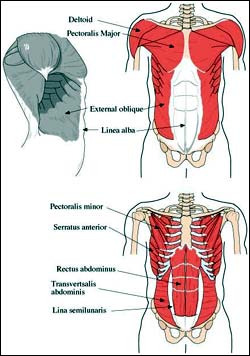
Functions of the core
The core is used to stabilize the thorax and the pelvis during dynamic movement and it also provides internal pressure to expel substances (vomit, feces, carbon-laden air, etc.).
- Valsalva maneuver
Core muscles are very important in the Valsalva maneuver, which is when a person's thorax tightens while holding their breath. This normally involuntary action can be induced by linking one's hands in front of the chest while standing, and then pulling against the hands without letting go. The Valsalva maneuver assists in lifting, excretion, pushing, and birthing.
- Continence
Continence is the ability to withhold bowel movements, and urinary stress incontinence (the lack of bladder control due to pelvic floor dysfunction can result in weak core musculature.
- Pregnancy
Women use their core muscles, specifically the transversus abdominis, during labor and delivery.
Anatomical posture and support
The core is traditionally assumed to originate most full-body functional movement, including most sports. In addition, the core determines to a large part a person's posture. In all, the human anatomy is built to take force upon the bones and direct autonomic force, through various joints, in the desired direction. The core muscles align the spine, ribs, and pelvis of a person to resist a specific force, whether static or dynamic.
Static core function
Static core functionality is the ability of one's core to align the skeleton to resist a force that does not change.
Example of static core function

An example of static core function is firing a rifle in the prone position. To maintain accuracy, the shooter must be able to transfer their own body weight and the weight of the rifle into the earth. Any attempt of the shooter to create a dynamic motion of the sights (muscle the sights onto the target vs. allowing it the posture to aim) will result in a jerky posture where the sights do not sit still on the target. For the shooter to maintain accuracy, the muscles cannot exert force on the rifle, and the skeleton must be aligned to set the rifle (and therefore the sights) onto the target. The core, while resting on the ground and relatively far away from the rifle, is nevertheless aligning the spine and pelvis to which the shoulder and arms and neck are connected. For these peripheral elements to remain static, and not move unnecessarily, the spine, pelvis, and rib cage must be aligned towards this end. Thus the core muscles provide support of the axial skeleton (skull, spine, and tailbone) in an alignment where the upper body can provide a steady, solid base for the rifle to remain motionless.
- Resistance: Gravity
- Plane of movement: Coronal (side to side), Sagittal (forward and behind the anatomical position).

The nature of dynamic movement must take into account our skeletal structure (as a lever) in addition to the force of external resistance, and consequently incorporates a vastly difference complex of muscles and joints versus a static position.
Because of this functional design, during dynamic movement there is more dependence on core musculature than just skeletal rigidity as in a static situation. This is because the purpose of movement is not to resist a static, unchanging resistance, but to resist a force that changes its plane of motion. By incorporating movement, the bones of the body must absorb the resistance in a fluid manner, and thus tendons, ligaments, muscles, and innervation take on different responsibilities. These responsibilities include postural reactions to changes in speed (quickness of a contraction), motion (reaction time of a contraction) and power (amount of resistance resisted in a period of time).
Example of dynamic core function
An example of this is walking on a slope. The body must resist gravity while moving in a direction, and balancing itself on uneven ground. This forces the body to align the bones in a way that balances the body while at the same time achieving momentum through pushing against the ground in the opposite direction of the desired movement. Initially, it may seem that the legs are the prime movers of this action, but without balance, the legs will only cause the person to fall over. Therefore, the prime mover of walking is achieving core stability, and then the legs move this stable core by using the leg muscles.
In the case of a slippery slope, a person may have to react and catch themselves to maintain balance. This is a function of how quickly a person's muscles can react to the situation, a measure of their quickness and speed (how fast they react and how quickly they can recruit the necessary muscles). A person who can react quickly but not recruit their muscles quick enough will know they are falling, but not be able to do anything about it. A person who cannot react quickly enough (or appropriately) but can recruit their muscles with quickness, will be jerky and over-react easily. Finally, assuming the subject has reacted in time and with speed, they must have the power to accept their body's weight, since slipping reduced the load on their muscles, however brief. This ability of the muscles to have power, will make sure that the immediate load can be taken by the muscles and they will be able to restore balance and, hopefully, achieve their goal.
 Core muscle activity during exercise on a mini stability ba.pdf