관절연골(articular cartilage) 표면접선층(superficial tangential zone)의 기능에 대한 논문
 New insights into the role of the superficial tangential zo.pdf
New insights into the role of the superficial tangential zone in influencing the microstructural response of articular cartilage to compression
- , ,
- N.D. Broom

Summary
Objective
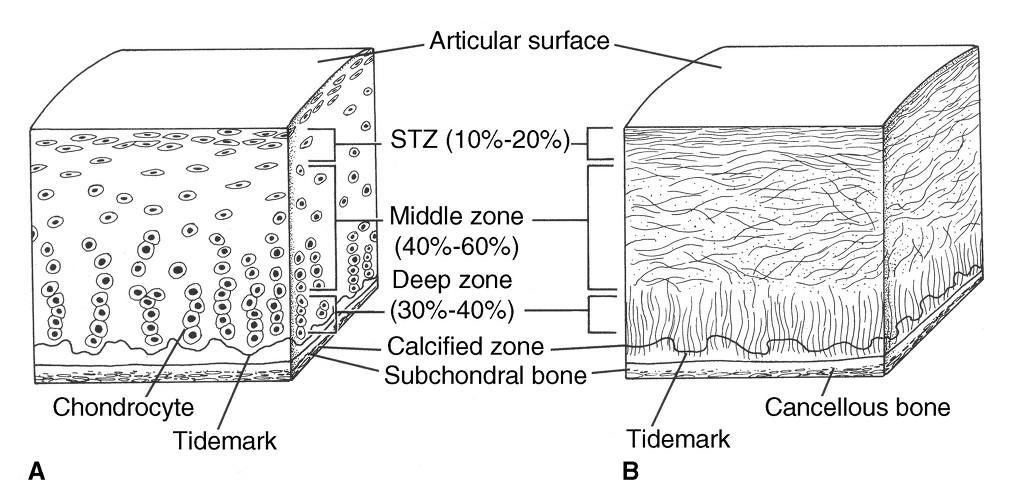
The purpose of this study was to characterize the microstructural response of healthy cartilage in a perturbed physical environment to compressive loading with a novel channel indentation device. Manipulation of the cartilage physical environment was achieved through (1) removal of the superficial tangential zone (STZ) and (2) varying the saline bathing solution concentration.
Design
Cartilage-on-bone blocks were subjected to creep loading under a nominal stress of 4.5 MPa via an indenter consisting of two rectangular platens separated by a narrow channel relief space to create a specific region where cartilage would not be directly loaded. Each sample was fixed in its near-equilibrium deformed state, after which the cartilage microstructure was examined using differential interference contrast (DIC) optical microscopy and scanning electron microscopy (SEM). The cartilage bulge in the channel relief space was studied in detail.
Results
STZ removal altered the indentation response at the macro- and microstructural levels. Specifically, the strain in the directly compressed regions was reduced (P=0.012) and the bulge height in the channel relief space was greater (P<0.0001) in the STZ-removed compared with the surface-intact samples. The bulge height in the STZ-removed group was always less than the preloaded cartilage thickness. There was intense shear in the non-directly-loaded regions of intact-cartilage but not in STZ-removed cartilage. Bathing solution concentration influenced only the STZ-removed group, where lower concentrations produced significantly abrupt transitions in matrix continuity between the directly compressed and adjacent non-directly-loaded cartilage (P=0.012).
Conclusions
This study showed that while the surface layer was important in distributing loads away from directly-loaded regions, so were other factors such as the matrix fibrillar interconnectivity, swelling potential, and tissue anisotropy.