Stretch-activated or stretch-gated ion channels are ion channels - 근육을 압박하거나 스트레칭하면 ???
작성자문형철작성시간13.10.13조회수1,503 목록 댓글 3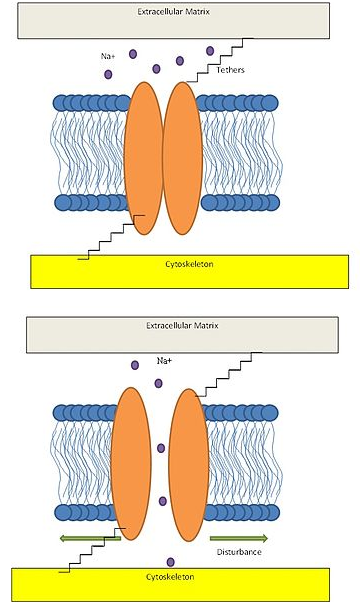
 mechanotransduction in repair and regeneration.pdf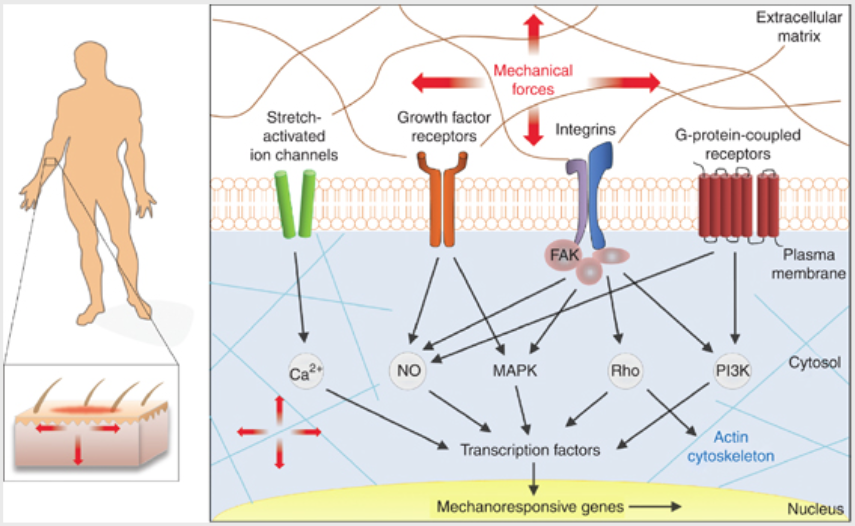
Stretch-activated ion channels are of use in the initial formation of an action potential from a mechanical stimulus, for example by the mechanoreceptors in an animal's vibrissae (whiskers).
Afferent nerve fibers responsible for sensory stimulus detection and feedback are especially sensitive to stimulation. This results from the specialized mechanoreceptor cells that are superimposed upon the afferent nerve fibers. Stretch-activated ion channels are located on these mechanoreceptor cells and serve to lower the action potential threshold, thus making the afferent nerves more sensitive to stimulation. Afferent nerve endings without mechanoreceptor cells are called free nerve endings. They are less sensitive than the encapsulated afferent fibers and generally function in the perception of pain.[1]
Stretch-activated ion channels are responsible for many bodily functions in mammals. In the skin they are responsible for sensing vibration, pressure sensation, stretch, touch, and light touch.[4][5] They are expressed in sensory modalities including taste, hearing, smell, heat sensation, volume control, and vision.[2][3][6] They can also regulate internal functions of our body including, but not limited to, osmotic pressure in cells, blood pressure in veins and arteries, micturition, and heart contractility.[2][6]
In addition to these functionalities, stretch-activated ion channels have also been found to be involved with balance and proprioceptive sensation.[2]
Stretch-activated ion channels are one of the three main types of ionotropic receptors, or channel-linked receptors. These channels open when mechanical forces of stretch or pressure is applied to the channels, causing them to undergo a conformational change. This change allows ions to pass through.[13] The channels may also be pulled open due to tension on the membrane itself.[13] Opening the channels allows ions to which they are permeable to flow down their electrochemical gradients into or out of the cell, causing a change in membrane potential.
All types of stretch-activated ion channels respond to mechanical stimuli with a similar mechanism. A stimulus resulting from a deformation of the capsule on the afferent neuron causes a stretch in the membrane. This mechanical deformation causes stretch-sensitive channels to have an increased probability of opening. A depolarization of the afferent nerve fiber occurs as the stretch-activated cation channel opens. An action potential fires if the cell is depolarized above threshold and it propagates to the CNS.[1] The sensory stimuli that excite stretch-activated channels are regulated by Ab and Aa nerve fibers.
These fibers have low thresholds and originate from mechanosensory neurons in the dorsal root ganglion.[4] ). Channels that have traditionally been known as just “voltage-“ or “ligand-gated” have also been found to be mechanically sensitive as well. Channels exhibit mechanical sensitivity as a general property. However, mechanical stress affects various types of channels in different ways. Voltage and ligand gated channels can be modified slightly by mechanical stimulation, which might change their responsiveness or permeability slightly, but they still respond primarily to voltage or ligands, respectively.[7]
조절기전
There are two different types of stretch-activated channels between which it is important to distinguish: mechanically-gated channels, which are directly influenced by mechanical deformations of the membrane, and mechanically-sensitive channels, which are opened by second messengers released from the true mechanically-gated channel.[4]
Two different mechanisms have been found to open stretch-activated ion channels: Mechanical deformations in the cell membrane can increase the probability of the channels opening. Proteins of the extracellular matrix and cytoskeleton are tethered to extra - and intra-cytoplasmic domains, respectively, of the stretch-activated ion channels.
Tension on these mechanosensory proteins causes these proteins to act as a signaling intermediate, resulting in the opening of the ion channel.[4] All known stretch-activated ion channels in prokaryotic cells have been found to be opened by direct deformation of the lipid bilayer membrane.[2] Channels that have been shown to exclusively use this mechanism of gating are the TREK-1 and TRAAK channels. In studies using mammalian hair cells, the mechanism that pulls on proteins tethered from the intra- and extra-cytoplasmic domain of the channel to the cytoskeleton and extracellular matrix, respectively, is the most likely model for ion channel opening.[2]
댓글
댓글 리스트-
작성자박건용 작성시간 13.10.26 -허혈성압박,롤핑,근막이완,치료적마사지,진동건,충격파 등으로 자극을 주면 통증이 줄어드는 이유: 근육은 진동, 압박, 스트레치, 촉각, 열 등의 물리적 자극에 의해 이온채널이 열리면서 근육긴장이 해소된다. 모두 근방추의 스트레치 반사기전에 의함.
-인장활성이온채널은 mechanotransducers임. 세포막에서 스트레스압박에 반응하여 이온이 흐르는 것을 말함
?? 인장활성이온채널은 neuron의 세포막에 있는 이온통로입니다. sounds, tastes, smell, vision보다 운동치료관점에서 vibration, pressure, stretch, touch 등의 기계적자극이 중요한데 이 자극을 받는 neuron은 근방추체, GTO, 인대,관절의 mechanoreceptor로 생각하면 될까요? -
작성자이영호 작성시간 13.11.04 1. 근육통이 발생했을때 물리적 자극( 허혈성 압박, 롤핑, 근막이완, 치료적 마사지, 진동건, 충격파 등) 을 주면 통증이 줄어드는 이유 : 근육은 진동, 압박, 촉각, 열 등의 물리적 자극에 의해 이온채널이 열리면서 근육긴장이 해소. 근방추의 스트레치 반사기전에 의함.
2. mechanotransducers - 세포막에서 스트레스압박에 반응하여 이온이 흐르는 것임.
3. 쭉 읽다 보니 깊고 어려워서 여기까지만 이해하고 넘어갑니다. -
작성자박수홍 작성시간 14.07.27 물리적 자극에 의해 이온채널이 열리면서 근육긴장이 해소 읽기