근육은 배열에 따라 다양하게 이름짓는다.
근육의 배열에 따라 기능이 달라진다. 예를들어 force production이 달라진다. angle of pennation의 개념은 그것을 설명하고 있다. 근육배열에 따른 근육의 서로다른 기능을 이해하기 위해서 개념을 명확해 해두어야 한다.
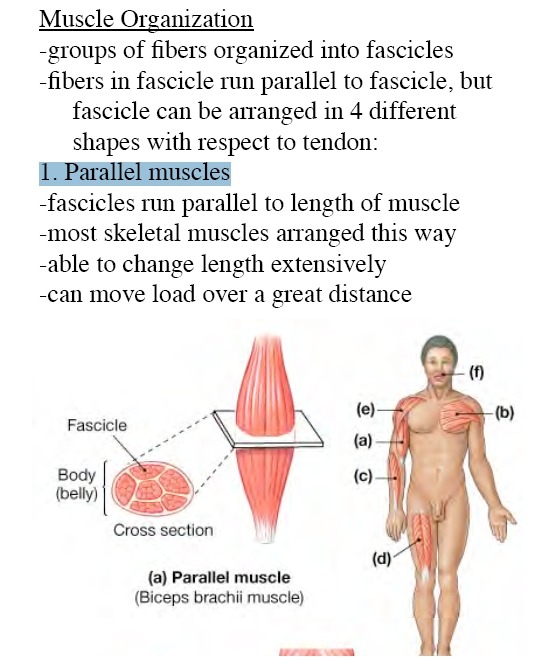
1. Parallel muscles
- 예를들어 biceps brachii muscle는 액틴과 미오신 구조가 평행하게 병렬연결, fascle을 둘러싸고 있는 endomysium과 평행하게 병렬, 건과는 직렬연결하고 있다.
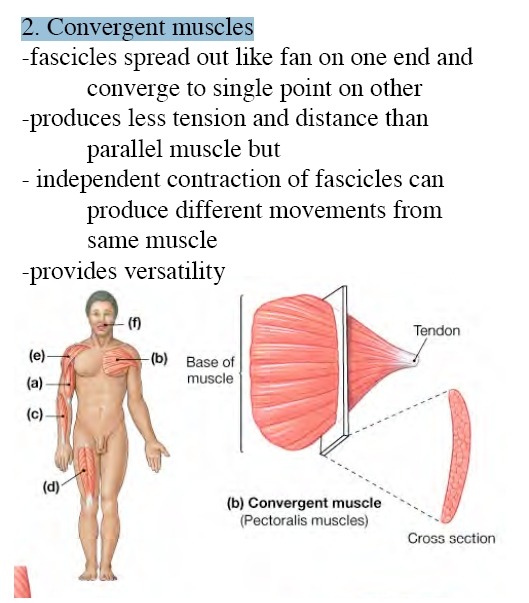
2. Convergent muscles(수렴근)
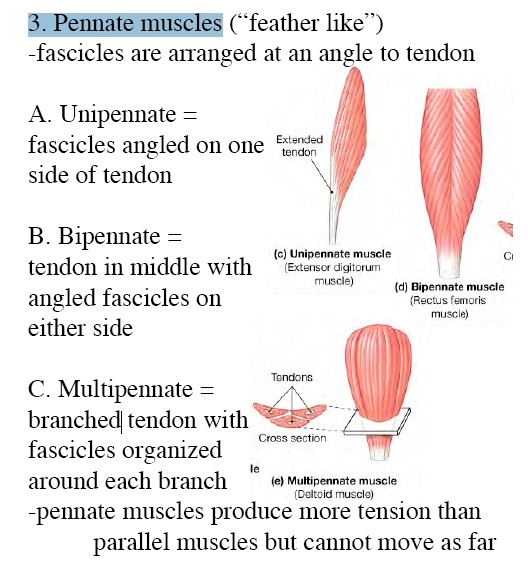
3. Pennate muscles(익상근)
1) unipennate - fascicle angled on one side of tendon
2) bipennate - tendon in middle with angled fascicles on either side
3) multipennate - branched tendon with fascicles organized around each brance
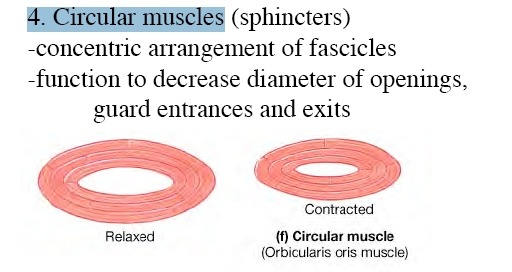
4. Circular muscles
Muscle Terminology
Origin = where the fixed end of the muscle attaches to bone, cartilage, or CT
Insertion = where the moveable end attaches Action = the specific movement produced by the muscle during contraction
Muscles often work in groups to increase tension or fine tune movement.
Different muscles serve different functions:
1. 주동근 Agonist = prime mover, muscle most responsible for the specific action
2. 협력근 Synergist = a muscle with the same action as the agonist, assists agonist at the beginning of contraction when fiber
length is not optimal for agonist
3. 길항근 Antagonist = a muscle whose action opposes the agonist: produces the opposite action to fine tune movement by the
agonist
Names of muscle derived from aspects of their features:
1. 근육 위치 Location: named for part of body where located e.g. Brachii, Abdominis
2. 근속의 배열 Fascicle organization: named for how fascicles are organized with respect to body
e.g. Rectus = straight, Oblique = angle
3. 상대적인 위치 Relative position: named for depth when layered
e.g. Externus/ Superficialis =top, surface Internus/ Profundus =deep
4. 구조, 크기, 형태 Structure, Size and Shape:
A. 건의 숫자 Number of tendons. e.g. triceps, biceps
B. 근육의 형태 Shape of muscle. e.g. trapezius = trapezoid, deltoid = triangle, soleus = fish
C. 다른 근육과 대비된 크기 Size of muscle relative to others
Major = bigger
Maximus = biggest
Longus = long
Vastus = great
5. 근육의 기시~ 종지 Origin and Insertion: name for regions of attachment, origin first, insertion second
e.g. Sternocleidomastoid. origin = manubrium of sternum and medial clavicle, insertion = mastoid process
6. 근육의 기능 Action: named for action performed and region acted upon. e.g. Extensor digitorum
Usually multiple naming schemes are combined to name the muscle: e.g. flexor carpi ulnaris
댓글
댓글 리스트-
작성자문형철 작성자 본인 여부 작성자 작성시간 14.12.14 Names of muscle derived from aspects of their features:
1. 근육 위치 Location: named for part of body where located e.g. Brachii, Abdominis
2. 근속의 배열 Fascicle organization: named for how fascicles are organized with respect to body
e.g. Rectus = straight, Oblique = angle
3. 상대적인 위치 Relative position: named for depth when layered
e.g. Externus/ Superficialis =top, surface Internus/ Profundus =deep -
작성자문형철 작성자 본인 여부 작성자 작성시간 14.12.14 4. 구조, 크기, 형태 Structure, Size and Shape:
A. 건의 숫자 Number of tendons. e.g. triceps, biceps
B. 근육의 형태 Shape of muscle. e.g. trapezius = trapezoid, deltoid = triangle, soleus = fish
C. 다른 근육과 대비된 크기 Size of muscle relative to others
Major = bigger
Maximus = biggest
Longus = long
Vastus = great
5. 근육의 기시~ 종지 Origin and Insertion: name for regions of attachment, origin first, insertion second
e.g. Sternocleidomastoid. origin = manubrium of sternum and medial clavicle, insertion = mastoid process
6. 근육의 기능 Action: named for action performed and region acted upon.