인지과학, 마음의 과학에 관심있는 누군가를 찾아야겠다. 그 분야에 전문가, 관심있는 분이 이 논문좀 읽어주면 좋겠다.
(이 글을 클릭하신 분 중에 이 분야에 관심있는 분께 번역하고 설명좀 해주라고 하시면 좋겠네요)
그리고 이 문제에 대해서 배워야 겠다.
 Mind in life. Evan Thompson 마음의 생리학 현상학 .pdf
- 92페이지 짜리 논문
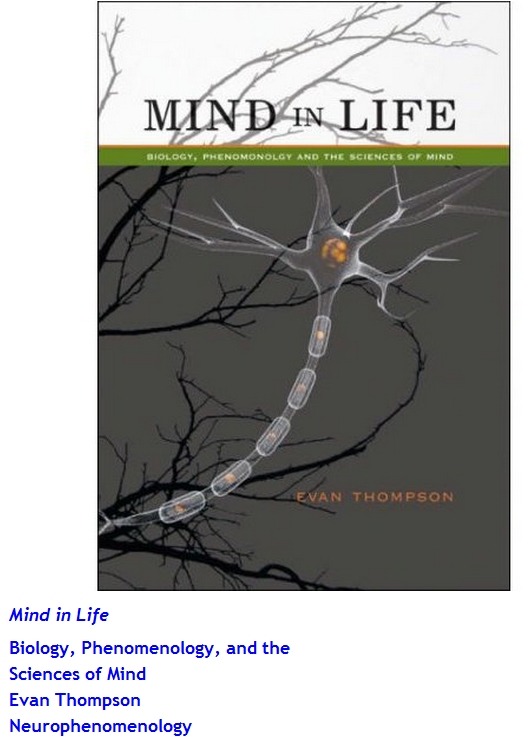
Mind in Life
Biology, Phenomenology, and the
Sciences of Mind
Evan Thompson
Neurophenomenology
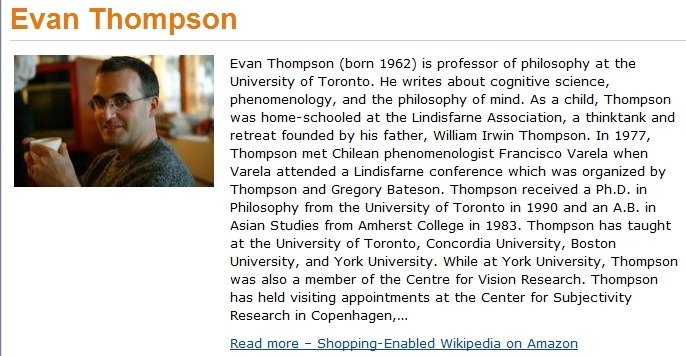
참고) Evan Thompson (born 1962) is professor of philosophy at the University of Toronto. He writes about cognitive science, phenomenology, and the philosophy of mind. As a child, Thompson was home-schooled at the Lindisfarne Association, a thinktank and retreat founded by his father, William Irwin Thompson. In 1977, Thompson met Chilean phenomenologist Francisco Varela when Varela attended a Lindisfarne conference which was organized by Thompson and Gregory Bateson. Thompson received a Ph.D. in Philosophy from the University of Toronto in 1990 and an A.B. in Asian Studies from Amherst College in 1983.
Thompson has taught at the University of Toronto, Concordia University, Boston University, and York University. While at York University, Thompson was also a member of the Centre for Vision Research. Thompson has held visiting appointments at the Center for Subjectivity Research in Copenhagen, and at the University of Colorado, Boulder. Thompson worked with Francisco Varela at CREA (Centre de Recherche en Epistemologie Applique) at the Ecole Polytechnique in Paris. During this time, Varela and Thompson wrote The Embodied Mind: Cognitive Science and Human Experience.[1] Thompson's latest book, Mind in Life: Biology, Phenomenology, and the Sciences of Mind, explores how life relates to mind.[2]
How is life related to the mind? The question has long confounded philosophers and scientists, and it is this so-called explanatory gap between biological life and consciousness that Evan Thompson explores in Mind in Life.
Thompson draws upon sources as diverse as molecular biology, evolutionary theory, artificial life, complex systems theory, neuroscience, psychology, Continental Phenomenology, and analytic philosophy to argue that mind and life are more continuous than has previously been accepted, and that current explanations do not adequately address the myriad facets of the biology and phenomenology of mind.
- 사람의 마음이 어떻게 우리의 삶에 연관되어 있는지는 오랫동안 철학자들과 과학자들을 혼란스럽게 하였다. Biological life 와 의식 사이의 실험적 사이(explanatory gap)라 불렸고, Evan Thompson이 MInd in Life에서 연구하였다. Thompson은 이것을 molecular biology, evolutionary theory, artificial life, complex systems theory, neuro science, psychology, Continental Phenomenology, and analytic philosophy 를 연관지어 다음과 같이 말했다. Mind and life가 더욱 전에 받아들여 진 것보다 지속적이고, 최신의 설명은 적절히 설명되지 않는데, 마음의 현상학과 생물학의 많은 방면들이...
Where there is life, Thompson argues, there is mind: life and mind share common principles of self-organization, and the self-organizing features of mind are an enriched version of the self-organizing features of life. Rather than trying to close the explanatory gap, Thompson marshals philosophical and scientific analyses to bring unprecedented insight to the nature of life and consciousness. This synthesis of phenomenology and biology helps make Mind in Life a vital and long-awaited addition to his landmark volume The Embodied Mind:Cognitive Science and Human Experience (coauthored with Eleanor Rosch and Francisco Varela). Endlessly interesting and accessible, Mind in Life is a groundbreaking addition to the fields of the theory of the mind, life science, and phenomenology.
-Thompson 은 우리의 삶이 마음에 있다고 주장한다 : 삶과 마음은 Self-organization, and the self-organizing features of mind 하는 공통점을 가지고 있다...
Dr. Thompson is currently writing a new book entitled Buddha and the Brain: Contemplative Neuroscience and the Nature of Consciousness,which explores how Asian contemplative traditions and Western mind-brain science can collaborate beyond the science/religion divide in order to create new ways of scientifically investigating human consciousness and of fostering contemplative wisdom and cognitive spirituality.
Editorial Reviews
Review
The overarching topic of Thompson’s book is nothing less than the nature of life and mind, where life and mind are conceived not as they often are–that is, as fundamentally separate subjects in need of largely nonintersecting theoretical frameworks–but rather as tightly intertwined phenomena in need of a common explanatory language. The long-anticipated follow-up to The Embodied Mind, this book is even better–clear, lively, original, and compelling. Mind in Life is a work for which a great number of thinkers in philosophy of mind and the cognitive sciences have been eagerly waiting.
-
–Michael Wheeler, author of Reconstructing the Cognitive World: The Next Step
Evan Thompson has emerged as a major presence in the science of the mind. His new book is quite wonderful to read, and I found it impossible to put down. In particular, his discussion of Husserl’s phenomenology is a revelation, as are his reasons for reversing his former criticisms of Husserl. His discussion of one of the central issues driving modern cognitive neuroscience, the binding problem, is particularly valuable and should compel a major reexamination of experiments being carried out in this field. Evan Thompson is doing important work in re-framing the very questions that define cognitive science.
–Merlin Donald, Case Western Reserve University
There is no deeper prison of the modern mind than the Cartesian legacy that splits mind from life, and no more arduous climb to escape. Thompson provides a topo map–rich, multifaceted, superbly documented–by detailing the work of the many (but relatively few among contemporary scientists and philosophers) who recognize the impasse and strive to transcend it.
–Walter J. Freeman, author of How Brains Make Up Their Minds
Neurophenomenology is the majestic method we naturalists have been seeking to blend experience, behavior, and the brain. This long-awaited book will open up the discussion of what experience is and where it is, and how we explain the connection between the objective world of physical activity and that of pain, love, and imagining. Thompson enacts the method he espouses, neurophenomenology, in each chapter with in-depth examples that mind scientists will find compelling. A tour de force!
–Owen Flanagan
Is Mind continuous with Life? Can better phenomenology improve our scientific understanding of consciousness and cognition? In this elegant and thought-provoking treatment, Evan Thompson explores a vision of mind and life that traces a path from simple cellular organizations all the way to consciousness, intersubjectivity, and culture. A wonderful and important journey, and a compulsory trip for all those interested in the explanation of mind and experience.
–Andy Clark, author of Being There: Putting Brain, Body and World Together Again
Though modesty prevents him from claiming an original theory or dramatic new synthesis, in Mind in Life, one of the world’s top philosophers offers a brilliant and inspired treatise into the so-called “explanatory gap” between life and mind, nature and consciousness. Thompson stands apart in his ability to link objective descriptions of life and mind with our subjective experience of them. Here he weaves the phenomenological analysis of experience and the latest developments in the fields of cognitive science, neuroscience and biology into a rich coordinated whole in which life and mind are seen to be intrinsically and essentially dynamic and self-organizing. Curious people who want to appreciate this hard won insight and better understand the deep continuity of life and mind will want to read this unique and illuminating book.
–J.A. Scott Kelso, author of Dynamic Patterns: the Self-Organization of Brain and Behavior and (with David A. Engstrom) co-author of The Complementary Nature.
Book Description
How is life related to the mind? The question has long confounded philosophers and scientists, and it is this so-called explanatory gap between biological life and consciousness that Evan Thompson explores in Mind in Life.
Thompson draws upon sources as diverse as molecular biology, evolutionary theory, artificial life, complex systems theory, neuroscience, psychology, Continental Phenomenology, and analytic philosophy to argue that mind and life are more continuous than has previously been accepted, and that current explanations do not adequately address the myriad facets of the biology and phenomenology of mind. Where there is life, Thompson argues, there is mind: life and mind share common principles of self-organization, and the self-organizing features of mind are an enriched version of the self-organizing features of life. Rather than trying to close the explanatory gap, Thompson marshals philosophical and scientific analyses to bring unprecedented insight to the nature of life and consciousness. This synthesis of phenomenology and biology helps make Mind in Life a vital and long-awaited addition to his landmark volume The Embodied Mind:Cognitive Science and Human Experience (coauthored with Eleanor Rosch and Francisco Varela).
Endlessly interesting and accessible, Mind in Life is a groundbreaking addition to the fields of the theory of the mind, life science, and phenomenology.