beyond reason

Graphical Review
Ketone bodies, stress response, and redox homeostasis
Author links open overlay panelPedroRojas-MoralesaJoséPedraza-ChaverriaEdiliaTapiab
Show more
https://doi.org/10.1016/j.redox.2019.101395Get rights and content
Under a Creative Commons license
open access
Abstract
The ketone body β-hydroxybutyrate is no longer viewed simply as a metabolic intermediate, as it regulates a broad range of physiological processes at cellular and systemic levels. Particularly, β-hydroxybutyrate functions as a stress response molecule and orchestrates an antioxidant defense program to maintain redox homeostasis in response to environmental and metabolic challenges, such as ischemia. This property of β-hydroxybutyrate might be key for the beneficial effect of calorie restriction on stress response and disease processes.
1. Introduction
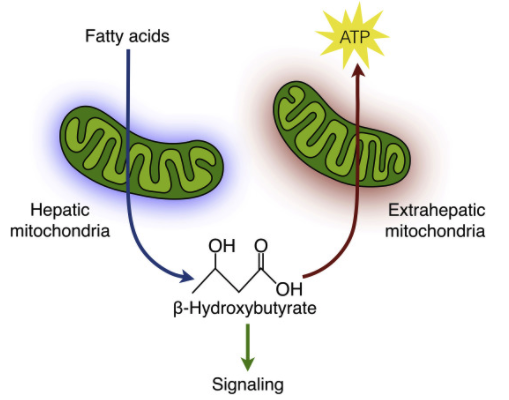
Under well-fed, resting conditions, glucose stands as the main physiological fuel supporting energy metabolism, growth, and reproduction. However, in naturally encounter environments prolonged episodes of limited food availability and also moderate physical activity dramatically alter blood glucose levels and provoke baseline physiological functions to be more dependent on fatty acids metabolism [1]. For example, prolonged fasting and endurance exercise cause blood glucose levels to drop while simultaneously lead to increases in ketone bodies at the expense of liver β-oxidation of adipose tissue-derived fatty acids. Also, hepatic ketogenesis—the synthesis of ketone bodies—is enhanced when feeding a high-fat, low-carbohydrate ketogenic diet or in animals undergoing calorie restriction. In any case, the liver takes up and transforms circulating fatty acids into ketone bodies, mainly β-hydroxybutyrate and acetoacetate, which are then exported out to essentially all of the body's tissues, including the brain, where they are primarily metabolized via mitochondria to produce adenosine triphosphate (ATP) (Fig. 1) [2]. In addition to functioning as alternative energy source during energy stress, it is now well established that β-hydroxybutyrate also moonlights as a signaling molecule [2,3] by for example activating the hydroxycarboxylic acid receptor 2 (HCAR2) [4] and inhibiting the nucleotide binding domain leucine-rich repeat-containing receptor, pyrin domain-containing-3 (NLRP3) inflammasome [5] on immune cells, thus blocking the synthesis of inflammatory intermediates. In addition, lysine modification by β-hydroxybutyrylation on histone and non-histone proteins is emerging as an important regulator of cellular physiology and metabolism [6,7]. Interestingly, β-hydroxybutyrate (and its polymerized form poly-β-hydroxybutyrate) is not solely present in eukarya, but also in bacteria and archaea [8], suggesting important roles for this widespread molecule on cellular homeostasis.
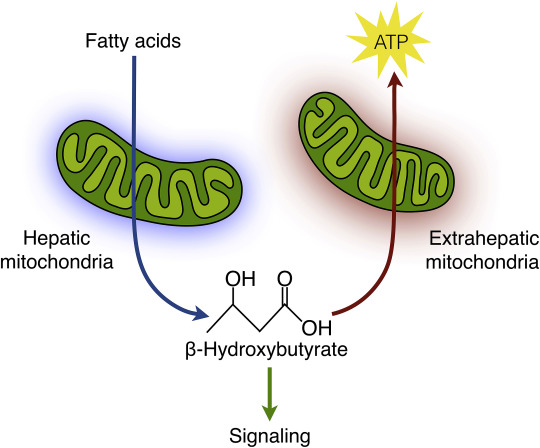
Fig. 1. The metabolic and signaling properties of β-hydroxybutyrate. The ketone body β-hydroxybutyrate allows organisms to tolerate systemic energy crisis in response nutritional challenges such as prolonged episodes of limited food availability and moderate physical activity that lead to enhanced free fatty acid oxidation and ketogenesis in hepatic mitochondria. In most extrahepatic tissues, β-hydroxybutyrate is fully oxidized to produce adenosine triphosphate (ATP). β-Hydroxybutyrate also can function as a signaling molecule.
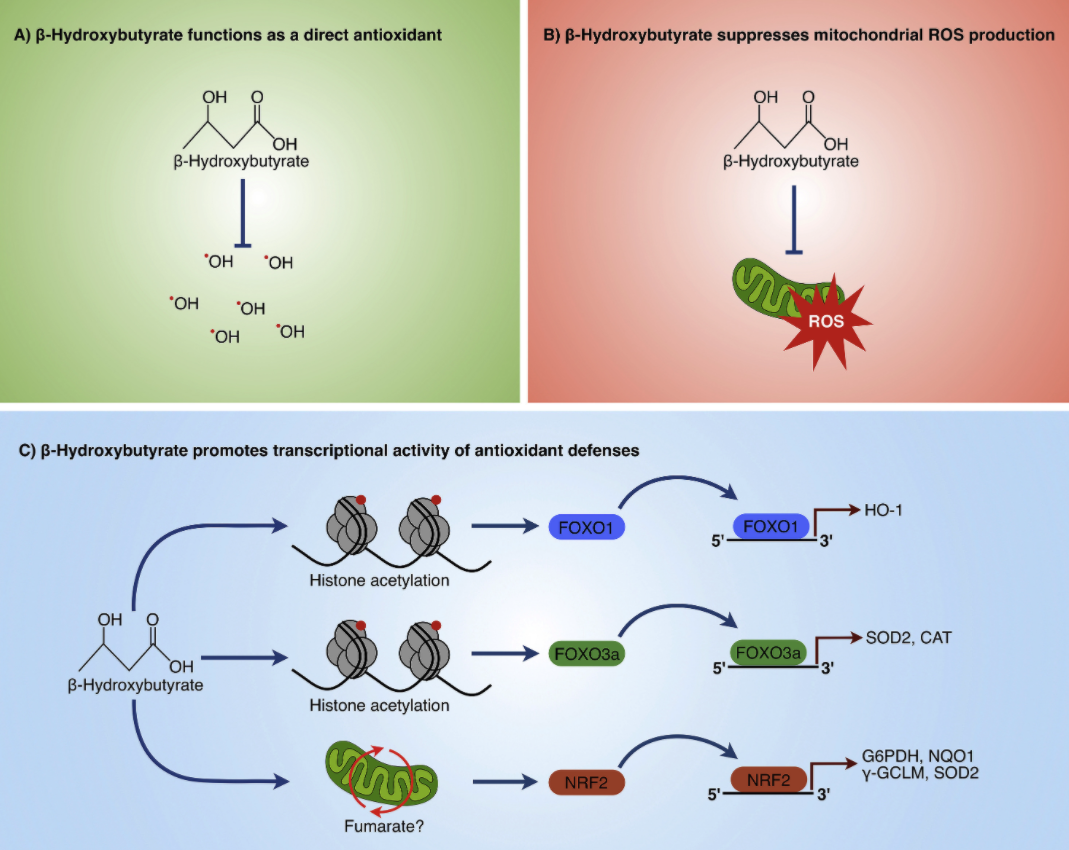
One important aspect of β-hydroxybutyrate that is increasingly been appreciated is its impact on reactive oxygen species (ROS) metabolism. In vitro studies have shown that, in the first place, β-hydroxybutyrate functions as a direct antioxidant for hydroxyl radical (•OH) (Fig. 2A) [9], and inhibits mitochondrial ROS production in stressed neurons by facilitating NADH oxidation (Fig. 2B) [10]. NADH oxidation, and hence the increase of the NAD+/NADH ratio, has important implications in the maintenance of cellular redox homeostasis, for example, through the activation of the protein deacetylases sirtuin 1 (SIRT1) and SIRT3. Convincing evidence has demonstrated that SIRT1 regulates redox status when deacetylates and activates the transcription factor forkhead box O3 (FOXO3), which controls the expression of superoxide dismutase 2 (SOD2) and catalase (CAT). SIRT3, on the other hand, reinforces mitochondrial antioxidant defense by deacetylating and increasing the activity of SOD2. Finally, SIRT3 also activates isocitrate dehydrogenase 2 (IDH2) to increase NADPH, which is used by several antioxidant systems to detoxify ROS [11]. β-Hydroxybutyrate also protects against highly oxidative stress conditions by driving the expression of heme oxygenase 1 (HO-1), SOD2, CAT, nicotinamide adenine dinucleotide phosphate (NADPH) quinone oxidoreductase 1 (NQO1), glucose-6-phosphate dehydrogenase (G6PDH), and glutamate-cysteine ligase (GCL), through the regulation of FOXO1, FOXO3, and nuclear factor-erythroid 2-related factor-2 (NRF2) (Fig. 2) [[12], [13], [14]]. β-Hydroxybutyrate transcriptionally activates FOXO1 and FOXO3 by promoting histone acetylation due to inhibition of class I histone deacetylases (HDACs). NRF2, on the other hand, seems to be activated by increased amounts of the tricarboxylic acid cycle metabolite fumarate resulting after mitochondrial consumption of β-hydroxybutyrate. However, as an enhanced mitochondrial activity is associated with increased ROS production [11], it cannot be excluded the possibility that the β-hydroxybutyrate-mediated NRF2 activation likely involves mild increases in ROS generation from the mitochondrial electron transport chain. Overall, the effect of β-hydroxybutyrate on redox homeostasis fits well with the ability of calorie restriction to reduce also oxidative stress and damage [15].
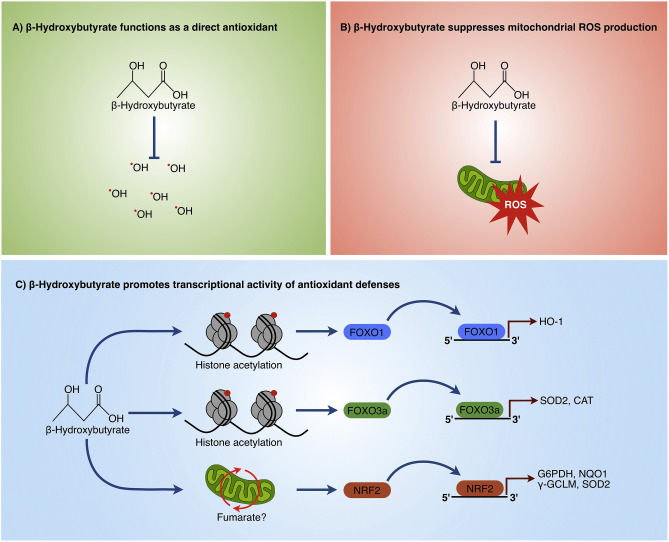
Fig. 2. The ketone body β-hydroxybutyrate protects against oxidative stress through direct and indirect mechanisms. β-Hydroxybutyrate is (A) an antioxidant for hydroxyl radicals (•OH) and (B) suppresses mitochondrial reactive oxygen species (ROS). (C) β-Hydroxybutyrate activates an antioxidant program through forkhead box O1 (FOXO1), FOXO3, and nuclear factor-erythroid 2-related factor-2 (NRF2) transcription factors. HO-1: heme oxygenase 1, SOD2: superoxide dismutase 2, CAT: catalase, G6PDH: glucose-6-phosphate dehydrogenase, NQO1: nicotinamide adenine dinucleotide phosphate quinone oxidoreductase 1, γ-GCL: γ-glutamate-cysteine ligase.
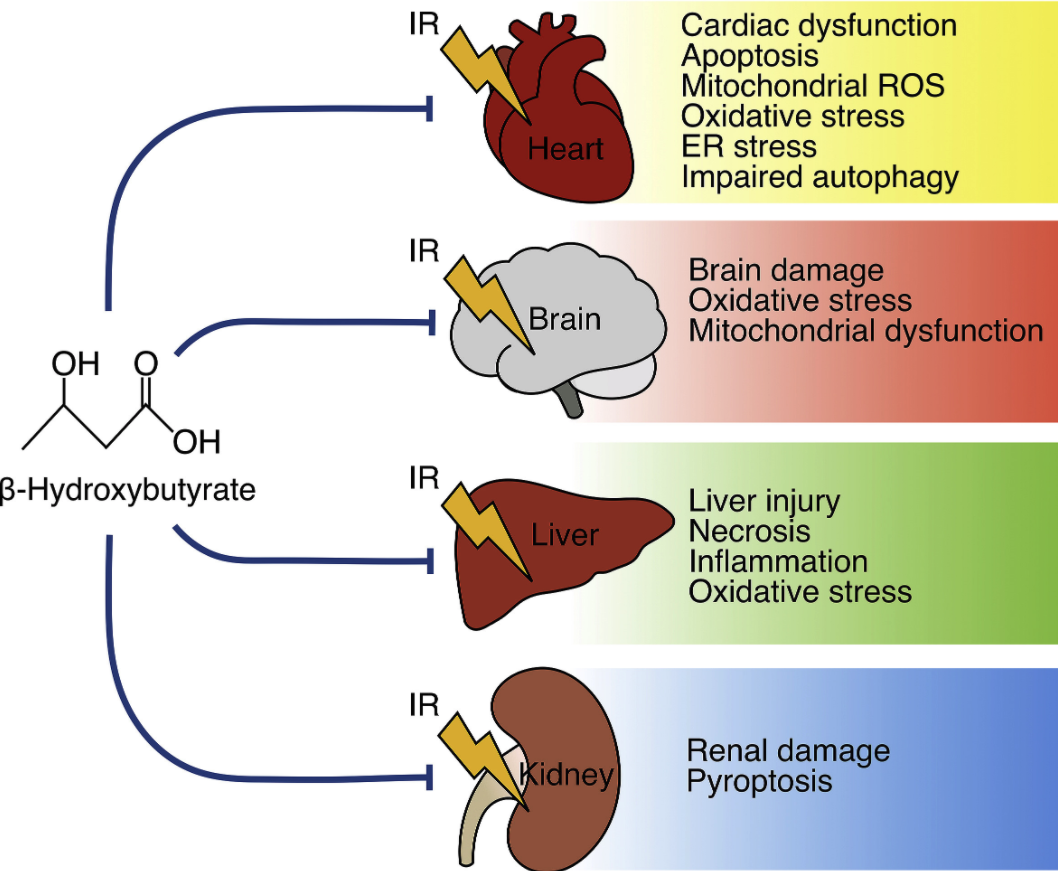
In vivo experiments have further illustrated that β-hydroxybutyrate is an anti-ischemic molecule. Ischemia follow by reperfusion supposes a tremendous metabolic challenge to cells and tissues leading to severe organ damage and death, owing in large part to oxidative burst [16]. Administration of β-hydroxybutyrate before or after ischemia and reperfusion results in strong protection of the heart, brain, liver, and the kidney of rodents [ [13,[17], [18], [19]]]. Mechanisms like reduction of oxidative stress, but also mitochondrial protection, suppression of endoplasmic reticulum stress, and enhanced autophagy, as well as the inhibition of cell death processes like necrosis, apoptosis, and pyroptosis, account for such protective effect of β-hydroxybutyrate (Fig. 3). In this case β-hydroxybutyrate also replicates the multi-systemic protective effect of calorie restriction against ischemia and reperfusion-associated injury [20].
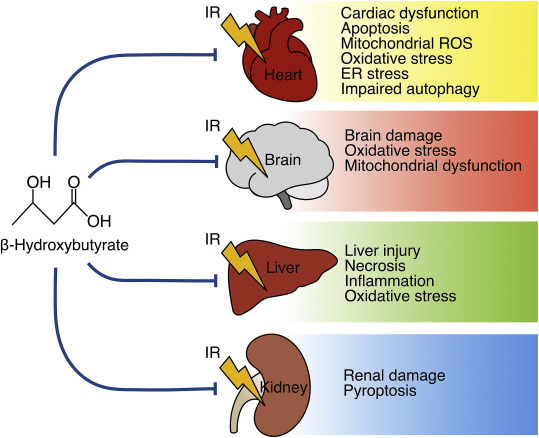
Fig. 3. The ketone body β-hydroxybutyrate is an anti-ischemic molecule. β-Hydroxybutyrate maintains organ integrity in response to ischemia and reperfusion by suppressing oxidative stress, mitochondrial dysfunction, and inflammation. Also, β-hydroxybutyrate inhibits apoptosis, necrosis, and pyroptosis induced by ischemia and reperfusion. ROS: reactive oxygen species, ER: endoplasmic reticulum.
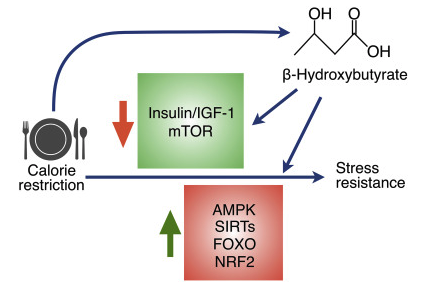
The exact mechanism linking calorie restriction to enhanced stress resistance, and particularly of reducing oxidative stress, is still missing. It has been hypothesized that β-hydroxybutyrate mediates the beneficial effects of calorie restriction [3,21]. This idea seems plausible because in addition to its anti-inflammatory and anti-oxidative properties, β-hydroxybutyrate also leads to lifespan extension [[17], [18], [19]]. In fact, besides to FOXO1/3, and NRF2, β-hydroxybutyrate actually seems to interact with signaling pathways activated by reduced nutrient intake, like the adenosine monophosphate (AMP)-activated protein kinase (AMPK) [22,23], and SIRT1/3 [22,24], and interferes with both insulin [25] and mammalian target of rapamycin (mTOR) signaling [26]. Thus, β-hydroxybutyrate helps organisms to overcome stressful/pathological situations by triggering a molecular program for stress resistance similar to calorie restriction [27] (Fig. 4).
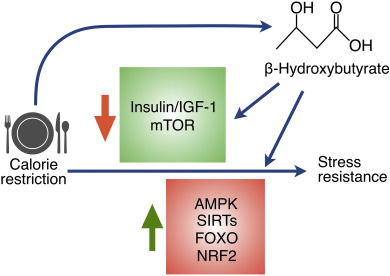
Fig. 4. The ketone body β-hydroxybutyrate links calorie restriction and stress resistance. β-Hydroxybutyrate, which is produced during calorie restriction, activates adenosine monophosphate-activated protein kinase (AMPK), sirtuins (SIRTs), forkhead box O (FOXO), and nuclear factor-erythroid 2-related factor-2 (NRF2) stress response signaling pathways while inhibiting insulin and mammalian target of rapamycin (mTOR) signaling. IGF-1: insulin growth factor like-1.
Currently, calorie restriction remains the most powerful tool to increase lifespan in various species [27]. More importantly, calorie restriction reduces risk of chronic diseases in both experimental animals and humans [28]. However, implementing a lifelong calorie restriction regimen in the general population is a bit of a challenge. In light of the contribution of oxidative damage in diverse pathologies [29], increasing physiological amounts of β-hydroxybutyrate might prove useful to promote cellular adaptation to stress and possibly overall human health.
Declaration of competing interest
“The authors declare that they have no known competing financial interests or personal relationships that could have appeared to influence the work reported in this paper.”
Acknowledgements
PRM is a doctoral student from Programa de Doctorado en Ciencias Bioquímicas, Universidad Nacional Autónoma de México (UNAM) and receives a scholarship from Consejo Nacional de Ciencia y Tecnología (CONACyT). This study was funded by grants from CONACYT-Mexico (A1-S-7495), Programa de Apoyo a Proyectos de Investigación e Innovación Tecnológica (PAPIIT-Mexico, IN202219), Programa de Apoyo a la Investigación y Posgrado (PAIP-Mexico, 5000-9105), and Fondos del Gasto Directo autorizado a la Subdirección de Investigación Básica, Instituto Nacional de Cardiología Ignacio Chávez.
Appendix A. Supplementary data
The following is the Supplementary data to this article:Download : Download XML file (273B)
Multimedia component 1.
Research data for this article
Data not available / No data was used for the research described in the article
References[1]
G.F. CahillFuel metabolism in starvation
Annu. Rev. Nutr., 26 (2006), pp. 1-22
CrossRefView Record in ScopusGoogle Scholar
P. Puchalska, P.A. CrawfordMulti-dimensional roles of ketone bodies in fuel metabolism, signaling, and therapeutics
Cell Metabol., 25 (2017), pp. 262-284
ArticleDownload PDFView Record in ScopusGoogle Scholar
J.C. Newman, E. VerdinKetone bodies as signaling metabolites
Trends Endocrinol. Metab., 25 (2014), pp. 42-52
ArticleDownload PDFView Record in ScopusGoogle Scholar
M. Rahman, S. Muhammad, M.A. Khan, H. Chen, D.A. Ridder, H. Muller-Fielitz, B. Pokorna, T. Vollbrandt, I. Stolting, R. Nadrowitz, J.G. Okun, S. Offermanns, M. SchwaningerThe beta-hydroxybutyrate receptor HCA2 activates a neuroprotective subset of macrophages
Nat. Commun., 5 (2014), p. 3944
Y.H. Youm, K.Y. Nguyen, R.W. Grant, E.L. Goldberg, M. Bodogai, D. Kim, D. D'Agostino, N. Planavsky, C. Lupfer, T.D. Kanneganti, S. Kang, T.L. Horvath, T.M. Fahmy, P.A. Crawford, A. Biragyn, E. Alnemri, V.D. DixitThe ketone metabolite β-hydroxybutyrate blocks NLRP3 inflammasome-mediated inflammatory disease
Nat. Med., 21 (2015), pp. 263-269
CrossRefView Record in ScopusGoogle Scholar
Z. Xie, D. Zhang, D. Chung, Z. Tang, H. Huang, L. Dai, S. Qi, J. Li, G. Colak, Y. Chen, C. Xia, C. Peng, H. Ruan, M. Kirkey, D. Wang, L.M. Jensen, O.K. Kwon, S. Lee, S.D. Pletcher, M. Tan, D.B. Lombard, K.P. White, H. Zhao, J. Li, R.G. Roeder, X. Yang, Y. ZhaoMetabolic regulation of gene expression by histone lysine β-Hydroxybutyrylation
Mol. Cell, 62 (2016), pp. 194-206
ArticleDownload PDFView Record in ScopusGoogle Scholar
K. Liu, F. Li, Q. Sun, N. Lin, H. Han, K. You, F. Tian, Z. Mao, T. Li, T. Tong, M. Geng, Y. Zhao, W. Gu, W. Zhaop53 β-hydroxybutyrylation attenuates p53 activity
Cell Death Dis., 10 (2019), p. 243
CrossRefView Record in ScopusGoogle Scholar
E.N. Dedkova, L.A. BlatterRole of β-hydroxybutyrate, its polymer poly-β-hydroxybutyrate and inorganic polyphosphate in mammalian health and disease
Front. Physiol., 5 (2014), p. 260
M.L. Haces, K. Hernández-Fonseca, O.N. Medina-Campos, T. Montiel, J. Pedraza-Chaverri, L. MassieuAntioxidant capacity contributes to protection of ketone bodies against oxidative damage induced during hypoglycemic conditions
Exp. Neurol., 211 (2008), pp. 85-96
ArticleDownload PDFView Record in ScopusGoogle Scholar
M. Maalouf, P.G. Sullivan, L. Davis, D.Y. Kim, J.M. RhoKetones inhibit mitochondrial production of reactive oxygen species production following glutamate excitotoxicity by increasing NADH oxidation
Neuroscience, 145 (2007), pp. 256-264
ArticleDownload PDFView Record in ScopusGoogle Scholar
H. Luo, H.H. Chiang, M. Louw, A. Susanto, D. ChenNutrient sensing and the oxidative stress response
Trends Endocrinol. Metab., 28 (2017), pp. 449-460
ArticleDownload PDFView Record in ScopusGoogle Scholar
T. Shimazu, M.D. Hirschey, J. Newman, W. He, K. Shirakawa, N. Moan, C.A. Grueter, H. Lim, L.R. Saunder, R.D. Stevens, C.B. Newgard, R.V. Farese Jr., R. de Cabo, S. Ulrich, K. Akassoglou, E. VerdinSuppression of oxidative stress by β-hydroxybutyrate, an endogenous histone deacetylase inhibitor
Science, 339 (2013), pp. 211-214
CrossRefView Record in ScopusGoogle Scholar
T. Miyauchi, Y. Uchida, K. Kadono, H. Hirao, J. Kawasoe, T. Watanabe, S. Ueda, H. Okajima, H. Terajima, S. UemotoUp-regulation of FOXO1 and reduced inflammation by β-hydroxybutyric acid are essential diet restriction benefits against liver injury
Proc. Natl. Acad. Sci. U.S.A., 116 (2019), pp. 13533-13542
CrossRefView Record in ScopusGoogle Scholar
Y. Izuta, T. Imada, R. Hisamura, E. Oonishi, S. Nakamura, E. Inagaki, M. Ito, T. Soga, K. TsubotaKetone body 3-hydroxybutyrate mimics calorie restriction via the Nrf2 activator, fumarate, in the retina
Aging Cell, 17 (2018), Article e12699
R.S. Sohal, R. WeindruchOxidative stress, caloric restriction, and aging
Science, 273 (1996), pp. 59-63
View Record in ScopusGoogle Scholar
D.N. Granger, P.R. KvietysReperfusion injury and reactive oxygen species: the evolution of a concept
Redox Biol., 6 (2015), pp. 524-551
ArticleDownload PDFView Record in ScopusGoogle Scholar
Y. Yu, Y. Yu, Y. Zhang, Z. Zhang, W. An, X. ZhaoTreatment with D-β-hydroxybutyrate protects heart from ischemia/reperfusion injury in mice
Eur. J. Pharmacol., 829 (2018), pp. 121-128