beyond reason
 nutrients-12-00243.pdf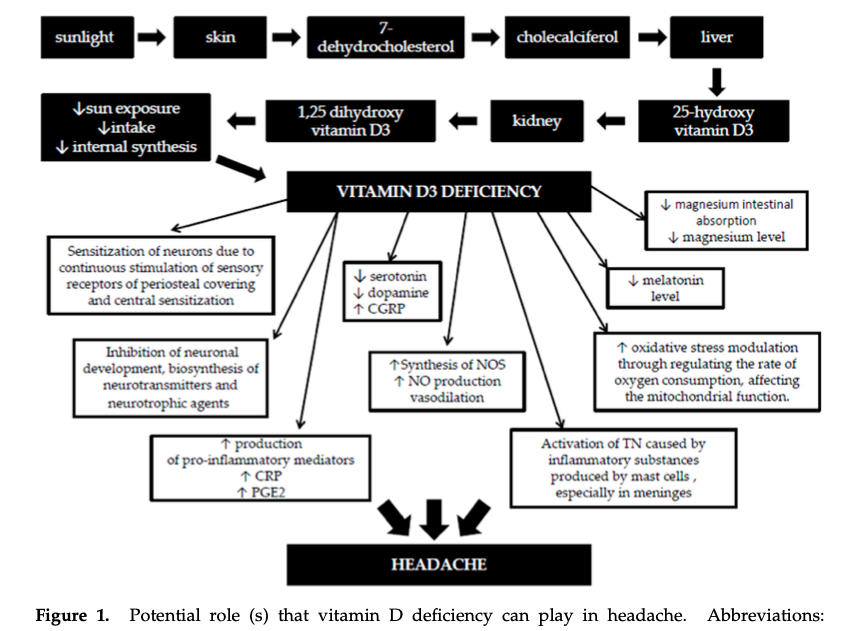
Review
The Role of Vitamin D in Primary Headache–from Potential Mechanism to Treatment
Abstract:
Some studies have suggested a link between vitamin D and headache; however, the underlying physiological mechanisms are unclear. We aimed to summarize the available evidence on the relationship between vitamin D and the various subtypes of primary headaches, including migraines and tension-type headaches. All articles concerning the association between primary headache and vitamin D published up to October 2019 were retrieved by searching clinical databases, including: EMBASE, MEDLINE, PubMed, Google scholar, and the Cochrane library. All types of studies (i.e., observational, cross-sectional, case-control, and clinical trials) were included. We identified 22 studies investigating serum vitamin D levels in association with headaches. Eight studies also evaluated the effect of vitamin D supplementation on the various headache parameters. Among them, 18 studies showed a link between serum vitamin D levels and headaches, with the strongest connection reported between serum vitamin D levels and migraine. Overall, there is not enough evidence to recommend vitamin D supplementation to all headache patients, but the current literature indicates that it may be beneficial in some patients suffering headaches, mainly migraineurs, to reduce the frequency of headaches, especially in those with vitamin D deficiency.
Keywords: cholecalciferol; headache; migraine; tension-type headache; cluster headache; pain; vitamin D; 25-hydroxy-vitamin D
1.2. The Role of Vitamin D in the Brain
As VDRs and 1-alpha-hydroxylase are present in many regions of the human brain (including the prefrontal cortex, thalamus, raphe, amygdala, cerebellum or, hippocampus), it is likely that vitamin D has specific functions in the central nervous system [15]. There is also evidence that vitamin D influence brain development: vitamin D deficient pups had larger brains, thinner neocortex and increased ventricular volume than controls in rodents [28]. Downregulation of genes controlling apoptosis is responsible for this changes in the brain, causing increased cellular proliferation [28]. Another important function of vitamin D is also regulation of the production of neurotrophic factors, (for example glial cell line-derived neurotrophic factor and nerve growth factor), thus it can act as a neuroprotective agent [16,28]. It is also a potent antioxidant, thus contributing to the vascular health of the brain [21]. Furthermore, vitamin D and its metabolites (as a steroid hormone) can influence many neurotransmitters, including dopamine, acetylcholine, and serotonin [23]. Indeed, some studies suggest vitamin D deficiency increases the risk of neurological diseases like stroke and dementia but also mood disorders [21]. Therefore, more and more data suggest they key role of vitamin D in maintaining brain health.
1.3. Vitamin D Deficiency and Pain
Several studies also indicate vitamin D deficiency can cause pain. In a meta-analysis of 81 observational studies, low vitamin D concentration was connected with arthritis, muscle pain, and chronic widespread pain [29]. However, the physiological mechanisms connecting vitamin D and pain is not fully known. The presence of VDR and vitamin D activating enzymes in the brain (especially the hypothalamus), and the influence of vitamin D on neurotransmitters, explains the connection between pain and vitamin D in fibromyalgia patients [15,23]. In addition, human and animal studies have shown insufficient vitamin D levels affect not only peripheral but also parasympathetic nerve function [23,30]. On the other hand, a Cochrane review published in 2015 showed vitamin D supplementation may not be better than placebo to control chronic pain in adults [31]. Therefore, there is some controversy surrounding the analgesic effects of vitamin D.
Kenis-Coskun et al. showed that although vitamin D replacement decrease pain and increase quality of life in patients with chronic widespread pain, it does not act via the spinal inhibitory circuit, ruling out any potential effect on the central pain sensitization mechanism [30]. In addition, other studies suggest the analgesic effect of vitamin D is more likely due to its anti-inflammatory action, rather than an anti-nociceptive effect [32]. Vitamin D appears to exert its anti-inflammatory effects by diminishing the release of pro-inflammatory cytokines and inhibiting T-cell responses [20]. For example, vitamin D shifts T-cell responses, increasing levels of T-helper (Th)-2 and regulatory T cells (Treg) instead of pro-inflammatory Th1 and Th17-cells [20,33]. In addition, in vitro studies show 25(OH)D inhibits the synthesis of prostaglandin E2 (PGE2) in fibroblasts [34]. There is also evidence that vitamin D supplementation stops musculoskeletal pain through diminished levels of inflammatory cytokines including PGE2 [35]. Thus, suppression of PGE2 is a credible explanation for the analgesic effect of vitamin D [35,36].
1.4. The Link between Vitamin D and Headache
In 2010, Prakash noticed that headache prevalence, including migraine, increase with increasing latitude [37]. Data also indicated that in autumn–winter frequency of headache attacks grow, while in summer, number of attacks decrease [37]. This pattern of headaches appears to match the serum vitamin D levels seasonal variations; however, the exact relationship between vitamin D deficiency and headache is somewhat enigmatic. Finding the link between vitamin D and migraine is made even more difficult due its complex pathophysiology, including metabolic, genetic, and hormonal elements that influence on the ability of the brain to process incoming sensory information [38]. Therefore, there are a number of ways by which vitamin D may influence primary headaches like migraines.
Inflammation plays a key role in migraine, whereby inflammatory substances produced by mast cells, mostly in the meninges, can activate the trigeminal nerve, a main structure involved in migraine headache [39,40]. Hence, the anti-inflammatory role of vitamin D may play an important part in migraine. In addition, in allergies, patients’ frequency of migraine attacks increases in certain seasons, which again suggests inflammation (and therefore vitamin D deficiency prompting excessive inflammation) may play an underlying role in primary headache. There is also an inverse association between the C-reactive protein (CRP, an inflammatory mediator) and vitamin D levels, and vitamin D supplementation can decrease inflammatory factors like CRP [33,41].
However, perhaps one of the most important mechanisms by which vitamin D deficiency could contribute to headache is through the possible sensitization of the second and third neurons, connected with stimulation of sensory receptors of the periosteal covering and central sensitization [30,42]. Another possible mechanism for headache associated with vitamin D deficiency is low serum levels of magnesium [43]. Magnesium plays an important role not only in neuromuscular conduction and nerve transmission, but also acts as a protective agent against excessive excitation causing neuronal cell death. The strong evidence exists regarding the close connection between magnesium and migraine, but also there are data suggesting a beneficial effect of magnesium for chronic pain conditions [44]. Intestinal absorption of magnesium depends on vitamin D, so diminished magnesium absorption due to vitamin D deficit may lead to TTH and migraine [17,18]. There is evidence that magnesium supplementation can be protective for migraine patients [8–10]. Thus, it is possible that the magnesium-associated benefit is partly mediated by vitamin D absorption and activation.
Vitamin D also reduces the production of nitric oxide (NO) by inhibiting the expression of NO synthase. NO is an important biological regulator that affects neurotransmission and vasodilation and is considered a key mediator in migraine [45]. During headaches attacks NO levels in jugular venous plasma increase; there are also evidence that NO synthase inhibitors are effective in treating migraine [46]. Moreover, in rodents, NO donors can enhance the release of the calcitonin gene-related protein (CGRP), which produce arterial vasodilatation and mast cell degranulation in the meninges. Moreover, NO controls the activity of spinal trigeminal neurons [46]. Therefore, it is possible that vitamin D diminish the frequency of migraine attacks by inhibiting NO synthase production.
Vitamin D also influence the release of dopamine and serotonin, which is known to be connected with the pathogenesis of migraine [38]. In particular, vitamin D can affect the synthesis of serotonin via tyrosine hydroxylase. So, in addition to its role in migraine pathogenesis, vitamin D deficiency may also cause depression, which often coexists with all types of headache [31].
More evidence of a potential connection between 25(OH)D and headache is the presence of VDRs, 1-alpha-hydroxylase, and the vitamin D binding protein (VDBP) in the brain, particularly in the hypothalamus [15,37,38,43]. In addition, the VDR gene, which is located on chromosome 12q, has several known polymorphisms that can produce different VDR proteins. The TaqI and FokI VDR polymorphisms have been shown to be associated with migraine without aura, and headache severity was found to be more significant in FokI heterozygote patients than in homozygote patients [47]. The explanation of this results is difficult, although may be connected with inflammation, because the relationship between polymorphisms of VDR, and susceptibility to several diseases associated with inflammation exist.
With regards to other types of primary headache, epidemiological studies show a strong relation
between low serum vitamin D levels and chronic musculoskeletal pain. As chronic TTH patients can
have generalized muscle pain, skull muscles tenderness, muscle atrophy and neck and other muscle
weakness [48], it is speculated vitamin D deficiency is connected to TTH. In addition, CH shows a seasonal predilection, with nights attacks, suggesting involvement of the hypothalamus and vitamin seasonal predilection, with nights attacks, suggesting involvement of the hypothalamus and vitamin D [3]. In particular, sunlight and vitamin D metabolism may be responsible for the diurnal and D [3]. In particular, sunlight and vitamin D metabolism may be responsible for the diurnal and seasonal seasonal variation of CH. Indeed, evidence exists for diminished melatonin levels in CH patients, variation of CH. Indeed, evidence exists for diminished melatonin levels in CH patients, with decreased with decreased nocturnal serum melatonin levels during cluster periods [49].
Therefore, there are a number of possible connections between vitamin D deficiency and
Therefore, there are a number of possible connections between vitamin D deficiency and headache,
headache, as summarized in Figure 1. In this review article, we aimed to further examine the
as summarized in Figure 1. In this review article, we aimed to further examine the relationship between relationship between vitamin D and primary headache, and whether supplementation of vitamin D vitamin D and primary headache, and whether supplementation of vitamin D may be beneficial to may be beneficial to certain patients.
3.1. Vitamin D Deficiency and Tension-Type Headaches
Based on the studies published to date and summarized in Table 1, vitamin D deficiency is common among patients with TTH: low serum 25(OH)D levels were present in 67.2–73.0% of patients [22,57,60], and ranged from 13.5 to 16.9 ng/mL.
Prakash et al. examined 71 patients with chronic TTH, and found significantly lower mean 25(OH)D serum levels in subjects with musculoskeletal pain coexisting with headache comparing to those with headache only [22]. Similarly, patients having daily headaches had significantly lower serum vitamin D levels than those who had lower frequency of headaches [22]. The authors speculated that the coexistence of body pain and headache in a patient may be a symptom of a single disease, rather than two different disease or two separate mechanisms [22]. Moreover, if the mechanisms of musculoskeletal pain and of headache are the same and if osteomalacia of skull exist-headache may be a symptom of skull osteomalacia. Since headache can potentially coexist with pericranial tenderness, osteomalcia of the skull bone due to vitamin D deficiency could be a cause of TTH. The potential mechanism may be connected with swollen deposition of collagen rich osteoid on the periosteal surface of the skeleton which puts pressure on innervated periosteal covering. This continuous nociceptive inputs from the periphery because of swollen deposition of skull may sensitize the second and third order neurons and produce cephalic and extra cephalic pain. Another explanation is based on the study which demonstrated muscle hypersensitivity in rats receiving vitamin D-deficient diets. This muscles hypersensitivity together with and sensory hyperinnervation may exacerbate musculoskeletal pain [22]. Another study also showed 100 patients with chronic TTH had a significantly higher prevalence of musculoskeletal pain, muscle tenderness and weakness, and bone tenderness score compared to controls [60]. In addition, they showed vitamin D insufficiency was accompanied by an increased risk of chronic TTH [60]. Similarly, Hanci et al. found lower 25(OH)D levels in those with headache compared to controls, with not statistically significant difference [53].
3.2. The Role of Vitamin D in Migraine
Most studies revealed vitamin D deficiency or insufficiency in migraine patients, while some other studies showed normal vitamin D level (levels ranging from 12.40 to 38.08 ng/mL) [53,65]. Although some studies found no differences in vitamin D levels between the migraine and control groups [49,53,66], others found significant differences [54,55,65]. In particular, Togha et al. reported a higher serum vitamin D level (i.e., between 50 and 100 ng/mL) was associated with 80–83% lower odds of migraine headaches than those with serum levels below 20 ng/mL, after considering several confounding variables (including gender, age, and body mass index) [55]. They concluded that with each 5 ng/mL increase in serum 25(OH)D, there was 19–22% decreased odds of developing migraine [55]. Celikbilek et al. confirmed this observation: serum vitamin D and VDR levels were lower in migraineurs than in controls, with no significant differences in VDBP levels between the groups [65].
Meanwhile, a number of studies found no significant correlations between serum vitamin D levels and headache parameters, including aura, attack frequency, severity, and duration, and disease duration (Table 2). In particular, Montaghi and Zandifar showed no significant relationship between serum vitamin D and migraine severity [42,66]. In addition, some studies found no difference in serum 25(OH)D levels between episodic and chronic migraineurs [55,63]. Celibilek et al. also found no correlation between serum vitamin D, VDBP, and VDR levels and headache characteristics [65]. However, Rapsidaria et al. did discover a linear negative correlation between days with headache and serum vitamin D levels (Pearson’s correlation coefficient of 0.506; p < 0.001) [58], and Montaghi et al. observed a positive weak relationship between serum vitamin D level and headache diary result (p = 0.042, r = 0.19) [42]. Similarly, Song et al. found that a frequency of headache was related to vitamin D deficiency among migraineurs [56].
One study revealed a significantly higher incidence of aura, allodynia, phonophobia/photophobia, autonomic manifestations, and resistance to medications in migraineurs with vitamin D deficiency compared to those with normal vitamin D levels. There was also a statistically significant negative correlation between serum 25(OH)D level and the attack duration in hours (p < 0.001), frequency of the attacks/month (p < 0.001), migraine severity (MIGSEV) score (p = 0.001), and headache impact test (HIT)-6 score (p = 0.001) [54]. Likewise, a large population-based, cross-sectional study reported migraine severity was associated with vitamin D deficiency: the prevalence of moderate, major, and severe disability was higher among hospitalized migraineurs with vitamin D deficiency, and the mean length of stay and total cost of hospitalization increased (p < 0.001) [51]. Moreover, patients with vitamin D deficiency had a higher prevalence of migraine compared to those with hypocalcemia or without such deficiencies (3.0% vs. 1.5% vs. 1.6%, respectively; p < 0.0001) [51].
Furthermore, Buetner et al. noticed that in the presence of higher levels of vitamin D (57 nmol/l), statin use was associated with a significantly lower prevalence of severe headache or migraine, even after adjusting for multiple confounders (odds ratio [OR]: 0.48; 95% confidence interval [CI] 0.32–0.71, p < 0.001); however, no significant association between statin use and severe headache in those with low levels of vitamin D was observed [64].
3.3. Vitamin D in Cluster Headache
At present, only one study has examined serum vitamin D levels in patients with CH. Vitamin D deficiency was present in 92.8% of CH patients, with an average serum 25(OH)D concentration of 14.0 ± 3.9 ng/mL [49]. There was no difference in the serum 25(OH)D concentrations regarding gender, cluster and remission periods, first and recurrent attacks, or presence and absence of daily or seasonal periodicity. However, of the 14 patients with seasonal periodicity, those with a periodicity of winter to spring tended to have lower serum 25(OH)D concentrations than those with summer to autumn periodicity [49]. Therefore, more studies are required to confirm the relationship between vitamin D and CH, and determine whether supplementation may benefit these patients.
3.4. Association of Vitamin D with Trigeminal Neuralgia and Other Types of Primary Headache
Only one study examined the relationship between vitamin D and TN, and reported a significant decrease in vitamin D in patients compared to the control group [59]. There is currently no data regarding the association of vitamin D with other rare types of primary headache, including hemicrania, SUNCT, or hypnic headache.
3.5. Benefits of Vitamin D Supplementation in Headache
All except one study [24] showed a decrease in headache frequency after vitamin D supplementation (Table 2), and yet most studies revealed vitamin D supplementation had no impact on headache severity. A recent randomized, placebo-controlled parallel trial of vitamin D supplementation in patients with migraine showed a significant decrease in migraine frequency from baseline to week 24 compared with placebo (p < 0.001) [68]. The number of headache days reduced from 6.14 ± 3.60 to 3.28 ± 3.24 by the end of the trial in those taking vitamin D; however, there was no significant change in the migraine severity, pressure pain thresholds, or temporal summation [68]. Similarly, Buettner et al. proved that simvastatin plus vitamin D is beneficial for the prevention of headache in adults with episodic migraine, with the significant decrease in migraine frequency compared to placebo [69]. In the active treatment group, 8 patients (25%) experienced a 50% reduction in the number of migraine days at 12 weeks and 9 (29%) at 24 weeks post-randomization [69]. Simvastatin together with vitamin D was also associated with a significantly higher responder rate, and diminished migraine frequency, as well as doses of abortive migraine medications used [69].
Mottaghi et al. found no significant difference in the mean severity and duration of headache attacks due to vitamin D supplementation; however, migraine frequency was marginally reduced in the treatment group compared to controls (5.9 ± 7.0 vs. 7.0 ± 6.0; p = 0.06) [41]. In addition, the mean headache diary record was significantly lower in the treatment group compared to controls (85.0 ± 134.2 vs. 132.1 ± 147.1; p = 0.04) [41]. Similarly, a study among children with vitamin D insufficiency and deficiency showed migraine duration was significantly shorter (p < 0.001) after 6 months of vitamin D supplementation, and the migraine frequency, VAS scores, and PedMIDAS scores were all reduced [52]. In addition, Cayir et al. found the addition of vitamin D to current anti-migraine treatment (amitriptyline) reduced the number of migraine attacks in pediatric migraine patients compared with the group receiving amitriptyline treatment alone [72].
Conversely, Knutsen et al. concluded vitamin D supplementation had no significant effect on the occurrence, anatomical localization, and degree of pain parameters or headache [24]. This lack of effect may have been due to the low dose of daily vitamin D supplementation used in their study. In addition, the authors did not differentiate between the different types of headaches, so it is unclear what percentage of subjects were suffering migraines or other types of headache [24].
To date, no clinical trials have examined the influence of vitamin D supplementation specifically on TTH. In addition, only one poster has presented survey results of 110 CH sufferers using a daily dose of vitamin and mineral supplements, including 10,000 IU/day vitamin D3 and omega-3 fish oil as a CH preventative [71]. Overall, 80% of CH patients had significant reductions in frequency, duration, and severity of headache [71]. Therefore, although the initial results are promising, further studies on the benefits of vitamin D supplementation in the various types of headaches are warranted.
It is also worth noting that to date, vitamin D supplementation appears to be a safe form of treatment. Indeed, even at high doses of vitamin D (up to 10,000 IU/day), no major adverse events have been reported [71].