Flowers by Jan BRUEGHEL the Elder
Biography
Flemish painter and draughtsman, second son of Pieter Bruegel the Elder. (The father spelled his name Brueghel until 1559, and his sons retained the "h" in the spelling of their names.) Early in his career he visited Cologne and Italy, before settling in Antwerp in 1597. He enjoyed a highly successful and honourable career there, becoming Dean of the Guild, working for the Archduke Albert and the Infanta Isabella, and making frequent visits to Brussels court. His specialities were still-lifes, especially flower paintings, and landscapes, but he worked in entirely different spirit from his father, depicting brilliantly coloured, lush woodland scenes, often with mythological figures, in the manner of Coninxloo and Bril. His exquisite flower paintings were rated the finest of the day, and his virtuoso skill at depicting delicate textures earned him the nickname 'Velvet Brueghel'. Often he collaborated with other artists (notably his close friend Rubens), painting backgrounds, animals, or flowers for them. He had considerable influence, notably on his pupil Daniel Seghers, his sons Jan II (1601-78) and Ambrosius (1615-75), and his grandson Jan van Kessel. Further descendants and imitators carried his style into the 18th century.
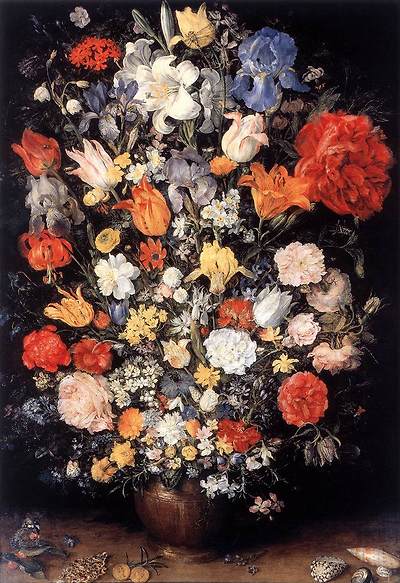
Bouquet
1606 Oil on copper, 65 x 45 cm
Pinacoteca Ambrosiana, Milan
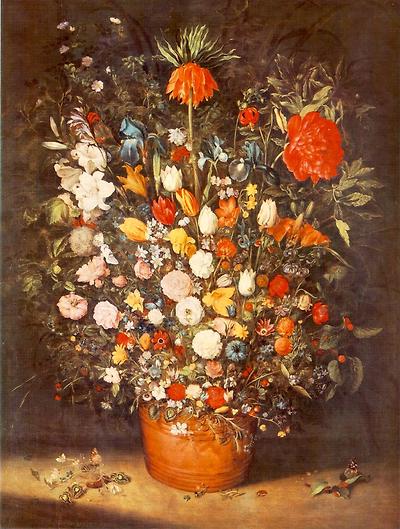
Bouquet
1603 Wood, 125 x 96 cm
Alte Pinakothek, Munich

Flowers
Oil on panel, 49 x 39 cm
Museo del Prado, Madrid

The Great Bouquet
1607 Oil on wood, 98 x 73 cm
Kunsthistorisches Museum, Vienna

Bouquet in a Clay Vase
1599-1607 Oil on wood, 51 x 40 cm
Kunsthistorisches Museum, Vienna
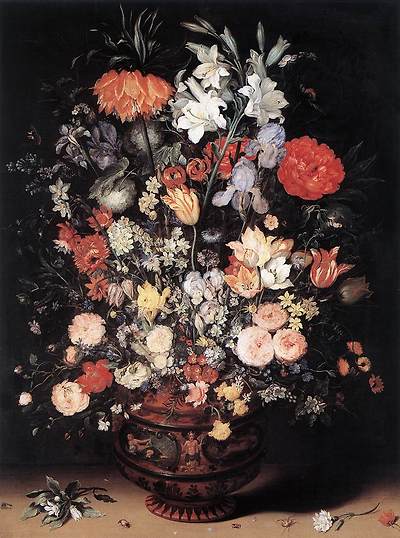
Flowers in a Vase
Oil on panel, 101 x 76 cm
Koninklijk Museum voor Schone Kunsten, Antwerp
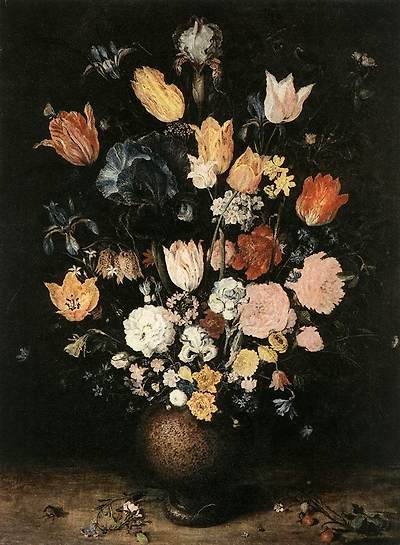
Bouquet of Flowers
Oil on oak, 67 x 51 cm
National Gallery, Prague

Still-Life with Garland of Flowers and Golden Tazza
1618 Oil on wood, 47,5 x 52,5 cm
Musées Royaux des Beaux-Arts, Brussels