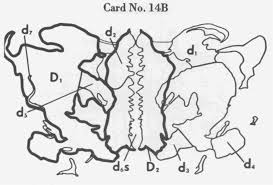
Based on the same underlying premise as the Rorschach, the HIT was constructed to be a psychometrically sound projective instrument. The test consists of two parallel forms (A and B), each composed of 45 inkblots with two additional trial blots identical in both test forms. Included are inkblots that are achromatic and chromatic. Unlike the Rorschach, which consists of symmetrical blots (similar on both sides), asymmetrical blots were also included in the HIT. Inkblot Perception and Personality (Holtzman, Thorpe, Swartz, & Herron, 1961) serves as a manual and a scoring guide for the test. The inkblots are presented one at a time to the subject, and (unlike the Rorschach) subjects are instructed to produce only one response per blot. A brief inquiry follows immediately, wherein the examiner seeks to determine where the percept was seen and the qualities of the blot that contributed to the forming of the percept. Responses on the HIT are scored according to 22 variables, some (such as "reaction time") quite familiar to Rorschach users and others (such as "penetration") less familiar. For the record, "penetration" refers to that which "might be symbolic of an individual's feeling that his body exterior is of little protective value and can be easily penetrated" (Holtzman, 1975, p. 247). Factor analysis of the different scoring categories has resulted in the establishment of six clusters or dimensions that reflect interrelationships among the variables. Some of these interrelationships are listed in Table 13-1. A computer-based interpretive scoring system has been developed for the HIT. Psychometric properties. The HIT was standardized on more than 1,400 normal, schizophrenic, depressed, and retarded individuals who ranged in age from 5 years through adulthood. Percentile norms based on these groups were developed. Several differences in test construction between the HIT and the Rorschach result in the HIT being more adaptable to psychometric analyses. The limitation of only one response per inkblot eliminates the problem of variability in productivity that may sometimes complicate statistical analyses of the Rorschach (that is, since there is no restriction on the number of responses a subject may give to each Rorschach card, responses may theoretically range from 0 to however many the examiner will sit for before stopping the respondent-a situation that makes for difficulty when trying to compare protocols from different people). The availability, of two forms of the instrument, constructed concurrently during test development and "carefully paired on both stimulus and response characteristics to enhance the equivalence" (Holtzman, 1975, p. 244), enables test-retest and alternate form-reliability procedures to be conducted. In addition, the order of presentation of "achromatic and chromatic blots is sufficiently random to minimize undesirable sequential effects" (Holtzman, 1975, p. 245), enabling split-half reliability procedures to be conducted. Internal consistency measures based on 50 samples and employing split-half (odd-even blots) procedures resulted in median reliability coefficients mostly in the .70s and .80s, with some being above .90. Inter-scorer reliability with respect to the HIT system was found to be exceptionally high, with reliability coefficients above .95 on all but two scoring categories. Test-retest reliability estimates using alternate forms of the test and extending over intervals from one week to one year were found to range from .36 to .81 for the standardization sample. In one cross-cultural longitudinal study of test-retest reliability, Holtzman (1975) used alternate forms of the test with a population of American and Mexican children. Over a six-year period, children were tested at 6 years 8 months, 9 years 8 months, and 12 years 8 months. Retesting intervals varied from one to five years. Test-retest reliability was found to be highest at the older age levels. In addition, as the length of time of the testing interval increased, the reliability decreased. Test-retest reliability estimates were found to be the highest for the Location scoring category (reliability coefficients falling mostly in the .80s), followed by estimates for the Movement, Human, and Form Definiteness categories. |
| TABLE 13-1 Key Variables on the Holtzman Inkbolt Test (HIT) | | ------------------------------------------------------------------------------------------------------------------------------------------------------------- | | Factor Number | Variables | | ------------------------------------------------------------------------------------------------------------------------------------------------------------- | | I | Movement | | | Integration | | | Human | | | Barrier | | | Popular | | II | Color | | | Shading | | | Form definiteness (reversed) | | III | Pathognomic verbalization | | | Anxiety | | | Hostility | | | Movement | | IV | Form appropriateness | | | Location | | V | Reaction time | | | Rejection | | | Animal (reversed) | | VI | Penetration | | | Anatomy | | | Sex |
Validity investigations have compared HIT findings with data obtained from other assessment instruments. For example, a study comparing HIT scores with scales on the Personality Research Form (PRF) resulted in significant correlations between high color scores on the HIT and high scores on the PRF scales of Impulsiveness, Exhibitionism, and Nurturance. These findings appear to be consistent with Rorschach theory, which holds that "the ways . . . color is handled in responding to the blots are believed to cast light upon the overt emotional reactions of the subject to the impact of his social environment" (Klopfer, Ainsworth, Klopfer, & Holt, 1954, p. 278). Also found to be positively correlated are the HIT score of Integration and the PRF scale of Understanding, both of which reflect intellectual abilities. Information concerning intergroup differences in performance on the HIT was illustrated in data obtained from the standardization sample, where the performance of "normals" was compared with such groups as depressives, chronic schizophrenics, and retardates. Mosely's (1963) reanalysis of Holtzman's standardization sample data resulted in differentiation of normals from schizophrenics, depressives from schizophrenics, and depressives from normals. Computer analysis of more than 5,000 cases of individuals, including depressives, neurotics, schizophrenics, the brain-damaged, and alcoholic groups from the United States and 16 other countries, have led to the development of additional normative data (Gorham, Mosely, & Holtzman, 1968). Mittenberg and Petersen (1984) explored the validity of the HIT measure of anxiety in a study that employed biofeedback measures and concluded that their findings supported the validity of the HIT as a measure of anxiety (though they weren't sure whether the anxiety was state or trait in nature). A standardized edition of the HIT designed for group administration by means of projection of slides has also been developed. The reliability of the group technique using split-half and test-retest procedures has been found to approximate that of individual administrations. However, certain scoring categories, such as Location, Color, or Space, were found to receive higher scores during group administration, suggesting that, when viewed from a distance, these qualities of the inkblots become more prominent. In addition, higher variance on the variable of anxiety was found to occur in group administration of the HIT, possibly substantiating the premise that the interpersonal relationship between examiner and examinee is of consequence in testtaking. In spite of what many view as the superior qualities of the HIT from a purely psychometric standpoint, the Rorschach has prevailed as the dominant projective inkblot method (see Table 13-2). We may speculate as to the possible reasons: (1) For many years the Rorschach was the only technique available, and clinicians interested in projective techniques would be routinely trained in its use-familiarity with the Rorschach, lack of familiarity with the HIT, and sheer inertia may therefore be factors; (2) the Rorschach is viewed as supplying more clinical content, since there is no limit on the number of responses obtainable and the procedure allows for extensive inquiry; and (3) some users of projective techniques may place their clinical intuition above any touted benefits of superiority with respect to psychometric qualities. At the very least, the HIT does seem to have been of value in stimulating thought and investigation with respect to the use of inkblots as a projective technique. |
|
|
 Holtzman inkblot technique.jpg

 14B.png