spring tide range
대조차
Some sources estimate the spring tide range at the mouth of the Leaf River as being as high as 17 m or 56 ft.
It has a large tidal range, 2.5 meters at spring tides.
The tidal amplitude at Muara ranges from about 2.0m at spring tides to 0.9m at neap tides.
The tidal range is also high with spring tides in each year exceeding 10 metres.
What are spring and neap tides?
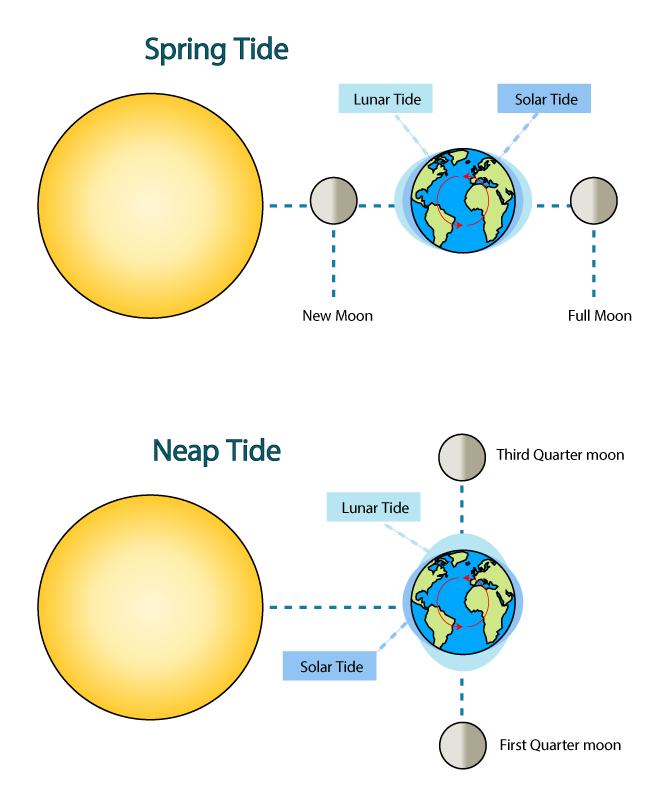
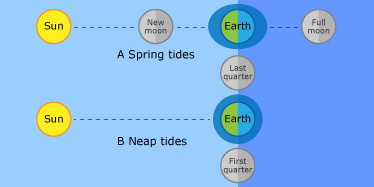
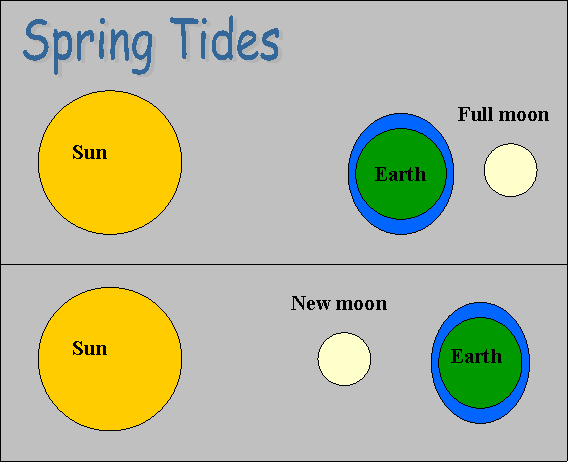
A spring tide—popularly known as a "King Tide"—refers to the 'springing forth' of the tide during new and full moon.
A neap tide—seven days after a spring tide—refers to a period of moderate tides when the sun and moon are at right angles to each other.
A spring tide is a common historical term that has nothing to do with the season of spring.
Rather, the term is derived from the concept of the tide "springing forth."
Spring tides occur twice each lunar month all year long without regard to the season.
Neap tides, which also occur twice a month, happen when the sun and moon are at right angles to each other.
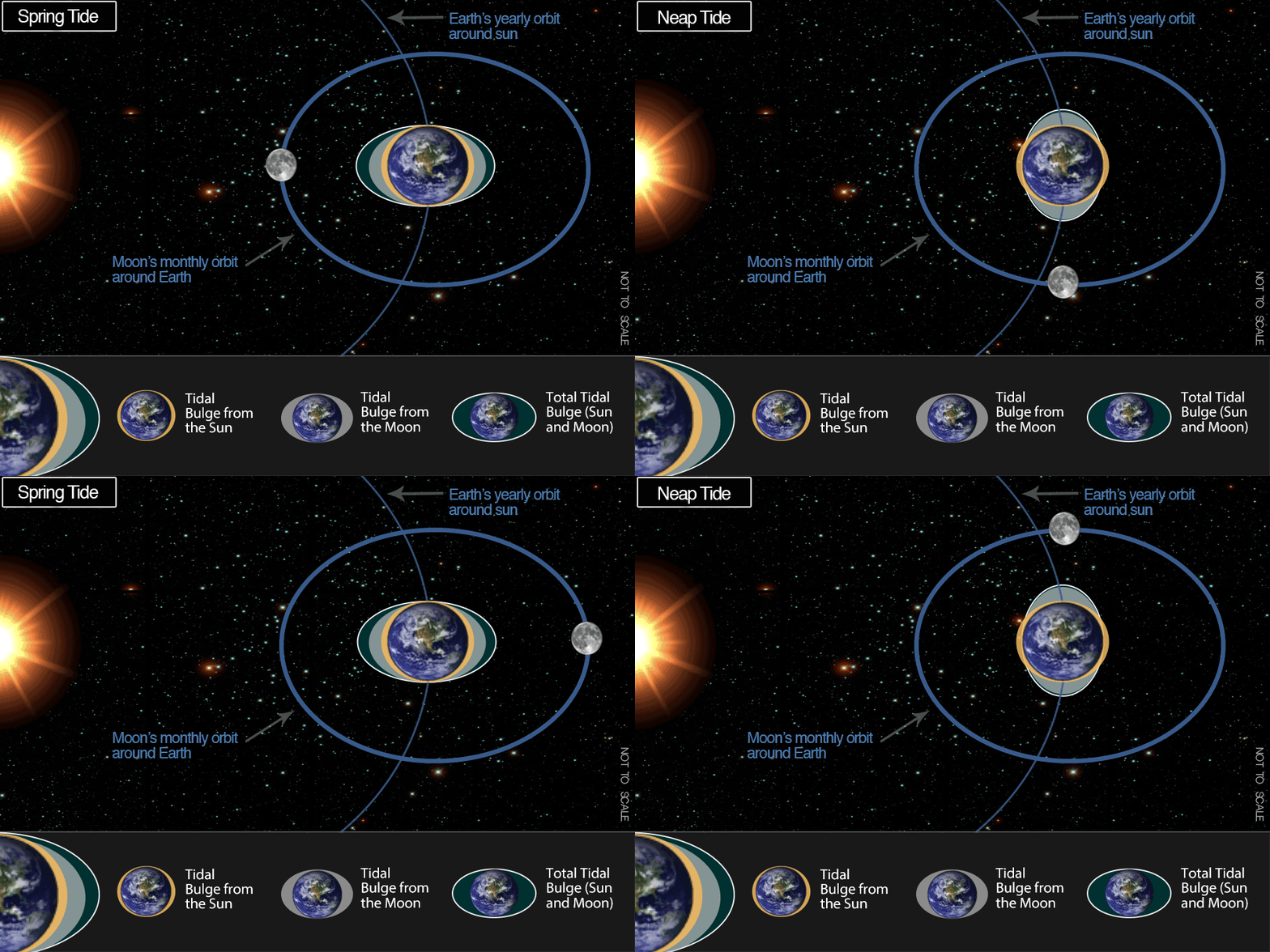
Tides are long-period waves that roll around the planet as the ocean is "pulled" back and forth by the gravitational pull of the moon and the sun as these bodies interact with the Earth in their monthly and yearly orbits.
During full or new moons—which occur when the Earth, sun, and moon are nearly in alignment—average tidal ranges are slightly larger. This occurs twice each month. The moon appears new (dark) when it is directly between the Earth and the sun. The moon appears full when the Earth is between the moon and the sun. In both cases, the gravitational pull of the sun is "added" to the gravitational pull of the moon on Earth, causing the oceans to bulge a bit more than usual. This means that high tides are a little higher and low tides are a little lower than average.
These are called spring tides, a common historical term that has nothing to do with the season of spring. Rather, the term is derived from the concept of the tide "springing forth." Spring tides occur twice each lunar month all year long, without regard to the season.
Seven days after a spring tide, the sun and moon are at right angles to each other. When this happens, the bulge of the ocean caused by the sun partially cancels out the bulge of the ocean caused by the moon. This produces moderate tides known as neap tides, meaning that high tides are a little lower and low tides are a little higher than average. Neap tides occur during the first and third quarter moon, when the moon appears "half full."
NOAA’s tide and tidal current predictions take into account astronomical considerations due to the position of the moon and the sun.