어항 청소시 필요한 도구들 : 사이펀, 수중펌프, 매직블럭, 말통
A siphon (from Ancient Greek: σίφων, "pipe, tube", also spelled nonetymologically syphon) is any of a wide variety of devices that involve the flow of liquids through tubes.
In a narrower sense, the word refers particularly to a tube in an inverted "U" shape, which causes a liquid to flow upward, above the surface of a reservoir, with no pump, but powered by the fall of the liquid as it flows down the tube under the pull of gravity, then discharging at a level lower than the surface of the reservoir from which it came.
사이펀(Siphon)은 관을 이용하여 액체를 어느 지점에서 목적지까지 높은 지점에서 낮은 지점까지 이동하는 장치이며, 이 메커니즘을 사이펀의 원리라고 한다.
어떤 수조나 저수지로부터 먼 거리에 있는 다른 수조나 저수지에 물을 운반할 때, 지리적인 조건에 의해 관이 동수경사선보다 높은 곳에 위치하게 되는 경우가 있다.
이런 관수로를 사이펀이라고 한다. 사이펀에서의 압력은 부압(마이너스 압력)이 된다.
사이펀 작용, 사이펀의 원리
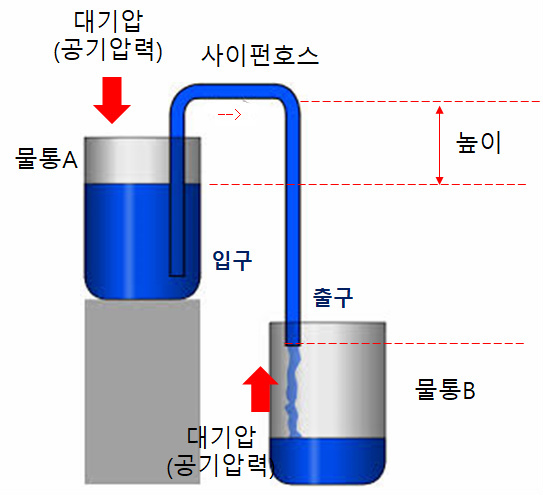
사이펀(Siphon)이란 대기압을 이용해 높은 곳의 액체를 낮은 곳으로 이동시키는 관, 또는 그러한 작용, 현상 등을 의미합니다.
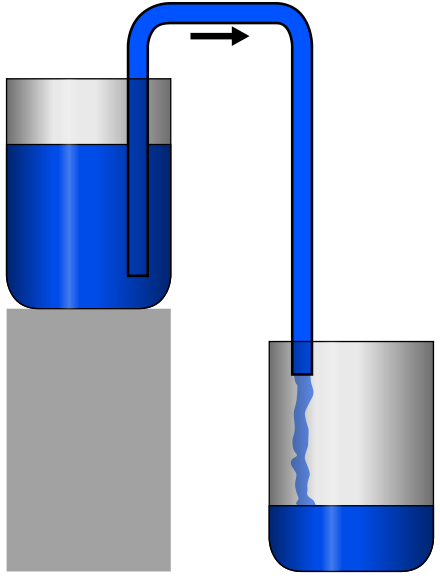
높은 곳에 위치한 통에 담긴 액체를 아랫쪽으로 구부러진 관을 통해서 수면의 높이 이하로 이동시키면 계속해서 액체가 아랫쪽에 위치한 통으로 이동하게 됩니다.
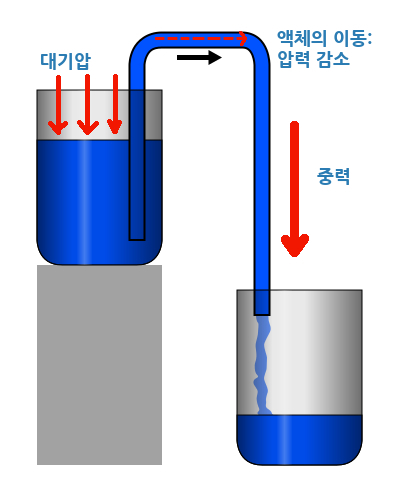
원리는 베르누이의 원리(유체의 속력이 증가하면 압력이 감소한다.)에 따라 액체를 구부러진 관을 따라서 이동시키면 관 내부의 이동하는 액체의 압력이 대기압 보다 감소해서, 대기압이 높은 곳의 통의 수면을 누르는 효과가 발생됩니다.
그리고 구부러진 관을 통해 흐르는 액체가 높은 통에 담긴 액체의 수면 아래로 내려가게 되면 중력의 영향으로 관 속의 액체는 아래쪽으로 떨어지게 되고, 관 속의 압력을 대기압보다 더 낮게 유지시켜서 액체가 계속해서 흐를 수 있도록 합니다.
그러다가 높은 통에 담긴 액체의 수면이 관 입구까지 내려가게 되면 액체의 이동이 끝나게 됩니다.
사이펀 작용을 일으키는데 필요한 요소는 공기보다 무거운 유체, 대기압, 대기압보다 낮은 관 속의 압력, 중력 등이 있습니다.
사이펀 작용을 일으키는 요인이 액체의 인력 또는 표면장력 때문이라고 오해할 수 있습니다.
인력은 액체의 분자가 서로 끌어당기는 힘을 의미합니다.
표면장력은 액체가 대기와 접해있는 표면적을 줄이는 힘을 의미합니다.
액체의 인력이나 표면장력이 사이펀 작용에 영향을 준다면 관 도중에 진공이나 공기층으로 액체의 인력이 끊어진 부분이 있다면 사이펀 작용이 진행이 되어서는 안 됩니다.
하지만 관 내부의 중간부분에 진공이 있거나 약간의 공기가 일정부분 있다고 해도 관 내부의 유체가 움직인다면(관 내부의 압력이 대기압 보다 낮다면) 사이펀 작용이 진행이 됩니다.
사이펀 원리를 체인과 도르레에 비유하는 것은 잘못된 비유입니다.
높은 곳에 있는 체인을 더 높은 곳에 있는 도르레에 연결해 낮은곳으로 이동시키면 체인이 계속해서 높은곳에서 낮은곳으로 이동이 됩니다.
하지만 사이펀 원리는 해수면높이 즉 1기압에서 약10m이상 높이의 관에서는 사이펀 작용은 나타나지 않습니다.
또한 수은을 1기압에서 약 76cm이상 높이의 관에서도 사이펀 작용이 나타나지 않습니다.
사이펀 작용이 실제로 쓰이는 곳은 변기의 원리, 계영배 술잔의 원리, 석유 자바라 호스, 배수구 트랩, 사이펀 커피 메이커, 농업 용수 관개, 세탁기 헹굼제(섬유유연제) 투입구, 압력계, 우량계, 등이 있습니다.
댓글 4
높이차30미터이고 싸이펀관은 25미리일때
관성때문에 싸이펀관 끝까지 물이내려갔을때
물이빨려들어가는것을 방지하려면 싸이펀낮은곳의
올라오는관을 몇미터는 해야할까요 ?
wblog
저의 짧은 지식 수준으로는 질문의 내용이 이해되지 않습니다.
관성의 정의는 물체에 힘을 가해 이동시키다가, 그 힘을 멈췄을 때도 물체가 즉시 멈추지 않고 그 힘의 방향으로 계속 이동하려는 성질을 의미합니다.
사이펀 작용은 관성력 때문에 물이 계속해서 이동하는 게 아니라 중력이 계속해서 지구 중심 방향으로 힘을(중력가속도) 가하기 때문에 물이 계속해서 이동합니다.
탄성력 때문에 물이 역류할 것이라고 생각한다면, 물은 탄성력이 거의 없습니다.
김한수
궁금한 것이 있어 질문드립니다. 글의 내용대로라면
관속에 물이 올라갈때는 중력의 영향을 받지 않나요? 이때는 대기압이 눌러서 올라가는 물의 방향이 중력의 방향과는 반대일텐데 대기압이 더 강해서 물리 올라가는 건가요?
관 속에서 내려오는 부분은 중력이 작용한다는 것은 이해가 되는데 올라갈때는 어떻게 올라가는지가 궁금합니다.
wblog
저의 짧은 지식으로 답변드리겠습니다.
관 속의 물이 올라갈 때도 중력의 영향을 받습니다.
'대기압(높은 압력)'과 '대기압보다 낮은 관속의 압(낮은 압력)'의 압력 차이 때문에 물이 올라갑니다.(압력이 높은 곳에서 낮은 곳으로 물이 이동)
공기가 가득 차있는 풍선(높은 압력)과 공기가 없는 풍선(낮은 압력)의 주입구를 연결하면 공기가 이동하는 것과 같습니다.
중력의 힘 보다 '대기압과 대기압 보다 낮은 관 속 압력 차이의 힘'(진공압력)이 더 크면 물이 빨려 올라갑니다.
중력이 오른쪽 관의 물을 아래로 계속 잡아당기면 관속의 압력이 대기압 보다 낮아지게 되고, 왼쪽 관에서 압력 차이로 물이 올라갑니다.
공학용어로 진공압력('대기압보다 낮은 압력' 또는 '진공을 없애려고 하는 압력' 또는 '대기압을 기준으로 마이너스 압력')이 있습니다.
Siphon
This article is about the device. For the carbonation tool, see soda siphon. For other uses, see Siphon (disambiguation).
Siphon principle
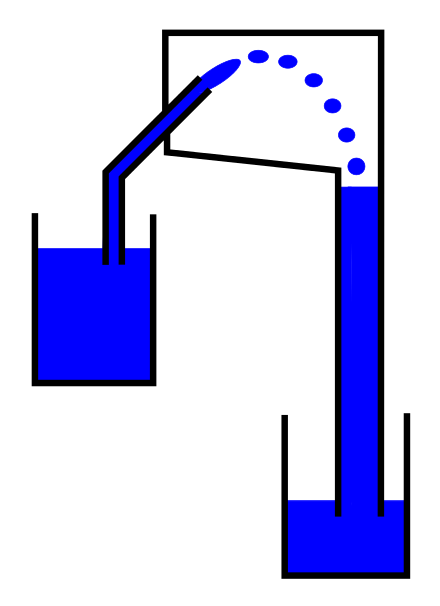
In the flying-droplet siphon, surface tension pulls the stream of liquid into separate droplets inside of a sealed air-filled chamber, preventing the liquid going down from having contact with the liquid going up, and thereby preventing liquid tensile strength from pulling the liquid up. It also demonstrates that the effect of atmospheric pressure at the entrance is not canceled by the equal atmospheric pressure at the exit.
A siphon (from Ancient Greek: σίφων, "pipe, tube", also spelled nonetymologically syphon) is any of a wide variety of devices that involve the flow of liquids through tubes. In a narrower sense, the word refers particularly to a tube in an inverted "U" shape, which causes a liquid to flow upward, above the surface of a reservoir, with no pump, but powered by the fall of the liquid as it flows down the tube under the pull of gravity, then discharging at a level lower than the surface of the reservoir from which it came.
There are two leading theories about how siphons cause liquid to flow uphill, against gravity, without being pumped, and powered only by gravity. The traditional theory for centuries was that gravity pulling the liquid down on the exit side of the siphon resulted in reduced pressure at the top of the siphon. Then atmospheric pressure was able to push the liquid from the upper reservoir, up into the reduced pressure at the top of the siphon, like in a barometer or drinking straw, and then over.
However, it has been demonstrated that siphons can operate in a vacuum and to heights exceeding the barometric height of the liquid.
Consequently, the cohesion tension theory of siphon operation has been advocated, where the liquid is pulled over the siphon in a way similar to the chain model.
It need not be one theory or the other that is correct, but rather both theories may be correct in different circumstances of ambient pressure. The atmospheric pressure with gravity theory obviously cannot explain siphons in vacuum, where there is no significant atmospheric pressure. But the cohesion tension with gravity theory cannot explain CO2 gas siphons, phons working despite bubbles, and the flying droplet siphon, where gases do not exert significant pulling forces, and liquids not in contact cannot exert a cohesive tension force.
All known published theories in modern times recognize Bernoulli’s equation as a decent approximation to idealized, friction-free siphon operation.
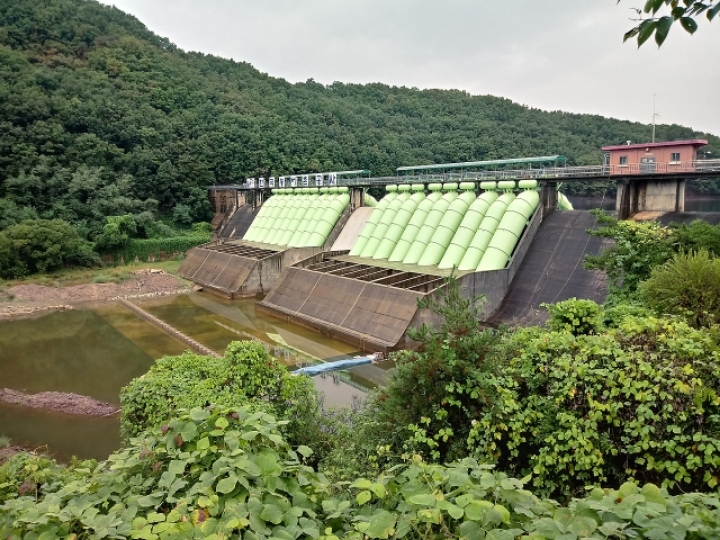
초평댐 사이펀 여수로. 2018년 8월