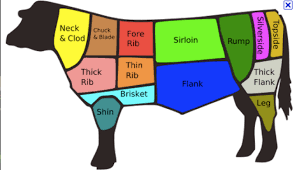
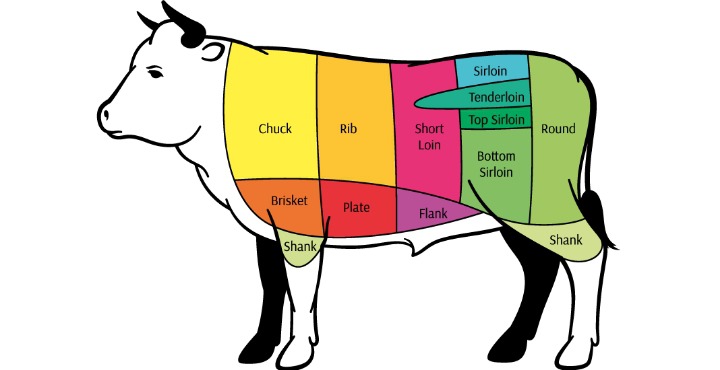
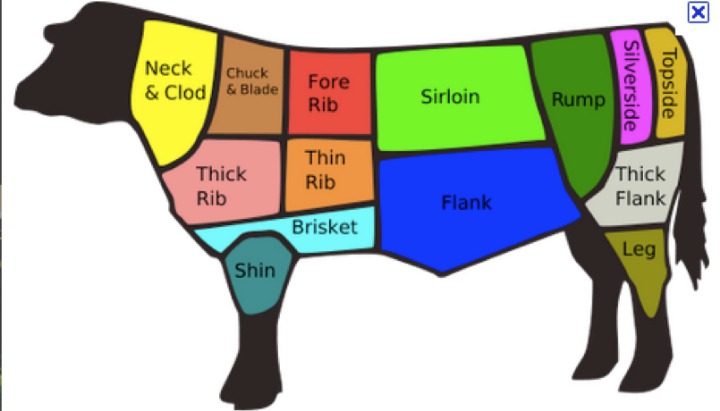
Cuts of beef are first divided into primal cuts, pieces of meat initially separated from the carcass during butchering.
These are basic sections from which steaks and other subdivisions are cut. The term "primal cut" is quite different from "prime cut", used to characterize cuts considered to be of higher quality. Since the animal's legs and neck muscles do the most work, they are the toughest; the meat becomes more tender as distance from hoof and horn increases. Different countries and cuisines have different cuts and names, and sometimes use the same name for a different cut; e.g., the cut described as "brisket" in the US is from a significantly different part of the carcass than British brisket. "Cut" often refers narrowly to skeletal muscle (sometimes attached to bones), but can also include other edible flesh, such as offal (organ meat) or bones without significant muscles attached.
American cuts
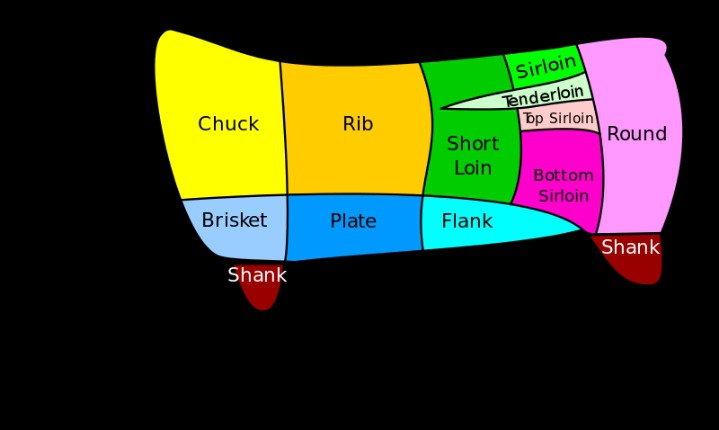
American cuts of beef
The following is a list of the American primal cuts, and cuts derived from them. Beef carcasses are split along the axis of symmetry into "halves", then across into front and back "quarters" (forequarters and hindquarters). Canada uses identical cut names (and numbering) as the U.S, with the exception of the "round" which is called the "hip".[1]
Forequarter cuts
The chuck is the source of bone-in chuck steaks and roasts (arm or blade), and boneless clod steaks and roasts, most commonly. The trimmings and some whole boneless chucks are ground for hamburgers.
The rib contains part of the short ribs, the prime rib and rib eye steaks.
Brisket, primarily used for barbecue, corned beef or pastrami.
The foreshank or shank is used primarily for stews and soups; it is not usually served any other way because it is the toughest of the cuts.
The plate is the other source of short ribs, used for pot roasting, and the outside skirt steak, which is used for fajitas. The navel is the ventral part of the plate, and is commonly used to make pastrami. The remainder is usually ground, as it is typically a tough and fatty meat.
Hindquarter cuts
The loin has two subprimals
the short loin, from which the T-boneand porterhouse steaks are cut if bone-in, or strip steak.
the sirloin, which is less tender than short loin, but more flavorful, can be further divided into top sirloin and bottom sirloin (including tri-tip), and
the tenderloin, which is the most tender, can be removed as a separate subprimal, and cut into filet mignons, tournedos or tenderloin steaks, and roasts (such as for beef Wellington). They can also be cut bone-in to make parts of the T-bone and porterhouseloin steaks.
The round contains lean, moderately tough, lower fat (less marbling) cuts, which require moist or rare cooking. Some representative cuts are round steak, eye of round, top round, and bottom round steaks and roasts.
The flank is used mostly for grinding, except for the long and flat flank steak, best known for use in London broil, and the inside skirt steak, also used for fajitas. Flank steaks were once one of the most affordable steaks, because they are substantially tougher than the more desirable loin and rib steaks. Many modern recipes for flank steak use marinades or moist cooking methods, such as braising, to improve the tenderness and flavor. This, combined with a new interest in these cuts' natural leanness, has increased the price of the flank steak.