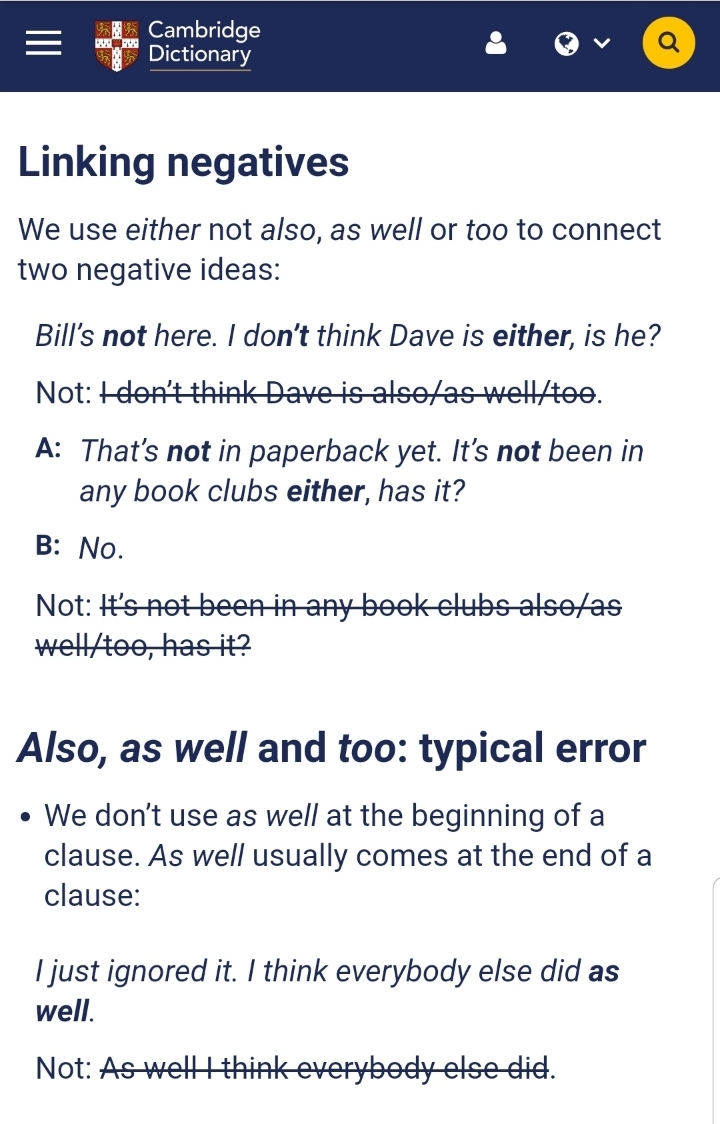
Also, as well or too?
Also, as well and too are adverbs and mean ‘in addition’.
Also
Also is commonly used in writing, but is less common in speaking. Also occupies different positions in a sentence.
We use also in front position to emphasise what follows or to add a new point or topic:
It’s very humid. Also, you can easily get sunburnt.
[on the telephone]
OK, I’ll phone you next week and we can discuss it then. Also, we need to decide who will be going to Singapore.
We use also in the normal mid position for adverbs, between the subject and main verb, or after the modal verb or first auxiliary verb, or after be as a main verb. In this position, the meaning of also usually connects back to the whole clause that comes before:
She works very hard but she also goes to the gym every week.
I’ve been working in the garden this week, and I’ve also been reading a lot.
In end position, also normally connects two phrases. We use as well and too instead of also, in end position, especially in speech:
She contacted him in the office but he didn’t answer the phone. His mobile phone was silent also. (or His mobile phone was silent too. or … was silent as well.)
As well
Spoken English:
As well is much more common in speaking than in writing, and is more common in speaking than also.
As well almost always comes in end position:
[In a restaurant. Customer (A) is ordering from a waiter (B)]
A:
I’ll have steak please.
B:
Yes.
A:
And I’ll have the mixed vegetables as well.
See also:
As well (as)
Too
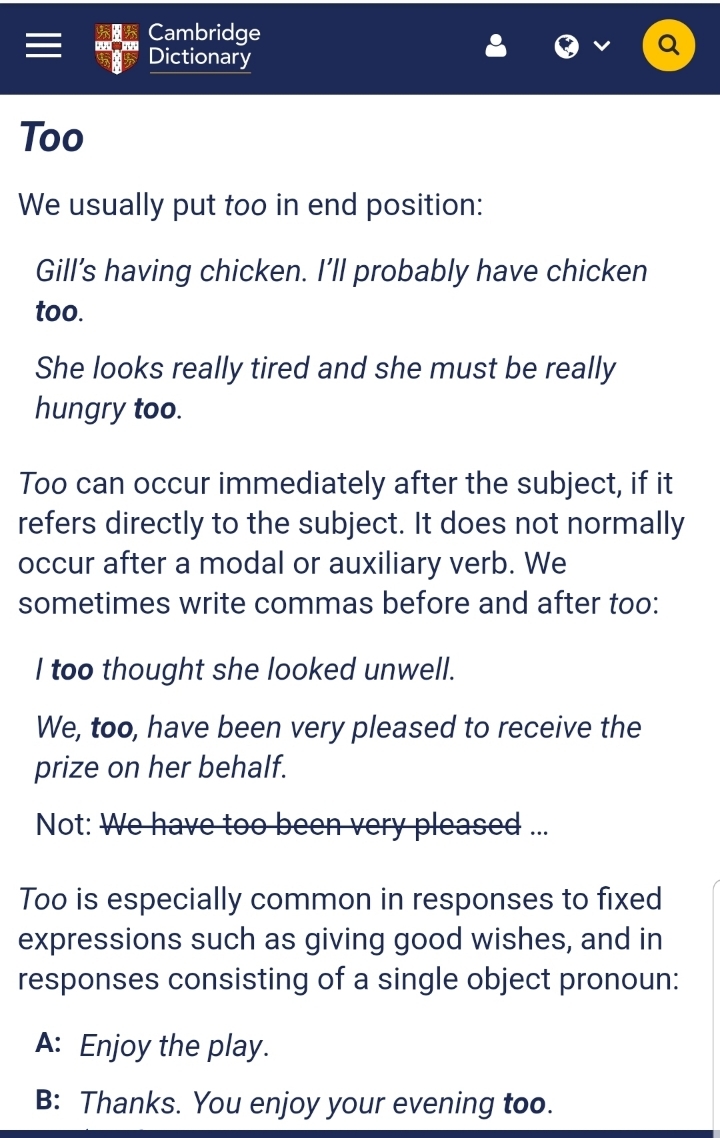
We usually put too in end position:
Gill’s having chicken. I’ll probably have chicken too.
She looks really tired and she must be really hungry too.
Too can occur immediately after the subject, if it refers directly to the subject. It does not normally occur after a modal or auxiliary verb. We sometimes write commas before and after too:
I too thought she looked unwell.
We, too, have been very pleased to receive the prize on her behalf.
Not: We have too been very pleased …
Too is especially common in responses to fixed expressions such as giving good wishes, and in responses consisting of a single object pronoun:
A:
Enjoy the play.
B:
Thanks. You enjoy your evening too. (preferred to You enjoy your evening as well. or You also enjoy your evening.)
A:
I need to go to the gym.
B:
Yeah, me too. (preferred to Yeah, me also. or Yeah, me as well.)
In imperative clauses, as well and too are normally preferred to also:
[customer in a post office, buying books of first and second class stamps]
Give me a book of ten first and a book of ten second as well then please. (preferred to … and a book of ten second also then please.)