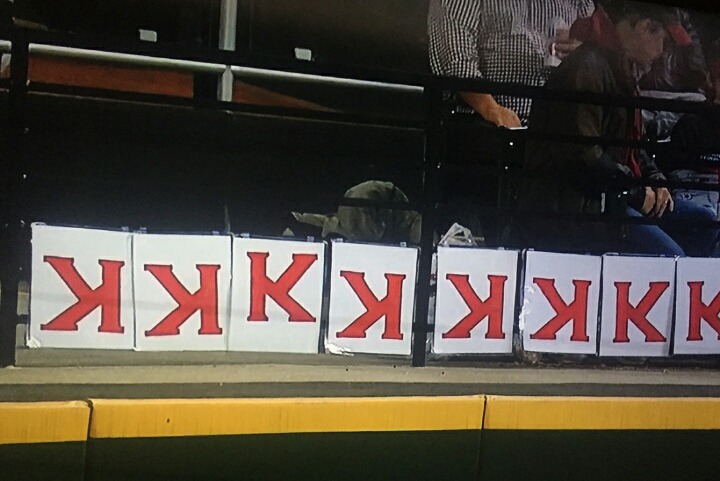
backwards "K"
reversed "K"
inverted "K"
In baseball scoring, a backwards K represents a called strikeout (i.e. batter watched strike 3 go by without swinging) whereas a forwards K is a swinging strikeout.
In baseball scorekeeping, a swinging strikeout is recorded as a K, or a K-S.
A strikeout looking (where the batter does not swing at a pitch that
the umpire then calls strike three) is often scored with a backward K,
and sometimes as a K-L, CK, or Kc (the 'c' for 'called' strike).
Answered Feb 29, 2016
A backwards K means a strikeout looking. The letter K is used to represent a strikeout. If the batter struck out on a called third strike, as opposed to swinging at the third strike, the scorer will traditionally write the K backwards.
A great advertising solution to get high quality customers.
Get your business to appear alongside the most relevant and popular topics. Setup simple ads in minutes.
Answered Mar 3, 2016
A reverse K means the batter took the pitch looking at it, because he didn't think it was a strike, and didn't swing, while, the Home Plate Umpire called a standing Strike Three and gave him the hammer.
Grab some pine and sit-down, you're out.
Answered Mar 6, 2016
A backward K is used to note a batter who took a called third strike by the umpire, as opposed to a swing and miss third strike, as represented by the normal K symbol.
Cesar Castillo, Playing the game since 2011
Updated Mar 20, 2016
As you probably know, having noticed the backwards "K" in scorebooks, a regular "K" denotes a strikeout. A backwards "K", on the other hand, denotes a strikeout looking, i.e. the batter did not make an attempt to hit the pitch. I'm not entirely sure what MLB rules are for denoting a successful out made on a dropped third strike in which the runner tried to reach first base, but I believe the defense is credited with some form of a strikeout (be it backwards or forwards "K") and a 2-3 (catcher to first baseman) play.
If you are referring to the display of "K"s along a wall in a ballpark, generally it's to avoid displaying "KKK" on the wall.
In a scoring book, sometimes the backwards "K" indicates a called third strike while a "K" denotes a swinging third strike.
In other words, if the batter takes a third strike without swinging the scorer will write a backwards "K" to indicate that; if the batter swings and misses to strike out, the scorer will write a "K".
When I learned to score, I wrote a large "K" followed by a small "c" for a called third strike. It has its advantages and disadvantages over the reversed "K".