CAFE

동양화와 서양화의 차이점 이해 자료모음

작성자천사의섬|작성시간10.08.17|조회수5,316 목록 댓글 0

굳이 박물관 까지 찾아가지 않더라도 웬만한 가정에서는 동양화 한점쯤은 볼 수가 있으리라 생각합니다.
그런데 서양화를 배우고 서양화에 익숙해 있는 우리의 시각으로 보면 동양화는 이해가 안되는 부분이 많습니다.
그 첫째가, 우리가 학교에서 미술(회화)를 배울때는 빈 공간 없이 크레파스로 짙게 칠을 잘 해야 잘 그렸다고 칭찬을 받았었는데, 동양화는 하얀 여백이 절반 이상의 공간을 차지하고 있어서 미완성의 그림으로 보이게 됩니다.
두번째는, 먼 경치는 작게 그리고 가까운 것은 크게그려야 원근법에 맞는데 동양화에서는 이와 같은 원근법이 없습니다.
세번째는, 요즘 말로 풍경화라 할 수 있는 진경산수화를 보면 실제 현장에서 보이는 경치와는 다른 모양으로 그려져 있습니다. 쉬운 예로 겸제선생의 금강산전도는 금강산 일만이천봉을 한장의 그림에 그렸는데 이 세상 어느 지점에서 보아도 그와 같은 경치는 보이지 않는다는 것입니다.

이상의 문제에 대하여 정리해 보고자 합니다.
첫째, 여백의 문제인데, 서양화에서는 여백은 미완성으로 보지만 동양화에서는 여백을 이용하여 구도를 잡는다는 것입니다. 그래서 동양화는 여백의 미를 극대화한 미술이라 합니다.
두번째, 원근법의 문제인데 미술에서 원근을 표현하는 방법은 여러가지가 있다는 것입니다. 서양화에서는 크기로 표현하는데 반하여 동양화에서는 먼 것은 흐리게 그리고 가까운 것은 짙게그리는 방법과, 가까운 것은 화폭의 아래에 그리고 먼 것은 화폭의 위에 그리는 방법(산에 올라가서 먼 경치를 본다고 상상해 보십시요)을 사용한다는 것입니다. 따라서 원근법은 표현기법의 차이가 있을 뿐 동양화에 원근법이 없다는 말은 옳지 않습니다(참고로 우리나라에 서양식 원근법의 도입은 조선 정조 때 부터입니다)
셋째, 사실과 다르다는 경치의 문제는, 서양화는 그림을 그릴 때 한곳에 이젤을 세우고 그 자리에서 보이는 경치를 그대로 그립니다. 다시 말하면 그림을 바라보는 시점이 한 곳에 고정되어 있다는 말 입니다. 그래서 서양화를 감상할 때는 액자에 넣어서 벽에 걸어두고 보는 것입니다.
반면에 동양화는 이동시점을 사용합니다. 금강산 전도를 그린다면 금강산을 전체를 돌아보면서 부분 부분을 스케치한 후 이것들을 모아서 한장의 그림으로 그린다는 것입니다. 이해를 돕기 위하여 하나를 더 예로 든다면, 조선초 안평대군의 꿈을 안견이 그렸다는 몽유도원도를 들 수 있는데, 옆으로 긴 그림입니다. 안평대군이 꿈에 무릉도원을 찾아가서 놀았다는 이야기를 한장의 그림으로 그렸는데, 좌측은 현실의 인간세상을 그렸고 우측으로 갈수록 산천이 점차로 기기묘묘해 지다가 우측에 도달하면 무릉도원이 나타나는 그림으로서 한장의 그림으로 나타나 있지만 출발부터 도착까지의 과정을 한장으로 표현한 요즘말로하면 파노라마식 그림이라는 것입니다.
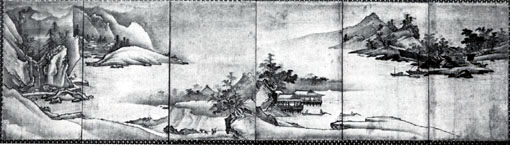
그래서 동양화를 감상할 때는 병풍이나 두루말이로 만들어서 펼쳐가면서 보도록 되어 있습니다.
시점이 다르다보니 서양화는 한 부분만 잘라 놓으면 그림으로서의 완성도가 훼손되어 버리지만 동양화는 시점마다의 독립된 그림들의 조합이기 때문에 전체도 보기 좋지만 부분 부분을 잘라 놓아도 완성도가 훼손되지 않는다는 잠점이 있습니다.

끝까지 읽어주셔서 감사합니다.


그래서 얘긴데 제가 항상 여러분들한테 강조하는 게 있어요.

우리말하고 영어는요.

동양화와 서양화의 차이점이다.

제가 아마도 여러분들한테 강의한 것 중에서

여러분들이 명심해야 될 게 이건지도 몰라요.

동양화의 서양화의 차이점이 뭔 줄 아세요?

서양화는요. 색칠을 다 해야 돼. 흰색도 남으면 안 돼.

그런데 우리나라 그림은요. 여백이 많아요.

건데, 서양화는요.

슬슬 색칠 하다말면 미완성이라고 얘기하지만은요.

우리나라 그림은 여백이 있어야 완성이에요.

무슨 말이냐?

우리말 속에는 여백이 많다는 거고, 일일이 말을 표현하지 않는다 이거야.

그래서 제가 어떤 얘기 많이 하느냐 하면요.

‘나 가슴이 아파요’ 라고 얘기하는 것도 영어로 옮기면은

상황에 따라서 영어는 다~ 다르다 이거야.

그런데, ‘가슴이 아프다’ 얘기할 때는요.

폐질환도 가슴 아픈 거구요. 심장마비도 가슴이 아픈 거구요.

정말로 뭐라고 그럴까. 가슴이 쓰린 것도 가슴 아픈 거구요.

정말로 마음이 슬퍼지는 것도 가슴이 아픈 거구요

연탄 깨스 마셔서 허파가 쑤시는 것두 가슴이 아픈 거다. 이거에요.

그러면은. ‘가슴이 아파요’라는 말을 영어로 옮길때는.

잘못하다가는요. 정말로 심장병 환자도 만들고.

이상한 번역이 된다 이거야.

그래서, ‘가슴이 아파요’ ‘니를 보니 마음이 아퍼’

그럼 예를 들어서 그렇게 얘기를 하더라도요.

예를 들어서, ‘I have a heart-attack .' 그러면은.

‘너 보니까 나 심장병 걸렸어.' 그런 말이잖아요. 그게 아니라.

‘I feel sad.' 'I feel sorry.' 이런 말이잖아.

‘너 보니까 안됐다.’ 그런 말이잖아.

예를 들어서 ‘허파가 아프다.’ 그러잖아요.

허파가. 가슴이 아프다도 들어가거든.

그러면 걔네들은요. I have a lung disease. 그래요.

lung이 허파잖아요. 그럼 ‘허파에 병이 걸렸다.’

그래두 가슴이 아퍼. 그런 식으로 표현을 하는데 우리말은 아니다.

이래서 내가 우리말을 영어로 옮길 때마다

‘가슴이 아포’(하선생님만의 특유의 말재치!)

왜? 고민을 해야 되니깐.

우리말은 여백 때문에 여러분들 고 잘 해석하지 않으면요.

이상한 번역이 될 수가 있어요.


동양화 서양화는 우리나라에서 사용하는 용어로 미술에서 회화의 재료나 화법에따라 분류된 용어입니다. 요즈음에는 미술의 형태에 따른 분류를 평면(회화)과 입체(조각)로 분류합니다. 우리나라에서 불리어지는 동양화는 먹을 사용하여 화선지나 비단에 그림 그림을 총칭하기는 하지만 서양화를 전공한 작가들도 먹과 화선지를 사용하기도 합니다. 요컨대 동양화와 서양화라는 것은 서양과 동양의 지역적 분류와 재료 사용에 따른 편의적인 분류입니다

먼저 서양화는 서양의 전통적인 재료와 화법을 이용하여 그린 그림을 말합니다. 재료에 따라 유화·수채화·펜화·연필화·파스텔화·크레용화 등으로 나뉘며 표현형태에 따라서는 구상화·비구상화로 나눌 수 있습니다. 서양화는 논리적이며 화면에 덧바르거나 깎는 식으로 층을 구성한다. 반면 동양화는 동양의 전통적인 재료와 화법을 이용하여 그린 그림으로서 직관적이며 되풀이하지 않고 한번의 터치로 그려지는 그림입니다. 한국·중국·일본 등에서 발달한 독특한 화풍과 화법의 그림으로 주로 먹을 사용하며, 화선지나 비단에 산수·사군자 등을 그립니다. 과거의 중국,일본 한국의 화가들은 모두 투시원근법과 명암법을 중요하게 여기지 않고 평면적으로 그렸으며 텃치와 선, 여백과 공간을 중요하게 여겼습니다. 동양화는 서양화의 특징인 논리적이고 과학적인 원근법을 사용하기보다 여백과 정신을 강조합니다.

그렇다면 동양화와 서양화의 공통점과 차이점에 대해 알아보겠습니다. 일단 동양화와 서양화라고 부르게되면, 회화의 종류를 두 가지 분류로 분리하여 칭하는 것이 됩니다. 즉 회화의 개념을 이분법적으로 구별한 개념이라는 것입니다. 그렇게 회화를 두 종류로 구분을 했으니, 둘은 재료나 내용, 형식에 있어서 당연히 많은 차이를 지니게 됩니다. 그리고 공통점은 자연히 회화의 특성이 될 것입니다. 예를 들자면 인간을 여자와 남자로 구분하는데, 여자와 남자를 구분했으니 차이점은 어느정도 명백하게 떠오릅니다. 그런데 여자와 남자의 공통점을 얘기하게 된다면, 그것은 인간의 특성이라는 것과 마찬가지의 맥락으로 해석할 수 있습니다. 붓을 사용한다는 재료상의 특징이나, 붓이 화폭에 닿게 되면서 어떤 형상이 생기게 된다는 것 등 회화의 특징은 그 공통점이라 할 수 있습니다. 우리 나라도 여인의 아름다운 한복을 강조하여 그리는데 르네상스 시대의 서양 인물화는 인간의 모습을 귀엽게 그렸습니다. 바로 인간의 아름다움을 아주 잘 표현하려 노력했다는 게 공통점입니다.
동양화와 서양화의 가장 큰 차이점으로는 동양화는 중국 한국 일본 등의 아시아권 미술이고 서양화는 유럽 쪽의 미술이라는 것입니다. 일단 눈으로봐도 동양화는 주고 먹, 다시말해 먹물을 주 재료로 쓰며 먹의 농도로 명암을 표현합니다. 반면 유화물감 아크릴 물감 흔히들 사용하는 수채화 등의 재료를 사용하는게 서양화 입니다. 서양화는 초기부터 칼라로 그려졌으며 그림의 밀도가 매우 높습니다. 멀리서 얼핏 보면 실제 사물과 착각을 일으킬 만큼 중간색이 많기 때문입니다. 서양화의 경우 대부분 다양한 칼라를 사용하는 유화가 대표적인데 반해 동양화는 거의 수묵화입니다. 서양화는 화선지에 그리는 동양화에 비해서 켄버스에 그리는게 특징입니다. 원근에 대해 비교하자면 동양화는 사물이 멀수록 밝고 제일 가까운 것을 어둡게 그립니다. 그러나 서양화는 반대로 가까이 있는 사물이 밝게 처리됩니다. 서양화는 이른바 눈에 보이는 대로, 꼭 정말 그것인 것처럼을 추구하기 때문입니다. 따라서 서양화에는 동양화에 없는 투시도법, 명암법이 발달했습니다. 이에 비해 동양화는 "눈에 보이지 않는 것"도 중시합니다. 동양화의 특징은 여백의 미에 있다고 합니다. 대상을 그리고 생각을 표현함에 있어서 서양화는 그대로 보여주는데 반해 동양화는 그것을 보여주면서 다른 어떤 것을 요구합니다. 그것은 이성을 중시하며 합리적인 서양과, 감성을 중시하며 합리적이기 보다는 감정의 문제가 많은 동양과 서양의 감성의 차이라 할 수 있습니다. 또한 동양화와 서양화는 풍경화를 보면 차이가 확연히 드러납니다. 동양화는 한 풍경화에 일점 투시도법을 적용하는 것이 아니라 풍경을 감상하는 사람이 절벽을 돌아서는 부분에서는 정말 절벽을 돌아설 때 보는 시점 즉 밑에서 위를 쳐다보는 시점으로 절벽을 그려넣습니다. 풍경을 감상하려 들어설 때는 멀리서 보는 시점이구요. 한자리에서 눈으로 직접 보고 그리는 진경산수화 이전까지는 이런 관념적인 산수화였습니다. 진경 산수화에서도 주관적으로 산수를 축약하는 것은 여전합니다. 여하튼 서양화는 사물을 객관적으로 똑같이 그리는 것이 발달한 반면 동양은 주관적, 관념적인 것이 중시되었습니다. 요즘의 이른바 포스트모더니즘에서는 동양화에서는 일찍부터 주목해온 주관적인 시각, 관념을 중시하고 있습니다.


동양화는 서양화에 비해서 그림의 수준을 판별하기가 수월합니다.

붓놀림이 얼마나 부드럽고 경쾌하면서도 힘찬지 보면 알 수 있습니다.

이것만 보자면 아마도 장승업 그림이 가장 탁월하겠지만

여기서는 기에 관한 이야기인 만큼 여기에 초점을 맞춥니다. 먼저 아래 그림.


                                           <신위의 묵죽화>


동양화와 서양화의 차이점은 대충 다음과 같습니다.

첫째, 동양화는 여백을 강조합니다. 여백은 그저 빈 것이 아니라

기로 꽉 찬 공간, 태허이며 사물은 그것에 의해 비로소 하나의 사물로 나타날 수 있습니다.

둘째, 서양화는 빛에 의한 원근을 강조하는 방면 동양화는 사물 자체가 빛을 머금습니다.

그래서 서양화는 빛의 소실점을 중심으로 거리가 배분되지만

동양화에서는 채색을 강하고 엷게 하는 방식으로 거리라기보다 기-느낌을 나타냅니다.

셋째, 서양화는 사물의 형식미를 강조하는 반면, 동양화는 사물을 탈형식화합니다.

그리하여 사물이 지니는 기운을 드러내려고 합니다.

위의 묵죽화는 제가 말한 특징을 고스란히 가지고 있지요.


이런 특징으로 인해 동양화는 사실적인 묘사에 충실히 해도 겉모습이 아니라

모습이 머금은 기운이 드러나게 마련입니다. 아래 그림을 보세요.


                       <윤두서 자화상>


그림에서 보시다시피 털 한올한올이 아주 섬세하게 그려져 있습니다만,

서양의 인물화와는 확연히 다르지요?

보이는 것을 통해 보이지 않는 것을 보여주는 것.


동양화의 특징인 여백과 생략은 세계의 기-특질을 드러내기 위해 필수적인 요소이지요.

아래 그림은 산의 허리를 생략해버림으로써 오히려 그 장대함을 드러낸 빼어난 그림입니다.


                          <곽희의 조춘도>


옛날 이야기 하나.

한 부자가 아주 좋은 병풍을 구한 후 그 병풍에 글씨를 써 줄 사람을 찾았습니다.

워낙 좋은 병풍이라 사람들이 이에 걸맞는 글을 써기가 힘들어 감히 청하지 못했는데,

한 걸인이 찾아와 자기가 써보겠노라고 자청합니다.

사실 이 걸인은 붓글씨를 몰랐고 그저 며칠이라도 잘 먹어보려고 거짓말을 한 것입니다.

마음준비를 해야 한다고 차일피일 미루다가 결국 병풍에 글을 쓰게 되었는데요,

이 걸인, 고심을 하다가 한 일자를 쭉 긋고는 붓을 던지고 달아납니다.

부자의 하인들에게 쫒긴 이 걸인은 돌부리에 걸려 넘어지고는 그 자리에서 죽습니다.

몹시 실망한 부자는 그 병풍을 사랑채 한켠에 치워놓습니다.

그런데 어느 날 한 스님이 왔다가 이 병풍을 보고 몹시 감탄합니다.

부자가 의아해하자 그 스님이 ‘일생일대의 일획’이라고 설명합니다.

기술이 아니라 기운이 중요합니다.


그런데 그 기운은 그리는 사람과 사물이 맞닿는 자리에서 일어나는 것이지요.

다시 말해 그림은 또한 그린 사람의 정신을 나타내는 것이기도 합니다.

그래서 매국노로 유명한 이완용은 조선 후기에 가장 난을 잘 친 사람이지만

그의 그림은 단돈 10원의 가치도 없는 반면 김구 선생의 글씨는

기술적으로 뛰어나진 않더라도 누구라도 갖고 싶어하는 것입니다.

이 방면으로 가장 유명한 그림은 아마도 추사 김정희 선생의 세한도일 것입니다.


                        <세한도. 문인화의 대표적 그림>


추사체는 워낙 유명하니 따로 설명하지 않겠습니다. 대신 일화 하나를 소개합니다.

어떤 글을 잘 쓰는 사람이 배를 타고 강을 건너려고 하다가 돌에 새겨진 글을 봅니다.

옛날 유명한 사람의 글이라지만 그 사람이 보기에는 별로 신통치 않았습니다.

그래서 그는 그 옆에 자신의 글을 쓴 다음 우쭐해 했지요. 그런데..

나룻배를 타고 가다가 그는 저만치 떨어진 자신의 글을 봅니다.

돌에 새겨진 글은 오히려 또렷이 보이는 반면 자신의 글을 점점 흐려집니다.

기운을 제대로 보이려면 단박에 드러내야지 꾸밈은 오히려 방해만 될 뿐입니다.

이를 박(樸)이라고 하며 그 기예를 졸(拙)이라 합니다.

아래 그림을 보세요.


             <탈춤-운보 김기창의 그림>


운보선생은 만년에 마치 어린아이 같은 그림을 그립니다.

제가 한 미술학도에게 짐짓 “이런 그림은 아무나 그릴 수 있는 거 아닌가?”

라고 물었더니, 보기에는 쉬워도 결코 다른 사람이 넘볼 수 없는 공력이 담겼다네요.


다음은 서양화입니다.


서양에는 없는 개념인 기로 서양화를 감상할 수 있는지 의아해 할 수 있을텐데,

물론 가능합니다.

기로 보면 세계는 이루 말할 수 없이 다양한 모습을 자신 안에 품고 있으며

화가는 수 없이 많은 습작을 하면서 점차 자신이 느끼는 세계의 한 특질을 잡아냅니다.

아래 그림은 고흐가 많은 습작을 통해 완성시킨 그림입니다.


                     <씨뿌리는 사람>


이 그림은 태양을 중심으로 빛이 뻗어나갑니다만, 그 힘은 조금도 줄지 않으며

강렬함이 그림 전체를 휩쓸고 지나갑니다.

햇빛에 의해 드러난 색체가 그 강렬함으로 사물들을 녹이고 엉키게 하고 있지요.


혹 매가 공중에서 거의 정지한 모습으로 있는 것을 보신 적이 있으신지요?

아시다시피 공중에서는 나는 것이 더 쉽지 정지하기란 결코 쉽지 않습니다.

뭐, 과학에서는 매가 상승기류를 타고 있어서 그렇게 할 수 있다고 설명하지만

그 모습을 보면 평안한 것이 아니라 대단한 강렬함이 느껴집니다.

고흐의 해바라기는 정물화이지만 공중에 정지된 매와 유사한 힘을 느끼게 합니다.


                                                   <해바라기>


서양화가 한 사람만 더 소개합니다.

클리는 대단히 독특한 선으로 그림을 그리는 화가인데요,

그의 선은 부드러우면서도 힘차고 어린아이 같으면서도 현묘한 느낌을 줍니다.

그 덕분에 그는 보이지 않는 모습을 그리는데 탁월한 솜씨를 발휘합니다.


                           <지저귀는 기계>


어떤가요? 새의 노래가 들리는 것 같은지요?


일담 하나.

전에 한국의 유명한 화가 작품의 진위 여부로 큰 소동이 벌어진 적이 있습니다.

국립박물관의 전문가들은 그것이 진품으로 판정했는데,

문제는 그 그림을 그린 작가가 가짜라고 주장한 것이 발단이 되었지요.

이에 대해 만화가 고우영씨가 이런 말을 했지요.

자신은 그저 만화쟁이에 불과하지만 십년 전에 들판을 표시하기 위해

약간 휘어진 선을 그려놓은 것도 그것이 자신이 그린 것인지 판별할 수 있다고 합니다.

그런데 그 뛰어난 화가가 자신의 그림도 구분하지 못한다는 것은 말이 안된다고요.

그 화가가 무슨 사정이 있어 거짓말을 했는지도 모르겠지만, 여기서 중요한 점은

자신의 그림을 보는 화가의 눈과 전문가의 감정의 눈은 확연히 다르다는 점입니다.

아시겠지요? 그 차이가 무엇인지?


마지막으로 제가 좋아하는 클리의 그림 하나를 더 소개합니다.


              < 식물과 대지, 공기의 영역 스케치 >


잠재성의 바다인 이 세계를 제대로 느끼려면 형식적 격자를 돌파하여야만 하며

그리하여 드러난 무한한 기-느낌의 세계로 들어가야만 합니다.

그 좋은 수단이 바로 미술입니다.

그림은 눈으로만 보는 것이 아니라 눈을 통해 신체로 감상해야 하며,

그리하여 화가가 느낀 그 세계로 빠져들어 보아야 하는 것이지요.


감상(感想)은 모습(相)이 마음(心)으로 들어오는 것이며

이를 씹어서(咸) 마음(心)이 되게 하는 행위입니다.

즉, 감상이란 자신의 존재가 그 그림을 통해 변모하는 행위인 것입니다.


동양식 꽃꽂이

동양식 꽃꽂이는 서양식 꽃꽂이 보다는 화려하지는 않지만, 미적 표현요소인 선을 강조하는 방식으로 선을 다양화 시킴으로써 내면의 미를 느끼게 한다. 직선은 강직하고 힘이 있어 보이게 하며, 곡선은 유연하고 섬세한 느낌을 주게한다.

대개 천(天), 지(地), 인(人)-(하늘,땅,인간)의 조화를 생각하여 3개의 주지로 삼아서 1주지,2주지,3주지의 칭호를 붙이면서 그림 상으로는 1주지는 ○로, 2주지는 □로, 3주지는 △로 표시한다.

동양식 꽃꽂이의 종류로는 직립형, 경사형, 하수형, 평면형, 분리형이 있다.

동양화를 표현할때는 세주지를 부등변 삼각형으로 구성, 대자연의 사실적 묘사, 선의 간결한 아름다움과 꽃과의 조화, 공간과 여백의 미를 강조, 음양의 조화, 움직이는 동,정을 살펴서 표현을 하는것이 좋다.


서양식 꽃꽂이

서양식 꽃꽂이는 미국을 중심으로 발전한 스타일로서 기원전 2800년 고대 이집트시대 부터 내려오던 유럽 정통 스타일이 영국의 영향으로 발달하여 내려온 것이다. 서양식 스타일은 종교적 요소에 합리적 사고방식, 시대 환경에 맞는 기능이나 장식성에 의한 표현에 중점을 두고 있다. 꽃의 모습을 그대로 재현하는 것뿐만 아니라 인공적인 기교를 가해 실내장식, 의상장식의 일부로서 생활 속에 활용되어 직업적 활용도와 상품적인 가치가 크게 발전된 실용화된 디자인이다.

서양식 꽃꽂이의 종류로는 수직형, 수평형, L자형, 삼각형, 사각형, 원형, 초생달형, S자형, 반구형, 구형, 원추형, 방사형의 있으며 꽃의 모양 및 형태에 따라 Line 플라워(선을 표현-글라디올러스,금어초,리아트리스 등), Mass 플라워(디자인의 양감을 표현-장미,국화,카네이션 등), From 플라워(꽂자체가 아름답고 색깔이 화려한 시각상의 포칼포인트-카라,극락조화,안스리움 등), Filler 플라워(라인과 매스의 부족한 공간을 메워줌-과꽃,소국,안개 등) 나눌수 있다.
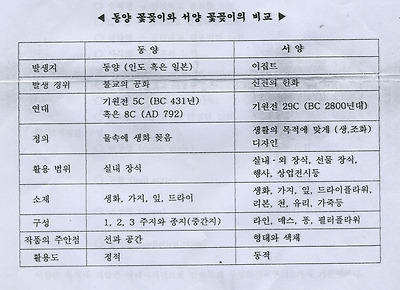


*입시 동양화를 잘 하기 위해서는 먼저 동양화와 서양화의 차이점을 정확하게 알고 그림에 임해야 할 것이다.


-동양화와 서양화의 차이점


동양화란 동양의(한국.중국.일본..등)전통적 기법과 양식에 의해 다루어진 회화를 말하며 서양화와 대별되는 용어이다.

동양의 문화권에 있어서 한국의 전통회화는 한국과,중국의 전통회화는 중국화, 일본의 전통회화는 일본화로 정한다.


-회화의 기본요소는 점, 선, 면인데


동양화는 획 즉 선의 예술로서 사물의 내부본질을 파악하는 것이며 화선지나 비단 등에 수간 안료를 사용하고 모필을 이용하여 그리며, 표현양식에 달라 수묵화, 수목담채, 채색화 등으로 구분되며 표현형식에 따라서는 문인화, 구상, 비구상등으로 나뉜다.  동양적 자연관과 철학에 바탕을 둔 회화관과 화론에 입각하여 그리는 그림이며 주로 중국의 전통 회화관과 아주 밀접한 관계를 갖고 있다.

서양화란 현상적으로 사물의 외부로부터 분석하여 체계를 세우려는 빛에 의한 면의 예술이라 하겠다. 재료적인 측면에서 유화, 수채화, 펜화, 목탄화, 콘테화, 연필화, 파스텔화, 크레용화, 과슈화...등이 있으며 표현형식에 따라 구상화. 비구상화로 나뉘며, 동양 문화권에 서양화가 알려지면서 동양의 그림(중국, 한국, 일본 등...)즉 동양화와 대별되는 개념의 용어이다.

동양화는 주로 객관적이고 사의적이며 되풀이하지 않고 한번의 터치로 그림을 그리는데 반해 서양화는 지극히 합리적이고 논리적이며 빛에 의한 명암법과 사실성에 중점을 두고 덧칠하고 긁고 깍아내는 그림 수법을 엿볼수있다. 동양화를 시작하기에 앞서 사혁의 화론을 숙지하고 이해하여야만 동양화에서 요구시되는 참맛을 표현할수있으리라 본다.


*사혁의 화론육법

:사혁은 AD510년경의 중국의 화가로서, 그가 세운 동양회화론은 이론에 있어서 가히 시조라 할 수있을만큼 고대회화를 체계적이며 과학적으로 정리했다. 그의 화품론은 후일 많은 화가들에게 영향을 끼쳤으며, 특히 이론적으로 후세에 지대한 영향을 미쳤다. 그가 저술한 고화품록은 육품론이 정리 된 것이며, 화품이란 화가들의 우열을 말하는 것으로 모든 화가들은 이 육품에 의해 서열이 정해졌다.


:화론육법

기운생도, 골법용필,웅물상형,수류부채,경영위치,전이모사, 등인데 그 뜻을 알고 그림에 임하여 한층 격있는 작품을 만들어보자...^^

1.기운생동...정기론에 근거하였고, 사물을 대할때 어떻게 기를 살려 표현할 것인가 하는 것으로 정신적인 감정과 공간적인 감각, 운율적인 감정, 생명감과 생동감등을 표현하는 문제이다.

2.골법용필...대상을 표현하는데 있어서 용필, 즉 붓의 사용을 뜻하는 것으로 골법이란 골자, 즉 뼈대를 말하는 것이며, 또한 운필이란 동양화에서는 생명과 같은 것으로 이 용필이 서툴면 그림은 생명력을 잃게 된다.

3.웅물상형...대상을 그리는데 있어서 윤곽을 정확하게 하여 형상을 사실적으로 표현하는 것을 만하며 윤곽과 정신이 일치했을때 비로소 형상과 내용을 표현할 수있다는 것을 의미한다.

4.수류부채...모든 사물에는 고유의 색채가 있으므로 채색을 바로 하지 않으면 그 물체의 빛깔을 잃어버리게 된다는 것이다. 느낌과 형태에 따른 색감을 회화적으로 잘 표현해야 한다는 것으로 필법과 윤곽, 생감이 잘 어우러져야 함을 말한다.

5.경영위치...화염의 포국, 즉 그도를 말하는데, 그림을 그릴때는 주제와 부 주제 등의 위치가 잘 위치해야 하고 또 다른 모든 사물들이 잘 배치, 배열되어야 함을 말한다.

6.전이모사...옛 선조나 스승의 그림을 모방하여 그리는 것을 말한다. 하지만 중국 육조시대의 그림공부는 이화로부터 시작했다고 하는데, 이화란 모사를 말하는 것이 아니라 자연의 경관을 어느 만큼 잘 옮겼는가를 뜻한다.

이처럼 사혁의 화론육법은 그 후 많은 화가들에 의해 연구 습득되어 발전하였으며, 화가 자신들의 생활과 경험속에 반영되어 왔다. 화론육법은 회화창작에서 요구되는 예술성을 계통적으로 지적해 냄으로써, 이때부터 창작또는 평론상으로 작품에 대한 우열을 가리는 기준이 되어왔다고 한다. 입시동양화 또한 위와 같은 화론에 입각하여 그림에 임한다면 좋은 작품평을 받을 수 있으리라 본다.


*선과 여백


입시에서 실기고사내용이 수묵담채화인데 여기선 선과 여백의 의의를 알아보자


-수묵화는 농담조차도 면으로 표현하지 않고 선으로 표현한다.

대상물의 색상을 뛰어넘어 그 내면의 기의 흐름은 어떻게 생동하는 것으로 표현할 것인가에 큰 비중을 두어야 한다.

남제의 사혁이 고화품록에서 주장하고 있는 당의 장언원이 화론육법에서 의미를 밝혀 기운생동을 첫째로 한것은 바로 기의 생동을 철학적인 고차원의 예술에서 해석한 것이다.


수묵화는 이와 같은 동양적 사고의 정신성을 나타내는 대표적인 예술이며 대상을 포착하여 마음으로 그것을 연소시켜 단순한 획(선)으로 화면에 정착시카는 것이다.


따라서 생략과 단순화는 수묵화의 가장 큰 특징이며, 그리지 않고 남겨 둠으로서 그리는 여백은 형상의 묘사에 그치지 않고 마음을 그리는 것이며 여백은 비어 있는 공백이 아닌 채워진 상태, 곧 표현의 저장인 것이다.


-동양화의 대표적인 수묵화는 표현방법이 대담하고 거침없는 필력과, 선의 단순함이 아닌 농담의 다양한 변화의 묘를 간직한 획(선)으로 그림을 그림으로써 세부적인 묘사를 암시적이고 은유적으로 처리한다. 그러므로 화선지에 붓을 대기전에 어덯게 표현할 것인가, 어떤 순서로 그릴 것인가 등의 기법 적인 면에서 계획을 세워 그림을 그려야 할 것이다.


따라서 사생(스케치 및 계획)을 충실히 하여 대상물의 형태나 그 성격을 잘 파악하고 대상을 자유자재로 그릴수있어야만 비로소 그릴수 있는 것이다.


선과 농담의 변화를 익혀보자


회화의 기본요소는 점, 선,면이다. 동, 서양화의 본질은 동일하지만 표현양식에 있어 동양화는 선의 예술이고 서양화는 빛에 의한 명암의 대비로 표현하는 면의 예술이라 할 수있겠다. 동양화에서의 선은 외곽형상의 의미에 그치는 것이 아니라 사물의 본질과 질감 및 양감을 함축적으로 표현하는 것이므로 그 뜻을 알고 필선의 운용에 유의해야 할 것이다.


수묵담채화에 있어서 중요한 것 중의 하나가 먹색의 짙음과 엷음을 적절히 사용하는 것이다. 먹색을 자유롭게 구사할 수 있어야 원하는 느낌의 그림을 얻을 수 있다.


물과 먹의 배율에 따라 그 변화가 수없이 많은데 적재소에 적합한 먹색을 올릴수있도록 물과 먹의 배합을 적절히 해주어야 하겠다. -먹색을 짙음, 중각, 옅음(농.중.담)으로 구분하여 3색이라고 하며 먹을 사용함으로써 나타나는 현상에 따라 검정, 짙음, 젖음, 마름, 엷음으로 구분한다.


다음은 동양화를 그리는 수법 중 붓 쓰는 방법과 그리는 방법 등을 알아보기로 하겠다.


-중봉...서예가나 화가드링 가장 선호하는  필법이며 붓을 다섯 손가락 모두 사용하여 단정하게 잡고 붓대를 지면과 수직으로 바로 세워 긋는 선이며 입시동양화에서는 주제부에 주로 활용한다. 주제의 부각을 꾀하기 위해서는 강직하고 힘차게 그어주는 것이 좋다.


-측봉...붓대는 80도 각도로 우측으로 기울여 운필하고 예리한 표현 및 경쾌한 맛을 살려 주기에 적합하다. 나뭇가지나 대나무 표현 등에 자주 쓰인다.


-역봉...위에서 아래로 긋거나 좌측에서 우로 긋는다든지 붓을 사용하는데는 누구나 습관이 있다. 이러한 운필의 방향을 상반되게 붓의 사용법을 익힘으로써 상하 좌 우 어느방향이든 자유롭게 선을 구사할 수 있게 된다. 대나무를 그릴때 아래서 위로 그리는 법이나 난을 그릴때 우측에서 좌측으로 뻗은 잎을 그리는 법 등이 바로 역봉법이다. 입시동양화에서는 사물의 방향성에 따라 많이 사용되는 필법이다.


-전봉...이 붓질법은 손목과 손을 자유롭게 움직여 손가락으로 쥔붓대까지 굴리거나 뒤틀면서 중봉,측봉,역봉 등을 서로 변환 교환하여 사용한며 풍부한 표현이 가능한 필법이다. 주로 넓은 면을 채색하기에 용이하며 항아리, 벽돌, 혹은 주전자 등의 표현에 활용하면 좋다.


-순봉...붓의 끝은 중봉처럼 중심에 가게 하되 붓대를 경사지게 하여 백합 잎이나 난초 잎혹은 둥근 형제의 정물표현에 있어서 쌍방향 진행선 등의 표현에 용이하다.


-파봉...붓긑을 거칠게 흩으려 붓질하는 법으로 한 획에 여러 갈래의 가는 선이 표현된다. 거친 사물의 질감 표현이나 솜털, 페인트 붓, 페인트, 로울러, 곰인형 묘사 등에 용이하다. 자칫 속기에 빠져 격이 떨어질 수있으니 신중해야한다.

-구륵법...선으로 물체의 윤곽을 그리는 방법이며 선의 강약, 굵거나 가는 여러가지 성질의 선으로 표현하는 묘법이다. 국화나 백합 그리고 대부분의 인공물을 표현할때 주로 사용하며 대체적으로 사물의 정돈된 느김이 장점이라 할 수있다.


간단한 선만으로 표현하는 백묘법과 먼저 채색한 후 나중에 선을 긋는 방법이 있고 먼저 선을 긋고 후에 채식을 하는 구륵 채색법이 있는데 전자는 화훼류에 적합하고 후자는 기물류나 질감이 견고하고 딱딱한 정물표현에 적합하다.


-몰골법..물체의 윤곽을 선으로 표현하지 않고 먹물이나 물감의 농담을 이용하여 그리는 방법이다. 먹물만을 사용하는 방법과 먹과 색을 병용하여 그리는 방법, 먹과 색깔을 혼합하여 그리는 방법, 색깔만을 사용하는 채색화등이 있다.


그냥 집에서 혼자 독학하시는 분들은 중국의 개자원 이라는 책을 사서 공부하는것도  하나의 방법이며 .많의 모방 ,,을 통하여 실력을 키워 나가는 방법이 있다고 할것이며,다른작가의 작품을 우선적으로 많이 보고 이해하는것이 먼저가 아닌가 생각한다.


동양화

축구관계로 수업을 빨리 끝나는 바람에 교수님(추계예대 김 지 현 교수)께 동양화에 대한 이론을 1시간 정도 강의 받았습니다.

동양화와 서양화의 차이점과 색에 대한 철학을 들을 수 있는 시간이었습니다.

조금은 어려운 말씀을 하시어 이해하는 데  조금은 ....

어째거나 동양화는 直觀 (직관)으로 보라는 말씀 ( 그 안의 것을 보라<내 생각>)이었습니다.

붓에 오색 육채를 표현한다고 합니다.

짧은 시간에 많은 것은 기억에 나지는 않지만 여기까지 입니다.

그럼 우리들의 직관을 감상하시지요


공판화

일명 스탠실 이라고도 합니다.

두꺼운 도화지에 밑그림을 그린 후 오려 붙혀서 선을 나타내고 싶은 곳에 덧붙여서 나타내는 것을 말합니다.

그럼감상하시지요


작가;이승희         작품명; 꽃과 나비 


작가; 신영준       작품명; 꽃밭에서


작가; 김철회     작품명; 꽃병


작가; 정구봉        작품명; 곰돌이


작가; 노경희          작품명;  오리가 태어났다


작가;  노병호           작품명; 슬리버


작가; 방혜옥          작품명; 사랑스런 꽃이여


작가; 이현숙         작품명; 금붕어


작가;             작품명; 연 꽃


작가;   민승기              작품명; 삼족오


작가;  장 광 복            작품명;  꽃다발


작가; 우경순           작품명; 미니 마우스


 작가; 민승기           작품명; 치우천황


전통적인 관점에서 본 동양화의 관찰방법


---진조복(鎭兆復) 著 <동양화의 이해> 중에서 요약


예술은 생활에서 비롯되는 것으로 회화예술의 표현문제는 먼저 현실생활에 대한 관찰과 인식에서 시작된다. 그러므로 관찰방법을 익히는 것은 그림을 공부하는 데 중요한 과정이다. 그러나 많은 동양화 연구자들은 그 표현기법에는 많은 관심을 보이나, 관찰방법은 크게 중시하지 않는다. 화가에게 눈의 훈련은 음악가의 귀의 훈련과 같은 것으로, 표현기법 역시 눈의 훈련에서 시작되는 것이다.


1. 걸으면서 관찰한다.


동양의 화가들은 어떻게 생활을 관찰하고, 또 어떻게 이를 창작과 연결시키는가? 이에 대한 많은 고사들이 전해오고 있는데 예를 들면 당(唐)의 현종(玄宗)이 가릉지방의 경치를 그리워하여 오도자(吳道子)로 하여금 그려오게 하였는데 오도자는 가릉지방을 둘러보고는 빈 손으로 돌아왔다. 현종이 그 이유를 물으니 `저는 비록 밑그림을 그리지 않았으나 모두 마음속에 담아 왔습니다`라고 답하였다. 훗날 오도자는 대동전이라는 건물에 벽화를 그리게 되었는데 여기에 3백여 리에 걸친 가릉지방의 풍경을 담아 하루 만에 완성하였다고 한다. 또 남당(南唐)의 고굉중(顧閎中)이 그린 <한희재야연도(韓熙載夜宴圖)>는 몇 개의 서로 다른 장면을 다른 각도에서 포착하여 연회의 장면을 묘사한 것으로, 각 장면들은 병풍을 이용하여 구분 짓되 자연스럽게 연결되도록 하여 한 작품으로 완성한 것이다.

이러한 고사들은 동양의 화가들이 그림을 그릴 때 어떤 고정된 시점에서 특정한 시야 안의 사물을 관찰하고 묘사하지 않음을 설명해준다. 화가들은 걸으면서 보고 생각하면서 대상의 각 방면을 관찰하게 되며, 그 후 대상을 떠나 대부분을 형상기억에 의해 창작을 하였다는 것을 알려준다.

서양회화와 비교하여 보면 그 차이점이 더욱 분명해지는데 전통적인 서양화는 사생을 중시하고 사생 때에는 특정한 시간과 장소, 일정한 거리와 각도에서 그 시야 안의 사물을 관찰하고 묘사한다. 그래서 화면 안의 명암과 색채의 변화는 특정한 시간과 공간의 객관적인 요소의 제한을 받게 된다.

동양화가들이 사용한 이동시점(移動視點)은 `마치 산이 가로 막히고 물이 끝나 길이 없을 듯하지만 버드나무 우거지고 꽃이 피어있는 사이에 또 하나의 마을이 있다`는 옛 시인의 시구와 같은 것이다.

초기 산수화에서부터 이동시점의 이른바 `산의 모습은 걸음에 따라 변하고``산의 면면을 모두 본다`라는 묘사방법은 이미 존재하였다. 동진(東晋)의 화가 고개지(顧愷之)의 <화운대산기(畵雲臺山記)>에서도 이에 관한 내용을 찾아볼 수 있다. 동양화는 그 화면에서 반드시 하나의 고정된 초점과 하나의 분명한 지평선, 혹은 수평선을 필요로 하지 않는다. 이것이 걸으면서 관찰하는 동양화의 관찰방법이다.

노신(魯迅)이 `서양인들은 그림을 볼 때 보는 이를 어떤 정해진 지점에서 감상하는 것으로 여기나 동양화는 그렇지 않다`라고 한 말은 바로 동양화와 서양화의 관찰방법 차이를 정확하게 지적한 것이다.


2. 모양을 버리고 정신을 취한다.


전통적인 동양미술은 대상이 되는 사물을 단순히 어떤 한 곳에서 생각하거나 관찰하거나 묘사하지 않는다. 관찰에서 묘사에 이르기까지 개괄과 취사선택을 거쳐야한다. 이것이 바로 `유모취신(遺貌取神)`이다.

동양화는 전면적인 관찰을 강조하면서 동시에 대담한 취사선택을 요구한다. 즉 정신이 깃들어 있는 부분은 될 수 있는 한 분명하게, 정확하게, 특출하게 공들여 표현하고 그 나머지 배경을 포함한 덜 중요한 부분은 최대한 간략하게 하거나 생략해 버리는데, 이러한 부분은 여백으로 대체된다.

일상생활에서도 자신의 이상이나 필요에 부합되는 것은 주의를 기울여 보고, 관계없거나 필요없다고 여겨지는 부분은 관심을 덜 갖게 마련이다. 그렇기 때문에 동양화가들은 기계적인 자연 모방을 경계했으며, 이러한 그림을 비록 자세하고 세밀하나 생기가 부족한 죽은 그림으로 간주하였다.

동양화가들은 현실을 관찰할 때 시종 느낌이 가장 크고 깊으며 가장 생동하는 면을 포착하였으며, 창작에 임할 때도 이렇게 포착한 것을 결코 잃지 않았다. 청(淸)나라 때 양주팔괴(楊洲八怪)의 한 사람인 이방응(李方膺)은 그의 매화 그림에 `분방하게 핀 매화 중 가장 마음에 드는 것은 단지 두세 개의 가지일 뿐이니, 그 두세 가지만 빼어나게 표현하면 될 것 아닌가`라는 시구를 적었다. 단지 그 가장 아름다운 두세 가지만을 화폭에 담고 나머지는 모두 화폭 밖에 놓아두어 보는 이들로 하여금 상상에 의해서 보충하고 발견케 한다.

‘유모취신’은 예술적인 중요한 형상을 돋보이게 하며, 동시에 보는 이에게 더욱 넓은 상상의 여지를 남겨주어, 눈앞에 펼쳐지는 경치 이외에 다하지 못한 또 다른 의미까지도 작품에 포함시키는 것이다.


3. 조직구조에 주의한다.


동양화가들은 각기 다른 시점, 다른 각도에서 느낌이 제일 강한 인상을 관찰하여 이를 하나의 화면에 돌출되고 과장되게 표현하기 때문에 작품에 종종 명암을 생략한다. 빛과 명암은 모두 객관적인 것들인데 왜 이를 표현하지 않는가? 그 이유는 작가가 사물을 관찰할 때 여러 각도에서 관찰하기 때문에 고정된 빛을 묘사할 수 없을 뿐 아니라, 서양화에서와 같이 빛으로 어두운 면과 밝은 면을 구별하는 방법을 사용할 수 없기 때문이다. 이렇듯 동양화의 관찰방법은 명암을 배제하고 대상의 조직구조에 주의하게 되어 있다.

동양화가는 작업에 임하기 전에 반드시 세밀한 관찰과정을 거쳐 대상의 생장법칙과 조직구조를 파악한다. 예를 들면 인체의 비례와 해부학적 규율, 바위의 체적과 질감, 나무의 생태 등을 자세하게 익히고 표현방법을 훈련한다.

동양화가들은 오랜 창작경험을 토대로 하여 대상의 각종 구조로 표현양식을 만들어내게 마련이다. 산수화에서의 각종 나무나 바위를 그리는 법과, 화조화의 여러 가지 새와 꽃의 조직구조와 그 화법, 인물화에서의 얼굴과 각종 옷주름을 표현하는 방법 등이 그것이다. 이러한 기본적인 규칙들을 익히고 난 후에야 비로소 현실에 대한 관찰 역시 바탕이 있게 되어 현실 중 어떤 것을 취하고 어떤 것을 버려야 할지 알 수 있게 된다.


동양화는 빛에 의한 명암의 변화보다 대상의 구조묘사를 중시한다. 수묵의 농담 변화, 선의 경중, 휘어지고 구부러짐 등은 모두 물체의 조직구조를 표현하기 위한 것이고, 밝고 어두운 선염은 단지 화면의 필요에 따라 배치하는 것으로 화면의 리듬감과 체적감을 증가시키기 위한 것이다. 묵죽(墨竹)을 예로 들면 일반적인 대나무 그림은 그 본래의 명암 변화는 무시되고 형태와 구조만으로 표현되어 왔는데 이러한 형태와 구조는 자연 상태의 대나무가 갖는 가장 본질적인 특징이다. 화가는 대나무의 생장법칙과 그 특성을 잘 이해하고, 필묵의 기교 또한 완전히 숙련한 후에야 비로소 모필(毛筆)이 화선지에 닿을 때마다 줄기, 잎이 드러나고 또 서로 어우러져 바람에 흔들리는 자연스러운 자태를 표현해 낼 수 있다.


Uniqueness of Korean Cusine I


(5-3, p. 4)

 
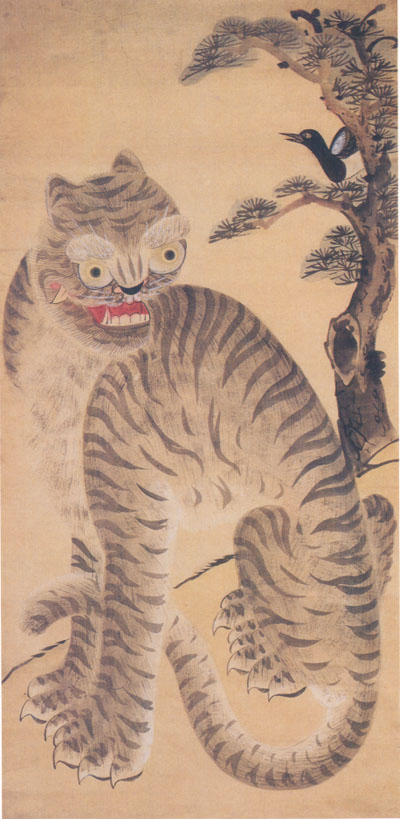
Plate 9. Tiger and Magpie (Yi dynasty, ninteenth century); ink and color on paper; 34.25 x 16.5 inches, exclusive of mounting; lent by Mrs. Carl L. Selden; loan no. L81.18.


In 1973, when I began working at The Brooklyn Museum, no Korean art was on display. The Oriental galleries occupied a relatively small space on the second floor in the east wing of the building, as they do today. The Oriental installation consisted of a Chinese gallery, a Japanese gallery, an Indian gallery, a tiny Himalayan and Southeast-Asian gallery, and an extensive Islamic gallery.

Most of my first six months at the museum were spent examining the unexhibited objects kept in the storeroom of the Oriental Department. This cavernous vault was crowded with rickety wooden shelves from floor to ceiling, and covered with a thick layer of greasy dust deposited by the New York City air over a period of several years. The storeroom contained thousands of objects from all over Asia; sorting them out was like a treasure hunt. Several hundred of the stored objects had never been catalogued, nor even assigned accession numbers and recorded. Unrecorded objects such as these are anathema to an art musuem; if one were to disappear there would be no trace of it. Thus our first priority was to register and catalogue these unrecorded pieces. Most of what we found was of poor quality, but there were also a few surprisingly good pieces; to my considerable delight these included several good Korean items.  
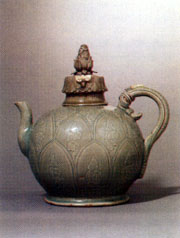
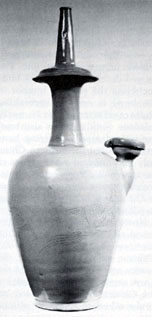
Plate 5. Ewer (Koryo dynasty, twelfth century; celadon porcelain; 9.87 x 9.5 inches, including lid; gift of Airs. Darwin R. Jarnes III; accession no. 56.138.la&b. According to family tradition, this ewer was presented to the Underwood family by the Korean royal court.

The next task which presented itself was the renovation of the Japanese gallery, which was formerly a boxcar-like hall located between the Chinese gallery and the Himalayan room. The lighting of this gallery was clearly inadequate. Moreover, its display cases had been poorly designed: opening one required a crew of several (5-3, p. 6) men using large suction-cup handles to lift off eighty-pound sheets of plate glass. This had proved so cumbersome that installations had seldom been changed, and dead insects accumulated. A grant of thirty thousand dollars from the National Endowment for the Artseven in 1974, only enough to pay for materialspermitted the renovation to begin. The museum matched these federal funds with salary money for the staff carpenters, electricians, and painters. Since the storage collection had yielded several good Korean pieces, and since no other New York museum has a permanent display of Korean art, it was decided to sacrifice one-fourth of the old Japanese gallery space in favor of a Korean gallery. It seemed logical to situate the Korean gallery between the Chinese gallery and the Japanese galleryKorea having been a frequent transmitter of Chinese influences to Japan.

The new Brooklyn Museum Korean and Japanese galleries are handsome, functional display areas with welllit, built-in cases having plate glass doors sliding on ball bearings, easily openable by one member of the staff. This facilitates rotating the installations more frequently. Aesthetically the new galleries have a contemporary, modular look, but they also utilize natural wood framing around the cases and across the ceiling to lend a traditional Far Eastern flavor.


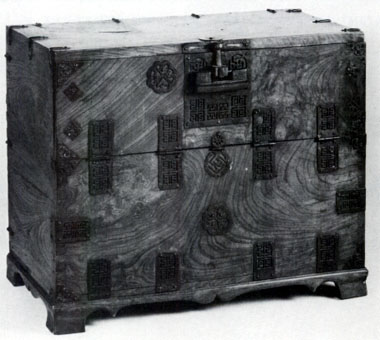
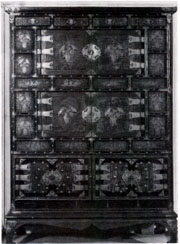
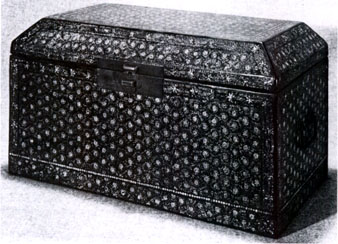
Plate 2. Blanket Chest Yi dynasty, nineteenth century); zelkova wood top, front and sides, pine back, iron hardware; 25.75 x 17 x 30 inches; source unknown; accession no. X652.3.


Misidentified Objects

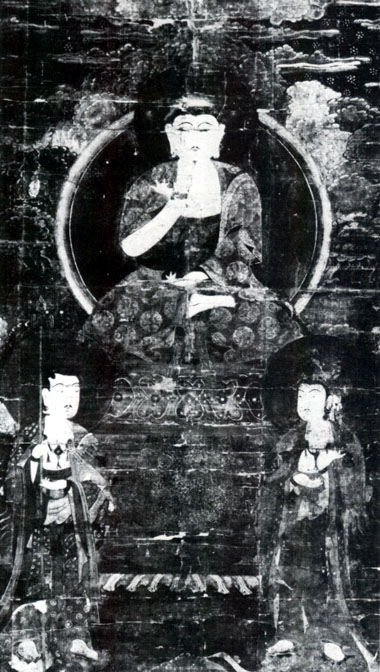
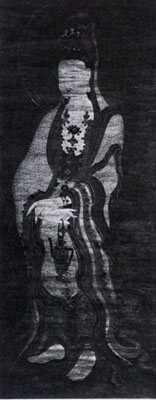
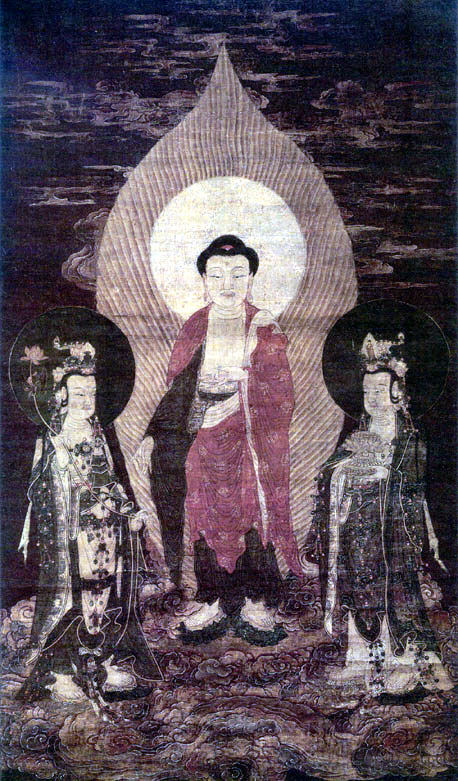
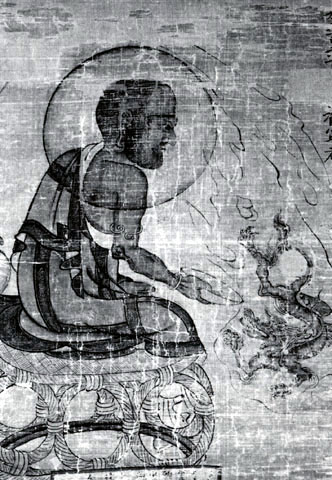
While preparing the inventory of objects in the storeroom, we discovered that a number of Korean items had been misidentified. A Koryo dynasty (918-1392) Buddhist painting purchased in Japan during the 1950s was catalogued as Chinese (pl. 1). It had been ascribed to the Song (Sung) dynasty (960-1279), and attributed to a painter named Chang Ssu-kung, whose name is inscribed on the old Japanese paulownia wood storage box in which the scroll was kept. This attribution was not surprising: many Koryo Buddhist paintings in Japanese temple collections were formerly identified as Song. These paintings had reached Japan from Korea during the thirteenth

 
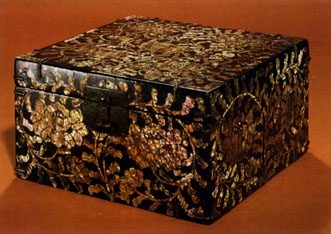
Plate 3. Clothing chest (Yi dynasty, eighteenth century); black and red lacquered wood frame, zelkova root burl front panels, cypress side panels, brass fittings; 63.13 x 49.75 x 29.75 Inches; George C. BrackettFund; accession no. 3 .530.

through sixteenth centuries by trade or pirate raids or Hideyoshi's invasions. Only in the last few years have Korean and Japanese scholars correctly reattributed them to the Koryo period. Not many Koryo dynasty Buddhist paintings have survived in Korea itself; in Western collections there are fewer still. In the United States, the Boston Museum of Fine Arts, the John D. Rockefeller III Collection, the Freer Gallery, and the Avery Brundage Collection own examples.

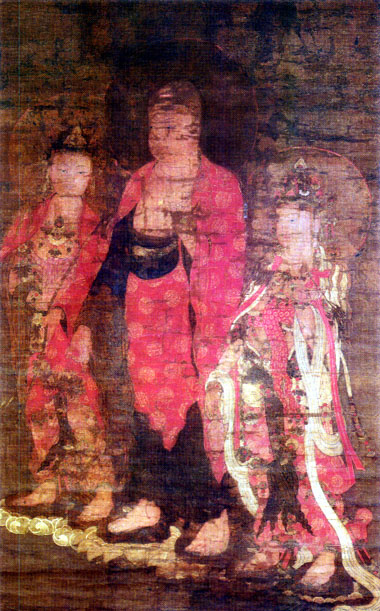
Among other misidentified objects was a typical Yi dynasty (1392-1910) Korean blanket chest, which had been catalogued as Ming dynasty (1368-1644) Chinese (pl. 2). This attribution (5-3, p. 7) was really quite surprising, since no type of Chinese furniture from the Ming or any other dynasty bears a resemblance to the ubiquitous Korean blanket chest, with its drop-front and openwork iron fittings. A splendid large Korean clothing chest in Brooklyn had been correctly identified as Yi dynasty furniture (pl. 3). Unfortunately, however, it had never been put on exhibition, or even consigned to the storeroom. Instead, it had stood for years in a hallway on the sixth floor of the building, where there are offices but no galleries. It was also surprising and unfortunate that a fine early Yi dynasty Buddhist painting in The Brooklyn Museum had been catalogued as Kamakura period (1185-1392) Japanese (pl. 4). Numerous details of its style-notably the small diameter of the necks relative to the full faces-are distinctly Korean and unlike those of any period in Japan.


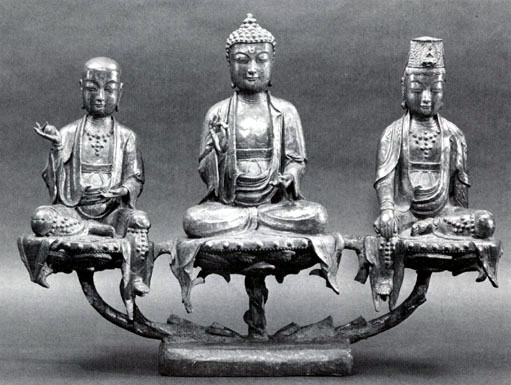
Plate 9. Amitabha Buddha flanked by the bodhisattvas Avalokiteshvara and Ksitigarbha (Yi dynasty, sixteenth century); ink and color on silk; 36.31 x 20.87 inches, exclusive of mounting; source unknown; accession no. X715.


Prior to 1974, only one of Brooklyn's Korean objects had received some of the attention it deserves (pl. 5). Although not on display in the museum, it became well known among experts in Korea, Japan, the United States, and Europe, and has been published several times. This glorious Koryo celadon ewer is acknowledged to be one of the finest of its type in the world. But alas, almost nothing is perfect! The ewer has a long, 'S'-shaped crack from top to bottom on the right side, so it is always photographed and exhibited from the left.

When I first examined the ewer in 1973, 1 concluded regretfully that it had an additional problem: the lid was from a similar ewer but was not the original. The incised decoration and dots of white slip matched, but the glaze color was quite different. The ewer itself displays the best 'kingfisher blue' color, while the glaze on the lid is more olive in hue. Fortunately, a visiting Korean expert subsequently corrected my error. He pointed out that the lid is in fact the original; it was simply fired in a slightly different position within the kiln-perhaps no more than one foot away from the ewer itself-and the difference in heat and degree of reduc- (5-3, p. 8) tion were sufficient to produce the difference in glaze color.

 
Plate 1. Amitabha accompanied by the bodhisattvas Avlokiteshvara and Samantabhadra (Koryo dynasty, thirteenth century); ink and color on silk; 51.25 x 32.25 inches, exclusive of mounting; gift of Professor Harold Henderson; accession no. 61.204.30.


Ethnography and Art

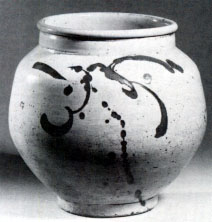
Among other treasures to have entered Brooklyn's collection at a relatively early date is a magnificent middle Yi storage jar decorated in underglaze iron (pl. 6). The iron oxide/water mixture was partly brushed on and partly dribbled on'abstract expression‎!ism three centuries before Jackson Pollack.' The resulting design is so spontaneous and stylized as to seem virtually non-representational. In seventeenth-century Korea, however, it had to be a picture of something. One thinks of a tree, a willow perhaps, with painted branches and dribbled trunk. Nevertheless, comparison with other jars of this type suggests that we are looking at the familiar dragon-in-clouds motif reduced to its most abbreviated form.

It is intriguing to note how early this storage jar entered the Brooklyn Museum collection. Its naive, spontaneous design looks so contemporarythe very antithesis of the late Victorian taste prevailing in 1917. How prescient Brooklyn's early curators seem to have been. But no; not really. There is another explanation. Until about 1930, the Brooklyn Museum was a general museummore of a science museum than an art museum. The anthropology department was especially active. The Korean storage jar was acquired as an ethnographic specimen rather than a work of art. Around 1930 the museum's board of governors decided to turn The Brooklyn Museum into an art museum. No doubt they felt the general museum was an outmoded, nineteenth-century concept. An art museum would lend far greater prestige to the Borough of Brooklyn. All the rocks, stuffed animals, birds and fish were shipped off to the American Museum of Natural History in Manhattan. But fortunately by 1930 Picasso had taught us that so-called primitive art is more than mere ethnography. Thus The Brooklyn Museum has one of the oldest and best collections of African sculpture in America. It was collected in the field as anthropological material (5-3, p. 9) around 1910, but kept here as art after 1930. The same is true of tire Yi storage jar. During the past ten years every effort has been made to add significant pieces to Brooklyn's collection of Korean art whenever possible. On several occasions, pieces have been acquired through extraordinarily good luck, as happened when a retired U.S. army sergeant walked into the museum with a keryongsan bowl (pl. 7). The bowl had been broken in ancient times and repaired with pitch, then broken again in more recent times and discarded.


Plate 6. Storage jar (Yi dynasty, seventeenth century); stoneware; 9.5 inches in height, 9.87 inches in diameter; Museum Collection fund; accession no. 17.21.
 

During the Korean War the sergeant had been in charge of a bomb-disposal squad, which dug up unexploded shells and defused them. He had discovered and excavated the broken bowl himself, while searching for a buried shell. After his retirement the sergeant, who lived in New Jersey, decided to sell the bowl. He first approached the Newark Museum, whose curators, in turn, very kindly referred the sergeant to us. The price was nominal, so, with the help of an anonymous donor, we were able to acquire the bowl for the museum.

As presented to the museum, the sergeant's keryongsan bowl was broken in nine pieces. Fitting them together, we found the breaks to be clean;

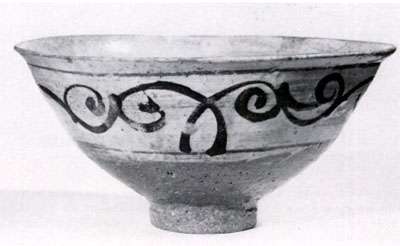
fortunately none of the fragments were missing. The museum's conservation department removed the pitch from the old repair and reassembled the fragments into a complete keryongsan bowl, decorated with a design of scrolling grasses in

a painted iron underglaze over brushed white slip. It may be argued that this type of keryongsan bowl is among the rarest and most beautiful of all Korean ceramics. While Koryo celadon is well known in the West and possesses undeniable elegance, it is ultimately an extension of forms and techniques developed in Song dynasty China. By contrast, punch'ong ware—and expecially keryongsan ware—is a more indigenous form of ceramic art whose spontaneous energy perfectly expresses the vitality of the Korean people. The sergeant's reassembled bowl, an excellent example of its type, is now one of the great treasures of The Brooklyn Museum's Korean collection.


Plate 7. Keryongsan Ware Bowl (Yi dynasty, fifteenth century); stoneware; 3.13 inches in height, 7 inches in diameter; anonymous gift; accession no. 83.32.5.


Perishable Material

The efforts of the Department of Oriental Art to obtain Korean objects have frequently been hampered by a lack of purchase funds. Of the eight curatorial departments in The Brooklyn Museum, six have endowment income for acquisitions, two do not. In order to overcome this lack of an endowment, a few of the more recently acquired Korean works of art have been purchased directly with deaccessioning funds; that is, funds obtained by the sale at auction of unexhibitable material from the storage collection. While preparing the inventory of objects in the basement storeroom, we set aside a number of items for subsequent deaccessioning. These pieces were left over from the old anthropology collection and were not works of art, nor folk art, nor artistic crafts, but strictly utilitarian or merely decorative objects with no function in an art museum context. Other items were deaccessioned because of ruined condition, or because they, were fakes. While this type of material is of no interest to the museum, there is a considerable demand for it by the New York interior decorator trade. Proceeds from the sale of deaccessioned objects are used for the purchase of works of art for the curatorial department from which the deaccessioned material came.

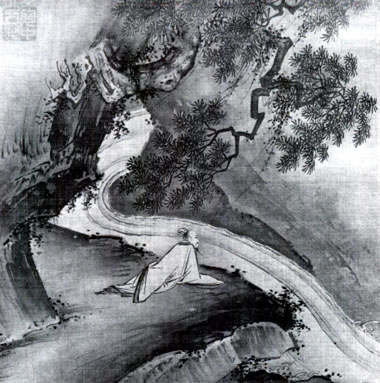
In this way the Department of Oriental Art was able to purchase an important sixteenth-century Korean ink-wash painting (pl. 8). Such paintings are extremely rare outside the collections of major museums in Korea. They were painted on perishable material; only a few have survived the ravages of time, war, and the relatively casual treatment that scroll and screen paintings used to receive in Korea, as compared to China and Japan. Among the small number of early Yi dynasty ink-wash paintings to reach the Westususally by way of Japanthe majority have been misidentified as Chinese and remain so today. Professor Shujiro Shimada has (5-3, p. 10) been active in correctly reattributing many of them to Korea.

Fifteenth and sixteenth-century ink-wash landscape painting in Korea and Japan is a fascinating field of study. This painting tradition was ultimately based on the landscape styles of Ma Yuan and Xiagui (Hsia Kuei), the two principal artists in the Imperial Painting Academy of the Southern Song court at Hangzhou (Hang Chou). During the succeeding Yuan (1279-1368), Ming, and Qing (Ch'ing; 1644-1912) dynasties, the academy style and its derivatives came to be castigated by the literati painters who became the leading artists. The influence of these artists was pervasive because they were also the art critics of their time. Nevertheless, the style of Ma Yuan and Xiagui was kept alive throughout the Yuan dynasty by artisan painters in the port city of Ningbo (Ning-po) and elsewhere. Despite the contempt in which it was held by the literati artists, therefore, the old Southern Song Academy land scape style was transmitted by Yuan artisan painters to the Zhe (Che) School of the Ming dynasty. By this time the style had lost most of its original restraint, refinement, and philosophical depth.

Due to the impact of the Mongols of the Yuan dynasty upon Korea, aspects of the Southern Song Academy and Yuan artisan-painter style were transmitted to Korea as well. In Korea this style coalesced with elements of the earlier Northern Song landscape style, with its greater vertical emphasis. The Northern Song style had persisted in northern China after the Song court fled to the south in 1126. This residual Northern Song landscape style spread to Korea because of geographic proximity and trade. What emerged in fifteenth-century Korea, then, was an ink-wash landscape painting style that combined Northern Song elements with Southern Song Academy, Yuan artisan, and Zhe School elements. Korea played a much larger role in trans mitting this style to Japan than has generally been acknowledged in the past. This Korean landscape style was, for instance, very influential on the development of Muromachi period (1392-1573) suiboku painting in Japan. One of the most influential Japanese masters of this style was the Zen painter-monk Shubun, who traveled to Korea in 1423-1424 to obtain a set of printed Buddhist scriptures for his monastery. While in Korea he was profoundly influenced by the work of painters there. Also, a few Korean painter-monks were migrating to Japan in those days.


Plate 8. Chinese Scholar Viewing Rapids (Yi dynasty, sixteenth century); ink on silk; 11.25 x10.87 inches, exclusive of mounting; Restricted Income Fund; accession no. 75.130.


Indigenous Expression‎!

Most recently, Brooklyn's Department of Oriental Art has concentrated on the acquistion of Korean folk art. Although this is one of the liveliest forms of Korean art, outside a few Korean and Japanese collections it has also been the least understood, least appreciated, and least collected. Even in Korea itself, the appreciation of folk art is of remarkably recent vintage, going back no further than the middle 1960s. Korean folk art's great advocate is the Harvard-trained Korean architect-collector-scholar, Cho Cha-yong, known in the West by his pen name 'Zozayong.' His many books and articles in English on the subject of Korean folk art-and folk painting in particular-have opened the eyes of the Western world to this delightful tradition. Prior to Zozayong, a handful of Japanese scholars and collectors were the only people in the world to admire Korean folk art. These men were associated with the Japanese Mingei (folk art) Movement, founded in 1918 by the artcritic and philospher Yanagi Soetsu. (5-3, p. 11) Yanagi, in turn, had been influenced by the ideas of William Morris, founder of the Crafts Movement in England.


In most countries, folk art constitutes only a minor artistic tradition. In Korea during the Yi dynasty, however, folk art became a mainstream tradition. The qualities that make Yi dynasty art so satisfying to contemporary taste and so uniquely Korean permeate its folk art much more fully than they do its scholar paintingthe latter having been based so closely on Chinese literati models. Korean folk  

art embodies many admirable characteristics of the Korean people themselves: directness, ruggedness, spontaneity, naivete, charm, strength, richness, and vitality. Free from the need to imitate Chinese models, Korean folk art was a fully indigenous expression‎!. The marvelous, biting, acrid harmonies of outrageously bright colors found in Korean folk painting and embroidery, for example, are entirely unique to Korea. Yi dynasty folk art is the purest expression‎! of the native artistic genius of the Korean people.

Korean folk paintings provided joyous decoration in all but the poorest Yi dynasty homes. Korean screens were usually single eight-panel screens, unlike the more familiar pairs of six-panel screens in Japan. Folk painting screens, hanging scrolls, and unmounted paintings to be tacked up on the wall, were enjoyed by all classes of Koreansfrom peasants through merchants to scholar-bureaucrats and even the royal court. Thus Yi dynasty Korea was the only sophisticated culture in the world where folk art was used by all classes of society.


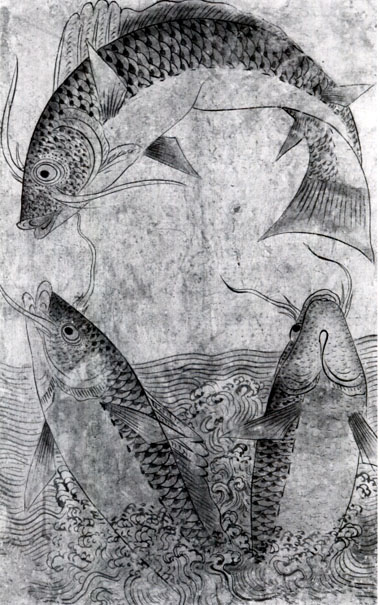
Plate 10. Three Jumping Carp (Yi dynasty, nineteenth century); ink and light color on paper; 25.5 x 15.75 inches, exclusive of mounting; gift of Mr. and Mrs. Burton Krouner; accession no. 82.79.


Bestiary of Symbolic Creatures

In addition to their decorative function, most Korean folk paintings had a magical purpose as well: to repel evil spirits or attract good fortune. Among the most frequent subjects of Korean folk paintings were animals from a fascinating bestiary of symbolic creatures, some real, some imaginary. Of these, the tiger is the most prominent. In ancient times, real tigers used to prowl the mountains of Korea; (5-3, p. 12) not big Bengal tigers, but smaller cousins the size of bobcats. The tiger became the most potent evil-repelling animal in the Korean bestiary. A tiger painting was displayed in the home at New Year's to protect the family from evil throughout the coming year. In the iconography of Korean shamanism, the tiger was also the messenger of the Mountain Spiritthe most popular shamanistic deity because of his power to grant the male children all Korean wives were required to produce.

Brooklyn's delightful tiger painting is a promised gift from one of the museum's board members (pl. 9). Here the tiger as messenger of the Mountain Spirit appears together with the magpie, messenger of the Village Spirit. Traditionally considered the bearer of good tidings, the magpie portends good fortune for the coming year. On another level, a magpie and tiger painting is satirical: it suggests a commoner taunting a corrupt, oppressive government official. The tiger sits on his haunches, angry and frustrated, while the magpie abuses him from the safety of a pine tree.

The carp was also a popular subject in Korean folk paintings and decorative arts (pl. 10). Korean artists borrowed the carp from China, where it symbolized courage, perseverance, and success. While the symbolism remained the same, however, the carp was more preval‎!ent as an art motif in Korea than it had been in China. Like salmon, carp swim upstream to spawn, struggling against currents, fighting rapids, leaping over waterfalls, jumping again and again until they clear the falls or die in the attempt; hence the symbolism. In China it was said that the carp in the Yellow River who managed to swim all the way upstream past the rapids at Longmen (Lung Men; Dragon Gate) would turn into dragons and ascend to the sky. jumping carp paintings such as Brooklyn's were common in Yi dynasty homes, but not many have survived. Such a painting was hung on the wall above a bride's bed to induce her to dream of a jumping carp or a dragon; this kind of dream signified that she would give birth to a son, and that he in turn would lead a successful life. A carp painting was also displayed in a boy's room to inculcate those qualities symbolized by the carp: courage, perservence, endurance, vigor and success.

Among Brooklyn's most recent and splendid acquisitions is a pair of Yi dynasty polychromed wood altar attendants (see rear cover). These charming figures represent Taoist immortal youths who never age beyond boyhood. They originally stood on an altar table to either side of a painting of the Mountain Spirit or some other deity in one of the side shrines of a Buddhist temple-Korean Buddhism having accommodated some of the most popular shamanistic and Taoist deities into its own pantheon. One of the attendants looks like a waiter with a white napkin over his arm supporting a tray of (5-3, p. 13) food with a domed cover. Actually the 'tray' is meant to represent a porcelain bowl, and the 'cover' is the Peach of Immortality presented as an offering to the deity. The other attendant offers the Tortoise of Longevity.

The Peach of Immortality is an old Chinese Taoist longevity symbol that appears frequently in Korean folk art. A person who eats one of these peaches will live for 3000 years. But such peaches are hard to find; they grow only in the orchard of So Wangmo (Chinese: Hsi Wang-mu), Queen Mother of the West, head of the Taoist fairies, at her palace in a remote fairyland high in the K'un Lun Mountains of Central Asia.


Plate 11. Wine Bottle (Yi dynasty, eighteenth century); blue-and-white porcelain; 11.75 inches in height, 6.25 inches in diameter; gift of Mr. and Mrs. Milton R. Rosenthal; accession no. 81.10.


Longevity and Expansion

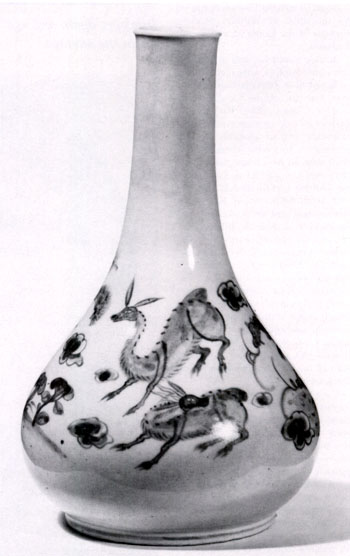
Finally, nothing could be more auspicious than Brooklyn's most recent Korean acquisition, a blue-and-white porcelain wine bottle (pl. 11) displaying all of the Ten Symbols of Long Life. Screen paintings of this subject are not uncommon, but it is quite unusual for all ten of the symbols to appear on one ceramic. Normally only two or three would be used to decorate a piece of porcelain. The Ten Symbols are: sun, clouds, water, rocks, deer, cranes, tortoises, pines, bamboo, and Sacred Fungus. The theme is Taoist and was popular in China as well as Korea.

The sun, clouds, water, and rocks last forever and thus suggest longevity. Deer are the companions and messengers of the Taoist Immortals; a pair of deer symbolize conjugal bliss. Cranes are also companions and messengers of the Immortals, who fly on the backs of cranes when traveling between the Islands of the Immortals and rest of the world. The Taoist tortoise is said to live for ten thousand years. Some giant sea turtles do in fact live for several centuries, so the tortoise became a fairly obvious longevity symbol. The tortoise is also the messenger of the Dragon King who dwells in the Dragon Palace at the bottom of the sea.

A pine tree remains green throughout the year and resists wind, rain and snow. Bamboo also stays green through the winter; it is hard and durable, bowing before the wind but never breaking. The mythical Sacred Fungus (Chinese: ling chih; Korean: pulloch'o) is perhaps the ultimate longevity symbol and became one of the most frequent Korean design motifs of all. It is the Fungus of Immortality, a magic mushroom that grows in the Land of the Immortals and bestows eternal life on those who eat it. In early times Taoists searched the forests for it. The Chinese Emperor Ch'in Shih Huang Ti (246-210 B.C.) sent an expedition of three thousand men across

  the Yellow Sea to find the mythical Islands of the Immortals and bring back some of the Sacred Fungus. The expedition never returned. Koreans believed it reached Korea and remained there, happy to escape Ch'in Shih Huang Ti's oppressive rule. Korean ginseng is traditionally equated with the Sacred Fungus.


The Brooklyn Museum's Korean collection has grown so rapidly during the past ten years that only a small portion can now be displayed in the Korean gallery. Fortunately, the cases of the new gallery have enabled the museum's staff to rotate the installation every few months, so that returning visitors may view a wider selection of the museum's Korean objects. Even so, expansion is rapidly becoming a necessity, and plans are now being made to increase the size of the Korean gallery as soon as additional space becomes available in the building.


Robert Moes studied Indian and Chinese art at the University of Michigan, taught Japanese art at the University of Hawaii, and served as curator of Oriental art at the Denver Art Museum before taking the equivalent position at The Brooklyn Museum. He resides in Brooklyn, and professes a love for Korean art, especially Yi ceramics.


Korean Cultural Center, Los Angeles


(15-4, p. 14)

By Clarence W. Kelley


In January of 1929, the cornerstone of The Dayton Art Institute was laid on its present hill site over-looking the Great Miami River across from downtown Dayton. Since its establishment, the Institute has actively developed its Asian collection, and overall the strength of this collection lies in its ceramic holdings. This article will examine a selection of the Korean ceramics in the collection. While a few works were purchased with funds provided by a private donor, the majority were donated. Most of the gifts reflect the generosity of Mrs. Virginia W Kettering, a patron and avid supporter of the Institute's Asian collection.


Figure 1: Wine Bottle, 17th century
Porcelain with underglaze cobalt
blue decoration
  The cultural heritage of Korea has been strongly shaped by migrations of influence from the Asian mainland. The geographically strategic position of the Korean peninsula has also made it a cultural link between the mainland and Japan—a link that was established early on in the human migrations. From the west, for example, Korea's Neolithic legacy shares many artistic and linguistic similarities with the peoples of North Asia, while later, more sophisticated earthenware and stone implements reflect the influences of China's Eastern Zhou period (ca. 771-221 B.C.) on the early tribal groups of the peninsula. To the east, Neolithic Korean pottery shards resemble the earthenware works of the Japan's Jomon period (ca. 10,500-300 B.C.) and skeletal remains suggest a shared racial ancestry. Ceramic technology, calligraphy, and such religious and philosophical systems as Buddhism and Confucianism represent other cultural migrations that traversed the peninsula.

(15-4, p. 15)

Figure 2: Wine Flask, late 14th/early 15th century
Porcelaneous stoneware with iron-black glaze


(15-4, p. 16)An early Chinese presence on the peninsula was concentrated at Luolang, an outpost of the Han dynasty (206 B.C.-A.D. 220). Established in 108 B.C. by Emperor Wudi, Luolang (Nangnang) flourished on the profitable trade links between the Chinese empire and the Japanese islands. Following the collapse of Han rule, nomadic bands from North Asia raided the Chinese territories on the Korean peninsula and, in the turmoil of military campaigns, the Koreans captured Luolang in A.D. 313, marking the beginning of the Three Kingdoms Period (313-668) in Korean history.

Three Kingdoms Period (313-668)

The earliest Korean ceramics in the collection date from the fifth and sixth centuries during the Old Silla Kingdom. These are a pair of covered stem cups with high, perforated feet. Sometimes called pedestal bowls, the covers are themselves an ingeniously inverted bowl with a short, single-tiered foot, also perforated. The elevated shape is likely derived from the Chinese dou form found in both ancient bronzes and Han period lacquers. The Korean version with its vented foot is typical of the period, and the openings allowed smoke to escape when placed over a fire. These pedestal cups are found in abundant numbers throughout Silla burials, and the similarities in dimension, form, color, decoration, and potting tends to indicate a strong production industry during the period.

Until 562 when they were assimilated by the Silla kingdom, there was a loose confederacy of clans known as Kaya along the southern coastal region of the Korean peninsula. The Kaya Confederacy had strong ties to Japan, which by some accounts had maintained a colonial trading post in the area since the midfourth century. The confederacy was an important conduit for the exchange of ideas and goods between Asia and Japan, a cultural relationship that is strongly reflected in the racial ties of the dominate Yamato clans of Japan to Kaya.

One important cultural exchange along this linkage was the advanced technology of Kaya kiln firing. The nature and lay of the Korean climbing kiln permitted a temperature of approximately 1200 degrees centigrade, thus achieving a stoneware hardness previously unknown in Japanese ceramic production. An example of the more highly vitrified Korean pots is a handsome storage jar. Similar in clay composition and decoration to the stem cups, these jars were used mainly for grain storage. A domed, globular lid, now lost, would have likely completed the jar. The jar has vitrified to a stoneware hardness and burned to a dark, grayish color. The incidental lustrous tones covering parts of the surface are the result of wood ash moving up the kiln and deposited on surface areas facing the updraft.

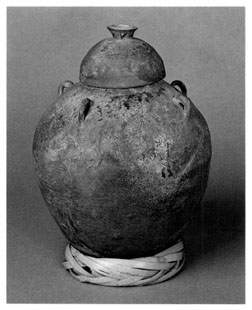
A similar jar in the collection served a rather different purpose—one tied to Buddhist practices. (Figure 3: cinerary jar) Buddhism had been introduced into the Silla kingdom by the fifth century and was officially sanctioned in 527. It substituted cremation rites for coffin burials, and from this period increased numbers of cremation urns have been recovered. Our cinerary jar is decorated with five lugs on the shoulder and has a cover in the shape of an inverted, footed bowl with perforations, much like the earlier storage jar and pedestals cups. While a new function in the daily rituals of life has been introduced, the art form here reflects the conservative strength of Korean art. The vessel is additionally decorated with delicate paddle markings, the result of being beaten with a wooden mallet with carved striations on the head. The striations also helped to prevent the paddle from adhering to the damp clay surface. No attempt was made to form a design pattern with the paddle markings, and the rather casual nature of the design is typical of Korean pottery of this period. There are traces of a natural ash glaze covering the body, again a result of the drifting gases in the kiln.

Unified Silla (668-918)

With the arrival of Buddhism, new art forms were also introduced. The shape of a covered bowl recalls the burial mounds or stupas of India whence Buddhism originated. The abundance of such bowls dating to this period attests not only to their popularity, but to the evolving strength and dissemination of Buddhism on the peninsula.

The seventh century—the date of the covered bowl—was a period of political transition in Korea. Although the peninsula was unified by Silla in 668, artistically many local and traditional idioms continued unabated. While the stupa-shape of this bowl illustrates the changes taking place in Korean art, there are elements present that likewise reflect the constancy of Korean ceramics at a time of political upheaval and consolidation. For example, the rounded contours and harmonious unification of the vessel's parts reflect the legacy of Old Silla pieces. Artistic continuity is also present in the overhanging lip of the cover and in the lid's rolled and slightly flattened finial, which allows the cover to be inverted and used as a shallow bowl. Potting tech- niques, the gray stoneware, stamped and incised decorations, and a natural ash glaze found throughout Old Silla pieces continued to be used by potters of the Unified Silla period.

The sophistication of this piece in highlighting a transitional date from Old to Unified Silla is also attested by the low and only slightly flaring foot. This design replaces the once elevated and perforated foot of earlier bowls and is very likely a (15-4, p. 17) result of Chinese influences. The decoration, while retaining the incised horizontal bands that emphasize the circular nature of the object, consists largely of a new artistic motif not found in Korean ceramics until the seventh century: rows of circles stamped into the wet clay and each impressed with a dot in the center. Stamped designs would begin to replace incised line decoration in Korean ceramics.

The squat yet fluent lines of the bowl's silhouette also reflect the pervasive influence of China's Tang dynasty (618-907) on the peninsula. Silla had allied itself with Tang China against its Korean rivals, Paekche and Koguryo. Following the conquest of Koguryo in 668, the Chinese and Silla armies each sought control of the peninsula. Silla, with the assistance of its defeated rivals, held the Chinese at bay, but thereafter sent an annual tribute to the Tang court.

Changing Artistic Tastes

Another seventh century piece in the collection is a vessel whose size and shape indicate its use as a wine flask. (Figure 4: wine flask) While the grey-colored clay and natural ash glaze are traditional elements, there are hints of the changing artistic tastes of the seventh century. For example, the decoration is stamped rather than incised, and the more elaborate and boldly shaped design of the jug indicates the introduction of a new stylistic idiom. Although only six inches in height, there is an appealing and dramatic quality to this flask. The thick neck flares open with a wide mouth and is decorated with incised circular bands and stamped, pendant triangular flags with raised dots, similar to that of the stupa-shaped bowl. The body has been slightly compressed, its rotund silhouette echoing the generous lines of the wide mouth.

One characteristic trait of seventh and eighth century Korean ceramics is the increasing tendency to cover the entire surface with adornment. This included applied elements such as lugs, buttons or projectiles, or an all-over surface design of stamped circles, dotted lines and geometric floral motifs. During the Unified Silla dynasty, stamped designs became the preferred and later the standard form of decoration, replacing the earlier, incised techniques of the Three Kingdoms period. A result of this, however, was that designs eventually tended to be more mechanical in nature, replacing the erstwhile casual temper of designs found on works from the Three Kingdoms period. A Unified Silla example of this proclivity is a simple yet elegantly, patterned storage box and lid. The stamped designs of radiating circles, floral motifs, geometrically shaped pendants, and circles capped with a leaf or flame-like stamp are all part of the new artistic vocabulary in Korean art.


Figure 3: Funerary Vessel, Kaya period, 5th-6th century Ash-glazed gray stoneware with beaten decoration
 

Koryo Dynasty (918-1391)

Toward the end of the eighth century, the fabric of Unified Silla society began to collapse. Government corruption and excessive taxation caused rebellions throughout the country. Although Buddhism was once viewed as the guardian of the state, the government now began to feet threatened by the growing power and wealth of the order. Excessive and lavish donations to monastic centers had increased their wealth beyond proportion, and many peasants, seeking relief from taxes, were fleeing the fields to become monks and thus gain exemption from military service.

At the start of the tenth century utter chaos reigned over the peninsula. In 901, the rebel leader Kungye—whose father was a Silla king—established his own kingdom in the north. He ruled by tyranny, however, and was eventually deposed in 918 by one of his generals, Wang Kon, who established the Koryo dynasty. Although the last Silla king survived until 935, the Koryo dynasty was in control of the peninsula from 918 to 1391.


During the Koryo period, Korean ceramic manufacture achieved stunning successes. Although grey-bodied wares with ash glazes continued to be produced in the tenth century, a new glazing technique emerged that was to make Korean ceramics world famous. These are Koryo celadons, and even (15-4, p. 18) today these celadons are considered the most famous wares of premodern Korea. The source for Korean celadons was the famed green wares of China's Yue district in Zhejiang and Jiangsu provinces. While Korean celadons are greatly indebted to these Chinese prototypes, and close associations are evident in both decorative designs and potting techniques, Koryo potters soon developed their own tastes and styles.


Figure 4: Wine Flask, 7th century Ash-glazed gray
stoneware with stamped decoration
Figure 5: Water Dropper, late 12th/early 13th century Porcelaneous stoneware, molded with carved, incised and applied decoration under a celadon glaze


Koryo celadons have a high fired, porcelaneous body with a translucent, feldspathic glaze. The glaze yields a typical grey-green color that ranges from pale olive to turquoise blue. While most Koryo celadons are in the olive to grey-green color range, the shades of turquoise blue are the most highly prized and technically the most difficult to achieve. This latter color is likened to the radiant, iridescence blue of the kingfisher and is thus often referred to as kingfisher blue.

The earliest of the Korean celadons in the collection is a modest bowl dating to the early eleventh century. The low sides are slightly uneven, and there is a flat bottom and a timid, unglazed footring. Covered with a transparent celadon glaze that has achieved the prized kingfisher blue color, the charm of this bowl lies in its simplicity of form and radiance of color. It is a hallmark of early Koryo celadons.

Dating from the late eleventh to early twelfth century is a five petalled tea cup with an olive green, celadon glaze. The clay for the cup is more finely levigated than the bowl, and its delicate thinness lends it an ethereal mien. The lip is foliated into five sections with an incised floral design in imitation of the lotus plant. Areas of darker coloration are the result of the glaze settling in the decor's incisions. Its boldness of design, delicacy of form, and the exquisiteness of its glaze parallel similar characteristics of earlier Chinese green wares, but the engaging directness of the teacup exemplifies the Koryo potter's mastery of celadon wares by the end of the eleventh century.

Wares for the Scholar's Table

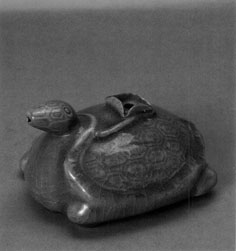
One of the more charming Koryo celadons in the collection is a water dropper in the form of a turtle. (Figure 5: turtle) Intended for the scholar's table, along with inkstones for calligraphy and other painting accoutrements, the turtle's carapace is marked with an hexagonal design believed to contain the hidden trigrams of magical divination. The pale evergreen blue glaze is crazed throughout and has thinned along the edges of the molded and applied elements. Water is admitted through the opening on the tortoises back in the center of the lotus plant, the curled edges acting as a natural funnel. The head, with a small hole at the mouth, acts as the spout.

Koryo potters were also experimenting with iron-black glazes at the end of the eleventh century. Tentative and extremely difficult to achieve, iron-black wares were only moderately successful. An early example of this type of ware is an imposing maebyong or "prunus vase" dating to the start of the twelfth century. Covered completely with an iron slip and then a celadon-type glaze, this vase has fired to a lustrous bluish—black with a bluish—green hue as a result of the celadon glaze. The surface has an overall worn appearance, a distinguishing characteristic of early iron-black wares, and where the (15-4, p. 19) glaze has not taken, air bubbles have surfaced. These technical imperfections, however, add another decorative dimension to the surface adornment.

The shape of this elegant vase is a splendid example of the so-called maebyong form, derived from the Chinese appellation meiping or "plum vase" of the Song dynasty. Vases of this type are commonly thought to have been ideal vestibules for a single branch of blossoming prunus-plum, peach, apricot, almond or cherry. The small mouths of these vessels, however, preclude this, and they were actually used as wine containers. The silhouette of this vase follows closely the classic Chinese form with its cylindrical outline, typical of early twelfth century maebyong pieces. Later Korean examples possess a constricted lower portion, thus emphasizing a more globular, swelling shape.

Although the early experiments in black glazes were highly tentative, Koryo potters continued to seek an effective black glaze ware. A more successful and rare example of Koryo iron-black glazing is a wine flask dating to the late fourteenth and early fifteenth centuries. (Figure 2: wine flask) As already noted, technical difficulties, especially with the glaze during the firing process,yielded vast numbers of marred pieces. Usually the glaze ran thin and turned a brownish color. Consequently, most black-glaze wares exhibit an austerity of decor. Unlike the earlier maebyong vase, this flask is covered with a genuine black glaze, thick and lustrous, almost velvety in color—the result of having been applied twice. The sides of the bottle have been flattened slightly, another Chinese convention, lending it a solid, yet graceful and elegant quality. Although Koryo potters continued to experiment with iron-black glazes, the wares never achieved either the popularity or sophistication of the celadon wares, and celadons far outnumber the black wares.


Figure 6: Wine Bottle, 12th century Porcelaneous stoneware with inlaid white and black slip decoration under a celadon glaze
 

Inlay Technique

While Koryo celadons are noted for their exquisite color, the glory in celadon wares are those decorated with inlay in a technique known as sanggam. Inlaid decoration became widely popular during the Koryo period, and fine examples in other media such as bronzes inlaid with silver, and lacquer inlaid with mother-of-pearl, tortoise shell and metals are also known. Although the origin of the sanggam technique is still debated, it is likely a product of both import!— Chinese metal inlay on lacquer as well as Chinese lacquer inlay—and also indigenous techniques such as Korean white underglaze slip painting.

In sanggam decoration, the design elements are first incised or stamped into the damp clay. White or black slip (clay suspended in a watery solution) was applied to the recesses. Once dry, the vessel was lightly polished to remove any excess slip from the surface, leaving only the incised areas filled (or inlaid) with the slip solution. (In a more difficult and skilled technique, iron and copper oxides were also inlaid, but kiln temperature control was (15-4, p. 20) more demanding for this.) A translucent celadon glaze was then applied by dipping. The wares were rotated to ensure an even application, the excess being allowed to run off.

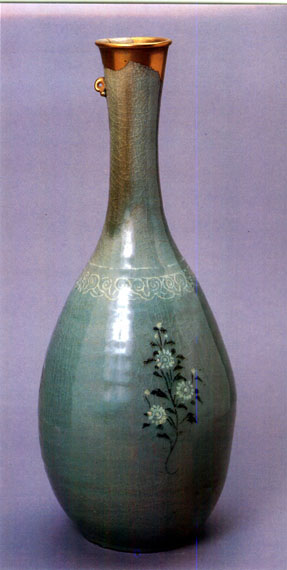
There are several excellent models of sanggam decorated wares in the Institute's collection. A particularly striking example is an elegantly tall and well proportioned, twelfth

century wine bottle. (Figure 6: wine bottle) The limited yet sumptuous design elements seen here are typical of early sanggam wares. The mouth area has been restored, as has the loop through which a cord once passed to secure the now missing lid.

In contrast to this early sanggam vessel is another of diminutive size dating to the early decades of the succeeding century. It has a far more encompassing inlaid design of adjoined circles, each with a central dot on the shoulder, a band of frets (now slightly deteriorated) just beneath the flaring mouth, and an overall pattern of stylized clouds in the shape of the fungus of immortality (K: yongji, C: lingzhi). The design motifs are both stamped and inlaid—a combined decorative technique of the early thirteenth century. Four cranes in flight, symbols of longevity and everlasting felicity, here also represent the four cardinal directions.


Figure 7: Bridal Bowl late 12th/early 13th century Porcelaneous stoneware with inlaid and reverse inlay slip decoration under a celadon glaze


Simple Yet Elegant Beauty

Inlaid celadons of the Koryo period exemplify one of the best achievements of the Korean ceramic tradition. The simple yet elegant beauty of inlaid designs quickly popularized the ware, and by the end of the twelfth century, technical difficulties in controlling the inlaid slip had been overcome. From the end of the twelfth century, the inlaid designs frequently cover the entire surface area. In general, the more crowded the decoration, the later the date of the ware. This lavishly decorated bottle is one such example of this crowded design trend in Koryo celadons.

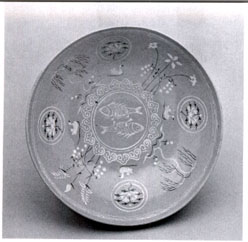
An interesting variation of Koryo inlay is seen on a bowl of the late twelfth and early thirteenth centuries. (Figure 7: bridal bowl) The interior is inlaid in the traditional manner with rui motifs and two opposing fish at the bottom of the well, with

ducks, water plants and willows, and four roundels with flowering peonies on the cavetto. The exterior of the bowl consists of four roundels of chrysanthemums, a fret design and a double ring of overlapping lotus leaves along the footring in both white and black slip inlay worked in the conventional sanggam technique. The areas between the chrysanthemum medallions, however, have been worked in reverse so that the pale, bluish green celadon floral elements are silhouetted against the white inlaid background. By the thirteenth century, reverse inlays had became a standard part of the Koryo potters' design vocabulary.

The paired design elements evident on this bowl suggest that the bowl was intended as a wedding gift, and originally there may well have been two bowls. The two fish are standard symbols for felicity, good luck, prosperity and abundant progeny—appropriate wishes for the conjugal couple. As an emblem of the fungus of immortality, the rui is also a wish for the happy couple to share many anniversaries together. The tendency to cover the entire surface with decor indicates its late twelfth and early thirteenth centuries date.

Choson Dynasty (1392-1910)

By the thirteenth century, Koryo society was in decline. Internal court conflicts and the external pressures of foreign invaders resulted in a period of chaos. Especially devastating were the Mongol invasions of 1231, and their domination of the peninsula lasted the entire century. The Mongols, who established China's Yuan dynasty (1279-1368), also made several failed attempts to conquer Japan, launching their ventures from the peninsula. In retaliation, Japanese brigades pirated the coastal regions of Korea. The collapse of the Yuan dynasty offered Koryo an opportunity to regain its sovereignty, but internal conflicts continued to plague the court. Finally in 1392, General Yi Song-gye deposed the Koryo ruler, proclaimed himself king and established the new Choson dynasty (1392-1910).

Just as Koryo rulers had imitated the practices and rule of Tang China long after it had passed into history, so Choson Korea followed the court practices of China's new Ming dynasty (1368-1644). An integral part of this emulation was the adaptation of a complex Neo-Confucian system of government rule and ritual, including ancestral worship. The growing acculturation of Confucian principles in Choson society also witnessed the diminishing influence of Buddhism. In ceramic production, a parallel change is visible in the decline (15-4, p. 21) of celadon wares and a magnificent florescence of Korean blue-and-white decorated wares. Choson period blue-and-white pottery is the result of a direct influence of Ming sources whose fame would spread across Asia to Europe and even to the New World.


Figure 8: Brush Stand, 18th century White porcelain with reticulated decoration
 

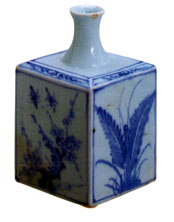
One of the most refined Choson wares in the collection is an exquisite wine bottle with an underglaze cobalt decoration. (Figure l: wine bottle) Cobalt has been the source for underglaze blue decoration in Asian ceramics since the seventh century. Although a few native sources of cobalt were available on the Korean peninsula, these failed to yield any sizable quantity of usable ore, and finer grades of cobalt continued to be import!ed from China. The expense of import!ing this raw material, however, not only placed the exquisite blue-and-white wares beyond the reach of the masses, but heightened the social status of those who could afford it. In 1461, a decree prohibited the common people from using blue-and-white porcelains. Eight years later, another imperial decree encouraged the production of blue-and-white wares as gifts to the court. This elegant wine vessel is just such a gift piece, likely presented as an indulgence for an official associated with the court.


In a masterful expression‎! of artistry, the potter has united two divergent forms in this bottle, the towering sweep of the neck and everted mouthrim being nicely contrasted against the flat faces of the square body. The sides are decorated with plum blossoms, bamboo, chrysanthemums and banana fronds. Floral motifs such as these are replete with symbolic connotations. The naturally long lifespan of the plum makes it a symbol of longevity. The plum is also a symbol of winter, its flowers appearing early in the season on apparently lifeless branches often still covered with snow. Bamboo is also a symbol of longevity. With its natural suppleness and pliancy, it is a preferred emblem of the yangban or class of scholarly gentlemen. As bamboo stalks bend before the wind but do not break, so too the scholar must bend before adversity without yielding. The chrysanthemum is similarly associated with the yangban class and has long been a symbol of retirement from office, and is cherished as an emblem of a life of ease. The prolific and nutritious fruit of the banana plant stands for both good health and abundance. An ancient legend relates that a student, for want of better writing materials, wrote his discourses on plantain leaves, and thus the banana plant is also an emblem of self-education.

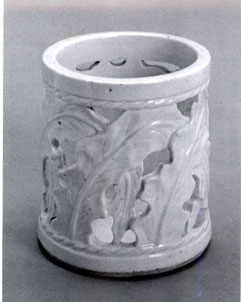
During the latter centuries of the Choson period, porcelain brush stands and other articles for the scholar's desk were produced in great quantities at the government kilns at Punwon-ri in Kwangju. (Figure 8: brush stand) The reticulated design was a popular device for such wares. Typical of the best of Choson porcelains is the finesse and boldness of design, as well as the lively vitality of the interlaced plantain fronds between twisted rope bands. Earlier white Choson porcelains are characteristically grayish white in color with an extremely hard body. Later examples such as this brush stand dating to the eighteenth century tend to be either a purer white or bluish white in tone.


ABOUT THE AUTHOR

CLARENCE W. KELLEY is Curator of Asian Art at The Dayton Art Institute. His principal fields of research are Chinese studies and problems in Asian aesthetics.


Sources for Further Reading:

G. St. G. M. Gompertz. Korean Pottery and Porcelain of the Yi Period. New York and Washington: Frederick A. Praeger, 1968.

Robert P. Griffing. The Art of the Korean Potter: Silla, Koryo, Yi. New York: The Asia Society, 1968.

Ikutaro Itoh. "Koreanization in Koryo Celadon." Orientations 23-12 (December, 1992), pp. 46-50.

Ikutaro hoh and Yutaka Mino, with contributions from Jonathan W. Best and Pamela B. Vandiver. The Radiance of Jade and the Clarity of Water: Korean Ceramics from the Ataka Collection. Chicago: The Art Institute of Chicago, 1991.

W. J. Joe. Traditional Korea: A Cultural History. Seoul: Chungang University Press, 1972.

Kim Won-yong, Ahn Hwi-joon, Kim Lena, Han Byong-sam, Chung Yang-mo, Shin Yong-hoon, edited by Roderick Whitfield and Pak Young-sook. Korean Art Treasures. Seoul: Yekyong Publications, 1986.

Robert D. Mowry. "Koryo Celadons." Orientations 17-5 (May, 1986), pp. 24-39.


Korean Cultural Center, Los Angeles


(6-2, p. 4) KOREAN ART IN WESTERN COLLECTIONS: 11

Sir John Figgess


Plate 2. Kundika (Koryo dynasty, late twelfth to early thirteenth century); celadon-glazed stoneware with
inlaid slip decoration; 44.5 cm. in height. Collection of the British Museum, accession no. 1936 10-12-198.

(6-2, p. 5)

Throughout Europe until some years after the end of the Second World War, interest in the arts and cultures of East Asia focused predominantly on China and—to a lesser extent—on Japan. The culture of Korea attracted little attention; and it is no surprise, therefore, that awareness of the heights attained by the arts of Korea came relatively late to the British Isles. Indeed, it was not until about 1952 that the pioneering activities of Godfrey Gompertz awakened English connoisseurs of oriental ceramics to the superb quality of the best Koryo celadons which had previously been rarely seen in England.

While the broad range of Korea's arts went largely unnoticed, however, this is not to say that the peninsula's ceramics were entirely unknown prior to the war. During the early years of the twentieth century, a fair number of representative ceramic pieces from both the Koryo (918-1392) and Yi (1392-1910) dynasties found their way to England, by way of collections assembled in Korea by resident diplomats or missionaries, or as single items acquired by the rare discriminating visitor. The objects thus collected were generally not, however, of the best quality-which may explain why they failed to arouse great interest among the growing band of enthusiasts of oriental ceramics then active in England. Nevertheless, among these Korean wares were a few notable examples—especially of Yi dynasty porcelains—which attracted the attention of connoisseurs of the time. The renowned collector George Eumorfopoulos cast his discerning eye over many of these pieces, and some of those originally acquired for his collection provided the basis for the collection of Korean ceramics now housed in the British Museum.

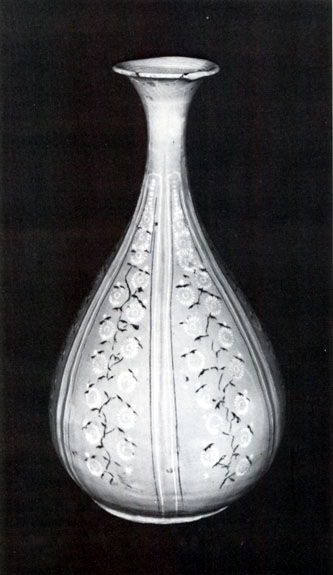
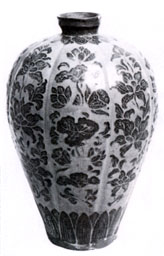
In 1911, Eumorfopoulos gave to the British Museum one of the first of its Korean works, a pear-shaped bottle vase of the Koryo dynasty (pl. 1). Few examples of Korean ceramics could have been better calculated to stir the interest of the museum's staff than this thirteenth-century vase of glazed stoneware, decorated with panels of chrysanthemum heads inlaid in black and white slip under a greyish-green celadon glaze. The elegant shape and large size of this bottle with its slender neck, flaring mouth, and swelling body mark it as an outstanding example of the Koryo potter's art.

  Plate 1. Pear-shaped Bottle Vase (Koryo dynasty, thirteenth century);
glazed stoneware decorated with panels oft chrysanthemum heads
inlaid in black and white slip trader a greyish-green celadon glaze;
35 cm. in height. Collection of the British Museum, gift of George
Eumorfopoulos, accession no. 1911 6-7-11.
 

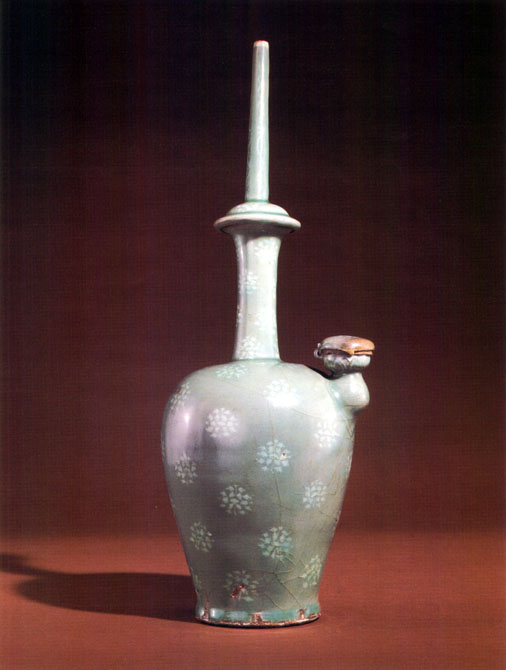
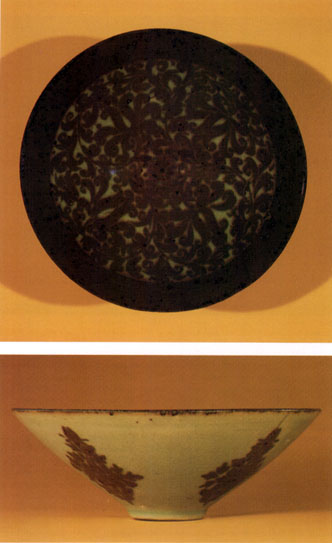
The museum subsequently purchased a number of ceramics from the Eumorfopoulos collection, including a celadon-glazed kundika (sprinkler) with inlaid slip decoration (pl. 2). (6-2, p. 6) This rare and beautiful example dates from the late twelfth or early thirteenth century, and once again shows the high quality of Koryo wares. Although the glaze color of this piece is perhaps not of the best-being a greyish green—its condition is very good, and its size is impressive. 1 Also purchased from the Eumorfopoulos collection was an unusual bowl decorated on its inner surface with arabesques, and on the outside with four floral sprays, all in copper-red underglaze beneath a celadon final glaze (pl. 3). This rare bowl is of great importance to the study of early Koryo wares, since its form and construction date it beyond reasonable doubt to the twelfth century—further implying that Korean potters began experimenting with underglaze copper decoration between the middle and the

end of the twelfth century, or at least a century before the same technique is known to have been practiced by the Chinese. At one time doubts were cast on the authenticity of this piece, but there is no longer any question that it is a genuine example of early Koryo celadon ware.

Post-War Acquisitions

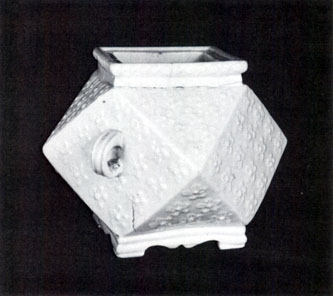
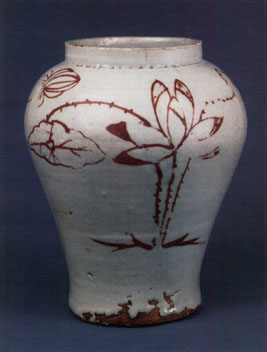
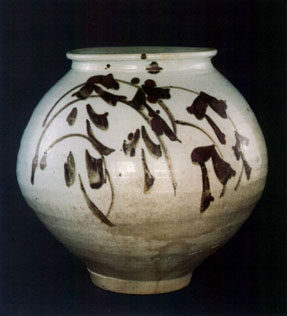
Since the war, the British Museum has continued to acquire Korean ceramics, some of which are unique in their beauty or significance. In 1946 the museum obtained a faceted porcelain jar of the Yi dynasty, decorated with stamped blossoms under a very pale bluish glaze (pl. 4). As seen in this jar, the faceting of simple basic ceramic forms to produce sharp angles and flat surfaces for decoration was an innovation of Korean potters of the middle part of the Yi dynasty. The technique was subsequently adopted by the porcelain factories of Japan, which employed it widely in the manufacture of arita and kakiemon decorated wares for export to Europe. This fine and unusual faceted jar is technically very advanced and, so far as is known, unmatched by any example of the (6-2, p. 7) type elsewhere. Also now in the collection of the British Museum is a seventeenth-century porcelain jar, decorated in iron-brown under a finely crackled transparent glaze (pl. 5). This strikingly handsome jar was given to the museum in 1957 by K. R. Malcolm; its bold shape and the freedom of its vigorous, almost abstract, iron painting give it an air of modernity.

Plate 4. Faceted Porcelain jar (Yi dynasty, eighteenth or nineteenth
centaur; decorated with stamped blossoms under a very pale bluish
glaze; 25 cm. in height. Collection of the British Museum, accession
no. 1946 7-20-5.

'Great Dignity'

At the Victoria and Albert Museum, the attractions of Korean ceramics were first acknowledged during the war by the then keeper of ceramics, William Bowyer Honey. Honey found himself captivated by the beauty of some of the Korean pottery which had entered the museum's collection from various sources in earlier years and, in 1945, he wrote of these with great discernment:

The best Corean wares are not only original; they are the most gracious and unaffected pottery ever made. They have every virtue that pottery can have. Their shapes are simple, characteristically beautiful in proportion and outline, flowering easily and naturally into plastic and other decorations, incised or carved or inlaid, of unsurpassed beauty and strength . . .. This Corean pottery in fact reaches heights hardly attained even by the Chinese. It has at all times great dignity, a quality which is said to accord with the character of the Corean people. 2

It is all the more remarkable that Honey could express himself so unreservedly, when we reflect that he had little opportunity to see the finest Korean wares as we now know them in collections in Korea, Japan, and the United States. Among those ceramics that Honey did inspect, however, were some remarkable examples that have remained in the collection of the Victoria and Albert Museum, including a thirteenth century bottle vase of porcellaneous stoneware with inlaid decoration in black and white slip and painting in copper-red under a celadon glaze (pl. 6). In the decoration of this beautiful vase—one of the first Korean pieces to enter the collection of the museum—may be seen the effective use by Koryo potters of the technique of inlaid slip. Here the single sprays of peony and chrysanthemum within roundels, set against the mellow tone of the celadon glaze, exercise a lasting effect on the imagination and seem to attain the highest level of artistry. The blossoms are enhanced by a touch of underglaze copper-red.


Plate 3. Bowl (Koryo dynasty, twelfth century); decorated
entirely in copper-red under a celadon glaze, on the
inner surface with arabesques and on the outside with
four floral sprays; 17.8 cm. in diameter. Collection of
the British Museum, accession no. 1938 5-24 736.


Another of the museum's thirteenth-century pieces is a lobed baluster vase of porcellaneous stoneware decorated with floral sprays of painted underglaze iron under a celadon final glaze (pl. 7). Although the mouth of this vase has been completely restored, its elegant form and the lovely brushwork of its painted decoration provide a fine example of iron-painted celadon wares from the middle of the thirteenth century. Wares of this type evidently enjoyed a vogue in Korea following the Mongol invasion of mid-century, which seems to have brought with it fresh artistic influences. Here, the influence is evidently that of Chinese Cizhou (Tz'u-chou) (6-2, p. 8) wares of the Northern Song (Sung) dynasty (960-1127). As with many of the known examples of this type of decoration, the celadon glaze of this vase has taken on a brownish color due to oxidation, and it has been suggested that this was caused by a deliberate change

in the firing technique; but it is more likely to have resulted from the potter's inability to maintain a reducing atmosphere during the firing.

'Bold Rendering'

It is likely that the use of painted decoration in underglaze copper-red was an innovation of Korean potters during the latter part of the twelfth century. While there is no means of telling whether the use of underglaze copper-red continued into the Yi period without a break, there is ample evidence from kiln sites and literary references to indicate that such wares were being produced during the sixteenth and seventeenth centuries. Relatively few complete pieces from this period have survived, however, and by far the largest number of existing underglaze copper-red painted wares date from the latter part of the Yi dynasty. The Victoria and Albert collection is fortunate in having a fine baluster vase which is unmistakably from the early part of the Yi dynasty (pl. 8). Honey, who particularly admired this rugged jar, regarded it as a test of ceramic appreciation, and described it as the first example to reveal to me the peculiar beauty of the Yi dynasty wares . . .. It is painted in an impure copperred with a bold rendering of a lotus plant. The large gestures of the drawing have an almost sublime quality, and the design fills its space in a most (6-2, p. 9) (6-2, p. 10) satisfying way. 3

(6-2, p. 9)

Plate 8. Baluster Vase (Yi dynasty, sixteenth to
seventeenth century); porcelain painted in
underglaze copper-red with lotus flowers and
foliage; 28.5 cm. in height. Collection of the
Victoria and Albert Museum, accession
no. C-131 1913.

Plate 5. Porcelain Jar (Yi dynasty, seventeenth century);
decorated in iron-brown under a finely crackled
transparent glaze; 35 cm. in height. Collection of
the British Museum, gift of K.R.Malcolm,
accession no.1957 5-14-1.

Another of the Korean pots in the Victoria and Albert collection that excited Honey's admiration is its seventeenth-century porcelain wine jar, with painted iron-brown decoration of a dragon among clouds (pl. 9). The hard but immensely vital linear drawing of the fiery dragon, the bold sweep and freedom of the brushwork, and the rich brown of the pigment used in the decoration of this handsome jar command our attention. As Honey wrote of the Yi dynasty painted wares, the decoration of this jar "seems to grow with perfect naturalness out of the very shape of the piece." 4 It seems likely that the widespread use of iron painting in Korea during the middle part of the Yi dynasty was due to difficulty experienced in obtaining cobalt ore for the production of underglaze blue decoration, and the consequent restrictions placed on its use. Looking at this iron-painted jar we may perhaps consider this to have been a felicitous combination of circumstances.

  Plate 7. Lobed Baluster Vase
(Koryo dynasty, thirteenth
century): porcellaneous stoneware
painted in iron with floral sprays
under a celadon glaze; 30 cm.
in height. Collection of the
Victoria and Albert Museum.
accession no. C-615 1920.
 

(6-2, p. 11)

High-Grade Wares

Unlike the older collections of London, the Korean holdings of the Ashmolean Museum, Oxford, have been acquired by gift from several benefactors in quite recent times. This museum first turned its attention to the serious study of oriental ceramics following the major bequest in 1960 of the magnificent collection of early Chinese ceramics formed by the late Sir Herbert Ingram. Although it is thus a relative newcomer to the field, the Ashmolean Museum can nevertheless boast a wide selection of stoneware vessels from the period of the Three Kingdoms (57 B.C.- A.D. 668), and a number of fine Yi dynasty porcelains-including a good selection of blue-and-white decorated porcelains of the late Yi dynasty donated by another well-known English collector, the late Gerald Reitlinger.


Plate 6. Bottle Vase (Koryo dynasty, thirteenth century);
porcellaneous stoneware with inlaid decoration in black and
white slip and painting to copper-red under a celadon glaze;
39 cm. in height. Collection of the Victoria and Albert
Museum, accession no. C-72-1911.

Most of the early stoneware items in the museum's collection originated in the Old Silla Kingdom (57 BC AD 668), which absorbed the ceramic traditions of the Kaya League—a small area in southernmost Korea during the course of the sixth century. These Old Silla items include a stoneware cup with a handle and perforated base, dating from the fifth or sixth century (pl. 10). Similar cups, together with many other funerary wares, have been unearthed at the ancient burial mounds of Kyongju, once the capital of the Silla Kingdom. Among the items donated to the museum by Reitlinger is a large porcelain baluster vase of the eighteenth century, with painted decoration of birds on a flowering plum tree in underglaze cobalt-blue, under a lightly crackled transparent glaze (pl. 11). This pleasing example of Yi dynasty underglaze blue decorated porcelain was given to the Ashmolean Museum in 1978. Its pale blue painting is joyously free, and the subject of the two birds singing away on a branch of prunus conveys the happiness of early spring.


Plate 9. Wine jar (Yi dynasty, seventeenth century); porcelain
painted to iron-brown with a dragon among clouds; 39 cm.
in height. Collection Iron of the Victoria and Albert Museum,
accession no. C-356 1912.
Plate 10. Cup with handle (Old Silla
Kingdom, fifth to sixth century);
stoneware with ash glaze;
13 cm. in height. Collection
of the Ashmolean Museum,
Oxford, accession no. 1982-221.

In the same year, the Ashmolean collection received a large globular porcelain jar of the seventeenth century, with painted decoration of a (6-2, p. 12) fruiting vine in underglaze ironbrown and cobalt-blue (see cover). This beautiful jar was given to the museum by Mr. and Mrs. K. R. Malcolm in memory of their son, John, a scholar of Worcester College, Oxford, who died in 1974. It is one of a rare group of high-grade wares decorated in iron-brown and cobalt-blue, which are believed to have been made for the court at the official potteries in Kwangju and at other kilns in the vicinity of Seoul. It is likely that the decoration of such wares was entrusted to skilled artists, who seem to have favored rather elaborate themes such as clusters of grapes or monkeys swinging on grapevines. One frequently illustrated piece of this type is a large baluster jar belonging to Ewha Women's University Museum, Seoul. 5 Although the Ashmolean example is smaller, it fully matches the Ewha piece in quality of potting and decoration.

Plate 11. Large Baluster Vase
(hr dynasty, eighteenth century);
porcelain painted in cobalt-blue
with birds on a flowering plum
tree under a lightly crackled
transparent glaze; 35 cm.
in height. Collection of the
Ashmolean Museum, Oxford,
gift of Gerald Reitlinger,
accession no. 1978-1800.

Jewels in Lacquer

As is the case in most Western museums, it is their excellent selection of ceramics that comprises the bulk of the Korean holdings in the public collections of London and Oxford. Aside from these items, the public museums are somewhat lacking in notable Korean works of arts. 6 The single outstanding exception to this is the collection of Korean lacquerware at the British Museum, which is probably unmatched by that of any museum in the world outside Japan. The jewel of the museum's collection is a Koryo dynasty mother-of pearl inlaid lacquer sutra box, which was acquired by purchase from Japan in 1966 (pl. 12). This superb example closely-resembles a sutra box in the Tokugawa collection in Japan, and is in similarly fine condition. Double wires with reverse twists frame the border patterns, while the stems of the main design are of mother-of-pearl set in the black lacquer ground. The petals of the flowers are sometimes lightly engraved to enhance their shape. The whole technique

is extremely sophisticated and accomplished, and worthy of a royal workshop. The lock and handles are possibly later additions. The museum has only one other piece of Koryo lacquerware, a small cosmetic bops from the Eumorfopoulos collection; evidently an excavated piece, it has unfortunately lost most of its shell inlay.


  Plate 12. Lacquer Sutra Box (Koryo dynasty, late twelfth or thirteenth century);
decorated with flower heads in mother-of-pearl enclosed by a continuous
running scroll of foliage; 47.2 cm. in length. Collection of the British Museum,
accession no. 1966 12-21-1.
 

  Plate 13. Lacquer Box (Yi dynasty, fifteenth to sixteenth century; with
bronze fittings, In laid to mother-of-pearl with a design of chrysanthemum
flowers and foliage; 29 cm. in length. Collection of the British Museum,
accession no. 0A 1979 12-19-2.
 

The museum does have at least four fine boxes from the middle of the Yi dynasty, of which two are illustrated here(pls.13, 14).The earlier of these dates to the late fifteenth or early sixteenth century, and is inlaid in mother-of-pearl with a design of (6-2, p. 13) chrysanthemum flowers and foliage, and has bronze fittings (pl. 13). This lacquer box is of superb quality and in excellent condition. The shell inlay is multicolored, giving the effect in changing light conditions of a mysterious irridescence. It came to England from Japan sometime after the Second World War, and was in a private collection until the museum acquired it by purchase in 1979. The later box dates to the late seventeenth or early eighteenth century, and is inlaid in mother-of-pearl with scrolling lotus flowers and foliage (pl. 14). It was probably made to contain clothing-perhaps a priest's vest merits. Its interior is lacquered red, and its base—as is usual with Korean boxes of this kind—is plain unlacquered wood.

  Plate 15. Standing Buddha
Amitabha (Unified Silla Kingdom,
eighth century); gilt bronze;
23.2 cm. in height. Collection
of the British Museum,
accession no. 1957 7-18-1.
 

Taoism, Buddhism, Confucianism

Korean metalwork is also best represented in the British Isles by the collection of the British Museum, which includes a variety of small gold ornaments from the Old Silla Kingdom, as well as a number of bronze mirrors of the Koryo dynasty. The thriving Buddhism of the Unified Silla Kingdom (668-935) is shown in the collection's gilt bronze figure of the Buddha Amitabha standing on a lotus pedestal (pl. 15). Amitabha, who rules over the Western Paradise of the Pure Land sect of Buddhism, was extraordinarily popular throughout the Unified Silla period, and numerous similar sculptures are extant. The British Museum's example dates from the eighth century, and was once adorned with a halo attached to the figure's back.

  Plate l8. Kwanum (Avalokiteshvara)
in White Robes (Yi dynasty, fifteenth
century); hanging ,oil, ink, colors,
and gold on silk; 172 x 69.6 Ili.
Collection of the British Museum,
accession no. 196512-17-03.
 
Plate 17. Flower Vase (Koryo dynasty,
twelfth to thirteenth century); bronze
with inlaid silver decoration; 24 cm.
in height. Collection of the Victoria
and Albert Museum, accession
no. M-1189-1 926.

Plate 14. Lacquer Box (Yi dynasty, seventeenth to eighteenth
century); inlaid in mother-of-pearl with scrolling lotus
flowers and foliage; 39 cm. in length. Collection of the
British Museum, accession no. OA 1979 12-19-1
.

The thirteenth-century-bronze moon palace mirror in the museum's collection derives its imagery from (6-2, p. 14) Taoism, and illustrates a story in which Ming Huang, Chinese emperor of the Tang (T'ang) dynasty (618-907), was said to have visited the moon with his court magicians (pl. 16). 7 The imagery of this tale was extremely popular during the Koryo dynasty, and, with some variations, is found in many mirrors of that period.

Among the non-ceramic items in the collection of the Victoria and Albert Museum is a Koryo dynasty bronze flower vase with inlaid silver decoration (pl. 17). The shape of this rare bottle is evidently closely related to that of its ceramic contemporaries of the twelfth to thirteenth century and especially to Koryo celadons of the twelfth century. Indeed, there is in the collection of Godfrey Gompertz (now housed at the Fitzwilliam Museum, Cambridge) a celadon vase which closely resembles this bronze in both shape and size. The simple linear decoration of this bronze has also its ceramic counterpart in some of the inlaid Koryo celadons. The purpose of this and similar bronze vessels is not known for certain, but it was probably made for use as a flower vase in a Buddhist temple.

Plate 16. Moon Palace Mirror (Koryo dynasty, thirteenth (century); bronze; 19.5 cm. in diameter. Collection of the British Museum, accession no. 1973 7-26-72.
Plate 20. Wine Bottle (Koryo dynasty,
mid twelfth century); celadon-glazed stoneware, with pear-shaped body
and flared neck; 19.5 cm. in height.
Private collection.


Turning to Korean paintings, the British Museum once again holds the finest examples in the United Kingdom. The fifteenth-century Kwanum in White Robes is a rare example of Buddhist painting from the first century of the Yi dynasty, when Buddhism often suffered from the proscriptions of the new Confucian court (pl. 18). During the Koryo dynasty, the bodhisattva Kwanum (Sanskrit, 'Avalokiteshvara') had appeared frequently as an accompanying figure in depictions of Amitabha, or as the 7. Pak, Korea: Korean Days, pp. 50-51. (6-2, p. 15) main figure of 'Water :Moon Avalokiteshvara' paintings. He is identified by-the kalasha (flask) he holds, as well as by his white robes. In most representations, Kwanum wears the Dhyani Buddha (Buddha of Purity, Meditation, and Enlightenment) in his crown; here, this has been replaced by a miniature Amitabha triad, symbolic of the Buddha's descent to receive the soul of a believer. The final triumph of Yi dynasty Neo-Confucianism over Buddhism is also reflected in the British Museum's portrait of a Confucian scholar, which dates to the eighteenth or nineteenth century (pl. 19). Executed in ink and light color, this portrait reflects both the stylistic influences at work in Yi dynasty Korea, and the changing ethics of its society. The otherworldly appeal of the Western Paradise is here replaced by the canny realism of the literati, as surely as the monk of the Koryo dynasty was replaced by the scholar-bureaucrat of the Yi dynasty.

  Plate 19. Portrait of a Korean Scholar (Yi dynasty, eighteenth to
nineteenth century); Ink and light color on paper; 54 x 95 cm.
Collection of the British Museum, accession no. 1922 6-30-011.
 

In Private Hands

'With Godfrey Gompertz' splendid donation of his entire collection to the Fitzwilliam Museum, Cambridge, it must be assumed that comparatively few Korean works of distinction now remain in private hands in the United Kingdom. Two examples from a private collection are however illustrated here: a Koryo celadon bottle vase of simple form, and a lacquer box of unusual shape with inlaid mother-of-pearl decoration of peony scrolls (pls. 20, 21). The celadon wine bottle dates from the middle of the twelfth century, and has a pear-shaped body and flared neck (pl. 20). It is obvious that the early Koryo potters were greatly influenced by Chinese wares-in particular by the Yue (Yueh) celadons of the Northern Song dynasty-but also by-the lovely plain bluish-green glazed official wares called Ru (Ju) wares. This graceful Koryo wine bottle with its undecorated bluish-green celadon glaze is an example of such influence. It is in fact almost identical in shape and appearance to a famous Ru ware bottle formerly in the Alfred Clark collection and now in the British Museum—the only marked difference being the more lavender tone of the RU glaze. The mouth of this piece has been repaired in gold lacquer. The shallow hinged lacquer box illustrated here is an example of a type not uncommon among mother-of-pearl inlaid lacquer wares of the Yi dynasty (pl. 21). Its bold decoration of peony scrolls, which includes a number of birds in flight, suggests that it is (6-2, p. 16) early-probably dating from the late fifteenth or early sixteenth century. The late Sir Harry Garner, who much admired this box, considered that it probably belonged to the fifteenth century. The metal fittings with strengthening corner-pieces terminating in rosettes, are of a type commonly found in Korean boxes.

Plate 21. Shallow Lacquer Box (Yi dynasty, fifteenth to sixteenth
century); inlaid in mother-of-pearl with scrolling peony; 25.5 cm.
in length. Private collection.

Despite the late recognition given in Britain to the arts of Korea, the public collections of London and Oxford have much of interest to the visitor who wishes to glimpse the culture of this land. As interest in Korean culture has surged during the past three decades, so too have these collections improved, and even the most recent offers a wealth of material. And for those whose appetites are merely whetted by

these collections, still more—including the recent donations of Godfrey Gompertz—can be viewed in Cambridge, which will be the subject of another installment in the present series.

Sir John Figgess is a noted collector and expert in Korean ceramics, who has studied the collections of Korean works of art in museums throughout the world, and has explored extensively the stylistic connections between the techniques of inlaid lacquerware and celadons o1 the Koryo dynasty.


1. The collection of the Freer Gallery of Art includes a similar, but smaller, celadon kundika, also with inlaid slip decoration; a photograph of this piece was published by Ann Yonemura, "Korean Art in the Freer Gallery of Art [Korean Art in Western Collections: 5]," Korean Culture 4:2 (June 1980), pl. 6.
2. William Bowyer Honey, The Ceramic Art of China and Other Countries of the Far East (London: Faber and Faber, 1945), p. 167.
3. William Bowyer Honey, "Corean Wares of the Yi Dynasty, "Transactions of the Oriental Ceramic Society, London 20 (1944-1945):20.
4. Honey, "Corean Wares," p. 19.
5. See, Rene-Yvon Lefebvre, d'Argence. ed., 5,000 Years of Korean Art [exhibition catalogue] (San Francisco: Asian Art Museum of San Francisco, 1979), color pl. xxxi; the Ewha Women's University Museum piece was also included in the European extension of this exhibition, "Treasures front Korea: Air through 5,000 Years.' which appeared in London, Hamburg, and Köln.
6. For a fuller illustrated discussion of many of the items held by these museums, see Youngsook Pak. Korea: Korean Days to Ingelheim am Rhein [exhibition catalogue] (Ingelheim am Rhein: 1984), pp. 9-83.
7. Pak, Korea: Korean Days, pp. 50-51.


Korean Cultural Center, Los Angeles


3-4, p. 4)


Marjorie L. Williams


Plate 1. Amitabha Triad (Koryo period, ca. 1250), hanging scroll, ink and color on silk,
119.1 x 53.3 cm. The Cleveland Museum of Art, Gift of Mr. and Mrs. Warren H. Corning,
Mr. and Mrs. Herbert F. Leisy, Mr. and Mrs. Oscar J. Lange and Mr. Leon Fletcher, Jr.

(3-4, p. 5)

Brilliantly-colored icons, greenhued celadons, and brightly-painted oxhorn boxes all highlight the collection of Korean art at the Cleveland Museum of Art. Almost as old as this institution itself, which opened its doors to the public in 1916, the Korean collection began in 1918 with gifts of a Koryo dynasty (1918-1392) bronze trinity (pl. 3) from the Worcester R. Warner Collection and a celadon bowl (pl. 6) of the same era from the John L. Severance Collection. During the following six decades the collection has grown through the gracious assistance of museum patrons, such as Severance and Greta Millikin and J. H. Wade, and the discriminating connoisseurship of the museum directors, William M. Milliken and Sherman E. Lee.

The unique assemblage of Korean ceramics is due in large part to John L. Severance, a patron of both the visual and musical arts in Cleveland. As a contributor to both the Western and Eastern collections, Mr. Severance donated approximately two hundred Korean ceramics from the family's collection. This well-known figure in the Cleveland art-world had a particular affinity for Korean art since his father, a noted Cleveland physician, established the Severance Medical School and Hospital in Seoul, Korea. Even after his death in 1936, the John L. Severance Fund enabled the museum to acquire additional masterpieces of Korean art.

The Cleveland Museum displays masterpieces of both ceramics and painting found in few other Western collections. The ceramics collection is a comprehensive one illustrating, in particular, the development of the stoneware tradition that dominated the historic evolution of Korean ceramics. To this already significant holding the museum has added, in only the last three years, four paintings — two rare Buddhist paintings dating from the Koryo dynasty and two hanging scrolls of secular themes completed during the later Yi dynasty (1392-1910) — to make the Cleveland Museum of Art an important collection for the study of Korean painting.

(3-4, p. 6)

Plate 2. Detail from Shakyamuni and
Two Attendants (Koryo period, ca. 1300),
hanging scroll, ink, color, and gold
on silk, 217.8 x 112.7 cm.
The Cleveland Museum of Art, purchase,
John L. Severance Fund.
Although Korean ceramics, dating from the fourth through the nineteenth centuries, still exist in numerous quantities in collections around the world, Korean paintings can be found primarily — and in much more limited numbers — in Korea and Japan. The majority of these illustrate secular themes of landscapes, bamboo, or pine trees — the appropriate themes of a Confucian scholar-painter — and were painted only within the last five hundred years. Paintings with Buddhist themes are practically nonexistent in Korea and relatively few remain in Japanese collections. The addition of the rare and masterfully-painted hanging scrolls of the Amitabha Triad (pl. 1), Shakyamuni and Two Attendants (pl. 2), and the Nahan (sanskrit, 'Arhat'; Chinese, 'Lohan'; pl. 4) — all creations of the thirteenth century — provides a major impetus to the representation of major achievements in Korean art.

Buddhism, the unifying religion of the East, entered Korea during the fourth century and continued to dominate the lives of the aristocracy and commoners alike throughout the following thousand years. These foreign doctrines inspired the kings of the Silla dynasty (668-918) to construct large temples such as Pulguk-sa and the magnificent mountainous shrine, the Sokkuram. Kings of the later Koryo dynasty designated separate offices within the court, called the Institute of Gold Letters and Silver Letters (Kumja-won and Unja-won), in which monks copied the Buddhist sutras, or scriptures. Although the Koryo rulers basically continued the grand traditions of Buddhism established during the preceding centuries, they introduced a new element to its doctrines and arts. The late Koryo kings established close ties with China and its foreign Mongol rulers who patronized Tibetan Lamaism. By the thirteenth and early fourteenth centuries Lamaistic doctrines had entered the court circles, thereby introducing a highly decorative flair to the Buddhist arts.

The three Buddhist trinities (pls. 1-3) in the Cleveland collection all attest to this elegant style which characterizes sculptures and paintings created during the late Koryo dynasty. Entering the Cleveland Museum in 1961, the Amitabha Triad (pl. 1 ) — painted around 1250 — exemplifies the majority of extant Koryo Buddhist paintings that illustrate scenes of the Pure Land Sect of Buddhism. This sect, which originated in India and developed more fully in China, gained widespread popularity throughout the East because it provided an easy path to salvation. The devotee was assured, through simple faith and the mere recitation of Amitabha's name, a rebirth into Amitabha's Western Paradise.

In the Korean hanging scroll, Amitabha — standing in front of a flaming mandorla — occupies the center of the trinity. In accordance with the iconography of this deity, he is attended by the bodhisattvas Mahasthamaprapta — positioned at his right and identified by the water jar in his headdress — and Avalokiteshvara — standing at his left and identified by the image of the Shakyamuni Buddha accenting his headdress. Amitabha's left hand — posed in a variation of the vitarka mudra — and the lotus throne carried by Avalokiteshvara suggest the theme of the painting, most commonly known by its Japanese designation, raigo, 'Welcoming Descent.' A common theme in Pure Land Buddhism, the raigo illustrates the moment when Amitabha appears at the deathbed of a faithful follower to welcome his soul into the Western Paradise. Avalokiteshvara, the God of Mercy, carries the soul of his devotee on the lotus seat to the land of unimaginable beauty. Unlike most raigos, in which both Mahasthamaprapta and Avalokiteshvara bow toward the viewer extending an invitation into the ideal world, however, this Korean painting depicts the trinity in a more formal, hieratic fashion.

The three figures are rendered in an elegant, decorative style most obvious in the bodhisattva's jewelry and Amitabha's robe enriched with gold medallions. The refined, linear brushwork, evident to a seemingly excessive degree in Amitabha's garments and the mandorla, enhances this decorative quality introduced into Korean Buddhist arts through the lavishly ornamented accessories of Tibetan Lamaism.

Plate 3. Buddhist Triptych (late Koryo dynasty, ca. 1300), bronze with traces of gilding,
40.6 x 54.6 cm. (with base). The Cleveland Museum of Art, Worcester R. Warner Collection.

The large icon, Shakyamuni and Two Attendants (cover and pl. 2), completed around 1300 and added to the Cleveland collection only this year, echoes the same decorative style preval‎!ent in Koryo Buddhist arts by the late thirteenth century. The large scale of the icon, achieved by joining vertically three strips of silk cloth, suggests that it originally hung in an important, metropolitan temple. Shakyamuni, the historical Buddha, sits in a large, hexagonal throne ornamented with lotus motifs and a recumbent (3-4, p. 7) lion (a protector of the Buddhist faith) encircled by flaming pearls (a symbol of purity representing Buddha's truth). His symmetrically rendered features — including his nose distinctively outlined by two vertical lines connecting with the arched eyebrows — recall the similar detailing of Amitabha's features (pl. 1 ). The deity's right hand, positioned in the mudra usually known by its Japanese name, kichijo-in, grants good fortune to the two adoring, priestly attendants who complete the frontal, symmetrical icon. Brilliantly colored with an intense red, malachite green, and azurite blue, and extraordinarily preserved, this masterpiece and the Amitabha Triad parallel in both style and date the famous painting depicting Avalokiteshvara with a Willow Branch, completed in 1313 by the Korean master Hyeho and presently in the Senso-ji Temple in Japan. A copy of the Korean trinity by the Japanese painter Jakuchi (1716-1800) is a part of the collection of the Shokoku-ji in Kyoto, Japan.

Although Shakyamuni is generally depicted with his attendant bodhisattvas, Avalokiteshvara and Maitreya, the bronze Shakyamuni Trinity (pl. 3) departs from this usual iconographic representation. All three deities sit on individual lotus thrones; Shakyamuni with his right hand expressing the vitarka or 'teaching' mudra sits in crosslegged fashion, while his attendants sit in the more relaxed, lalitasana pose with one leg pendant and the other bent at the knee. Avalokiteshvara, identified by the seated Buddha image in his crown, sits at his left while Kshitigarbha, holding the sacred jewel, sits at his right. This deity, commonly known by his Japanese name, Jizo, is represented with shaven head in the guise of a monk. The idealized proportions of the deities' faces and the sharp curves of their eyebrows and noses — coupled with the beaded jewelry accenting their necks, knees, and lotus seats — suggest that the triptych is a creation of the late thirteenth or early fourteenth centuries.

Bodhisattvas, or enlightened beings (such as Avalokiteshvara), who delay the state of their Buddhahood to become teachers of Buddhist doctrines, are the most essential deities in the East Asian Buddhist pantheon, and are commonly represented in Korean art. In contrast, nahans (Chinese, 'lohans') or Buddhist disciples, hold a lesser position in northern Buddhist doctrines and iconography and appear less (3-4, p. 8) frequently in Korean art. Depicted as wizened, mystical men, nahans are occasionally represented alone but more frequently encountered in groups of sixteen, eighteen, or crowds of five hundred.

Plate 4. Nahan (Koryo period, ca. 1235), hanging scroll, ink and
light color on silk, 52.5 x 40.6 cm. The Cleveland Museum
of Art, purchase from the J. H. Wade Fund.
The rare Korean hanging scroll of a Nahan (pl. 4) is one of an original set of five hundred paintings. Although only this painting and two others have survived into this century, the entire set can be dated to the thirteenth century from an inscription on one of the other extant scrolls presently in Japan. According to historical records a set of five hundred lohan paintings entered the Korean court in 923 from China where formal lohan worship had begun as early as the seventh century. By the following eleventh and twelfth centuries, it had gained widespread appeal under the influence of Ch'an (Japanese, 'Zen') Buddhism. In Korea this sect of Buddhism, known as Son, became increasingly popular after the eleventh century. Within three hundred years, nahans had become established themes of Buddhist painting throughout the Far East.

This Korean nahan, seated in profile view, is distinctively Indian in appearance. Subtle tones of ink model his face, and his gnarled arm extends an alms bowl to a writhing dragon, a protector of the Buddhist faith. The partially visible inscription in the upper right corner reads "464 [?] nahan" while the names of the donors are written at the lower edge. Customarily an individual donor commissioned a single nahan painting while a group of worshippers commissioned a set of sixteen, eighteen, or, in this case, five hundred.

Plate 5. Covered Bowl
(Silla dynasty, eighth-ninth
century), glazed gray
stoneware, 8.4 x 12 cm.
The Cleveland Museum
of Art, Gift of John L. Severance.
Korean craftsmen and artists traditionally utilized to the fullest extent the natural materials such as gold, granite, or clay found in abundant sources throughout this peninsular country. Clay, of all these artistic medias, is the most plentiful. As early as 3000 B.C. Korean potters were already transforming this formless substance into both ritualistic and functional articles. Found in practically every household in traditional Korea, ceramics were produced throughout the following centuries in such astounding quantities that even in presentday Korea ceramic shards still pepper the top of temple grounds or glisten alongside country roads.

Of all the Korean arts, ceramics, by virtue of their functional nature, are the most easily understood by Western museum visitors. The casual visitor immediately knows when looking at the covered bowl (pl. 5) or the Ewer in Form of a Sprouting Bamboo (pl. 10) that they served food and wine because their shapes demonstrate their original (3-4, p. 9) functions. This bowl and ewer represent the climactic stage of the long stoneware tradition characterizing Korean art. Produced as early as the first century A.D. in southern Korea, stoneware ceramics are impervious to liquids when fashioned from clay fired at temperatures of 1200-1300 degrees centigrade. This tradition, culminating in the green-glazed celadon of the Koryo dynasty, continued to be the foundation of Korean ceramic history throughout the following centuries.

Plate 6. Bowl (Koryo dynasty,
eleventh-twelfth century),
stoneware with incised
parrot motifs under celadon
glaze, 6.4 x 18.8 cm.
The Cleveland Museum
of Art, John L. Severance
Collection.
Plate 7. Kundika (Koryo dynasty,
eleventh-twelfth century),
stoneware with celadon glaze
and incised decoration,
36.2 x 18.2 cm. The Cleveland
Museum of Art, John L.
Severance Collection.
Plate 8. Lobed Vase (Koryo
dynasty, twelfth-thirteenth
century), stoneware with
celadon glaze and incised
decoration, 25.4 x 13 cm.
The Cleveland Museum
of Art, The Elisabeth
Severance Prentiss Collection.

The covered bowl with stamped decorations (pl. 5), dating from the eighth and ninth centuries, represents the earliest type of stoneware produced during the Silla kingdom (668-918) near the city of Kyong-ju. Wheel-thrown, the bowl typifies the early ceramics created from a dark, grayish-black clay found in this region. The decorations accenting these early ceramics were simple and direct; geometric or floral patterns were either incised or stamped directly onto the clay body. In contrast, slight glazing discernible on the bowl was not an intentional element of the decorative scheme but was a purely accidental addition of the firing process. Ash from the wood used to fuel the kiln settled in the heated clay, uniting with iron impurities to form drops of glass on the bowl's surface.

Admired by both Chinese scholars and Korean kings, Korean celadons dating from the eleventh and twelfth centuries of the Koryo dynasty represent the crowning achievement of Korean potters. The three celadon ceramics — the bowl (pl. 6), kundika (pl. 7), and vase (pl. 8) — all typify the early stages of this industry when Korean potters were influenced by Chinese celadons and porcelains brought to Korea by merchant ships or official envoys. These wares are identified by their blue-green color, the result of small quantities of iron present in the glaze mixture that turns green during a reduction firing (when all the oxygen is removed from the kiln). The Chinese called this coveted color bi-se, 'the secret color,' while Korean poets compared it to the color of the autumn skies or the blue-green feathers of the kingfisher bird.

(3-4, p. 10)

Plate 9. Kiln site in Kangjin, excavated by the curatorial staff of
the National Museum of Korea during the Summer of 1982.
Bowls similar to the one in the Cleveland Museum of Art were
the most common type of celadon unearthed at the site.
Kangjin, located on the southern tip of Korea, was the largest kiln center producing celadons during the Koryo period. Last summer the curatorial staff of the National Museum of Korea excavated a kiln site from this vast reservoir of ceramic history (pl. 9). Bowls, similar to the eleventh or twelfth-century example in the Cleveland Museum (pl. 6), were the most common type of celadon unearthed at the site. The incised decorations of flying birds
encircling the shallow interior of the bowl is one distinguishing characteristic of these early celadons. Similar bowls also bearing incised motifs of flying birds were produced in southern China only one hundred years earlier in the state of Wu-Yueh, originally occupying the present-day provinces of Zhe-jiang (Che-chiang) and Jiangsu (Chiang-su).

Historical records document political ties between this state and the Koryo kingdom. In 924 and 925 Chinese envoys sailed from the nearby port city of Ning-p'o to the Koryo capital Kaesong. Examples of the Chinese Yueh bowls were no doubt taken to Korea as official gifts since the penchant for fine ceramics, shared by all Korean rulers, was well-known in China. Once in Korea, the bowls inspired the native Korean potters who 'Koreanized' the Chinese phoenix motif so that it resembled a parrot.

Although wispy incised birds commonly accent eleventh and twelfth-century celadon bowls, they are rarely, if ever, seen highlighting the body of a kundika (pl. 7) of similar date. The unique combination of this particular motif and shape introduces a masterpiece of Korean art in the Cleveland collection. The kundika, or holy water sprinkler, is an essential element of Buddhist liturgy and iconography. This ritual water container is identified by the tall pointed spout for pouring or sprinkling water, and the smaller one, capped and cupshaped, for filling the hollow interior. Although the shape, introduced to Korea from China, and derived ultimately from India, is a common one among Far Eastern countries, Korean craftsmen in particular fashioned numerous examples of this accessory of worship during the Koryo Dynasty. The kundika, created from either metal or ceramic, reflects the dominance of the Buddhist faith during this period.

As early as the fifth and sixth centuries, ceramics were considered important furnishings for a royal tomb. This desire to surround the deceased ruler with earthly riches continued into the Koryo dynasty when the greenhued celadons served as mortuary gifts. The lobed vase (pl. 8) in the Cleveland Museum recalls a similar vase excavated from the tomb of King Injong (reigned 1123-1146). The shape with pleated foot, lobed body resembling a melon, and a flaring rim probably originated in Chinese Qing-bai (Ch'ing-pai) porcelains. Examples of similar Qing-bai vases, found near aristocratic tombs located near Kaesong, are presently housed in the National Museum of Korea located in Seoul.

(3-4, p. 11)

Plate 10. Ewer in the Form of Sprouting Bamboo (Koryo dynasty,
twelfth-thirteenth century), stoneware with celadon glaze,
20.4 x 22.2 cm. (with spout and handle). The Cleveland Museum of Art,
Gift of John L. Severance.


Plate 11. Lid for a box (late Koryo period, thirteenth-fourteenth century),
stoneware with inlaid decoration of white and black slip under celadon glaze,
19.3 cm. in diameter. The Cleveland Museum of Art, Worcester R. Warner Collection.

By the twelfth century, Korean potters had established an independence from the Chinese ceramic industry by developing unique sculpturesque shapes and ceramic techniques. This phase of Koryo celadons is further illustrated at the Cleveland Museum through the Ewer in Form of Sprouting Bamboo (3-4, p. 12) (pl. 10) and the lid for a box (pl. 11). Korean potters ingeniously integrated botanical motifs into ceramic forms so as to create a unique union of decoration and shape. The delicately incised and veined leaves accenting the swelling profile of the wine ewer recalls a young bamboo shoot with overlapping sheaths. The decorative scheme extends even to the segmented, notched handle that resembles a mature bamboo stalk.

Swirling cranes, a traditional symbol of immortality, and stylized chrysanthemums enliven the lid of a circular cosmetic box (pl. 11). Although the decorative techniques of incising and stamping were widely used by Chinese and Japanese potters, inlaying motifs with white or black clay slips was a unique innovation of Korean potters. Originating during the reign of King Uijong (reigned 1147-1170), who was scorned by Korean scholars of succeeding centuries for his hedonistic life-style and extravagant building campaigns, this decorative technique takes those other, more common techniques of incising and stamping to their ultimate conclusion. If left untouched, those incised, recessed decorations such as the flying parrots (see pl. 6) would be subtly highlighted by the pooling of the green celadon glaze. The innovative potters simply filled in the intaglio designs incised or carved out of the clay body with colored slips. Most ceramicists today agree that these inlaid celadons received two firings: an initial, low-temperature one after the completion of the inlay process, and a final, high-temperature firing after glazing the wares. The flat surface of the ceramic lid with intricate motifs orderly arranged in a medallion-like design resembles a richly-embroidered tapestry. Korean potters extended the traditional limits of the ceramic medium so it resembled other artistic media sharing similar motifs.

The maebyong vase (p1. 12), dating from the twelfth century, introduces one of the most common shapes observed in Korean ceramics. Originating in China where it is called the mei-bing or 'prunus vase,' the form is distinguished by a small neck opening, broad, bulging shoulders — emphasized by the constricted lower half — and a flaring base. This particular maebyong exemplifies a rare type of stoneware with underglaze black slip. Produced at the Sadang-ni kiln sites in South Cholla Province, the ware's affinity to celadon is obvious through its iron-bearing glaze and the inlay decorative technique. The vine motif accenting the rounded shoulders was incised into the body after coating it with a dark slip. The potter then carved away the black slip and filled-in the intaglio design with white slip. Existing in numerous examples, the vase shape probably functioned as a container for storing or serving wine and water.

Plate 12. Maebyong vase (Koryo
dynasty, twelfth century),
stoneware with celadon glaze,
underglaze iron slip, and
inlaid decoration, 29 x 17.8 cm.
The Cleveland Museum of Art,
purchase from the J. H. Wade Fund.
Although Korean celadons have become virtually synonymous with the Koryo period, this stoneware tradition continued throughout the following Yi dynasty (1392-1910) in the 'folkish' punch'ong wares. Made of a coarser stoneware clay than its more aristocratic ancestors, these wares were produced throughout central and southern Korea. Unlike the Koryo celadons that were primarily reserved for use in aristocratic homes, punch'ong wares served the tables of both the nobility and commoners. Masterfully created during the fifteenth century, the wine bottle (pl. 13) and placenta jar (pl. 14) — added to the Cleveland collection in 1962 and 1963 — exemplify this honest ware.

A white glaze freely painted over the dark clay body is a common feature of both these ceramics and a distinguishing characteristic of all punch'ong stoneware. Using a variety of decorative techniques, potters manipulated this slip to create diverse decorations. The entire surface of the pear-shaped wine bottle, for example, was first coated with a clay slip having the consistency of heavy cream. Motifs of fish and water foliage and stylized lotus leaves were next drawn onto the slip.

In contrast, the decorative scheme of the placenta jar with four 'ears,' or handles, is more complex. It combines the inlay technique — inherited from the Koryo celadon tradition — with the more spontaneous decorations typical of punch'ong ware. The potter thoughtfully divided the surface of the bold jar into three concentric bands of decoration. Using a serrated tool, he stamped into the clay slip covering the shoulder the 'rope-curtain' pattern. The combination of these two techniques suggests that the jar was a creation of the late fourteenth or early fifteenth century — the transitional period between the refined inlaid celadons and the coarser punch'ong wares. The jar reflects both innovative pottery techniques and traditional folk practices. The afterbirth of a child was buried in these large jars to grant its future happiness.

(3-4, p. 13)

Plate 13. Wine Bottle (Yi
dynasty, fifteenth century),
punch'ong stoneware with
celadon glaze and incised
decoration, 30.5 x 16.5 cm.
The Cleveland Museum of
Art, purchase, John L.
Severance Fund.
Plate 14. Storage Jar (early Yi dynasty, fifteenth century), punch'ong
stoneware, 37.5 cm. in height. The Cleveland Museum of Art,
purchase, John L. Severance Fund.

(3-4, p. 14)

Plate 16. Yi Su-min, Landscapes of the Four Seasons (mid-fifteenth century), pair of six-fold screens, ink and slight color on paper, each 92.7 x 348.7 cm. The Cleveland Museum of Art, purchase, John L. Severance Fund.


Plate 15. Jar with Relief Design of Four Characters (Yi dynasty, late eighteenth century),
porcelain with molded and incised decoration, 20 x 21.5 cm.
The Cleveland Museum of Art, The Severance and Greta Millikin Purchase Fund.

The porcelain Jar with Relief Design of Four Characters (pl. 15) is the most recent acquisition to the Cleveland collection of Korean ceramics. Sometime after its creation in the eighteenth century, the jar was taken to Japan where it served as a mizusashi, or cold water jar, in a tea ceremony. The black lacquer lid was, no doubt, added to the jar at this time.

Although porcelains were created as early as the eleventh and twelfth centuries, the coveted celadons overshadowed their simple, unobtrusive beauty. This white ware produced from the high-fired kaolin-rich clay was not patronized by Korea's ruling communities until the Yi dynasty. It then became the official ceramic ware of this era ruled by Confucian kings and scholars. Unlike many Yi dynasty porcelains painted with underglaze blue decorative themes, this mel-on-shaped jar consists of molded designs expressing wishes for a prosperous life. The four molded characters su, neung, kang, bok (long life, safety, health, and happiness) accent the floral medallions. Created at the height of Korean porcelains, the thickly potted jar is thought to be a product of the Punwon-ri kilns located in the area of Kwangju, Kyonggi-do.

If Buddhist monks and painted or sculpted icons distinguish the Koryo dynasty, the scholar-official and the arts of painting and calligraphy characterize the following Yi dynasty. The late fourteenth century witnessed the downfall of the (3-4, p. 15) Buddhist aristocracy and the ascent of Neo-Confucian rulers and scholars.

During this five-hundred-year period, the art of painting rose to a respected position equal to that traditionally held by the ceramic arts. Fifteenth-century Korean kings followed the examples of earlier, twelfth-century Chinese emperors by establishing a Bureau of Painting (Tohwa-so) at the court. The professional artists who were members of this academy continued the Chinese classical styles of painting established in that neighboring country during the earlier eleventh and twelfth centuries.

Congenial relations between Korea and its neighbors during the fifteenth century afforded Korean artists the opportunity to travel to both the mainland and to Japan where a school of ink painting was developed within the Zen monasteries in Kyoto. Yi Su-min is just one of the artists who made the journey from Korea to Japan during this century. Although none of his works remain in Korea, an album of his bamboo paintings exists in a private collection in Japan and a pair of his folding screens (pl. 16) can be observed at the Cleveland Museum of Art.

An autobiographical note inscribed on his bamboo album establishes that Yi Su-min was in Japan by 1425. Although very little is known about this enigmatic figure, it is possible that he traveled to Japan with the Japanese priest-painter Shubun who had visited Korea as part of an official envoy one year earlier in 1423-24. It is speculated that Yi Su-min returned to Japan with this artist, who is considered to be one of the founders of the Japanese school of ink-painting ultimately based on Chinese painting styles. Once in Japan, Yi Su-min became an established artist, patronized by the Asakura family, and the founder of the Saga school of painters centered around the Daitoku-ji monastery in Kyoto.

The Landscapes of Four Seasons (pl. 16) in the Cleveland Museum is the only work by this artist, also known by his Japanese name Ri Shubun, in the Western world. The landscape scenes follow the usual format for representing seasonal themes in screen paintings. The Winter and Summer scenes appear at the end panels while the gentler Fall and Spring seasons join where the folding screens meet. The screens recall the composition of thirteenth-century Southern Sung Chinese handscrolls where fragments of land, located 'near' the viewer at the lower edge, are complemented by receding mountainous forms on the other or 'far' side of the river. Using only limited brush techniques Yi Su-min simplified the mountains and travelers to angular brushstrokes and subtly graded washes.

(3-4, p. 16)

Plate 18. Portrait of an Official (Yi dynasty, seventeenth century),
hanging scroll, ink and color on silk, 150.4 x 94.5 cm.
The Cleveland Museum of Art, The Thomas W. Fawick Memorial
Collection.
Plate 19. Hwagak (late Yi dynasty,
nineteenth century), wood inlaid with
painted oxhorn, 29.9 x 16.5 x 16.2 cm.
The Cleveland Museum of Art,
Sundry Purchase Fund.

In 1979, the Cleveland Museum acquired another fifteenth-century Korean landscape painting (pl. 17). The carefully rendered hanging scroll represents a Buddhist temple in a mountainous landscape. The (3-4, p. 17) monumental, rocky forms — outlined with dark ink and modeled with graded washes and staccatolike strokes — dominate the painting composition at the left and are sharply contrasted by a river valley — created primarily from soft ink washes — receding at the right of the painting. The viewer's eyes are drawn to the temple at the top of the mountain silhouetted by a distant, misty gulf. The juxtaposition of the mountain and river views plus this isolation of one particular vantage point in the upper half of the scroll recalls the 'high distance' compositions typical of earlier eleventh-and twelfth-century Chinese painting.

Plate 17. Landscape (Yi dynasty,
first half of the fifteenth century),
hanging scroll, ink on paper,
107.2 x 44.6 cm. The Cleveland
Museum of Art, The Severance
and Greta Millikin Purchase Fund.

No seals, signatures, or inscriptions (other than an apocryphal one dated 1490) document this painting, which has no counterpart in Korean museums or private collections. It is speculated, however, that the work is a creation of a skilled but anonymous Korean master who studied the Chinese Chin dynasty (1115-1234) paintings that continued the earlier classical landscape styles. This painting, coupled with Yi Su-min's landscape screens, provides a unique opportunity for scholars to study fifteenth-century Korean paintings and their relationship to the development of Japanese ink painting.

Under the Confucian atmosphere of the Yi dynasty that fostered a respect for scholarly men, portraiture developed into a mature and sophisticated genre of painting. Professional painters working at the court generally painted official portraits, similar to this eighteenth-century painting (pl. 18) by an anonymous artist. Many of these portraits hung in administrative halls as paragons or examples of leadership while other, more quickly painted ones, were exchanged as tokens of friendship or to commemorate a literati gathering.

This particular portrait of a stout, affable anonymous official typifies most Yi dynasty portraits based on Chinese imperial portraits. The official is seated in a formal, frontal pose. The head of a tiger skin, draped over his chair, is visible near the gentleman's shoes. Although the artist attempted to individualize his model's physical features, the portrait accomplishes — through insignias of rank — its true intent: to convey the social status and court position of the official. The breast plate embroidered with flying cranes and the winged, silk sano hat indicates this man of large stature was one of the three highest-ranking ministers at court.

No collection of Korean art is complete without at least one example of the traditional folk crafts created by Yi dynasty artisans. The nineteenth-century storage chest (pl. 19) is a superior example of the hwagak, or oxhorn boxes, representing a craft unique to Korean art. Pieces of oxhorn — flattened through a soaking and heating process — were glued onto the wooden core of the chest. The colorful animal and floral designs set against a yellow ground were painted on the underside of the horn so their bright forms are visible through the thin, transparent sheet. The decorations introduce the themes of traditional folk paintings generally hung in Korean homes for good omen. The dragon protects the family, the tiger ensures good luck, and the deer with the tree-like lichen extends wishes for a long life.

Including both the aloof icons of the Buddhist faith and the familiar symbols of folk beliefs, the Cleveland Museum of Art introduces to its museum visitors some of the finest achievements of Korean art.


Marjorie L. Williams is an assistant curator in the Department of Art History and Education at the Cleveland Museum of Art.


Korean Cultural Center, Los Angeles


 3-3, p. 4)

George Kuwayama


Plate 2. White ware jar datable by its inscription to 993,
in the collection of Ehwa Women's College Gallery.
 
Plate 4. Celadon roof tiles, excavated at Tangjon-ni
in the area of Kangjin.
Now preserved at the National
Museum of Korea.


(3-3, p. 5)

Of the major ceramic traditions of East Asia, Korean ceramics are the least known. Since the mid sixteenth century, the palaces of Europe have been embellished with Chinese porcelains; while Japanese Kakiemon and Imari bottles, covered jars, and figurines have long adorned the chambers of European castles. By contrast, it has been only within the twentieth century that Korean ceramics have come to be admired in the West.

The first Korean wares to enter an American museum collection arrived at the Smithsonian in Washington in 1891. During the first two decades of this century European and American collections of Korean ceramics grew enormously, with wares of the Koryo dynasty (918-1392) obtained from the royal tombs around the ancient capital of Kaesong and from the island of Kanghwa in the Han River estuary. In 1918, Bernard Rackham, the Keeper of Ceramics at the Victoria and Albert Museum, wrote admiringly of Korean wares in his Catalog of the LeBlond Collection of Corean Pottery. Among these wares, Rackham mentioned porcellaneous celadons as being "the most characteristic of all Korean wares and in their finest manifestation the most beautiful." Rackham's successor at the Victoria and Albert, W. B. Honey, wrote in 1945 that Koryo celadons were "one of the summits of all ceramic achievement." In recent decades American museums have slowly acquired some excellent examples of Korean ceramics, ranging in date from the Old Silla period through to the Yi dynasty.

Although the West has been slow to appreciate them, Koryo celadons have been ardently admired in the Far East since as early as the twelfth century. Xu Jing (Hsu Ching), a young Chinese official renowned for his calligraphy, accompanied the Chinese emissary to the Koryo court in 1123. In the following year he wrote a detailed account of his travels, with illustrations, entitled Xuan-he Feng Shi Gao-li Tu-jing (Hsuan-ho Feng Shih Kao-li Tu-ching). Although the original illustrated copy of this text was lost when the Chin Tartars invaded north China in 1126, a Song dynasty printed edition without illustrations remains, and is currently preserved in the Palace Museum, Taipei. The Gao-li Tu-jing is a comprehensive account (in forty chapters, comprising some three hundred headings) of Korean customs and institutions, with a brief but informative section on 'wares and vessels' in which Xu Jing gives high praise to Koryo celadons. He was particularly impressed by the (3-3, p. 6) wine pots and incense burners, because their novel design and glaze color resembled "the old bi-se (secret color) of Yueh and the new wares from the Ru kilns." For a Chinese official to admit that anything matched the beauty of Imperial Ru wares would have been an extreme compliment, indeed.

Plate 1. Celadon pottery sherds excavated at the Seaside Golf Club, Inch'on, in 1964. The remains found at this site were of an early type
of celadon, with stylistic similarities to ninth-and tenth-century
Chinese wares.

Celadons are high fired stonewares, during the making of which kiln temperatures reach 1,300 degrees centigrade. Their light grey or buff colored bodies are covered with a transparent feld-spathic glaze containing traces of iron that turn blue-green when fired under reduction conditions (that is, without air), and brown when combined with the oxygen of the atmosphere. Oddly, the word celadon is not a Chinese or Korean term at all, but French. It derives from an otherwise undistinguished

seventeenth-century French play in which a shepherd named Celadon wore a grey-green costume. This grey-green color — but not the play — was the rage of the season, and Celadon has been remembered ever since.

Of all the Korean celadons, ceramic connoisseurs consider those of the Koryo period most attractive, because of the beauty of their form. Curved contours — without jagged angles or rigid, straight lines — provide Koryo celadons with a graceful silhouette, while their flowing lines and subtle curves suggest freedom and strength. The coloration of Koryo celadons ranges from a subdued greyish-to-bluish green to an exquisite light green, infinitely rich in its subtle variations of tone and lustrous, opalescent depth. Their incised and carved decorations are executed with great flair and finesse, while molded or impressed patterns — essentially mechanical in technique — appear free and spontaneous. These celadons Also display the greatest innovation of the Korean potter: the use of black and white inlaid designs under the glaze. The overall feeling imparted by these celadons is one of endless tranquillity evoked without pretension, in a mood of peaceful solitude.

Plate 3. Celadon vase dated 1049,
produced at Kangjin.

Influences and Origins

The foundations of the Koryo ceramic industry were laid in the ceramic technology of the high fired stonewares and glazed ceramics of the preceding Unified Silla period (668-935. The ceramic wares of China, however, also stimulated the development of Koryo celadons, which reveal their indebtedness to Chinese prototypes in their glazes, shapes, decorative techniques, and motifs.

In China, ash-glazed proto-celadons were produced at Zheng-chou (Cheng-chou) as early as the middle Shang dynasty, about 1400 B.C. However, fully developed celadons have only been made in China since about the third century A.D. at the Yueh kilns in Zhe-jiang (Che-chiang) province. These Yueh kilns, which could be reached easily by sea from the south-west coast of Korea, provided an important source of ceramic techniques. In later centuries, these influences were accompanied by other contacts between the regions: the Chinese state of Wu-Yueh [in the provinces of Zhe-jiang [Che-chiang] and Jiang-su [Chiang-su] and the Koryo dynasty were both Buddhist states with frequent cultural and religious exchanges.
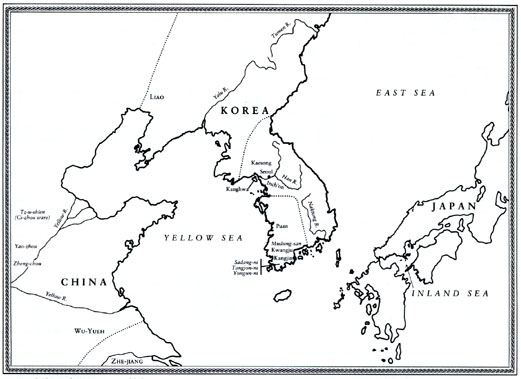
Korea and China, showing principal kiln sites.

Toward the end of the Unified Sil-(3-3, p. 7)la period, north China provided still another source of ceramic technology. Northern Chinese kilns had already begun to produce high fired wares, and may have assisted in establishing kilns at Inch'on and at other sites along the west coast of Korea. Some evidence for this northern Chinese influence has been unearthed in recent decades. In 1964, during the construction of the Seaside Golf Club at Inch'on, pottery sherds of an early type of celadon ware were found. The sherds were brownish in color due to oxidation, and were often incompletely fused because of underfiring (pl. 1).* Together with these sherds were found the remains of several kilns, built on a slope which extended about twenty-five to thirty feet. The early date of the Seaside site is suggested by the fact that the kilns discovered there lack the partitions characteristic of all kilns of the Koryo period. Further, the remains of only five kilns were found, indicating that this ceramic center had a short life. Like many ancient kiln sites in Korea, this site is near to the sea so as to facilitate transport by boat. Examination of the sherds by Korean archeologists reveal stylistic analogies with ninthand tenth-century wares of the late Tang and Five Dynasties period in northern China. It may be surmised that an incipient form of celadon began to be produced at the Seaside site early in the tenth century. Since this discovery, several similar kiln sites have been discovered up and down the Yellow Sea coastline from Inch'on.

Early Koryo Celadons

The earliest dated Koryo vessel is a wide-mouthed jar, now in the collection of Ehwa Women's University, which bears an inscription stating that it was made for the ancestral shrine commemorating the founder of the dynasty (pl. 2). The Koryo-sa (History of Koryo) records that this shrine was begun in 989 and completed in 993, confirm‎!ing the inscription on the jar. This vessel represents one of the early efforts to produce high fired stoneware with feldspathic glaze in Korea. It is essentially a white ware with a primitive glaze, and its simple form — with straight mouth and slightly splayed foot-rim — derives from Chinese prototypes.

During the eleventh century, and particularly during the peaceful and prosperous reign of King Munjong (1047-1083), rapid strides were made toward the production (3-3, p. 8) of fine celadons. Chinese Song wares were import!ed by Korea, in a flourishing reciprocal trade that inspired high levels of achievement. The elegant forms and subtle potting of white Ding (Ting) and Qingbai (Ch'ing-pai) wares acted as models for early Koryo vases. By the end of the eleventh century, the celadons of Ding, Qing-bai, and Yao-zhou (Yao-chou) — that is, the wares of northern China — were also the dominant influences for carved and molded decorations. Ding was the main inspiration for carved and incised wares, while molded designs were derived equally from Ding and Yao-zhou. Some of the painted designs used during this period may owe their origins to the influence of wares from Ci-zhou (Ts'u-chou); however, designs painted in white slip on a black ground, and then glazed with celadon, reflect a development that is uniquely Korean.

In addition to Chinese influences, wares from Liao — a state to the north of Korea inhabited by Khitan peoples — provided another important stimulus to the development of Koryo celadons. Although Liao was strongly sinicized, it also maintained a culture and style of its own. Liao vases with long, narrow necks and dish-shaped mouths appealed to the Koryo potter, and the angularity of the upper portions of these vases formed a pleasing contrast to the rounded contours of the body. Liao influences are evident in the designs of floral arabesques on Koryo wares, as well as in Koryo ewers with pronounced shoulders. The thin, sinuous, elongated dragon inlaid on Koryo vases also derives from Liao, and is visibly distinct from the full, rounded, scaled bodies characteristic of Chinese dragons. The influence of Liao on Koryo pottery is partly explained by the Koryo-sa, which reports that the Jurchen Tartars revolted against their Khitan rulers between 1115 and 1117, and that as a result hordes of Khitan refugees streamed into Korea. A few years later, Xu Jing's report on his Korean trip states that "there were many thousands of Khitan [that is, Liao] captives of whom one in ten was a craftsman."

Maturity and Invention

The second phase in the development of Koryo celadons occurred during the twelfth century, when the Korean potter had mastered his craft and began experimenting with new forms, techniques, and designs. This was the apogee in the development of Koryo celadons, with production centered at Kangjin and Puan. The ceramic vessels created during this period are unsurpassed for their elegant shapes, exquisite glazes, and superb artistry.

In 1914, archeologists discovered a large kiln complex at Kangjin on the southwestern tip of the Korean peninsula. This kiln site had been active from the tenth through the thirteenth centuries, and by the mid twelfth century incomparable celadons were being produced there. Many Kangjin pieces were covered with the fabled Kingfisher blue glaze, decorated with incised or impressed designs, and inlaid or painted with slip. Early Kangjin wares, such as the sherds excavated from Yongun-ni kiln number eleven, datable to the eleventh century, owe their inspiration to the Yueh wares of Zhe-jiang province. In view of the history of sea-links and other close relationships between Zhe-jiang and southernmost Korea, it is conceivable that Chinese potters emigrated and settled in southern Korea, and assisted in the establishment of the Kangjin kilns. The earliest of these kilns were built during the tenth century at the end of a steep valley; subsequent kilns were constructed lower down in the valley, with the result that by the twelfth century the kilns were close to the shore. Early Kangjin wares were roughly potted, with a dull, grey-green glaze or a glaze that had turned light brown due to oxidation. The highly splayed foot-ring, and the flat, wide foot-rim found in early Kangjin wares are both characteristic of Chinese Yueh wares, as are also the large white clay spurmarks made by kiln supports; all of these suggest the influence of Chinese potters. Interestingly, there is a celadon bottle from Kangjin in the National Museum of Korea that bears the date 1049 (pl. 3).

Some of the finest extant Kangjin wares are those which came from the village of Sadang-ni, a twelfth-century kiln site that received the patronage of the Koryo court. The significance of findings that have been made at Sadang-ni was slow to be realized: although fragments of celadon roof tiles were discovered in the Kangjin kiln area in 1914, these received little further attention. In June of 1928, several small celadon roof-tile fragments ornamented with floral arabesques in relief were found at the site of Sadang-ni kiln number seven. Together with these, many other ceramic sherds of the finest quality were uncovered, adorned with underglaze incising and slip inlay. Two months later, fragments of both round and flat celadon roof tiles were found at Manwol-tai, the site of the Koryo royal palace in Kaesong. The Koryo-sa records that the epicurean King Uijong commissioned the construction of a Summer palace in 1157. The pavilions were filled with rare and precious objects, the grounds were landscaped with plants and flowers, and an artificial lake was made within the palace grounds. On the northern section of the palace grounds the Yang-i-jong pavilion was constructed, and celadon tiles were used for the roof. The discoveries of 1928 did not exhaust the available sites, by any means. In 1964, celadon-glazed roof tiles with molded decoration were excavated at Tangjon-ni in the Kangjin area; these tiles are now preserved in the National Museum of Korea (pl. 4). In these examples, the round end tiles depict in relief a peony twig within double circles and bordering dots. Between the circular end tiles are the slabs of concave roof tiles, embellished at their outer edge with an elegant floral arabesque handsomely rendered in relief. These designs are crisply molded and thickly glazed with greyishgreen celadon. The tiles reflect the (3-3, p. 10) sumptuous elegance and refined tastes of the aristocratic Koryo court.

Puan was another twelfth-century ceramic center that produced some of the finest Koryo celadons, and received the patronage of the court. Puan was established a little later than Kangjin, and was particularly noted for its fine inlaid celadons.

(3-3, p. 9)

Plate 9 Celadon incense burner with openwork, produced during
the first half of the twelfth century. Now preserved at the National Museum of Korea.
Plate 11. Celadon covered
maebyong vase, showing
the uniquely Korean innovation
of black and white inlaid design;
produced during the mid twelfth
century. Now preserved at the
National Museum of Korea.


  Plate 10. Celadon ewer, produced during the first half of the twelfth century.
Now preserved at the National Museum of Korea.
 

Korean Form and Style

There is an essentially Korean character to the form and style of twelfth-century Koryo wares. When a shape was borrowed from China, it was inevitably modified to suit Korean aesthetic sensibilities. Koryo celadon vessels were often used in rituals, and the traditionalism of Koreans may be observed in vessels that copy and continue the archaic bronze ritualforms of ancient China. The Ding tripod in the National Museum of Korea, for example, is typically Sino-Korean, with its relief design of a tao-tieh monster mask, vertical flanges, horizontal grooves, and spiral ground (pl. 5); but there is also a typically Korean whimsy in the rendering of the zoomorphic beasts. Among the most popular forms of Koryo celadons are the wine pots and incense burners. Xu Jing, the Chinese diplomat who visited Korea in 1123, was enormously impressed by these shapes, and mentions that they were frequently surmounted by ducks, lions, or mythical beasts modeled in the round. The National Museum of Korea has an incense burner with a lion-shaped cover that closely matches Xu Jing's description (pl. 6). Reflecting Buddhist tradition, this incense burner depicts a male lion holding a ball; carved, incised, and appliqued details enliven the beast and define its form, while animal masks adorn the three legs and cloud patterns are incised on the surface of the burner. The Koryo potter excelled in producing small ceramic sculptures of animals and figures, as is demonstrated by an early twelfth-century water dropper in the shape of a duck (pl. 7). The bird seems to float placidly, holding 10 a lotus stem in its beak. The carefully modeled feathers are further detailed with fine incised lines. Celadons such as these reflect the enormous curiosity and interest that the Koryo potter had in the life and nature of the Korean countryside.

The excavation of the tomb of King Injong, who died in 1146, was one of the most significant of all excavations relating to the history of Koryo ceramics. There, celadon vases of superlative quality were unearthed, attesting to the extraordinary quality of the ceramics of this period. Although the melonshaped lobed vase discovered among these may derive its form from Chinese Qing-bai models, its flawless execution and aesthetic ambience is typically Koryo (pl. 8). The stately, lobed body of this vase is supported by a pleated foot, and the mouth emerges with the graceful petals of a morning-glory. The smooth glaze is exquisite, and has the tone of a warm, liquid green. Fragments of similar vessels have been found at the Sadang-ni kiln site in Kangjin.

One of the novel features of Koryo celadons is a preference for reticulated openwork, such as that often found on incense burners (pl. 9). A beautiful burner in the National Museum of Korea is supported by three charmingly obedient rabbits who support an assemblage of gracefully modeled leaves appliqued to a central pod. A ball atop the container is intricately rendered with interlocking circles in openwork.

Tea-drinking was a popular social custom during the Koryo period and, at first, Chinese Yueh teabowls were preferred because of their jade-like color and elegant shapes. By the twelfth century, however, many handsome tea-cups, bowls, and ewers were being created in Korea. Typical of these is an elegant ewer that was subtly modeled in the shape of a bamboo stem, with delicately incised details (pl. 10).

The supreme invention of the Koryo potter was the use of black and white inlaid design. It is exemplified by a handsome maebyong vase with an inlaid design of cranes flying amid mushroom-shped clouds (pl. 11). The technique of inlaying seems to have been invented around the middle of the twelfth century. Xu Jing's memoirs of 1123 make no mention of inlaid designs; nor did the tomb of King Injong, who died in 1146, yield any specimens of inlaid celadons. However, the tomb of King Mun Yu, who died (3-3, p. 11) in 1159, did contain examples of Koryo inlay.

The process of inlaying designs in celadons is complex. The design must initially be incised from the leather-hard clay body. The recessed design is then filled by brushing in a white or reddishbrown clay, and the piece is fired at 900 degrees centigrade. This baked biscuit is then covered with a transparent celadon glaze and, after a second firing at 1,300 degrees centigrade, the reddish-brown clay appears black. In some Koryo vessels only white clay was used, while in others the background was cut out and inlaid to create a reverse inlay. Although the black and white sgraffiato slip designs of Chinese Cizhou wares may have been one of the sources of the Koryo inlay technique, the incised and stamped patterns on Old Silla and Unified Silla grey wares suggest that there were also Korean antecedents.

  Plate 5. Celadon incense
burner in the form of an
ancient bronze ritual vessel,
produced during the early
twelfth century. Now reserved at the National Museum of Korea.


  Plate 6. Celadon incense burner
with a lion atop its cover, produced during the first half of
the twelfth century. Now preserved at the National Museum of Korea.


  Plate 7, Celadon water dropper
in the shape of a duck, produced
during the first half of the twelfth
century. Now preserved at the
National Museum of Korea.
 

Another unique innovation of the Koryo potter was the use of a copper oxide underglaze, which produced red designs when fired under reduction conditions. The earliest use of this technique occurred during the first half of the twelfth century, as exemplified by a celadon bowl with floral arabesques in underglaze copper oxide, now preserved in the British Museum. By the late twelfth century — and throughout the thirteenth century — copper oxide was frequently used to create colorful accents on inlaid celadons. Considering that cultural exchanges are usually reciprocal, it is interesting that Chinese potters did not begin to use copper oxide underglaze until the Yuan period, at the end of the thirteenth century.

Plate 8. Celadon lobed vase from
the tomb of King Injong. produced
during the first half of the twelfth
century. Now preserved at the
National Museum of Korea.


Plate 12. Celadon maebyong
dated 1345, showing the
considerable decline in the
craftsmanship of Korean
celadons since the height
of the Koryo period.
Now preserved at the
National Museum of Korea.

Loss of Momentum

By the beginning of the thirteenth century, the richest period in the development of Koryo celadons had ended. Aesthetic inspiration lost momentum, and decline set in. The excavation of later Koryo kiln sites confirm‎!s this. The ceramic kiln complex at Mudungsan near Kwangju, for instance, is known to have been active during the transitional period between the late Koryo and early Yi dynasties /that is, from the mid fourteenth to mid fifteenth centuries. In 1962 this site was excavated, revealing celadon sherds of poor quality, inlaid with repetitive stamped patterns. Inlaid designs had become overly profuse, bold, and pretentious, and their execution lacked technical skill and grace. In addition, firing techniques had deteriorated: underglaze iron painted designs — a relatively unsophisticated technique in use as early as the eleventh century — had become the common medium. A maebyong jar inscribed with the date 1345 provides eloquent testimony to this decline (pl. 12).

A Rare Moment

The artistic efflorescence and splendor of twelfth-century Koryo celadons is a wondrous historical phenomenon. Korean potters had spent nearly two centuries under the tutelage of Chinese and Liao potters, perfecting their skill in the creation of celadons. By the end of the eleventh century, many excellent celadon wares had been import!ed to Korea from Ding and other northern Chinese sites, and a number of these were subsequently interred in Koryo tombs. Emigrant potters from Liao, who sought refuge in Korea between 1115 and 1117, brought with them still another ceramic tradition. Magnificent examples of Chinese Imperial Ru wares — created for Emperor Hui-zong (Hui-tsung) during the first quarter of the twelfth century — arrived in Korea as a result of exchanges between the ruling

dynasties, and provided a further standard of ceramic excellence. By the twelfth century, however, the Koryo potter was ready to break free from these influences: he had mastered his craft, and began to develop new forms, techniques, and designs. The amalgam of different cultural influences had a catalytic effect in stimulating the superb creations of the mid twelfth century. The celadons of this period, then, represent a rare moment of artistic greatness, in which aesthetic content and superb technique combined in perfect harmony. Every aspect of these celadons — their strong, graceful shapes, their incised or inlaid decorations, and their infinitely rich opalescent glazes — testifies to the benign patronage of a sophisticated Koryo court that encouraged the production of magnificent art.


George Kuwayama is Senior Curator of Far Eastern Art at the Los Angeles County Museum of Art.


* Photographs are from the author, and from Sunu Choi, ed. Hanguk Eui Mi, vol. 4: Chungja [The Beauty of Korea, vol. 4: Koryo Celadon] (Seoul: Joonang Daily Newspaper, 1981), and Sunu Choi, The World's Great Collections: Oriental Ceramics, vol. 2: National Museum of Korea, Seoul (Tokyo: Kodansha International Ltd., 1982).


Korean Ceramics

Long admired in China and Japan, and more recently recognized in the West for its achievements, the ceramic tradition is an enduring feature of Korea’s culture. The earthenware vessels of the Neolithic period, the earliest of which date to about 7000 BC, show a variety of shapes and decorative techniques. By 1000 BC, the increasingly complex social organization of the population of the Korean peninsula is suggested by the many ceramic objects produced both for everyday use and for ritual and mortuary purposes. Advances in ceramic technology in the Three Kingdoms period (57 BC–AD 668) include the production of stoneware, requiring kiln temperatures of more than 1000 C. With the exception of Chinese stoneware, these are the earliest known high-fired wares in the world. Lead glazes, which may have been inspired by Chinese Tang dynasty (618–907) wares, first appear in Korea during Unified Silla (668–935). By the Koryo dynasty (918–1392), consistent advances in ceramic technology, including the use of the climbing kiln, led to the production of Korea’s widely acclaimed celadon wares. Most likely derived from Chinese Yue wares, these celadons reached their high point of perfection in the mid-twelfth century. The exceptional clarity of Koryo celadon glazes made possible the decoration of wares with inlaid designs, a technique known as sanggam, which is a unique achievement of Koryo potters. In the twelfth century, these craftsmen were among the first to employ successfully the difficult technique of underglaze copper-red decoration on high-fired wares. Ceramic production in the succeeding Choson dynasty (1392–1910) is characterized by innovative punch’ong stonewares and by white porcelain wares. The latter in particular reflect the austere tastes of the Neo-Confucian governing class. Developments in decorative techniques in porcelain wares include underglaze cobalt-blue painting, adopted from China, as well as underglaze copper-red and iron-brown decoration. There was concurrently an exploration of new ceramic forms.


The Korea Times October 2, 2008

By Chad Meyer

This is the sixth and final part of a series focusing on the benefits of a Korean well-being lifestyle. We will explore the Korean diet and reveal that even desserts can have nutritional value. ― ED.

We have spent some time examining Korean food and drinks in previous articles. Our final nutritional analysis is with Korean desserts.

Internationally, desserts are sweet dishes served after a large meal. They satisfy our senses of smell and taste and cleanse the palate after a hearty meal. In the West, it is not uncommon for women to skip dinner and leap directly to dessert trying to minimize calorie intake.

Western restaurants implant desires in our minds by positioning dessert showcases within our line of sight. From cheesecakes to ice cream, these restaurants cater to our mouth's sweet tooth.

Interestingly, Asian restaurants located in Western countries often have reputations for serving desserts worth passing over. Why? Is it because Western desserts contain dairy products that are less popular in Asia? Or is it due to the fact that Western desserts are simply too sweet? Both of these statements are correct. But the true answer lies in tradition.

Traditionally, Koreans did not consume overly sweet foods. ``Ddeok,'' which we previously explored, along with Korean apples, pears, and persimmons are the most common traditional Korean desserts. All of these are low calorie, nutritious alternatives that the international community would enjoy.

Each of these fruits has a distinction from their Western counterparts. Korean apples can be traced back to 1103AD and were originally served as a dessert to royalty.

To this day, Korean apples are generally consumed raw and are not cooked with food. Korean pears are shaped like Western apples and exported in large quantities. They command high prices as they are considered to be among the best in the world. Like Korean apples, Korean pears are especially succulent and great care is taken in their handling. Each Korean pear is wrapped individually before becoming showcased in department stores and supermarkets. These pears can remain unspoiled for several weeks and are considered healthy gifts for relatives at holidays. Pears cleanse the blood and reduce the risk of cancer coming from smoking and the overeating of red meat.

Above apples and pears, Korean persimmons are especially unique. Persimmons appear similar to an unripe tomato taste much sweeter. There are two types of persimmons harvested in Korea in October. Only one of these types can be eaten before fully ripening, but both are a good source of vitamins B2, B9, and vitamin C. And along with red ginseng, Korean persimmons are frequently used as an ingredient in hangover remedies.

``Hangwa'' is another famous category of traditional Korean desserts. Hangwa consists of different types of sweets and cookies made of rice flour, honey, fruit, and roots. Hangwa is considered nutritious as it is made using natural ingredients and natural food coloring. Hangwa outlasts Western cookies in retaining flavor and not deteriorating too quickly over time. Similar to ddeok, it is an artistic food that is decorated in colors, textured with patterns, and given nature themed shapes. It is commonly found in special confectionery shops and department stores and gifted to family members during Lunar New Year's, Chuseok, weddings, and other ceremonies.

Due to the labor intensive preparation required, hangwa are considered a sophisticated traditional snack and therefore cost more than Western cookies or crackers. A box of hangwa can easily cost upwards of one hundred dollars. Traditionally served while fruit was out of season, hangwa can last long periods of time. Insadong is a famous traditional neighborhood of Seoul that houses many hangwa confectionary shops. There are too many types of hangwa to list but ``dasik'' is one variety that Westerners can enjoy.

Dasik is a soft round cookie that is normally accompanied by tea. Dasik is lighter and healthier than Western snacks as it is not as sweet as cookies or chocolate. Typical ingredients include: rice powder, flour, herbs, grains, sesame seeds, starch, chestnuts, green tea powder, and red ginseng powder. These ingredients are mixed together with honey to form dough. The dough is then pounded flat and pressed into molds. As the recipe for dasik originally derives from a Chinese type of cookie, dasik are frequently stamped with the Chinese characters for luck, health, and longevity.

``Pahtbingsoo,'' or red bean with ice flakes, is a summertime dessert that anyone can enjoy. It consists of shaved ice, sweet red azuki beans, condensed milk, and is topped with ice cream or frozen yogurt. Whipped cream, diced ddeok, green tea powder, and corn flakes often adorn ``bingsoo'' as well.

The sweet azuki red beans in pahtbingsoo are cooked into a red bean paste by boiling, mashing, and adding honey. These paht are an Asian bean that has existed since 1000BC. This bean is only second in popularity to the soybean. Red beans are high in protein, iron, and calcium. A variation of this dessert is ``gwa-ilbingsoo.'' Gwa-il is the Korean word for fruit. Fruit with ice flakes is a great dessert for those searching for something sweeter than red azuki beans. The fruit used in this dessert can be strawberries, bananas, or kiwi. Both types of bingsoo desserts are found in cafes, department stores, and other restaurants. Apgujeong and Cheongdam are great neighborhoods to find bingsoo. A typical bowl for two costs around $10-15 and is only 200 calories per person.

Bbang, or bread, is another healthy food that has taken off in the past decade. Interestingly, Korean bread is an entire category of food encompassing anything baked using flour. Often sweeter than American bread, bbang is considered more of a dessert than a meal. Korean style bakeries can be found at nearly every major intersection of Seoul.

Popular chains include Paris Baguette, Shilla Myunggua, Tous Les Jours, and Crown Bakery. Favorite breads include: hot dogs baked in croissants, chocolate covered croissants, pizza bread, panini pockets, baked rolls, croquettes, green tea cake, mango cake, and sweet loafs of bread. Croquettes are an interesting variation here. Often spelled ``koroke,'' these are deep fried dough stuffed with curry, potato, and vegetables.

In the past several years there has been an explosion of Waffle shops in Seoul. Street vendors sell a quickly prepared take away waffle. These finger food waffles come plain or sandwiched with ice cream. The cost is extremely low at two dollars or less.

These smaller shops can be found near universities and nightlife areas such as Ehwa University or Gangnam Station. Samcheong-Dong is a popular cultural district of Seoul with many deluxe waffles shops. This type of dessert cafe offers large Belgium-style waffles that are freshly prepared with premium ingredients and served on a dish. I have seen nothing like these in the States.

These sit down waffle dishes are topped with a mountain of ingredients including ice cream, fruit, red beans, whipped cream, and green tea powder. Often costing upwards of $10 for a two person serving, these are desserts that cannot be skipped.

Chad Meyer is a robotics engineer working in Korea with a passion for Korean food. He can be reached at: food.korea@hotmail.com


The Korea Times September 18, 2008


By Chad Meyer

This is the fifth part of a series focusing on the benefits of Korean well-being. We will continue to explore the Korean diet and its relationship with longevity and health. ― ED.

Traditional and contemporary Korean beverages provide a number of dietary benefits. Their role has more in common with medicine and healing agents than with simply stimulating our taste buds and quenching our thirst. Although a variety of carbonated sodas are accessible, Koreans choose to minimize the sugar pleasures from Coca Cola, Sprite, and Fanta.

These caffeinated drinks are consumed on occasion and in much smaller sizes. Korean children are not served sweetened drinks with meals either, avoiding the addictive properties of caffeine and sugar at a young age. Teenagers occasionally consume soda with friends as it infrequently infiltrates the home.

In the United States, ninety percent of adults and seventy-six percent of children consume caffeine daily. Caffeine occurs naturally in products such as tea, coffee and chocolates, and is also added to cola soft drinks. An eight-ounce cup (245ml) of coffee contains 135mg of caffeine. A twelve-ounce can of soda has 34mg of caffeine.

American adults ingest large amounts of caffeine from coffee while American children get caffeine from carbonated soda. Studies demonstrated that three to four cups of coffee per day could reduce the risk of type-two diabetes by up to thirty percent. Later studies showed that the reduced risk likely comes from the combination of caffeine, potassium, magnesium, and antioxidants found in the coffee. While coffee may not be too harmful and may have some benefits, a diet heavy in caffeine can lead to insomnia, nausea, diarrhea, and obesity through a stimulated appetite.

Water and tea are the two healthiest beverages known to mankind. Both are in abundance and have few undesired side effects. What other drinks could be considered healthy for our bodies? In order to better understand beverages and their benefits, let's take a closer look at calorie and sugar intake.

A person's metabolic rate is a measure of the energy required for involuntary body processes. A human requires roughly ten calories per pound (.45kg) of body weight to maintain life. A 200lb person would then require a 2,000-calorie diet. More than half of the required calories for living are used for breathing, maintaining body temperature, developing hormones, and maintaining a constant heart rate.

Sugar ingestion, along with calorie intake, is something we must also monitor. Human taste buds love things that are sweet. Excessive amounts of sugar, however, can increase the risk of type 2-diabetes, tooth decay, and obesity. The typical size of a Korean beverage bottle is one hundred to three hundred ounces. A Western size can of Coca Cola is twelve ounces while bottles are twenty ounces. A can of Western soda contains about 150 calories and nearly 40 grams of sugar.

For comparison, a typical packet of sugar contains four grams of sugar. A single can of soda therefore contains the equivalent of ten packets of sugar. A twenty-ounce bottle of carbonated soda holds 69 grams of sugar, the equivalent of over 17 packets of sugar. It's sickening to think how much sugar this is. Unfortunately, even some Western health drinks such as vitamin water are misleading. A twenty-ounce bottle of Glaceau Vitamin Water, for example, contains 130 calories and 33 grams of sugar!

Koreans have a tendency to listen when their bodies speak. As a Westerner, I often tolerate stomachaches, headaches, and other undesirable physical pains knowing that the sensation will eventually pass.

Instead of looking after our health, Westerners are emotionally consoled via 'comfort drinks' like Diet Coke and Diet Pepsi. The irony of diet drinks is that they really do not help your diet. Western diet drinks offer little to no nutrition and are marketed to people looking to reduce their sugar and calorie intake to fend off obesity.

The remaining non-diet Western drinks are high in calories and sugar. Although these provide no nutritional value, psychologically they provide the stimulus and pleasure that Westerners crave. Westerners want an immediate uplifting feeling regardless of the actual long-term health risk. Koreans are more proactive searching for relief from these unwelcome feelings via more natural means.

Many types of Korean drinks have specific functions. Whether it's treating indigestion, a cold, fatigue, or even a hangover, you will find a drink created for every ailment. Over-the-counter herbal drinks, vitamin drinks, juices, energy drinks, and general well-being beverages are found ubiquitously in Korea and are a representation of a culture cradled by well-being.

The Korean bottle, can, and drinking carton size are distinguishable from Western drinks. Portions are realistic and a typical three to eight ounce bottle is designed to be fully consumed during a break or resting period of the day. These drinks can be found seemingly everywhere: Korean supermarkets, convenient stores, and pharmacies all offer a large assortment of nutritional stimuli. The refrigerator case in a Korean supermarket has very little in common with the Western counterpart. And in addition to the cold case refrigerator, you'll often find a smaller warm case where coffees and teas can be found ready to drink in a hot can.

Western medical treatment for common colds and ailments are usually a combination of rest and prescribed medication. Koreans can consult a doctor or utilize a trained pharmacist who can offer several over the counter (OTC) treatments. Red ginseng is an energy drink that can be found in all pharmacies and supermarkets.

It is sold in six-ounce cans. It contains Korean red ginseng extract and vitamin C, known to combat stress and fatigue. Red ginseng is a root that becomes red while it grows over six years time. It is then processed by continuous drying and steaming. Red ginseng has many health benefits such as quenching thirst, eliminating fatigue, removing stress, preventing diabetes, preventing overeating, regulating urine flow, aiding in hangover recovery, and minimizing the effects of aging. A similar Western energy drink is Red Bull. Although Red Bull does not contain ginseng, it is functionally the same.

Served in eight-ounce cans, it contains 160 calories and 39 grams of sugar. The problem is that Red Bull simply mimics what caffeine does to our body, acting as a quick pick-me-up. Red ginseng not only provides short-term benefits but it also provides the body with long-term nutrition, healthy skin, and an improved immune system.

Aloe Vera drinks are another unique Korean beverage. They are sold in short and tall green tinted plastic bottles. Normally containing thirty percent aloe vera gel in a drinkable form, they are rich in minerals, calcium, potassium, Vitamins B3, B1, B6, B2, and Vitamin C. Aloe vera drinks are characterized as aiding the digestive system and helping relieve gastrointestinal problems. They are also considered as a treatment for athlete's foot and acne.

Bacchus-D is a favorite energy drink in Korea. Served in small three ounce brown glass bottles, this product dominates five percent of the total Korean pharmaceutical market. Bacchus-D was created in 1963 by the pharmaceutical company Dong-A.

It was produced to combat fatigue, lower stress, improve concentration and maximize energy levels. It is yellow in color and contains royal jelly, a secretion from honeybees that is fed to queen larva. In recent years, the company acknowledged that people with Asthma and allergies to bee products should limit their exposure to royal jelly.

Bacchus-D also contains apple juice and the extracts of strawberries, oranges, and pineapples. It has a minimal aftertaste, which makes it a good alternative to Red Bull. Also considered a hangover remedy, Bacchus-D is a popular beverage to have after an evening of drinking. The total amount of caffeine is low compared with Western beverages. The eight-ounce can contains 120 calories, 29 grams of sugar, and 60mg of caffeine. This is half the dosage of caffeine of a similarly sized cup of coffee. A sugar-free version is also available.

Vita 500 is a Korean beverage that is famous for being one of the few caffeine-free energy drinks. It is produced by the Kwang Dong Corporation and contains a vitamin enriched apple juice. Each bottle contains 155 calories and 35 grams of sugar. It is very popular globally, selling over 100 million dollars worth of product in 2006. Similar to Bacchus-D, it is bottled in small six ounce brown glass bottles. It is a Vitamin C based drink designed to improve physical strength and energy. The US RDA recommends at least 60mg of Vitamin C per day for adults. Vita 500 has 500mg of Vitamin C, which is 830% of the US RDA. It also contains vitamins B2, B3, and B5. The artificial sweeteners inside unfortunately give this a slightly strong aftertaste.

Vita 500 is commonly purchased in larger ten pack cartons. During important business meetings, it is common for the attendees to bring two cases of Vita 500 for the host as a gesture of respect. When arriving, the guests will hand out one bottle to each attendee. If the meeting is with only one person, two cases totaling twenty bottles can be given to a single individual as a gift.

Besides drinking water or tea with meals, Koreans sometimes enjoy a traditional after-dinner drink in lieu of dessert. Sweet cinnamon punch, ``soo jeonggwa,'' can be made at home or purchased in an eight ounce can. It is a traditional Korean natural drink made of cinnamon, sugar, dried persimmon, and ginger. It is believed to assist in digestion. Another traditional Korean drink is ``Sikhye. Sikye is an inexpensive sweet rice punch. It contains barley germ powder, sweet rice, sugar, and pine nuts and is served cold over ice.

Koreans have a favorite high calorie drink that deserves recognition: banana milk. Although milk and dairy products are not indigenous to Korea, banana milk became a favorite drink care of the Binggrae Company in 1974. During this time, the Korean economy began to flourish and banana milk became a hit.

Since then, it has been considered a contemporary reminder of the success that Korea experienced in the 1970s. Packaged in a unique small plastic capsule, Binggrae banana milk is a unique type of Korean beverage.

Chad Meyer is a robotics engineer working in Korea with a passion for Korean food. He can be reached at: food.korea@hotmail.com


The Korea Times September 4, 2008 


By Chad Meyer
Contributing Writer

This is the fourth part of a series focusing on the benefits of Korean well-being. We will continue to explore the Korean diet and its relationship with longevity and health.

After spending several articles discussing different types of Korean cuisine, we will shift our focus to Korean well-being beverages. Traditional and contemporary Korean beverages hold an equal number of health benefits and remain very unique compared to Western beverages such as milk, soda, coffee, and juice.

In Korea, tea drinking is an experience characterized in social, cultural, and spiritual aspects. It has evolved from a simple drink into an herbal treatment for various ailments. Traditional Asian medicine follows the belief that there are three hundred and sixty vital energy channels in the human body. Referred to as chi, these channels must remain unblocked in order for nature to provide balance and harmony to the body. Maintaining chi levels is preventive maintenance for the body. Along with meditation and exercise, tea is used as a treatment to unblock or repair damaged chi.

A tea drink is created by steeping processed parts of a tea bush. The buds, twigs, and leaves of a tea bush are placed in a pot of boiling water for a specified amount of time. Korean tea is a unique blend that combines the above mentioned with fruits, grains, and roots that are common to Korean medicine. Besides water, tea is the second most popular beverage in Korea.

Korean tea was first recorded to have been consumed in the year 661 during a spiritual ceremony of the Geumgwan Gaya Kingdom (42-562). The latter Goryeo Kingdom (918-1392) also has records of tea in Buddhist monk tea offerings. And during Korea's Joseon Kingdom (1392-1910), tea was consumed by the royal family and dignitaries during daily daytime tea ceremonies and on special ceremonial days. Commoners too began consuming tea towards the later years of this dynasty. During this time of Confucian philosophy, Koreans believed that tea held a role as both drink and medicine. The Korean physicians of the Joseon Kingdom divided human beings into four types based on their emotional characteristics. Different body types were determined to require different medicines. Tea creates a harmony between body and nature. As a medicine used to treat each of the specific body types, tea can successfully mend damaged health.

There are numerous health benefits to drinking tea. In some studies, tea is shown to lower cholesterol levels and protect against lung, prostate, and breast cancer. Additionally, tea is shown to reduce the risk of heart disease and aids in weight loss. Tea helps in digestion, metabolism detoxification, fatigue, and clearing our minds for improved thought processes.

The antioxidants in tea have put it in the spotlight in recent years. Tea contains large amounts of antioxidants that are believed to be linked to longevity. Oxidation is a standard process that occurs in our body and is vital to life. As a result of a normal metabolism, our cells are progressively damaged by means of cell oxidation. Environmental influences such as pollution and excessive sunlight amplify the cell damaging oxidation process.

Antioxidants reduce the pace of oxidation to our cells, thereby limiting the effects of aging. Blueberries and pomegranates hold distinction for their antioxidant properties. Green and black teas provide nearly ten times the amount of antioxidants of these fruits. While tea production in Korea is limited due to the cold climate, the warmer southern part of the country is where most tea is grown. Jeju Island, Boseong, and Jiri Mountain are prominent green tea growing locations. Jeju's teas are known to be slightly salty due to the proximity of the ocean.

All teas can be grouped into four categories: green, white, oolong, and black tea. Oolong and white teas are common in Chinese culture. In Korea, the earliest tea used for ceremonial purposes was a type of black tea. Ceremonial Korean teas were consumed on days related to the seasons as well as birthdays and anniversaries. The teas later import!ed and grown by Buddhist monks provided a greater variety and included green teas. Koreans believe that each of the four tea categories can heal us and influence our individual senses. Teas can be described by the following categories: bitterness, astringency, sweetness, sourness, and saltiness.

``Boricha'' is a traditional roasted barley tea served with meals in restaurants. Made of barley, ``boricha'' may remind Westerners of the flavor of Cheerios cereal. ``Boricha'' is served all year, as a hot beverage in the winter and as a cold drink in the summer. The Korean variety differs from the more simple Japanese form. In Korea, it is often combined with roasted corn. The sweetness of the corn helps to minimize the bitterness of the barley.

Barley tea is naturally caffeine free and is considered a good treatment for the common cold as it alleviates congestion. It is also known to relieve upset stomachs and constipation, cool the body, and cleanse the digestive system. A recent study in Japan found that barley tea increases blood viscosity. A tea similar in flavor to barley tea is ``hyeonmicha.'' It is made from an unpolished roasted brown rice and tastes slightly sweeter.

``Insamcha'' is another common traditional Korean tea. Insamcha is a ginseng tea that can be purchased in the supermarket or department store in powder form. It is also served as a hot tea at cafes. The flavor of the ginseng varies depending on whether it was dried, not dried, or steamed. Ginger is believed to be helpful in relieving fatigue as well as protecting the liver from damage. Ginseng contains adaptogens which help to manage stress, fatigue, and anxiety. Western case studies have established that ginseng is effective in lowering blood sugar levels and lowering cholesterol. People with Type-two diabetes and high cholesterol can benefit the most from ginseng tea. Currently, additional studies are underway to link ginseng consumption with improved memory and thinking capabilities as well as increasing body energy.

Ginseng tea is prepared by slicing ginseng into thin strips. Sugar or honey is added and the combination is left to sit. The ratio is ten parts water to one part ginseng. The ginseng is then boiled for several hours with water to make the tea.

``Saenggangcha,'' or ginger tea, is a Korean tea served hot and enjoyed at cafes. It can also be purchased as an instant mix from the supermarket. The ginger root is cleaned and sliced thin with the skin left intact. It is stored in honey for several weeks before boiling. Ginger is commonly used as an ingredient in Asian medicine. It is recommended for cold prevention, headaches, motion sickness, diarrhea, and for those with lower than normal body temperatures.

``Omijacha'' is another unique and interesting traditional Korean tea. The name omija means ``five tastes.'' These tastes are: sweet, sour, bitter, salty, and pungent. It can be purchased as a cold tea in the supermarket or as a hot tea at cafes. ``Omija'' is an Asian Schizandra berry used in Korean medicine. It is dried before boiling. It is typically mixed with honey or watermelon juice to create ``omijacha''. This berry tea is believed to tame coughing and help treat asthma.

Chad Meyer is a robotics engineer working in Korea with a passion for Korean food. He can be reached at: food.korea@hotmail.com.


The Korea Times August 14, 2008

By Chad Meyer
Contributing Writer

This is the third part of a series focusing on the benefits of Korean cuisine. We will continue to explore the Korean diet and its effect on longevity and health.

A rich history and strong country pride have inspired generations of Koreans to enjoy traditional cuisine. While many of the traditional meals are rich in flavor, some Westerners have found that Korean meals are lacking in taste. I am convinced that with an understanding of local history, culture, and health, their cuisine will gain appreciation and grow in appeal. A diet merging meals from Korean and Western cultures is proven to yield higher body nutrition.

Rice cake, or ddeok, is a traditional Korean food holding numerous dietary benefits. Ddeok is recorded to have been eaten in the year 57 BC during the Three Kingdoms of Korea. When the Goryeo Kingdom (918-1392) later unified the Korean Peninsula, ddeok became a commonly consumed food. Finally, during the Chosun Kingdom(1392-1910), two hundred different types of ddeok were documented to have used a total of ninety different ingredients. However, as Western cultural influence grew in the 20th century, interest in ddeok slowly began to wane. It eventually became a traditional food served only during the Lunar New Year Day, birthdays, and weddings.

In 2002 the first rice cake cafe opened in Seoul spawning national interest. Around 2004, a health craze for traditional Korean meals kicked off and interest in health food exploded. Today, rice cakes have become an important part of the Korean diet. Found in supermarkets, department stores, public markets, street vendors, and even subway station kiosks, it is a food that has penetrated all locales.

Unlike the dry Western version, Korean rice cakes are slightly moist and appetite satisfying. They can be served alone as a meal or enjoyed as a dessert. As a dessert, rice cakes are very different from the sweeter Western cakes. The Korean variety is made from rice and only naturally sweetened with red beans and assorted fruits, and decorated with raisins, ginger, or sesames seeds.

As a low calorie meal, ddeok is a good source of protein, vitamins, and minerals. As an ingredient in soups and stews, rice cakes are a soft and chewy nourishment for your body. The taste of rice cake can vary and is a function of the preparation method used. For example, ddeok that is pounded flat becomes very chewy.

Rice cakes have also become a Korean consumable art form and a feast for the eyes. In May, the sixth annual Ddeok Exhibition and Beautiful Ddeok Contest showed off the best creations Seoul has to offer. The Institute of Traditional Korean Food uses this festival to promote ddeok. Using a palette of natural food colorings, Korean chefs have elevated rice cakes to new heights by designing museum-worthy masterpieces.

Another famous traditional health food is jook, or Korean porridge. Historically, a meal of juk was served during the longest night of the year, the winter solstice. ``Dongji patjuk'' is a type of red bean juk eaten on this day. Korea's Confucian society believed that the red color of the beans warded off disease spreading spirits. This special red bean juk was even thrown at the front door to prevent these bad spirits from entering the home.

Today, juk is prepared for family members who are sick, have stomachaches, or other digestion problems. Juk is a comfort food known to warm your stomach while not upsetting your digestive system. Common types are: seafood, tuna and vegetable, beef and mushroom, pumpkin, chicken and ginseng, and pine nut. It is otherwise served unseasoned.

Korean porridge is also eaten for breakfast or as a late night snack since it is not heavy or greasy. Elderly people who are sensitive to body changes also choose it. And for a Korean baby, a diet of jook begins six months after birth.

Juk begins life in a rice cooker. After normal cooking, the rice is mixed with six to seven times more water in a stove pot. Over low heat, the rice is cooked and slowly expands. Considered a slow food, juk is a labor intensive meal requiring constant stirring to prevent the rice from burning. Total time for preparation is about an hour.

In Korea, Hyun Juk is one of the largest chains with locations in most Seoul neighborhoods. I interviewed the owner of the Yangjae-dong location to uncover some of the mysteries of this meal. First, I learned that seafood and tuna jook are the most popular dishes served. Seafood, such as salmon and tuna, are high in Vitamin D. A recent American study published in the Archives of Internal Medicine shows that deficiencies in vitamin D can lead to cancer, diabetes, and immune system problems affecting longevity.

The owner also said that many patrons return to the restaurant once or twice per week to enjoy Korean porridge. During the workday, a majority of the customers were young working females. At night, more men enjoyed jook. She said that Korean females are normally cautious about their diet and therefore plan on healthy meals such as jook. Korean men on the other hand, suffer from high stress levels from Korean living which brings them to the restaurant for dinner. As stress can give people upset stomachs, juk serves as a cure for indigestion.

Chad Meyer is a robotics engineer working in Korea with a passion for Korean food. He can be reached at: food.korea@hotmail.com


The Korea Times July 31, 2008

By Chad Meyer
Contributing Writer

This is the second part of a series focusing on the benefits of Korean cuisine and nutrition. We will continue an exploration of the Korean diet and an examination of culture, health, and longevity.

The average lifespan of Koreans continues to rise, according to the 2008 Korean Health Data Report issued by the Organization for Economic Cooperation and Development (OECD). Koreans are now living 79.1 years, above the OECD average lifespan of 78.9 years. The data links longevity, among other things, to health care expenditure per capita. But South Korea goes against the trend. According to the report, Korea, with an above-average lifespan, ranks 28th out of the 30 OECD countries in terms of health care expenditures, based on GDP. Is Korea's diet the key contributor to longevity in the Land of the Morning Calm?

Korea has one of the smallest pool of doctors of the 30 OECD countries. Koreans live longer lives and spend far less on health care than other leading countries such as Japan. And although Japanese live slightly longer, they are spending significantly more public and private money on healthcare. While individual health care spending in Korea is rising, it remains below the OECD average and well below that of Japan. South Koreans also work more hours than all the members of the OECD. With elevated stress levels from longer work hours, why do Koreans require less health care while living longer lives?

Korea may one day boast to having the oldest and longest living people in the world. The climate and geography of the Korean Peninsula have led to a land strong in agriculture. Local cuisine primarily consists of vitamin-rich vegetables and fruit, thus minimizing the harmful effects of a meat-based diet. The Korean diet is also high in antioxidants that promote longer living and is a reflection of a healthy culture.

Speaking with Koreans reveals their lifestyle of well-being. Nutrition and healthy ingredients are their primary sustenance. Until recent years, there was little demand for foreign foods in restaurants and supermarkets. The youth of today have developed tastes for pizza and fried foods, but the local demand still favors traditional foods. Both urban and rural areas of Korea continue to have a limited number of foreign restaurants curtailing the effects of excessive meat consumption. This kind of diet has allowed Koreans to avoid obesity and heart disease.

U.S. researchers have found that people who eat two portions of beef per day are more likely to develop long-term heart conditions and diabetes. According to the US Department of Agriculture (USDA), the average American eats 66 pounds (30kg) of beef per year. Koreans consume 16 pounds (7.25kg) of beef per person per year, less than ¼ of the American consumption rate.

A staple of the Korean diet is kimchi. Kimchi is a fermented mixture of ingredients such as red pepper powder, cabbage, green onion, radish, and garlic. Its efficacy is well known, and Koreans consume 22-33 pounds (10-15kg) of kimchi per person per year. According to the Korean Ministry for Food, Agriculture, Forestry, and Fisheries (MIFAFF), kimchi is highly nutritious, strengthens the immune system, prevents cancer, lowers blood cholesterol levels, and delays the aging process promoting longevity. The MIFAFF also states that Kimchi contains ingredients providing antibiotic effects, preventing hyperacidity, and restricting the growth of undesirable bacteria in the intestines.

A medicinal ingredient in prepared kimchi is garlic. Garlic assists in preventing cancer, reducing the risk of heart disease, and minimizing the effects of aging. Garlic is known to lower cholesterol levels in the body. It can help maintain lower blood pressure levels by thinning our blood. Thinned blood deters plaque build up in arteries and veins. It is known that regularly eating garlic can add up to four years to a person's lifespan.

Cabbage, another ingredient in kimchi, also has numerous health benefits. Cabbage is low in calories and sugar. It is high in fiber and vitamins A, B, C, and E. The high fiber content, as well as iron and sulfur, aid in digestion preventing problems in the intestines. Cabbage can inhibit infections and is known to prevent ulcers.

My personal favorite, out of the hundred or so different kimchi types that I have tried (and there more that I have not yet tried) is ''ggaktugi.'' It uses the daikon radish as the base of the kimchi, rather than cabbage. Ggaktugi shares many of the health benefits provided by the more widely eaten cabbage kimchi.

Koreans are living longer than ever thanks to nutritious traditional food such as kimchi. Kimchi slows the effects of aging and reduces the risks of disease. If Koreans continue to resist the temptations of a Western diet in favor of traditional diets, the trend in the country's growing longevity will continue. And as the benefits of a Korean diet become internationally known, traditional dishes will explode into the restaurants of the world.

Chad Meyer is a robotics engineer working in Korea with a passion for Korean food. He can be reached at: food.korea@hotmail.com


The Korea Times July 10, 2008 

By Chad Meyer
Contributing Writer

Korean foods and cuisine have been refined and adapted since the Gojoseon Kingdom 4,300 years ago. While Western foods have evolved to rely mainly on salt and sugar for taste, Korean foods remain simpler, lighter, and healthier.

There is also a uniqueness that differentiates Korean cuisine from many of its Asian neighbors. And with only 3percent of the Korean population over the age of 15 overweight, clearly there is something to be taught.

The international demand for Korean cuisine is growing, but still continues to be an undertapped export absent from many Western palettes. This series of articles will examine the distinctions and benefits of a Korean food diet.

In the course of this exploration, we will also observe that Korean foods assist in preventing wrinkles, remaining thin, and living above the OECD average life expectancy.

There are numerous reasons why Korean food remains unpopular and under-appreciated by Western diners. Poor perception is one of them. Just as American food can be oversimplified to hot dogs and hamburgers, Korean cuisine can be oversimplified to very hot spicy dishes without flavor. Korean food is also unhelpfully sandwiched between Chinese and Japanese cuisine.

To some degree this is unavoidable. Geography, climate, and history determine the types of vegetables and roots that are grown and consumed. Visit any Korean department store food court and you will find a selection of Japanese and Chinese foods.

Certainly these foods are popular here and have influenced local cooking. And while some traditional Korean dishes have evolved from recipes of these two countries, you will find substantial differences. Chinese food is more heavily seasoned and stronger in taste, while Japanese food usually consists of seafood and is milder in taste.

For those of us that have experienced Korean food, we know that it is much more than just fish soups, chili peppers, beans, and fermented vegetables. Korean cuisine is distinct in its color, texture, and flavor. It is a labor intensive creation that requires the preparation of numerous dishes that are both harmonizing and distinctive. The effort required to prepare Korean food towers over cuisine from other countries.

It can take days to prepare a single meal. And so, Koreans have built a cultural pride in their food that has prevented family recipes from dying. The defining constituent of Korean culture is the rich heritage of food.

Many foods are cooked in exactly the same ways as they were long ago. The methods for preparation, preserving, and pickling remain unchanged. Red peppers are used as they were when they first arrived on Portuguese trade ships in the 17th century. Kimchi, which originated in seventh century Korea, also remains largely unchanged and is consumed with every meal.

Recipes for meals like Dwenjang jjigae and cheonggukjang are hundreds of years old and are served as they were to earlier kings and queens.

Korean food is especially unique when compared to North American and European food. Western cuisine relies on dairy products to provide rich flavor. Koreans consume significantly smaller portions of yogurt, milk, and butter as local meals do not require dairy products. Milk is consumed as a drink and butter is limited to use in baked goods. Cheese, a staple of European food, remains an expensive luxury import! in Korea. Prices for dairy products, in general, are nearly double that of other countries. And although you can find cheese on pizza and other foreign dishes, the local variety of cultivated cheese is generally bland and poor in quality when compared to its European counterpart.

Another unique aspect of Korean cuisine is the complimentary side dishes. Patrons of international restaurants have experienced small complementary dishes of food upon arrival at their table. Mexican restaurants, for example, offer free nacho chips and salsa.

Italian restaurants provide bread. Korean restaurants instead offer a complementary selection of side dishes called banchan. You will find that the variety and selection varies from place to place, as does the quality. Generally, more expensive multi-dish course meals include premium banchan featuring beef, noodles, Korean pancakes, and exotic vegetables.

Less expensive restaurants offer more basic side dishes such as bean sprouts, radish, and kimchi. A trip to the Insa-dong neighborhood of Seoul will demonstrate what I mean. There, you will find a selection of traditional restaurants that offer dozens of side dishes.

If you happen to find a side dish that you like, do not be afraid to ask for more. It's nearly impossible to leave a Korean restaurant without a full stomach. Koreans pride themselves in their cooking skills and deserve to be recognized for their talents.

Don't forget to comment on the food if you enjoy it. Through uniqueness in color, flavor, texture, and taste, Korean food provides a glimpse into the cultural heritage of Korea. And with a rich history and tradition in food, there will be enough Korean dishes to keep you exploring for years to come.

The writer is a robotics engineer working in Korea. Although he can cook Italian
and American foods, Korean food remains his favorite. As Columbus discovered America, so did Chad discover the uniqueness of Korean cuisine. He can be reached at:
food.korea@hotmail.com


Why Internet connections are fastest in South Korea

By John D. Sutter, CNN
April 1, 2010
STORY HIGHLIGHTS
  • South Korea has the world's fastest Internet speeds
  • The U.S. Internet lags far behind for a number of reasons
  • South Korea has more competition; it's also more dense, which makes for shorter lines
  • Culture may also contribute; S. Korea has helped breed demand for fast speed

Editor's Note: Which 17 countries have faster Internet connections than the United States? See our Internet speed map.

(CNN) -- People in the United States basically invented the Internet. So U.S. connections must be the fastest and cheapest in the world, right?

Not so much.

Broadband Internet speeds in the United States are only about one-fourth as fast as those in South Korea, the world leader, according to the Internet monitoring firm Akamai.

And, as if to add insult to injury, U.S. Internet connections are more expensive than those in South Korea, too.

The slower connection here in the U.S. costs about $45.50 per month on average, according to the Organization for Economic Cooperation and Development. In South Korea, the much-faster hookup costs $17 per month less. An average broadband bill there runs about $28.50.

So why is U.S. Internet so much slower and pricier than broadband connections in South Korea? The question is timely, as the U.S. government pushes forward with a "broadband plan" that aims to speed up connections, reduce costs and increase access to the Internet, especially in rural areas.

Map: U.S. Internet is slower than Slovakia's?

The comparison between South Korea and the United States is not perfectly instructive, especially since "we probably won't ever be South Korea," said Robert Faris, research director at Harvard University's Berkman Center for Internet & Society.

"The whole political and social climate is so different, the geography is different, the history is so different," he said. "It's all pretty different."

With those caveats in mind, here are the five potential reasons U.S. Internet speeds are slower and more expensive than those in South Korea. This list was gleaned from interviews with broadband experts and from policy papers:

Korean competition

Countries with fast, cheap Internet connections tend to have more competition.

In the U.S., competition among companies that provide broadband connections is relatively slim. Most people choose between a cable company and a telephone company when they sign up for Internet service.

In other countries, including South Korea, the choices are more varied.

While there isn't good data on how many broadband carriers the average consumer has access to, "I think we can infer that South Korea has more [competition in broadband] than the United States," Faris said. "In fact, most countries have more than the United States."

Some academics, including Yochai Benkler, co-director of the Berkman Center, have criticized the U.S. government's broadband plan as not doing enough to create the kind of competition that is present in other countries.

In a New York Times editorial, Benkler says competition will reduce costs for broadband consumers.

"Without a major policy shift to increase competition, broadband service in the United States will continue to lag far behind the rest of the developed world," he writes.

Culture and politics

There are stark cultural differences between hyper-connected Korea, where more than 94 percent of people have high-speed connections, according to the OECD, and the United States, where only about 65 percent of people are plugged into broadband, according to an FCC survey.

The South Korean government has encouraged its citizens to get computers and to hook up to high-speed Internet connections by subsidizing the price of connections for low-income and traditionally unconnected people.

One program, for example, hooked up housewives with broadband and taught them how to make use of the Web in their everyday lives.

Parents in Korea, who tend to place high value on education, see such connections as necessities for their children's educations, said Rob Atkinson, president of the Information Technology & Innovation Foundation.

These cultural differences mean Korea has a more insatiable demand for fast Internet connections, he said. That demand, in turn, encourages telecommunications companies to provide those connections.

Faris, of the Berkman Center, said no one society has a stronger appetite for Internet connectivity than another. Korea's government simply has whetted that appetite, and provided the incentives to make high-speed connections accessible to a large segment of society.

Political culture has more to do with it, he said.

"The United States is a more litigious culture than others, and the power of the FCC [Federal Communications Commission] to regulate is not as strong here as it is in other countries," which means its less likely that the U.S. will pass policies to promote the growth of ultra-fast broadband.

Open versus closed networks

There is vigorous debate in the telecommunications world about the role "open networks" have in creating fast, cheap Internet connections.

The idea behind an "open" system is essentially that, for a fee, broadband providers must share the cables that carry Internet signals into people's homes.

Companies that build those lines typically oppose this sharing. A number of governments, including South Korea and Japan and several European countries, have experimented with or embraced infrastructure-sharing as a way to get new companies to compete in the broadband market.

The U.S. does not require broadband providers to share their lines, and some experts cite Korea's relative openness as one reason the Internet there is so much faster and cheaper than it is here.

The most important thing is that countries create a way for companies to enter the broadband market without having to pay for huge amounts of infrastructure, said Faris.

Population density

South Korea, with more than 1,200 people per square mile, is a lot denser than the United States, where 88 people live in the same amount of space, and where rural areas and suburbs are large.

The result for broadband? It costs less to set up Internet infrastructure in a tightly populated place filled with high-rise-apartments, such as South Korea, than it does in the United States, where rural homes can be great distances apart.

In both countries, copper wires tend to carry broadband signals from fiber optic cables and into the home. Data can travel fast on copper wire, but it slows down the farther it goes.

In South Korea, that's usually just from the base of an apartment building to a particular unit. In the U.S., copper wire may have to link a home with a fiber optic cable that's a mile away.

Korea had a plan ... a decade ago

In the 1990s, South Korea set a priority that it would be a highly connected country with a high degree of Internet literacy.

"They made this a priority 10 years ago and they've really executed on it," said Atkinson, from ITIF, the Internet policy think tank.

The country is still four to five years ahead of the U.S. when it comes to broadband policy, even as the United States tries to catch up, said Taylor Reynolds, an economist at OECD.

"Korea has long been a leader in broadband and in very fast broadband," he said. "And, in fact, the technology that Korea has used for probably the past four to five years is VDSL, and that's a technology that's now being put in by AT&T" in the United States.

Meanwhile, Korea is abandoning that technology in favor of the next big thing, Reynolds said. That likely involves bringing super-fast fiber optic cables straight into homes. And, according to a recent report by the Berkman Center, that could make South Korean Internet 10 times faster than it is now.

Faris said Korea's clear-cut plan helped lead to its faster broadband speeds.

"A big difference is that Korea made a decisive move to expand Internet in the country," he said. "They said we want to be very good at connecting to the Internet. A lot of government money was thrown at it ...

"The U.S. has taken a fairly hands-off approach to the sector. They've left it to the private sector. There's been some money put into it, but not that much, on a per capita basis. We just haven't taken it that seriously."


Links referenced within this article

Broadband Internet
http://topics.edition.cnn.com/topics/Broadband_Internet
Asia
http://topics.edition.cnn.com/topics/Asia
U.S. Government
http://topics.edition.cnn.com/topics/U_S_Government
Internet speed map
http://edition.cnn.com/interactive/2010/03/tech/map.broadband.speeds/index.html
only about one-fourth as fast
http://www.akamai.com/stateoftheinternet/
U.S. government pushes forward with a "broadband plan
http://edition.cnn.com/2010/TECH/03/15/fcc.broadband.plan/index.html
Map: U.S. Internet is slower than Slovakia's?
http://edition.cnn.com/interactive/2010/03/tech/map.broadband.speeds/index.html
Robert Faris
http://cyber.law.harvard.edu/people/rfaris
Berkman Center
http://cyber.law.harvard.edu/
Benkler says
http://www.nytimes.com/2010/03/21/opinion/21Benkler.html
only about 65 percent
http://edition.cnn.com/2010/TECH/03/16/life.without.broadband/index.html
Information Technology & Innovation Foundation
http://www.itif.org/


I heard that at events some people ask how much Korean technology is widesread throughout the country.

You may explain them that Korea is roughly the size of UK, and is one of the most wired country, and Korean people are

the most early adaptors to new technologies. Google has set up its Korean branch for this reason.

Except the poorest people or oldest citizens in rural areas, virtually everyone uses DMB, satellite TV, smart phones, etc.

(가끔 행사때 IT영상에서 본 기술들이 한국에 얼만큼 퍼져 있는 것인지 묻는 사람들이 있다고 하여 관련 기사를 보내오니,

참고하셔서 대답해 주시기 바랍니다. 감사합니다.)


DMB article on wikipedia

http://en.wikipedia.org/wiki/Digital_Multimedia_Broadcasting


S. Korea Tops OECD in Internet Penetration


Korea Times 07-17-2008


http://www.koreatimes.co.kr/www/news/biz/2009/10/123_26007.html


South Korea ranked first in terms of household Internet penetration among member nations of the
Organization for Economic Cooperation and Development (OECD), a report showed Tuesday.

As of the end of 2007, 94 percent of South Korean households had Internet access, taking first place in the list of 31 OECD member nations, according to the report released at the OECD Ministerial Meeting that opened Tuesday.

The Internet penetration rate for the Paris-based club of rich countries averaged 58 percent.

Following South Korea, Iceland and the Netherlands ranked second and third with 84 percent and 83 percent, respectively. Japan and the United States placed 15th and 16th.

Among the countries that posted the fastest growth in Internet penetration between 2000 and 2007 were Germany, South Korea, Britain and Switzerland.

South Korea ranked second in the rate of music and game downloads from the Internet with 44 percent, followed by the Netherlands with 45 percent.


S. Korea Retains No.1 Position in Average Internet Speed

Maeil Business Newspaper 01-19-2010


http://news.mk.co.kr/outside/view.php?year=2010&no=32120


A recent survey found that South Korea has averaged an Internet speed of 14.6 megabits per second (Mbps), retaining a global top position in the average speed of high-speed Internet.

According to a report “The State of the Internet” for Q3 2009 released by a global web traffic monitor Akamai Technologies on January 19, South Korea’s average Internet speed accelerated to 14.6Mbps, 16 percent and 29 percent up from a year ago and a quarter ago, respectively, solidifying its No.1 position around the globe.

Japan came in second at 7.9Mbps, followed by Hong Kong (7.6Mbps), Rumania (6.2 Mbps) and Sweden (5.7 Mbps). The U.S. ranked merely 18th with 3.9 Mbps.

An average for a total of 226 countries surveyed in broadband connection speed was at 1.7 Mbps. The figure is 13 percent and 18 percent faster on year and on quarter, respectively.

Especially, South Korea’s speed rise showed a wide margin with other nations.

South Korea’s year-on-year growth of 16 percent and quarter-on-quarter growth of 29 percent is roughly two-fold larger compared to Japan’s respective rise of 8.2 percent and 11 percent. In the top ten ranking group, only the sixth ranking Ireland outpaced South Korea with a year-on-year and quarter-on-quarter rise of 26 percent and 73 percent, respectively.

South Korea also sustained a top position in the penetration ratio of high-speed Internet connection speed of 5 Mbps or higher, recording 74 percent. Likewise, Japan ranked the second with 60 percent, followed by Hong Kong, Rumania, and Sweden.

[Eun-jung Kim / edited by Soyoung Chung]

[ⓒ Maeil Business Newspaper & mk.co.kr, All rights reserved]


The lotus grows in a swamp or pond, but is not tainted by the mud and has clear and subtle fragrance. This natural chracteristic has been used symbol of purity, nobility and sublimity. Also, in Buddhism, they say everyone has his or her own lotus in the heavens and the flowers can be blooming beautifully or wither depending on how they cultivate their minds.


The lotus (Sanskrit and Tibetan padma) is one of the Eight Auspicious Symbols and one of the most poignant representations of Buddhist teaching.
The roots of a lotus are in the mud, the stem grows up through the water, and the heavily scented flower lies pristinely above the water, basking in the sunlight. This pattern of growth signifies the progress of the soul from the primeval‎! mud of materialism, through the waters of experience, and into the bright sunshine of enlightenment.
Though there are other water plants that bloom above the water, it is only the lotus which, owing to the strength of its stem, regularly rises eight to twelve inches above the surface.
According to the Lalitavistara, "the spirit of the best of men is spotless, like the lotus in the muddy water which does not adhere to it."
According to another scholar, "in esoteric Buddhism, the heart of the beings is like an unopened lotus: when the virtues of the Buddha develop therein, the lotus blossoms; that is why the Buddha sits on a lotus bloom."
The lotus is one of Buddhism's best recognized motifs and appears in all kinds of Buddhist art across all Buddhist cultures. Scrolling lotuses often embellish Buddhist textiles, ceramics and architecture.
Every important Buddhist deity is associated in some manner with the lotus, either being seated upon a lotus in full bloom or holding one in their hands. In some images of standing Buddhas, each foot rests on a separate lotus.
The lotus does not grow in Tibet and so Tibetan art has only stylized versions of it, yet it appears frequently with Tibetan deities and among the Eight Auspicious Symbols.
The color of the lotus has an important bearing on the symbology associated with it:
  • White Lotus (Skt. pundarika; Tib. pad ma dkar po): This represents the state of spiritual perfection and total mental purity (bodhi). It is associated with the White Tara and proclaims her perfect nature, a quality which is reinforced by the color of her body.
  • Pink Lotus (Skt. padma; Tib. pad ma dmar po): This the supreme lotus, generally reserved for the highest deity. Thus naturally it is associated with the Great Buddha himself.
  • Red Lotus (Skt. kamala; Tib: pad ma chu skyes): This signifies the original nature and purity of the heart (hrdya). It is the lotus of love, compassion, passion and all other qualities of the heart. It is the flower of Avalokiteshvara, the bodhisattva of compassion.
  • Blue Lotus (Skt. utpala; Tib. ut pa la): This is a symbol of the victory of the spirit over the senses, and signifies the wisdom of knowledge. Not surprisingly, it is the preferred flower of Manjushri, the bodhisattva of wisdom.


 Wonder of Korea

In just a few generations the Republic of Korea has overcome the depredations of occupation, a world war, a civil war, the Cold War, involvement in the Vietnam War and the Asian financial crisis, to emerge as the world's tenth largest economy, and the most wired nation in Asia, if not the world.


Korea is playing a very significant role in world affairs. First of all, its economic development was remarkable, but then its political development has been equally remarkable since the overthrow of the Jun dictatorship. It is becoming a lively, exciting society. Many things are happening.-Noam Chomsky

Yurii Mushka
Ambassador of Ukraine


Quotes from <Korean Celadon> by Gompertz

G. St. G. M. Gompertz, Korean Celadon, New York: Thomas Yoseloff, 1965


p.1 : Korean wares wait for you.

   It has been well said that Korean wares ‘wait for you.’ They rarely make any assault on the sense by sheer brilliance or expertise; rather they wait their turn with aloof dignity for the appreciation which must surely come with increased knowledge and familiarity. Their special appeal seems to derive from subtlety of form, line, and colour, and the ‘quiet’ effect which this produces. The exhibition in America and Europe of Korean National Art Treasures (held in this country at the Victoria and Albert Museum), which included so many fine examples of the celadon and other wares of the Koryo period (A.D. 918-1392), has done a great service in making them more widely known, for they should occupy a special place in the esteem of all who set store by ceramic art and regard it as a significant expression‎! of the human spirit.


pp. 3-4: Gompertz discusses the Japanese’ admiration of Korean pottery.

Numerous Japanese writers have paid tribute to the beauty of Korean pottery. Their reactions have been ably summed up by Fujio Koyama, the leading authority on Chinese and other Far Eastern wares, as follows: ‘There are no wares so beautiful as the Korean—this is a concept quite wildly held among us. The quietness and subtlety of Korean pottery also are said to show the quintessence of the Oriental spirit: its quiet elegance, simplicity of form and style of make have been compared with the profound and exalted spirit of Zen Buddhism; it gives rise to that feeling of loneliness from which a mysterious fascination springs. (Fujio Koyama, Toki Zuroku, Illusrated Catalogue of Ceramics, Vol. 9. P. 1.) This sensation of sabi-shi —of which ‘loneliness’ is a poor translation, for there is no equivalent to in Englsih—has been experienced by the Japanese most powerfully in connection with Koryo celadon ware. It has also led to the development a rather typical mystique, which we may regard with respect though not uncritically, for it has undoubtedly arisen from their long experience and deep sensitivity to aesthetic overtones in the appreciation of ceramics. Thus Shozo Uchiyama declared: ‘Koryo wares are a religion to me…whenever I hold one in my hand, my weariness is relieved, my sternness relaxed, my irritability alleviated, my parched feelings quenched and my ugly heart purified…because of this noble moment I am able to endure and even enjoy this confused life in our world of today. (Shozo Uchiyama, Chosen Toji, Korean Pottery, pp. 3-4)

   The Japanese have always considered Koryo wares to rank with the supreme creation of the Chinese potter and have never ceased to wonder at the inspired artistry of the potters who brought them into being. The carefree spontaneity of the Koreans, working quite simply and naturally , as it were by instinct, is something to which the Japanese always aspire, though it is often inhibited by their tendency to be self-conscious and meticulous. The Korean seems always to achieve it with complete ease, so that among the traditional Koran crafts, as Soetsu Yanagi repeatedly affirmed, there are simply no ugly or insincere things.


pp. 6-7 Gompertz points out some outstanding Korean achievements in ceramics.

First, the Koryo potters seem to have excelled in ceramic sculpture, many fine examples of which have survived.

Secondly, the Koreans made a unique technical contribution to ceramic art by inlaying with different coloured clays to produce subdued but pleasingly contrasted decoration.

Finally, attention should be drawn to another technical invention which seems likely to have been made by the Koreans in the latter part of the twelfth century, namely the use of copper-red decoration under the glaze. It is a fair assumption that copper-red decoration was introduced to China from Korea during the period of Mongol domination, since the earliest Chinese porcelains with this type of ornament are believed to date from the late thirteenth or fourteenth century and there are no grounds for supposing that the technique was derived from Western Asia, like the use of cobalt blue.


p.21: About the decoration of Koryo Celadon

   Second to form and style we may place decoration, and here Korean individuality finds unmistakable expression‎!. Floral designs such as the lotus, peony and chrysanthemum continue to be popular, but there is a notable trend towards subjects which can be indentified with the native scene: one of these is the much-loved combination of ducks, reeds, and willow trees, and another the recurring pattern of flying cranes among clouds. Japanese connoisseurs have waxed eloquent in their appreciation of ‘quiet Korean spirit’, and it is quite true that nowhere else in the entire fields of decorative art will be found such captivating naïveté and such a tranquil sense of beauty as in these pastoral scenes drawn directly from the Korean countryside


 낙제점 국가브랜드

뉴스위크지금 돌이켜 보면 2007년 여름 서울에 부임할 무렵 나는 한국에 대해 문외한에 가까웠다. 독일에서 나고 자랐고, 전 세계를 여행했지만 내가 알고 있는 한국의 이미지와 정보는 아주 제한적일 수밖에 없었다. 하지만 1년 반 동안 이 나라에서 살면서 한국의 실제와 외부에 비친 모습 사이에 엄청난 괴리가 있다는 것을 알아차리게 됐다.

이렇게 뛰어난 역량을 갖고 있는 나라가 왜 해외에 제대로 알려지지 않았을까? 심하게 말한다면 한 나라의 이미지가 이렇게 왜곡돼 있는 경우를 본 적이 없다고 말할 정도다. 사실 한국의 개인과 기업들은 이미 세계 무대에서 그 능력을 지속적으로 증명해 왔다. 무엇보다 높은 교육열로 인해 인적자원이 우수하다.

2006년 고등교육기관 진학률이 82%에 달했고, 국제올림피아드나 국제학업성취도비교평가(PISA)에서 꾸준히 상위권을 차지한다. 더욱이 세계 각국과 경쟁하는 선도적인 기업들이 있다. 2007년 포춘 500대 기업 중 한국 기업은 14개나 된다. 네덜란드(14개)나 스위스(13개)와 비슷한 반열이다.

한국인들은 또 국가 중대사를 맞았을 땐 말 그대로 감동적인 응집력을 발휘한다. 해외엔 독특한 근면성을 갖고 세계 각지에서 기반을 닦은 660만 명에 이르는 동포 네트워크가 형성돼 있다. 세계 최고 수준의 정보기술(IT) 인프라를 갖추었고 새로운 트렌드에 높은 수용성을 보이기도 한다.

평상시엔 잠재돼 있다가 간헐적으로 터져 나오는 창의적인 에너지도 인상적이다. 그런데 한국의 국가브랜드는 어떤가? 한국이 지닌 다채로운 경쟁력과 전혀 동조가 되지 않는다. 심하게 말한다면 국가브랜드라는 것이 전무하다고까지 볼 수 있을 정도다. 글로벌 브랜드 전략 회사인 퓨처브랜드가 세계 여러 지역에서 22개의 국가 경쟁력 항목을 제시하고 우수한 나라가 어디인지를 설문으로 조사한 적이 있다.

여기에서 한국이 인정받은 항목은 ‘쇼핑’ 한 가지뿐이다. 파이낸셜타임스나 뉴욕타임스처럼 국제 여론을 움직이는 언론에 비친 한국의 모습도 긍정적인 것보다 부정적인 것이 압도적으로 많다. 한국은 매력적인 국가 브랜드 이미지를 가질 자격이 충분하다고 생각한다. 단지 필요한 것은 일관된 전략과 거국적인 공조 노력, 그리고 지속적인 조율이다.

국가 브랜드는 단순한 홍보나 슬로건이 아니라 전략을 통해 탄생하는 상품과도 같은 것이다. 나는 전통적이고 지속적이며 확고하게 긍정적인 이미지를 ‘타고난’ 나라를 본 적이 없다. 선진국과 개발도상국을 막론하고 오늘날 점점 더 많은 국가 브랜드가 ‘창조’되고 있다.

특히 한국처럼 기존의 이미지를 대대적으로 수정해야 할 필요가 있는 나라는 나라 밖의 여론이 좋아지기를 소극적으로 기다려서는 안 된다. 그러나 한국은 지금까지 통일된 이미지를 만들고 전략적으로 이를 알리려는 노력이 부족했다. 한국이 내건 캐치프레이즈는 ‘다이내믹 코리아’ ‘코리아 스파클링’ ‘코리아 프리미엄’ 등 중구난방이었다.

게다가 지방자치단체마다 제각각 다른 목소리를 내기도 한다. ‘하이 서울’이 있고, ‘컬러풀 대구’ ‘프라이드 경북’ ‘투어파트너 광주’가 있다. 한국에는 이런 지역 브랜드가 200개가 넘는데, 국가 브랜드에 수렴이 안 된다. 국영 방송국과 각종 정부기구 사이에도 통일된 이미지가 없이 제각각 마케팅을 펼친다.

국가 브랜드 전략에 성공하려면 전략적 목표가 있어야 하며, 강력한 이행 기구가 필요하다. 청중을 명확히 정의하고, 메시지에 통일성이 있어야 한다. 그러자면 중앙정부의 강력한 리더십이 필요하다. 민간과 정부의 빈틈없는 공조도 필요하다. 최근 국가 브랜드 전략에 성공한 대표적인 지역을 말한다면 두바이를 꼽을 수 있다.

두바이는 최고 통치자인 셰이크 모하메드가 비전을 이끌고 관광상업마케팅부(DTCM)가 이를 총괄적으로 시행한다. ‘글로벌 비즈니스 허브’와 ‘파이낸스 센터’라는 전략적 목표 아래 우선해서 호텔과 공항 등 외국인들의 눈에 가장 먼저 띄는 인프라 시설에 집중 투자했다. 에미리트항공과 DTCM 등 민관이 유기적으로 움직였다.

물론 이 모든 전략 뒤에는 설득력 있고 통일된 스토리가 있었다. 두바이가 내건 ‘사막을 꿈과 비전의 도시로’라는 컨셉트는 전 세계에 어필했다. 청와대가 주도하는 국가브랜드위원회가 조만간 정식 발족한다는 소식을 듣고 나니 반가웠다. 전 세계적으로 경제가 어려워 발등에 떨어진 경기침체의 불이 급해 보일 수 있다.

하지만 사실 이번 침체는 한국이 국가 브랜드를 재정립하기에 호기로 활용할 수도 있다. 이번 침체를 잘 이겨 낸다면 아시아의 약진에도 가속도가 붙을 것이다. 한국은 이미 선진국 문턱에 도달했기 때문에 중국처럼 하드웨어 및 인프라 투자를 통해 고성장을 할 수 있는 여지가 그다지 많지 않다.

하지만 소프트파워와 국가 브랜드는 한국이 도약할 발판이 돼 줄 것이다. 경제가 회복되는 2010년 즈음 한국이 G20에서 어떻게 활약할지 미래를 가늠해 본다. 그때 어떤 위상을 갖느냐는 지금 어떤 전략을 세우느냐에 달렸다.

[필자인 롤랜드 빌링어는 독일인으로 매킨지&컴퍼니 서울오피스 대표다.]

[뉴스위크 861호]


전환의 리더십 - 죽음에서 삶으로


                                                 김   훈 (소설가)


목  차


  Ⅰ. 서언

  Ⅱ. 이순신 리더십의 특성

  Ⅲ. 전환의 리더십

  Ⅳ. 결언


I. 서언


필자는 조선전쟁사나 이순신의 생애에 관한 전문가가 아니다. 그러나 오래전부터 이순신의 생애와 임진왜란의 전개과정에 대하여 깊은 관심을 가져왔다. 졸작 소설 <칼의 노래>를 쓰려는 준비과정에서 임진왜란 당시의 문헌과 기록. 이순신 자신이 남긴 글들을 정밀하게 읽게 되었다. 그러나 나의 독서는 아마도 국민교양수준을 넘어서지는 못할 것이다. 이 빈약한 독서량에 내 자신의 헤아림을 곁들여 나는 이 짧은 글에서 이순신이라는 인격의 내면과 그의 리더십이 작동하는 모습을 복원해 보려한다.

리더십이란 남을 지휘통솔하고 장악하거나 자발적 헌신을 유도해서 목표를 향해 나아가게 하는 지도적 자질을 말한다고 할 것이다. 전쟁에서 리더십이란 고난을 돌파하고, 고난을 향해 사람들의 몸과 마음을 몰아가는 힘일 것이다. 이순신이 감당해야했던 임진왜란, 정유재란의 특징은 대체로 두 가지로 설명할 수 있을 것이다.

첫째 이 전쟁은 한민족이 통일왕조 수립 이후로 치루어야 했던 수많은 민족방어전의 하나라는 점이다. 이 전쟁은 온 민족의 힘을 합쳐서 국토를 유린하는 압도적인 왜세와 맞서야했던 총력전이며 전면전이었다. 이 전쟁은 고구려, 백제, 신라의 삼국통일 전쟁이나 또는 일본 중세의 군사적 패권을 건설하기 위한 내전 성격의 국지전과는 그 성격이 판이한 것이다.

둘째, 이 전쟁은 민족방어전이라는 절체절명의 사명을 걸머진 사할적 싸움이었지만 그 사명의 막중함에도 불구하고 중앙정부나 지방정부로부터 아무런 물적 인적 지원이 없었던 전쟁이라는 점이다. 중앙정부는 이순신에게 수군통제사라는 지휘권을 인정해준 것뿐이었다. 그리고 이 지훠권은 끊임없는 정치적 감시와 박해의 대상이 되었으며 그가 투옥되고 백의종군하게 되는 비극의 근원이 되었다. 전시에 지방 관아는 수군에게 일정한 군량을 제공하는 것이 원칙이었으나 피난민들의 경작지 이탈과 지방 관아의 부패 등으로 군량의 징수는 용의치 않았으며, 실제로 이순신의 수군 부대는 계사년 한 해 동안 한산수영에서 극심한 식량난을 겪는다. 이 해에 이순신 휘하 수군 6천2백여명 중 10%가 넘는 6백여명이 굶어죽었고 나머지 병졸들도 극심한 배고픔과 질병으로 전투에 동원할 수 없게 되었다.(<난중일기> 계사년 편) 따라서 이순신의 전쟁 경영이란 적을 섬멸하는 전투 지휘뿐 아니라 군수, 병참, 보급, 징모, 부상자 처리에서부터 전함 제작, 화포 제작, 탄약 생산, 농경, 제렴에 이르는 전쟁의 모든 국면을 스스로 해결해야하는 싸움이었다. 의주로 달아난 피난 조정은 오히려 남해안의 수군 진영에 대해 궁중용 소비물품(종이, 훈련용 총포와 탄약)을 요구해 오는 판이었다.


II. 이순신 리더십의 특성

이순신이 남긴 기록에 의지해서 그의 지도력이 작동하는 모습을 헤아리건 데, 그는 우선 이 모든 악조건과 그의 정치적 불운을 모두 '사실'로 긍정하고 있다. '사실'에 정서를 이입시키지 않고 '사실'을 오직 '사실'로서 수용하는 태도는 그의 리더십에 한 중요한 본질을 이루고 있는 듯하다. 그가 바다에서 벌어졌던 전투에 있어서나 또는 그의 신변에서 공적으로 발생한 일을 상부에 보고할 때 얼마나 사실성을 존중했던 지를 들어내 보이면 다음과 같다. 개전 초기인 임진년 4월 15일(음력)에 조정으로 보낸 장계는,


전라좌도수도절도사 이순신은 사변에 대비하는 일을 아뢰나이다. 경상우도수군절도사 원균의 공문이 4월 14일에 발송되어 오늘(4월 15일) 술시에 저에게 도착했습니다. -중략-

그런데 왜선 1백5십여 척이 모두 부산으로 향하고 있다고 하는 바 이들은 세견선(무역선) 선단으로는 심상치 아니하므로 저는 군사와 전선을 정비하여 강의 어귀에서 대처하고 있습니다. 그리고 병마절도사, 전라우도수군절도사에게도 이 사태를 긴급히 통고하였으며, 연해안에 여러 고을과 포구에도 급히 알려 경계하며 사태에 대비하라고 지시했습니다. <임진년 4월 15일 술시 절도사 이순신 올림>


이라고 기록했다. 이 보고서는 원균으로부터 입수한 정보를 다시 상부에 보고함에 있어서 전해들은 정보와 자신이 내린 조치를 정확히 분리하고 있다. 원균의 첩보에 따르면 웬 수상한 선단이 부산 앞바다에 나타났다는 것이고, 이순신은 이 첩보를 다시 간접 정보로서 상부에 보고하고 있다. 그리고 1차 첩보가 발송된 시간과 이 첩보가 자신에게 도착한 시간 및 이 첩보를 다시 상부에 보고하는 시점을 날짜와 시간까지도 소상히 기록하고 있다. 또 이 첩보에 대한 자신의 판단으로써 이 일본 선단이 무역선인지 전투함인지는 알 수가 없으나 그 규모가 1백5십 여척이라는 점을 보아 무역선으로 보기는 어렵다는 정황 판단을 보고하고 있다. 또 이 같은 정황 판단에 따른 자신의 조치로서 인접 육군 부대와 수군 부대에 이 정황을 통고했고 자신이 관장하고 있는 경비 구역 안에 비상 경계령을 발령했다고 보고하고 있다. 그리고 조정으로 가는 이 보고서가 4월 15일 술시에 발송된 것임을 명기했다. 이 보고서에 따르면 정보가 유통되는 시점은 원균의 적 동태 탐지가 4월 14일이고, 이 첩보가 다시 조정으로 올라간 시간은 다음날인 15일 술시(저녁 7시에서 8시)이다. 이순신은 15일 저녁 7시에서 9시 사이에 원균의 통고를 받고 그 2시간 안에 상황을 판단하고 자신의 조치를 끝내고 나서 다시 상부로 보고했다. 이 보고서의 특징은 정보가 유통되는 단계에서마다 정보의 발송, 도착, 2차 발송, 정보에 따른 판단, 판단에 따른 조치의 내용을 확연히 명기했다. 자신이 전해들은 상황과 자기 자신의 판단과 조치를 이순신은 뒤섞지 않았다. 이 같은 보고서 작성의 원칙은 그의 지도적 성품의 일면을 확연히 드러낸다. 이 첩보는 이순신이 앞으로 닥쳐올 기나긴 전쟁과 시련에 관해 입수한 첫 번째 첩보이다. 원균의 첩보는 매우 부정확하고 근접도가 떨어진다. 원균은 부산 앞바다에 몰려온 1백5십 여척의 선단의 성격을 전혀 파악하지 못하고 있다. 원균은 근접 관찰하지 않았다. 그래서 이 첩보는 군대를 움직일 만한 정보가 되지 못했다. 이순신의 보고서는 이 불안전한 정보를 윤색하지 않고 그 불안전성을 온전히 유지함으로써 사실성에 도달했다. 그리고 4월 15일 하루 동안 시간이 경과할수록 적정은 더욱 다급하고 확연해진다. 한 건의 예를 더 보이면 다음과 같다.


4월 15일 유시(저녁 5시~7시)에 발송되어서 4월 16일 해시(저녁 9시~11시)에 저에게 도착한 원균의 공문에 따르면.... 중략 ...

또 4월 14일 사시(아침 9시~11시)에 작성된 경상좌도수사의 통문에 따르면 ...중략...

신이 관장하고 있는 전라좌도는 경상 지역과 바다로 마주 닿아 있는 지역으로 적들이 침범하는 주요 길목입니다. 만약 이곳을 빼앗기면 잡색군을 징발하기 어려울 것입니다. 저희 군사를 두 패로 나뉘어 일부는 성을 지키게 하고 일부는 해전에 배치했습니다. <임진년 4월 16일 해시 절도사 이순신 올림>


이 보고서도 역시 정보의 유통 경로와 발송, 재발송 시간을 명기하고 있고 이에 따른 판단과 조치 사항을 정확히 보고하고 있다. 이처럼 사실적이고도 시간의 선후를 분명히 가리는 보고 방식은 그가 전쟁 기간 중에 작성한 모든 장계에서 일관되게 드러나 있다. 그가 현실을 파악하고 이해하는 마음의 바탕은 오로지 '바다의 사실'에 입각하고 있었다는 점을 알 수가 있다. 그는 이 사실에 절망이나 희망 같은 정서적인 요소를 일체 개입시키지 않고 사실을 순결한 사실로써 긍정하고 거기에 입각해서 군대의 진퇴를 결정했다.

임진년 5월에 옥포 싸움과 연이어 벌어진 당포 싸움은 개전 초기의 첫 승전이며 전과도 컸다. 옥포 싸움에서 이순신은 적선 26선을 격파했다. 이때 임금은 이미 서울을 버리고 의주로 가는 피난길에 올라 있었는데 이순신의 이 첫 승리는 패주하는 조선 관민의 정신의 힘을 버티어주는데 크게 기여했다. 옥포 싸움과 당포 싸움에 경과를 보고하는 이순신의 장계는 그 뛰어난 사실성에 있어서 임진왜란과 관련된 많은 기록들 중 백미를 이룬다. 이 기록에서 이순신은 전투의 과정뿐 아니라 피난민과 포로들의 참상, 적선의 생김새, 적의 대응 태세, 적의 화포와 장비들의 기능까지도 상세히 보고하고 있다. 그리고 아군 전사자와 부상자, 그리고  전공을 세운 사람들의 명단까지도 소상히 기록했다.


신이 지휘하고 있는 대장선의 정병 김막산, 우후선 방포 장언기, 순천배의 사삿집 종 배귀실, 보성 관청에 딸린 종 기이, 흥양 관청에 딸린 종 난성, 격군 박궁산은 적탄에 맞아 죽었으며 ...중략...


이 전사자들은 대부분이 관청, 사찰 또는 개인에게 딸린 종들이었거나 연안의 어부들이었다. 최하층 천민들의 이름과 출신, 그들의 복무처, 그들의 전공 등을 임금에게 낱낱이 적어 보낸다는 것은 그 당시 계급 사회의 문화와 의전 속에서는 상상하기 어려운 일이었을 것이다. 이순신은 사실을 기록했을 뿐 첨삭을 가하지는 않았다. 그리고 이 같은 사실 존중의 태도 속에는 높은 지위의 군관의 죽음이나 전쟁에 끌려온 노비들의 죽음은 한 생명의 순국으로써 동등하다는 인간관을 느끼게 한다.

그가 받아들이고 긍정했던 '사실'들은 압도적으로 열세인 군사력, 물량 부족으로 인한 굶주림과 추위, 부하들의 이탈과 명령 불복종, 전쟁을 지원해야 할 행정 관료들의 부패와 무능, 당쟁의 틈바구니에서 짓밟혀야 하는 자신의 정치적 불운과 같은 시련과 역경이었다. 그리고 그의 지도자 된 자질은 이 절망적인 역경을 희망으로 전환시키는 데 있었다. 그의 전 생애를 통해서, 그의 리더십에 가장 강력하고도 아름다운 대목은 이 전환의 국면 속에서 작동되었다. 후인이 전환의 내면을 말하는 일은 두렵다.


III. 전환의 리더십

그는 정치적 불운과 박해를 백의종군의 방식으로 전환시켰으며, 군사력의 열세에서 우세로 수세에서 공세로 죽음에서 삶으로, 끊임없이 전환해 나아갔고, 그 전환의 목표를 향해 수군 부대를 몰고 나갔다. 이 전환의 힘이 전투에서 발현되었을 때 그는 한산도 싸움에서처럼 압도적인 승리를 거둘 수가 있었고 이 전환의 힘이 그의 실존적 인격 안에서 작동될 때 그는 백의종군의 역경을 건너가면서 명량싸움을 수행할 수 있게 된다.

이순신의 정치적 불운은 수군에 부임하기 이전, 육군 초급 지휘관 시절부터 시작되었다. 그의 나이 마흔여섯살이던 1590년부터 1591년 사이에 이순신에 대한 인사발령은 극심한 파행을 보인다. 그는 고사리진 병마첨절제사에 임명되었으나 사간원의 반대로 부임하지 못했다. 그 직후 그는 만포진수군첨절제사에 임명되었으나 역시 부임하지 못한 채 발령을 취소되었다. 그는 또 진도군수에 발령된 후에도 부임하지 못했고, 가리포에도 부임하지 못했다. 사간원은 이순신에 대한 임명과 부임에 끝없이 반대했던 것인데, 이 파행은 당시 조정 대신들 간의 당쟁과 권력 투쟁의 재물이었다.

이순신은 정유년 1597년 2월에 한산통제영에서 채포되었다. 이순신에 대한 혐의는 군공을 날조해서 임금을 기만하고 조정을 능멸했으며 바다에서 가또의 부대를 요격해서 적장의 머리를 바치라는 기동출격 명령에 따르지 않았다는 것이었다. 이 혐의는 살아남기 불가능한 죄목이었다. 이순신의 죄를 논하기 위한 어전 회의는 여러 차례 열렸다. 선조실록이 그 어전 회의의 대화록을 전하고 있다. 이 발언 내용을 들여다보면 선조는 이순신을 파직시키고 사형에 처할 작정을 하고나서 조정대신들의 동의를 구하고 있다. 선조는 조정대신들이 이순신을 죽여야 한다는 여론을 몰아  오기를 은연중에 부추기고 있다. 한편 이순신을 탄핵했던 사헌부는 국문으로 이순신의 죄상을 밝혀야한다고 주청하고 있다. 이순신은 고문을 받았다. 이순신의 몸에 가해진 고문의 내용은 알 수가 없다. 그러나 <난중일기>의 기록에 따르면 그는 출옥 직후 부축하는 사람 없이 걷거나 말을 타고 남해안까지 내려갔다. 이것이 그의 백의종군의 시작이다. 그는 출옥 후 가끔씩 술도 마셨다. 이 일기의 기록으로 보아 짐작컨데 이순신에 대한 고문이 그의 몸을 아주 망가뜨려버린 것은 아니었다. 그러나 출옥 후의 일기에 오한, 식은땀, 두통, 소화불량 등 병고에 시달리는 모습이 자주 등장하고 있는 것으로 보아 고문은 그의 건강을 크게 훼손시켰던 것으로 짐작할 수 있다. 이순신의 일기는 병신년 1596년 10월 12일부터 이듬해 정유년 3월 말일까지가 누락되어 있다. 일기는 출옥하던 당일인 정유년 4월 1일부터 다시 계속된다. 이때부터 그는 지방 관아의 객사나 병졸의 집, 종들의 행낭방에서 잠을 자고 얻어먹어 가면서 다시 싸우는 남쪽 바다로 내려간다. 그의 일기는 자신에게 가해진 고문과 관직 사탈, 정치적 음모와 박해 등에 관해서는 일언반구도 기록하지 않았다. 그리고 그의 사후에 여러 사람들이 남긴 글 속에서도 이순신은 자신이 겪은 고통과 치욕에 관하여 일언반구도 언급하지 않았다. 그가 육군 초급 장교 시절에 임지에 거듭 부임하지 못하게 되는 정치적 불운에 대해서도 그는 아무런 기록이나 발언을 남기지 않았다. 그래서 우리는 그의 정치  의식이나 그 당시 조정 권력 투쟁과 당쟁에 대한 그의 인식, 또는 자신에게 가해진 박해와 치욕을 스스로 어떻게 생각하고 있었는지를 그 자신의 발언이나 기록을 통해서 짐작하기가 불가능하다. 그는 백의종군의 길에 나서서까지도 오직 침묵으로 일관했다. 이순신은 그해 7월에 복권되어 삼군수도통제사에 임명되었다. 그 직전에 원균의 부대가 칠천량 싸움에서 참패했고 이 싸움에서 조선수군무력의 거의 전부가 궤멸되었다. 남은 것은 전선 12척과 사기가 꺾여 흩어진 패잔병들뿐이었다. 삼도수군통제사 임명을 받고 임금에게 올린 장계에서 이순신은 말했다.


신에게 아직도12척이 남아있고 또 신의 몸이 살아있는 한 적이 우리를 업신여기지 못할 것입니다.


이 문장을 백의종군 전후의 정치 상황 속에서 읽을 때 우리는 이순신의 침묵의 내면을 희미하게나마 짐작할 수 있다. 그의 침묵이 삶을 향한 전환을 예비하는 침묵이었음을, 이 한 줄의 문장을 일깨워준다. 수백 척의 적선 앞에서 단지 12척뿐이라는 이 비극적 사실을 그 사실로서 긍정함으로써 그 사실 위에서의 전환을 그는 도모하고 있다. 그리고 자신을 고문하고 삭탈관직한 임금을 향해 자신의 정치적 원한을 감춘 채 새로운 싸움의 시작을 알린다. 그가 '신의 몸이 살아있는 한'이라고 말했을 때 그 한 마디는 그 자신의 생명의 내부에 들끓는 전환의 힘을 느끼게 한다. 그리고 그의 전환의 리더십은 곧 이어 닥친 명량해전에서 승리를 거두는데 이 승리는 세계 해전 사상의 일대 장관이었다. 명량에서 그는 12척의 배를 몰고 나가 적선 3백5십 여척을 부수었다. 적들은 궤멸되었고 살아남은 자들은 도주했다. 이 패전으로 일본 수군은 서해우회전략을 전면 포기했고 전쟁의 국면은 바뀌었다. 전투 초기에 아군 선단은 적의 숫자에 압도되어 겁에 질려 있었다. 거제도 현령 안위조차도 앞으로 나아가지 못하고 후미에서 머뭇거렸다. 이 전투에서 이순신의 리더십은 부하들로 하여금 임박한 죽음의 현실을 명확히 인식토록 하는데 있었다. 도망갈 길이 없다는 것, 싸우다가 죽는 것 이외에는 아무런 다른 길이 없다는 운명을 그는 부하들에게 명백히 인식시켰다. 그는 머뭇거리는 안위를 불러서 불했다.


안위야, 네가 물러서면 살 듯 싶으냐? 네가 군법에 죽고 싶으냐?


이 꾸지람이 안위를 앞으로 나가게 했고 안위는 큰 전과를 올렸다. 전투 초기에서부터 적과는 도저히 비교할 수 없는 압도적인 물적 열세는 모든 장병들이 함께 느끼고 있었다. 여기서 두려움이 생기게 되는 것은 당연한 인지상정이다. 그리고 이 공유된 두려움 속에서 리더십을 작동시킨다는 것은 거의 불가능한 일이었을 것이다. 이순신은 이 두려움을 죽음에 대한 명백한 인식으로 돌파한다. 그리고 그의 이러한 지휘 스타일은 수많은 전투에서 일관되게 작동되고 있다.

최초의 해전인 옥포 전투에서도 여러 부하들은 그 해역이 전라도 수군의 관할 구역이 아니고 경상도 수군의 구역이라는 이유로 출전을 머뭇거렸다. 이순신은 여러 부하들의 의견을 오랫동안 듣고 있다가 단호한 결단을 내렸다.


나라가 위태로운데 어찌 제 구역에만 앉아있을 것이냐. 내가 너희들에게 물어본 까닭은 너희들의 속내를 알아보려고 시험해 본 것뿐이다. 우리는 나가서 싸우고 싸우다가 죽는 수밖에는 길이 없다. 감히 반대하는 자가 있다면 군율로 목을 베리라. -'이분'의 <행록> 중에서


죽음의 현실을 직시하는 바탕 위에서 역설적이게도 삶의 전망을 열어나가는 그의 모습은 부하를 지휘하는 전투 현장에서나 또는 그가 남긴 언행 속에서 자주 확인할 수 있는 것인데, 이러한 리더십은 물적인 열세 속에서 압도적으로 우세한 적과 싸우기 위한 단 하나의 방편이었을 것이다. 그는 임금에게 보낸 장계에서 전쟁의 목적은 '적의 종자를 박멸하는 데 있다'고 말했다. 그는 전쟁에서 외교적인 측면을 고려할 수는 없었다. 그는 군사외교적인 이유로 일본군 주군지에 가까이 가지 말고 철수하려는  조짐을 보이는 일본군을 공격하지 말라는 명나라 군대 담도사의 요청에 대해서 이렇게 대답했다.


지금 적들이 차지하고 있는 김해, 거제, 동래에는 모두 우리 땅입니다. 또 우리더러 이제 그만 고향으로 돌아가라고 하시나, 우리에게는 이미 돌아갈 고향이 없습니다. 적이 스스로 물러갈 조짐이 보인다고 하시나 적들의 약탈과 살인이 점점 더 흉포해지고 있으니 적이 어찌 스스로 물러갈 뜻이 있다고 하겠습니다. 적들이 우리와 강화하려고 한다는 것은 한낱 속임수일 뿐입니다. 이 뜻은 그대로 우리 임금께도 아뢰려 합니다.


그는 늘 사지의 한복판에 처한 자신의 위치를 직시하고 있다. 이러한 현실 인식과 거기에 바탕한 리더십은 '죽으려 하면 반드시 살고, 살려 하면 반드시 죽는다'(명량해전 출동 하루 전날인 1597년 9월 15일 밤에 부하들에게 한 말. <난중일기>)라는 말로 선명히 요약되고 있다. 그는 또 말했다.


한 사람이 길목을 지키면 천명의 적도 두렵게 할 수가 있다. 이는 모두 오늘의 우리를 두고 하는 말이다. 너희 장수들은 절대로 살 생각을 하지 말라.


그는 부하들에게 당당히 죽음을 요구하면서 삶의 길은 그 죽음에 대한 인식 속에 있다는 역설을 각인시키고 여기서부터 전투의 동력을 이끌어낸다. 그가 치루어낸 수많은 해전의 승리는 이 전환의 리더십이 가져온 승리였고 명량싸움은 그 절정이다.

죽음에서 삶의 국면을 전환시켜 나가는 그의 리더십은 전투 현장에서 보여준 그의 수군진법에서도 확인할 수 있다. 그는 명량에서 전선 12척으로 일자진의 대형을 이루어 적의 진로를 가로막았다. 일자진은 말 그대로 적의 전방에 아군 전선을 한 줄의 횡렬로 펼친 것이다. 12척으로는 일자진 이외에, 다양하고도 기습적이며 유동적인 싸움의 대열을 구상할 수는 없었을 것이다. 그래서 이순신 함대는 다만 외줄기 일자진으로 3백척이 넘는 적의 진로 앞에 펼쳐졌다. 이 일자진은 그야말로 죽음을 각오한, 죽기로 작정을 한 전투 대형이었다. 그리고 이 죽음을 내포한 전투 대형은 그의 내면의 바람대로 삶의 길을 열어주었다. 명량해협의 물길은 하루에 네 번 방향을 거꾸로 바꾼다. 북서조류와 남동조류가 교차할 때 바다는 뒤집히고 물살은 거칠다. 그래서 해남 우수영 앞바다에서는 언제나 거친 물결 소리가 들리는데 이 소리는 파도 소리가 아니고 해류가 일으키는 흐름의 소리다. 명량에서의 승리는 북서에서 남동으로 전환하는 해류 속에 적의 선단을 모조리 끌어들여 놓고 나서 앞에서부터 밀어부친 전투의 승리였다. 이 싸움은 해류의 전환의 힘입었지만 이순신이 애초에 생사의 전환을 전투에 적용시키지 못했더라면 이길 수 없는 싸움이었다.

한산도 앞바다 싸움에서 이순신 함대는 학익진으로 나아갔다. 한산도 싸움은 견내량(지금의 거제도 북쪽 하청면 앞바다)과 안골포(지금의 진해시 안골동) 두 물목에서 벌어졌다. 이때 이순신의 함대는 전라좌수영, 전라우수영을 합친 전라도 전선 48척에 원균이 인솔한 경상도 전선 7척을 합쳐 모두 55척의 군세를 이루었다. 적은 와키사카가 지휘하는 1백10척이었다. 적들은 견내량, 안골포의 내항에 포진해 있었는데 이 몰목은 수로가 좁고 암초가 많아서 공세를 몰아가기가 어려운 바다였다. 이순신의 전술은 수색섬멸에서 유인섬멸로 바뀌었다. 이순신 함대는 판옥전선 5~6척으로 적의 주력을 한산도 앞바다까지 유인해냈다. 이 바다에서 조선 수군은 학익진으로 펼쳤다. 학익진은 후퇴하던 선단이 돌연 방향을 거꾸로 바꾸어 중군을 중심으로 하고 좌우로 날개를 펼쳐서 적을 포위하는 대응이다. 학익진법은 넓은 바다에서 유용하게 쓸 수 있는 전투 대형이다. 학인진은 수세에서 공세로, 후퇴에서 전진으로 돌연 국면을 전환시킬 수가 있다. 군대의 진행에 앞과 뒤가 따라 있는 것이 아니라 돌아서면 뒤가 앞인 것이다. 이 대형은 전선의 척수가 어느 정도 많아야 운영할 수가 있었을 것이다. 학익진은 전투에서 국면 전환의 목표를 실현시킬 수 있었던 유동성 높은 전투 대형이었다. 수세 안에 공세를 내포하고, 공세 안에 다시 수세를 감추어서 수공의 전환이 삽시간에 이루어지며 수세와 공세 사이에 이음새가 없이 수공이 서로 보완하면서 합치되는 전투 대형이다. 이 유연한 기동성에 도달하기 위해서는 병사들에게는 강도 높은 노젖기 훈련과 대형형성 훈련, 그리고 방향전환 훈련이 필요했을 것이다. 이순신은 싸움의 현장 속에서도 수세와 공세를 유연하게도 전환시켜 나아갔다. <난중일기>와 이순신의 장계문들은 그 뛰어난 사실성에도 불구하고 애석하게도 미흡한 부분들이 많다. 거북선의 제작 과정이나 제원과 성능, 운영 방식에 대한 기록이 없고 또 일자진이나 학익진 같은 전투 대형들이 실전에서 구체적으로 적용되는 모습, 그리고 그런 진법을 채택하지 않으면 안되는 전술상의 필연성 등에 대해서 이순신은 기록하지 않았다. 아마도 이순신은 당연하게도 <난중일기>를 군사문제연구서나 작전분석보고가 아니라 개인의 전투 일지로 생각하고 있었을 것이며, 또 임금에게 보내는 보고서에서 군사실무기술에 관한 문제를 시시콜콜히 적는다는 것은 적절치 않다고 판단했을 수도 있다. 그러나 전투 때마다 예측할 수 있는 전황과 아군의 군세, 바다의 형국을 종합판단해서 가장 적절한 진법을 선택하는 그의 전술을 들여다볼 때 그는 인간의 당면 현실이나 운명을 고착된 것으로 이해하기보다는 언제나 전환 가능한 유동적 실체로 이해했던 것 같다.

<난중일기>에는 이순신이 부하들을 군법으로 처단한 사례들이 이따라 등장한다. 이 대목은 그가 부하들을 어떻게 다루었나를 보여줌으로써 그의 리더십을 이해하는데 중요한 도움이 되고 있다. 이순신의 부대에서도 많은 군사 범죄와 기강 해이가 발어지고 있었다. 그 범죄는 강도, 강간, 절도, 명령불복종, 군사물자횡령, 음주난동, 근무지 이탈, 탈영, 기밀 누설, 적전 도주, 징모부정, 간첩 행위, 유언비어 유포 등 다른 모든 군대들의 전시 범죄와 별로 다를 바가 없었다. 해군사관학교 최두환 님의 분석에 따르면 1592년부터 1598년 사이에 이순신이 군법으로 부하들의 죄를 다스린 사례는 96건이었다. 처벌의 종류는 사형, 곤장, 투옥 등이었다. 부하를 처벌할 때 이순신은 자신의 사법적 제량권을 포괄적이고도 단호히 적용했다. 그는 온정주의보다는 엄벌주의 쪽으로 법을 집행했던 것으로 보인다. 탈영한 자, 탈영병을 잡으러 갔다가 부당한 재물을 받고 놓아준 자, 같은 범죄를 두 번 이상 저지른 자, 부대 주변에서 병사들을 상대로 음란한 행위를 저지른 여자, 적 앞에서 유언비어를 퍼뜨린 자는 모조리 목을 베었다. 특히 탈영한 자들은 목을 베어서 머리를 병영에 걸었다. 부하들의 죄를 법으로 처단할 때 그는 신속했고 단호했으며 자기 확신에 가득찬 태도를 보인다. 그는 자비로운 리더가 아니었으며, 무자비한 리더도 아니었다. 그의 리더로서의 법 집행은 자비나 무자비 같은 인간적인 정리에 이끌리지 않고 법을 그야말로 객관적 실체로 작동시키는 태도를 보인다. 사법에 있어서 이순신의 리더십은 참여형이라기 보다는 독단형에 가깝다. 그는 부하의 범죄 사실에 대해서 법의 실체를 가차 없이 적용했다. 그리고 부하를 베거나 곤장을 치거나 투옥하는 일들을 기록하는 <난중일기>의 대목은 차갑고도 비정하다. 그의 기록은 우선 그날의 바다의 날씨를 적고 부하 아무개가 군율을 어기므로 잡아다가 베었다는 사실을 기록하고, 이어서 바다의 물결이 높았는지 어땠는지를 적는 방식이다. 그의 글에서는 부하를 베었다는 사실과 바다의 물결이 높았다는 사실이 동등한 중요성을 갖는 사건으로 기록된다. 처형에 따른 인간적 감정이나 갈등은 일절 보이지 않는다. 그는 아마도 법이란 최고 지휘관인 자기 자신의 인간된 감성이나 온정으로 재단할 수 없다는 별도의 실체로 이해하고 있었던 것 같다. 법에 대한 그의 이러한 태도 역시 삶의 현실에 아무런 수식적 장치를 가하지 않고 실체를 실체로서 마주 대하는 현실 대응 자세와 크게 다르지 않다.


IV. 결언


이순신의 지도자된 덕성은 많은 다양성을 내포한다. 그는 신중한가 하면 과감했고 자비와 무자비를 일체 떠난 엄중한 냉철함으로 부하들을 대했으며 어머니와 아들의 죽음에 통곡했지만 부인의 일은 일기에 기록하지 않았다. 그러나 그의 복합적인 리더십의 중층 구조 속에서 가장 빛나는 대목은 죽음에서 삶으로 전환하는 방향으로 헐벗은 부대를 이끌고 나가고 또 실제로 그 같은 원칙으로 전투를 수행해낸 능력에 있다고 할 것이다. 이 점은 그가 끝끝내 탈 정치적이었고 자신의 공적에 대해서 아무런 대가도 바라지 않았던 그의 보상 없는 생애의 모습과 연관이 있다 할 것이다. 이순신의 러더십은 물론 중세적 봉건의 토양 속에서 배태되고 양성된 자질일 것이다. 그러나 그가 중세적인 충효 사상과 근왕주의 정신만으로 7년간의 길고도 참혹한 전쟁을 돌파해 나왔다고는 보기 어렵다. 근왕주의는 정치권력을 향한 자신의 내면의 경건성을 단속하는 이념이 될 수는 있겠지만 근왕주의만으로 부하들을 전투의 현장으로 이끌고 나갈 수는 없었을 것이다. 그는 정치가 군사적 현실을 왜곡하는 사태를 견딜 수 없어 했고 군사적 현실에 개입하려는 정치 세력의 힘에 저항했다. 그의 군사주의는 탈 정치적이라는 점에서 순결하다. 그리고 이 염결성은 부하들을 대하는 그의 태도에서도 나타난다. 그는 부하들을 지옥 같은 삶의 현실과 조선 수군의 비참한 역경의 직면케 했고 회피할 명분이나 길을 열어주지 않았다. 그 마지막 벼랑 끝으로부터 그는 반격을 시도했고 그의 반격은 언제나 성공적이었다. 그의 생애와 리더십의 특징은 이 탈정치성에 있다고 할 것이다. 그는 봉건의 정신이라기보다는 실존적 내면의 힘으로 전쟁을 수행했으며 그의 리더십의 본질도 그 연장 위에서 전개되었다고 볼 수 있다. 그의 탈정치성은 그의 생애의 가장 큰 힘이었고 참혹한 비극이었다. 그는 부패하고 무능한 지방 관리들의 이름과 죄상을 낱낱이 적어서 임금에게 고하는 일을 주저하지 않았고 그러한 고발 행위가 거꾸로 자기 자신에게 미칠 정치적 불이익을 염두해 두지 않았다. 그가 투옥되고 고문당하고 백의종군하게 되는 비극도 그의 이 탈정치성에서 비롯된 것으로 보인다. 그는 전쟁이 끝나던 날 죽었다. 그래서 정치는 백의종군 이후에 그의 생애에 더 이상 손을 댈 수가 없었다. 그는 전쟁 후에 재편될 정치 질서 속에서 자신이 처하게 될 입지를 염두해 두지 않았다. 아마도 그에게는 그런 정치적 입지가 허락되지 않았을 것이다. 그의 죽음이 전사가 아니라 전사로 위장한 자살일 수도 있다는 추론과 정황도 역시 이 탈정치성에서 온다고 할 것이다. 민주적이고도 참여적이고 온정적이고 여론 수렴적인 리더십이 현대 사회의 만인이 요구하는 리더십이다. 그러나 이 같은 민주적 성격만으로는 리더십의 내용이 모두 충족될 수 있는 것인지 관하여 이순신의 생애는 많은 생각거리를 제공해 준다. 리더십이란 때로는 여러 사람들이 싫어하고 회피하려는 방향과 목표를 향해 다중을 거슬러가면서 그 다중을 다시 몰고나갈 수 있는 덕성까지를 포함해야 온전하다 할 것이다. 그리고 국가적 위기에 있어서 이 같은 리더의 자질은 국가 존망의 관건이다. 다수에 의해 선택되고 다수의 동의 위에서만 존립할 수 있는 정치적 리더십이 지배하는 시대에 이순신의 탈정치적인 생애와 죽음에서 삶으로 전환하는 지휘 스타일은 리더십의 본질이 정치적 욕구를 충족시키는 것만으로는 완성될 수 없다는 점을 보여준다고 할 것이다.


 이순신 장군과 도고 제독

朝鮮についての無知識、認識不足は、単に国民一般だけではなく、民主陣営の仲にも、いや、日朝友好運動そのものの仲にさえある。二、三の例を申し上げてみましょう。

 ある時、日朝友好運動の活動家の集りで、朝鮮から来た郵便物の切手を互にわけあっている時、その切手に描かれている李舜臣という人物について、「どういう人か知っているか?]と私がたずねましたら、十五、六人のうち一人も知らなかった。李舜臣というのは、さっき話したいわゆる秀吉の「朝鮮征伐」の時、朝鮮の海軍の大将で、日本の海軍をメチャメチャにやっつけ、朝鮮では軍神とされている人です。すべて戦争というものは相手があり、戦争の話には両将二つの名前が出てくるものである。乃木大将といえば、「敵の将軍ステッセル」である。川中島の戦争といえば武田信玄と上杉謙信である。加藤清正とならんで、李舜臣の名前ぐらいは、知っていてもよいではないか。しかもこの李舜臣というのは、ちょっとやそっとの人物ではないのです。面白い話がある。それは、日露戦争の時に東郷平八郎が日本海海戦で大勝利をして凱旋した。彼は元帥となった。そのお祝いの席上である人がおべっかをつかって「この度の大勝利は歴史に残る偉大なものだ。ちょっど、ナポレオンをトラファルガーの海戦で敗ったネルソン提督に匹敵すべきあなたは軍神である」といった。東郷はそれに答えて、「おほめにあずかって恐れいるが、私に言わせればネルソンというのはそれほどの人物ではない。真に軍神の名に値する提督があるとすれば、それは李舜臣ぐらいのものであろう。李舜臣に比べれば自分は下士官にも値しないものである」と言っています。今、日本で日朝友好をやっている指導的活動家が、李舜臣の名前さえ知らないというのでは、日本帝国主義を育てあげた東郷元帥の朝鮮認識よりも劣るという無見識なことになる。


조선에 대한 무지식, 인식부족은 단순히 국민일반에게 뿐만 아니라 민주진영의 안에서도, 아니 일조우호운동조직의 내부에도 있다. 두세가지의 예를 말씀드리도록 하겠다.

언젠가 일조우호운동의 활동가의 모임에서 조선에서 온 우편물의 우표를 서로 나누어 가지고 있을 때, 그 우표에 그려져있는 이순신이라는 인물에 대해서 ‘어떤 인물인지 알고있나?’라고 내가 물었을 때 열 다섯, 여섯이나 되는 사람들 가운에 한 사람도 아는 이가 없었다. 이순신이라는 인물은 아까 이야기했던 도요토미 히데요시의 ‘조선정벌’의 때에 조선의 해군대장으로 일본의 해군을 산산이 부수어 조선에서는 군신이라 불리는 인물이다. 모든 전쟁에는 상대가 있는 법이어서, 노기 장군에게는 적장 스텟셀이 있었고, 천중도에의 전쟁에서는 다케다 신겐과 우에스기 겐신이 있었다. 가토 기요마사와 더불어 이순신의 이름 정도는 알고 있어도 좋지 않을까. 게다가 이 이순신이라는 인물은 대수롭지 않은 인물이 아니다. 재미있는 이야기가 있다. 러일전쟁의 시기에 도고 헤이하치로가 일본해해전에서 대승리를 하고 개선했다. 그는 원수가 되었다. 그 축하연 석상에서 어떤 사람이 아첨을 하면서 ‘이번의 대승리는 역사에 남을 위대한 것이다. 이는 정확히 나폴레옹을 트라팔가해전에서 물리친 넬슨제독과 필적하며, 당신은 군신이다’라고 하였다. 도고제독은 이에 답하여 ‘말씀은 감사합니다만, 제 생각에 넬슨이라는 인물은 그정도의 인물이 아닙니다. 진정으로 군신의 칭호를 붙일 만한 인물이 있다고 한다면, 그것은 이순신정도의 인물이겠지요. 이순신과 비교하면 저는 하사관에도 미치지 못합니다’라고 말하였다. 지금 일본에서 일조우호운동을 하고 있는 지도적 활동가가 이순신의 이름조차 모른다고 한다는 것은 일본제국주의의 토대를 쌓은 도고원수의 조선인식보다도 뒤떨어지는 무견식의 꼴입니다.

安藤彦太郎ほか、『日朝中,三国人民連帯の歴史と理論』(日本朝鮮研究所、1965) pp 6-7


다음검색
현재 게시글 추가 기능 열기

댓글

댓글 리스트
맨위로

카페 검색

카페 검색어 입력폼