Mock trial(모의재판)
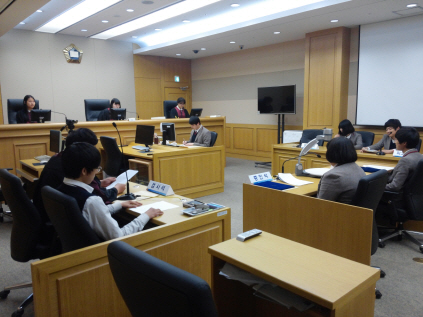
A mock trial is an act or imitation trial. It is similar to a moot court, but mock trials simulate lower-court trials, while moot court simulates appellate court hearings. Attorneys preparing for a real trial might use a mock trial consisting of volunteers as role players to test theories or experiment with each other. Mock trial is also the name of an extracurricular program in which students participate in rehearsed trials to learn about the legal system in a competitive manner. Interscholastic mock trials take place on all levels including primary school, middle school, high school, college, and law school.
|
|
|
mock trial(모의재판) | ower-court trials(하급심재판)으로 a simulated jury trial or bench trial(모의배시재판 또는 단독판사재판) | 학생들이 예비재판에 참여. 학교대항 모의재판 |
moot court(모의법정) | a simulated appellate court or arbitral case(모의상소법원또는 중재사건) | 법과대학원에서의 과외활동. 증인에 의한 증언 또는 증거의 제시 불포함 |
모의재판
형사공판절차의 흐름
1. 공소제기(246. 266) | ||
2. 증거개시(266의 3) | ||
3. 공판준비절차(266의 5. 임의적) | ||
4. 제1회 공판일자 지정(246, 266) | ||
모두절차(冒頭節次) | ||
5. 진술거부권 고지(283의 3) | ||
6. 인정신문(284) | ||
7. 검사공소장 낭독(285) | ||
8. 피고인의 공소사실인정여부등(286) | ||
9. 쟁점정리 질문(287①) | ||
10. 주장입증계획진술(287②) | ||
사실심리절차 | 11. 당사자의 증거신청(294) | |
12. 증거조사결정(295) | ||
13. 증거조사 실시(291의 2. 292) | ||
14. 피해자 등의 진술(294의 2) | ||
15. 피고인 진술(296의 2) | ||
변론절차 | 16. 논고구형(302) | |
17. 변호인변론(303) | ||
18. 피고인 최종진술(303) | ||
19. 선고 | ||
노명선 이완규 형사소송법 인용
형사소송절차
출처: 대법원 홈페이지(www.scourt.go.kr)
합의부원 | 재판장 | 합의부원 | |||
법원사무관 | |||||
검사 | 변호인 | ||||
피고인 | |||||
증인1 | 중인2 | ||||
배심원단 | |||||
방청객 | 방청객 | ||||
토론순서
1. 재판장의 개정선언
가. 판사 검사 변호인의 출석
나. 피고인의 출석
다. 개정선언
라. 피고인의 진술거부권의 고지
마.인정신문
2. 검사의 공소제기
3. 변호인 변론
4. 피고인 심문(검사, 변호인 신청허가/재판장 직권)
5. 증인신문 : 교호신문방식(주신문, 반대신문, 재주신문)
가. 검사
나. 변호인
다. 피고인
(피해자의 진술권)
(6. 배심원 질문)
7. 검사의 구형(의견진술)
8. 변호인의 최후진술
9. 피고인의 최후진술
10. 배심원 평결
11. 판사의 선고
12. 재판장의 폐회선언
Moot court(모의법정)
A moot court is an extracurricular activity at many law schools in which participants take part in simulated court proceedings, which usually involves drafting briefs (or memorials) and participating in oral argument. The term derives from Anglo-Saxon times, when a moot (gmot or emot) was a gathering of prominent men in a locality to discuss matters of local importance. The modern activity differs from a mock trial, as moot court usually refers to a simulated appellate court or arbitral case, while a mock trial usually refers to a simulated jury trial or bench trial. Moot court does not involve actual testimony by witnesses or the presentation of evidence, but is focused solely on the application of the law to a common set of evidentiary assumptions to which the competitors must be introduced. In most countries, the phrase "a moot court" may be shortened to simply "a moot" and the activity may be called "mooting".
Moot court, together with law review, form the two key extracurricular activities in many law schools. Students typically spend a semester researching and writing the memorials, and another semester practicing their oral arguments. Whereas domestic moot court competitions tend to focus on municipal law, regional and international moot competitions tend to focus on subjects such as public international law, international human rights law, international humanitarian law, international trade law, international maritime law, and international commercial arbitration.