At the Woman’s House
- Kim Yong-taek
In autumn, the ginkgo’s leaves
turn yellow at the house—
the house that first catches my eye
even from afar at sunset.
When I think of it, I yearn;
when I gaze upon it, I feel warmth.
On nights I wander home late,
the lights—warm lights—
tremble alive
among the dark hills.
Under those lights, I imagine
that woman stitching—
her black hair, her shoulders—
and my hands grow warm
just thinking of her.
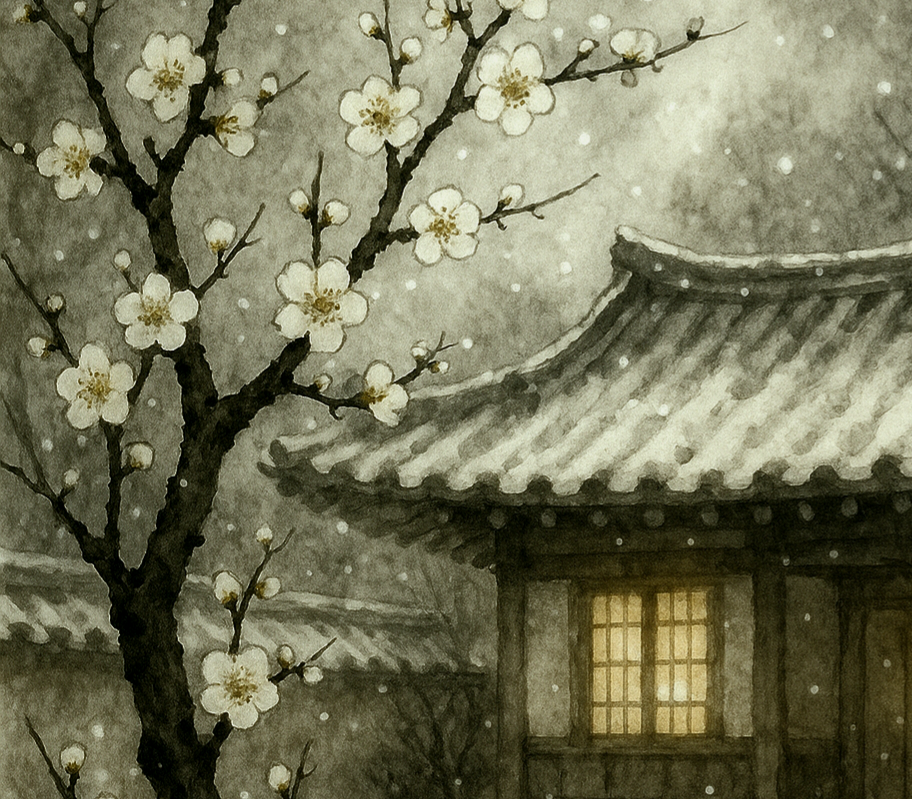
In spring, the apricot blossoms bloom white
at the house—
petals drifting beyond the wall.
Under the falling blossoms,
she draws water into her jar;
when a petal lands on the water’s wave,
I wish to drift there too.
After the bright yellow ginkgo leaves fall,
that woman, her father, her brother—
they climb the roof,
all day weaving yellow
on the tiles of the thatched house.
Sometimes I glimpse her courtyard
through the open gate—
hear her murmuring words I cannot catch,
see her skirt flit by the door—
and I ache to enter that courtyard
and join whatever she’s doing.
Sunlit courtyard,
straight evening smoke rising,
persimmons ripening red in the back yard,
sparrows chattering—
barley threshing, bean beating,
the flail on the roof—
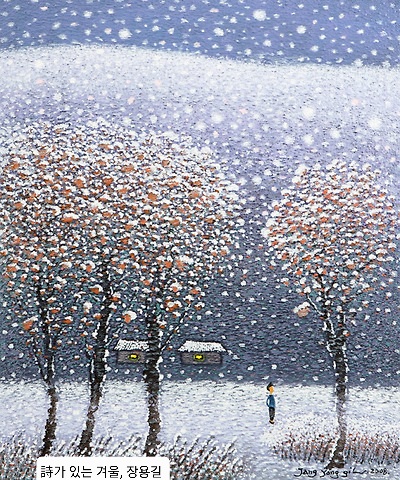
snowy mornings where white drifts
pass the eaves, settle in the yard,
and she, wrapped against cold,
crosses the unused yard
to fetch kimchi from the back,
saying, “Oh, how beautiful the snow!”
She brushes flakes from her brow,
her dark lashes,
opens the kimchi jar—
white snowflakes fall,
and I wish I were that gentle snow.
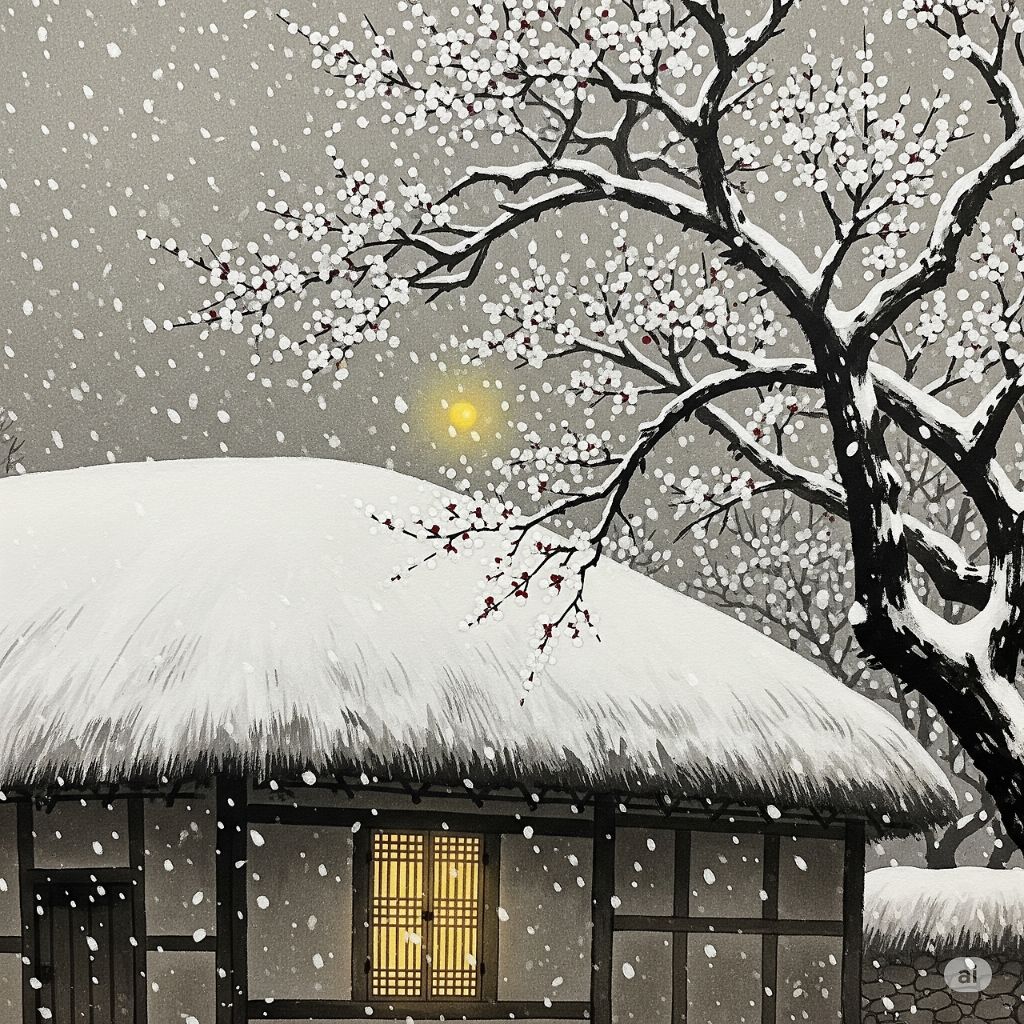
On late nights when the world is still,
only her room glows warm—
I slip past the yard in silence
to stand at her door,
shaking snow from my hair and shoulders,
and whisper her name
so quietly even falling flakes
cannot hear me.
That
woman’s
house.
One day, carrying steamed rice on my head,
we met face to face—
“Oh!” she gasped, stopped dead,
eyes wide,
her welcome as bright
as a high mound of rice in the field,
her smile revealing white teeth like blossoms—
that woman, like a full-bloomed flower.
The house where she lived until nineteen,
the very first house
up the lane from mine—
whenever I got off the cart,
my eyes sought that house.
If I passed and saw no sign of her,
my steps would slow
before the woman’s house—
a house gone from this world now,
rebuilt only in my heart:
a house where apricot petals
drift white in the wind,
a house where three days of snow
fell like cotton through the branches—
the woman’s house
where my heart always went first,
always, at any time—
the
woman’s
house.
When I think of it, when I
think… I must… think…
그 여자네 집
가을이면 은행나무 은행잎이 노랗게 물드는 집
해가 저무는 날 먼 데서도 내 눈에 가장 먼저 뜨이는 집
생각하면 그리웁고
바라보면 정다웠던 집
어디 갔다가 늦게 집에 가는 밤이면
불빛이, 따뜻한 불빛이 검은 산속에 깜빡깜빡 살아 있는 집
그 불빛 아래 앉아 수를 놓으며 앉아 있을
그 여자의 까만 머릿결과 어깨를 생각만 해도
손길이 따뜻해져오는 집
살구꽃이 피는 집
봄이면 살구꽃이 하얗게 피었다가
꽃잎이 하얗게 담 너머까지 날리는 집
살구꽃이 떨어지는 살구나무 아래로
물을 길어오는 그 여자 물동이 속에
꽃잎이 떨어지면 꽃잎이 일으킨 물결처럼 가 닿고 싶은 집
샛노란 은행잎이 지고 나면
그 여자 아버지와
그 여자 큰오빠가
지붕에 올라가
하루 종일 노랗게 지붕을 이는 집
노란 초가집
어쩌다가 열린 대문 사이로 그 여자네 집 마당이 보이고
그 여자가 마당을 왔다 갔다 하며
무슨 일이 있는지 무슨 말인가 잘 알아들을 수 없는 말소리와
옷자락이 대문 틈으로 언뜻언뜻 보이면
그 마당에 들어가서 나도 그 일에 참여하고 싶었던 집
마당에 햇살이 노란 집
저녁연기가 곧게 올라가는 집
뒤안에 감이 붉게 익은 집
참새떼가 지저귀는 집
보리타작, 콩타작 도리깨가 지붕 위로 보이는 집
눈 오는 집
아침 눈이 하얗게 처마끝을 지나
마당에 내리고
그 여자가 몸을 웅숭그리고
아직 쓸지 않은 마당을 지나
뒤안으로 김치를 내러 가다가 “하따, 눈이 참말로 이쁘게도 온다 이이”하며
눈이 가득 내리는 하늘을 바라보다가
싱그러운 이마와 검은 속눈썹에 걸린 눈을 털며
김칫독을 열 때
하얀 눈송이들이 어두운 김칫독 안으로
하얗게 내리는 집
김칫독에 엎드린 그 여자의 등에
하얀 눈송이들이 하얗게 하얗게 내리는 집
내가 함박눈이 되어 내리고 싶은 집
밤을 새워, 몇 밤을 새워 눈이 내리고
아무도 오가는 이 없는 늦은 밤
그 여자의 방에서만 따뜻한 불빛이 새어 나오면
발자국을 숨기며 그 여자네 집 마당을 지나 그 여자의 방 앞
뜰방에 서서 그 여자의 눈 맞은 신을 보며
머리에, 어깨에 쌓인 눈을 털고
가만가만 내리는 눈송이들도 들리지 않는 목소리로
가만가만히 그 여자를 부르고 싶은 집
그
여
자
네 집
어느 날인가
그 어느 날인가 못밥을 머리에 이고 가다가 나와 딱 마주쳤을 때
“어머나” 깜짝 놀라며 뚝 멈추어 서서 두 눈을 똥그랗게 뜨고
나를 쳐다보며 반가움을 하나도 감추지 않고
환하게, 들판에 고봉으로 담아놓은 쌀밥같이,
화아 안하게 하얀 이를 다 드러내며 웃던 그
여자 함박꽃 같던 그
여자
그 여자가 꽃 같은 열아홉 살까지 살던 집
우리 동네 바로 윗동네 가운데 고샅 첫 집
내가 밖에서 집으로 갈 때
차에서 내리면 제일 먼저 눈길이 가는 집
그 집 앞을 다 지나도록 그 여자 모습이 보이지 않으면
저절로 발걸음이 느려지는 그 여자네 집
지금은 아, 지금은 이 세상에 없는 그 집
내 마음속에 지어진 집
눈 감으면 살구꽃이 바람에 하얗게 날리는 집
눈 내리고, 아, 눈이, 살구나무 실가지 사이로
목화송이 같은 눈이 사흘이나
내리던 집
그 여자네 집
언제나 그 어느 때나 내 마음이 먼저
가
있던 집
그
여자네
집
생각하면, 생각하면 생, 각, 을, 하, 면…
-김용택, 『그 여자네 집』 (창비, 1998)