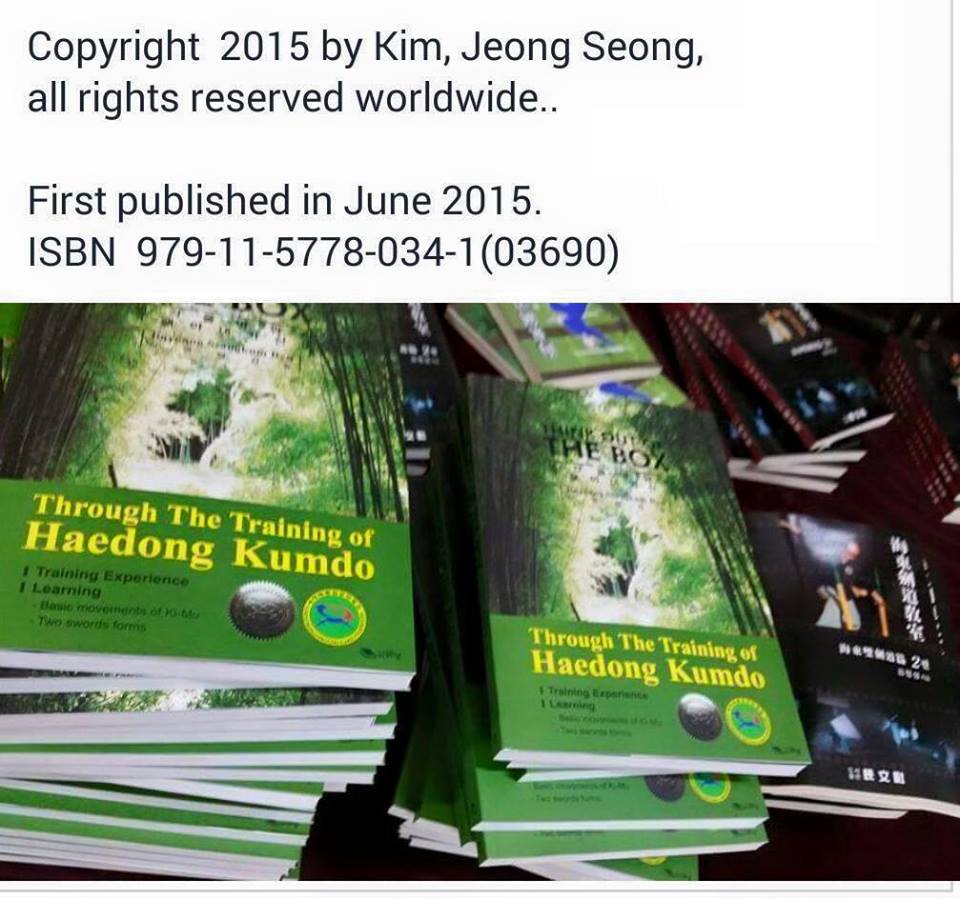
I would kindly like to raise the below questions that can be answered by reading and understanding the book "Think out of the box" and through the candidates’ personal experience in martial arts.
1) Can you explain what energy is and where and how it moves inside your body? If you are going to explain and teach mental training, you should study and know how to learn it.
2) With the understanding you have of energy and its movement inside the body, explain what is good for our body and mind. Why?
3) What is the relationship between mind and body when practicing martial arts? How can that be extended to personal life?
4) What practical examples can you give of learning the above (energy, relationship between mind and body, what is good for the body) through your training in martial arts?
5) If you know all of the above well, what will you do next? How will you develop yourself for your next level in martial arts and in life?
6) What are your thoughts or experiences on meditation upon a cliff, a rock or a similar natural environment?
7) What is the relationship between ancient martial art teachings and modern life? Should you look backward or forward in your training and your life?
8) Do you have a beautiful mind? If so, what does it mean? Can you describe it in a way that can be taught to your students? Can you explain how to achieve it through martial arts training?
9) When you teach martial arts, do you only teach fighting skills? If not, what else do you do, and is mental training included? Can you explain what it is in reality and how it works?
---
We will be able to get rid of illusions, false images and untruthful things in our consciousness or around us through studying “Think out of the box”.
In the 20th century, it has been 50 years since senior martial arts instructors and Grand masters from Korea started to spread martial arts all over the world both emphasizing body and mind with the spirit of their arts. They have been showing and teaching power and technique that stretch the limits of human physical capabilities.
Commencing with this book publication, I am going to start to teach how to learn and teach mental and physical skills with ease and simplicity according to the principles of nature. In modern times we can use these skills for better training and better life because all around us is interconnected in the universe.
10) There is one part in the teaching and studying of martial arts that has been mostly forgotten in modern times. Some rare dojangs still include it in their teaching, but the content varies according to the teacher’s abilities. Can you tell which part that is, when we are used to teaching about just body and mind?
11) What is the essence of martial arts?
12) In your personal opinion, what is the most important part in martial arts for you?
---
A few thoughts about martial arts, learning and life
Ilkka Hämäläinen,
Haedong Kumdo Järvenpää,
Finland
Energy
To me, the word energy means some kind
of life preserving flow or vibration that
occurs everywhere. I guess it’s the most
vital factor to all living things – the ability
to be and to do something.
Naturally, energy is strongly associated to all movement and action. So when it comes to martial arts, we have to carefully think about how can we channel the energy on particular exercises and techniques,
and how energy flows easily in our bodies. In martial arts one are basically transferring a certain amount of energy – depending on the intensity of the action – from one point of your body to another. To do this correctly, you have to be relaxed and focused – I call it a flow motion mode.
It’s important to breathe and use your whole body to execute a technique. That’s how you get energy to flow. Mental training and understanding what you are doing is as important as physical training. For mental training, one can use some memory techniques to i.e. memorize the kumbups.
I usually use visualization techniques to remember all the correct forms and
patterns. Learning a good technique takes a lot of physical repetition, but you also need to understand the technique in theory – what's behind the movement. I believe everything depends on the balance and the control between the two main cotdistract the other, but body and mind must work together as one.
=>
Body + E ( just follow),
Mind + E(act for body, selfish one etc.),
Spirit(original nature) + E(pure one)
As you can see it at the drawing of Spinning-top's theory shown as a metaphor for better understanding, the original basement for Energy of body and mind come from the area of spirit which is called the zone of emptiness(MU or Kong).
i.e) see the below site
http://cafe.daum.net/uwhkf/JvX2/87
What is good for our body and mind?
As everything affects everything, to keep yourself fit physically and mentally,
you have to give a thought to a few basic principles. I’m not saying that I always follow the list mentioned below, but at least I do my best. So, here’s a short list of the four principles that one should embrace on a way to good and healthy body and mind:
a) Eat good healthy food (organic if possible) and avoid food additives
as well as meat to keep your body clean.
b) Sleep, relax and meditate often enough to keep your mind clean
and to avoid stress.
c) Exercise your body and mind regularly,
but remember it shouldn’t be too serious – don’t forget to have fun.
d) Stay true to yourself.
=> Yes, it is very good principles you made as a general definition anybody can understand and follow.
I may make some descriptions with yours in brief.
a) is good for body +E,
b)& c) are good for body+E and mind+E,
d) is good for your spirit
The mean of "stay true to yourself" is to "forget yourself or know yourself, which mean my will is not there. So we can stay into the Light with pure Energy.
It is for an enlightenment.
What is interesting and important for me in martial arts?
I’ve been practicing taekwondo about ten years, and haedong kumdo for a couple of years now. As I also play and teach a few different instruments, I see a lot of similarities between music and martial arts. For example: creativity, movement, rhythm, timing, patterns, improvisation and flow. That relation and how to make use of it, is one thing I’m very interested in. The most important parts in martial arts for me are learning, developing a good technique and of course mental growth.
Practicing martial arts is a lifelong path, and try to implement the above mentioned things from dojang to everyday life.
=> As I always stress through every seminar, the principle of Nature is very simple and clear. All is interconnected in the universe. I mean the principle of body movements and the one of martial arts or music is exactly same as it lies under one principle in the universe, also it is naturally same as the principle or way of our life.
4.8.2017
Questions and Answers for Grandmaster Kim,
by Samu Iiskola
6) What are your thoughts or experiences on meditation upon a cliff, a rock or a similar natural environment?
It is said that us Finns have a connection with nature as we have so much more forests and lakes in our country. Many of us usually have a family cabin or have at least been to many cabins owned by relatives or friends. Finns are described as quiet, stoic, not much for the small talk - that we appreciate the silence of nature.
I'm fortunate enough in that my family has a cabin. It is a place I've visited many times in my childhood and my adult years. Sometimes it might be only once a year, but there I feel a connection. All the memories we've had as a family, all the quiet moments - those form a firm balance that I feel there.
When I go there, I usually find myself at least once just sitting at the pier listening to the waves or looking at the stars. There is also a huge boulder atop a hill. We used to climb it as children. Now I might sit atop it and admire the view over the river and soak in the silence. The energy of nature.
The modern life can be hectic, bustling from work to hobbies and social events. At the cabin my mind can rest. There is no thought to start meditating - it just happens naturally. My mind finds its place in the world and starts to relax, ignoring the fast pace of the city. After a few days my mind relaxes and helps my body to relax too so that I can feel energised to go back to my hectic work life.
You just need to let your mind find the rhythm of nature. Quiet down, listen to it and let yourself become focused yet relaxed for that precise moment.
7) What is the relationship between ancient martial art teachings and modern life? Should you look backward or forward in your training and your life?
The relationship between ancient martial art teachings and modern life is to me a simple one. The human mind has always asked the same questions and though the times have changed we can still read and learn from the answers our ancestors made. Be it in martial art teachings, philosophy or science.
But should we always look behind us? No.
Those ancient teachings are just the foundation that we stand upon. We can learn from them but we should not stop looking for new ways. Humans have always evolved and adapted, being stagnant is not good for you. A running river is clear and has a direction. A stagnant pond will eventually just vanish.
I have a foundation of my life in the choices I have made in the past. Have they formed me? Yes. Should they chain me into place, to be only that person? No.
I started martial arts because I finally had the time and wanted to do something for myself. And I came back to them even after a hiatus, because I felt that this was a good thing. And it has helped me to consider myself in another way. But am I only my martial art training? No, but it has helped me to release stress in my modern life.
So we should learn from the past and acknowledge it, but we should not bind ourselves to it so that we may live more fully.
12) In your personal opinion, what is the most important part in martial arts for you?
For me the most important part in martial arts is fellowship. I had tried a couple other martial arts before I found Haedong Kumdo. I liked that it was a relaxed environment that encouraged learning and asking questions. Where you pushed your own boundries in mental and physcial endurance. It was not too much about fighting, just understanding that this was a martial art - not for only harming but to bettering yourself in a like minded companionship.
Without that fellowship, martial arts can become just excercising or wanting to be the best for your own sake. With fellowship you are all learning together. Others might learn the basics, more experienced ones how to teach. In Haedong Kumdo I learned not to judge yourself according to others, just doing the best you can do and learning to get better. This has helped me to focus myself in other martial arts and in all aspects of my life.
A place to belong, a fellowship, a dojang where the energy of the whole group helps individuals to overcome their boundaries and develop their skills.
Written down by
Jari Nieminen
Three questions relating to
practicing of martial arts
Q: 3) What is the relationship between mind and body
when practicing martial arts?
How can that be extended to personal life?
A: In martial arts and also in your personal life the key to success is that you are in balance both mentally and physically. That means both sides need to be practiced equally. If you mind does not allow you to fully focus on the task you are doing to do or if you lack the physical capability to do the task – the task won’t get done. Nowadays it is quite common that physical exercises have overcome the mental exercises.
For achieving the harmony people should focus more on their well-being by trying to find a balance between the mind and body. By this way one can eventually find a true happiness which is based on right things in life.
Training of martial arts with talented teacher may help in this task as the teacher will keep the focus on both sides and mental exercises as well as technical/strength exercises have equal role in everyday training sessions.
Q: 11) What is the essence of martial arts?
A: The Energy (KI) can be understood as the essence of martial arts. You must be in balance internally and externally for controlling the energy. KI MU means the inception of energy into martial arts. KI MU practices are essential part of Haedong Kumdo training. Through KI MU practices you will be able to relax and feel the energy. Afterwards when you focus you will even be able to see the energy and eventually you will be able to do something with the energy. All the steps do not happen immediately but they require long term training.
Essential aspect in understanding the energy is to understand your own role in the universe. First of all you must understand that your body or the energy is not yours. Energy is love in the nature and all is interconnected in the universe. The key is to realize that all efforts you do in life should promote the better quality in life.
Q: 12) In your personal opinion,
what is the most important part in martial arts for you?
A: For me the best part in martial arts is the continuous development of myself both mentally and physically. In addition to practices in dojang martial arts also help me in other parts of life too. It gives me a lot of new good tools for managing different situations in work or with family.
For example it helps me to think more positively and not to highlight the
negative characteristics such as anger and greed for example. Martial arts also
help me to focus on things that are truly meaningful in life and bring
happiness and health to me and people around me.
For me as a parent it is also
important that I can share my learning with my sons and by this way teach them
the things that I have found meaningful.
Sakari Kukko
4.8.2017
What is the relationship between mind and body when practicing martial arts? How can that be extended to personal life?
I think that there is no distinction between the mind and the body. Mind is in the
body an body is in the mind.
The separation of mind and body rely too much on western philosophy of material and immaterial dualism, that the mind is somehow separate from the body, or the body is only a vessel for the mind or the ”spirit” or
”soul”.
We are physical beings in physical reality, and thus it follows that the mind has to
be physical, since there is no such thing as nonphysical. But it is not that simple,
since physicality is only a label we put on tangible objects, that have weight, mass, or some other measurable quality.
Mind has none of those, but it still exist. Mind seems to be a property of
living beings, since we have not found minds on any other entities, such as rocks,
on this planet.
But as ”mind” ”body”, ”soul” or ”martial arts”are words, describing some predefined object, event or concept ”physicality” or ”tangible” are also merely words.
The definition of a word, its’ conventional usage and it’s relation to the object
what it represents separates the used word from other words and other objects.
We enter the realm of semantics which on the other hand is necessary and
fundamental, since everything that is necessary needs a signifier, a label,
otherwise it would not exist.
On the other hand
semantics clouds our way of thinking, in such way that everything seems to be
separate entities or objects on its own without any relation to other thing
around them.
In reality language is the only thing separating things from one another, and here is where the problem of mind and the body arises. Mind is inseparable from the body, and in my thinking mind is an echo of the body. Mind is similar to waves in the ocean.
Surely waves seem to behave like they are objects or entities on themselves, we even have distinct words for them and their quality such as ripple or a tidal wave, but in reality all waves are properties of the ocean, and they would not exist without the ocean.
In similar vein, the mind does not exist. Or surely it does, but it is all an illusion of the body. This leads to a peculiar conclusion. You have to become the martial art. But more on this subject on the other written assignments.
What is the essence of martial arts?
Martial arts, like Haedong Kumdo is a paradox. On the other hand, our main tool is a sword, which in essence is a mean of harming or killing another human being. Then again harming one another is essentially forbidden not just in Haedong Kumdo but in society in general, and consequences from harming another would be traumatic both to the one harming and the one getting harmed.
Then again in order to have a peaceful and prosperous society, we need to have governmental bodies dedicated to violence, such as the military or the police. Balance is essential. No power and the society will crumble into anarchy, and too much power and we will end up in a police state. Same is true in martial arts.
The true essence of Haedong Kumdo and martial arts in general is this paradox.
To gain balance and /or inner peace one must aim to be contact with true self,
in all of its’ wholeness both good and bad, beautiful and ugly.
They are not separate, they are two sides of the same thing and one does not go without the other. It is useless and even harmful to try deny the other, for it is like denying your arms in favor of your legs.
But there is a catch. To know what it is to be relaxed, one must know what it is to be tense. To be successful you must know what it is to fail. To know what is to be peaceful, one must know what it is to be aggressive. To understand this is the true nature of both yourself and martial arts.
This is the paradox,
and it takes time to understand and overcome it.
In your personal opinion,
what is the most important part in martial arts for you?
The most important part in martial arts is constant reminding that I am incomplete,
that there is still so much to learn and so much to improve. I am too dumb to quit, and too simple to give up.
Martial arts are only one method of striving towards being a better human being.
Martial arts are a medium, and like any other canvas or piece of paper it is blank at
first. Then after countless repetition, failing and failing again, a form is beginning to
take place.
At first this form is crude, the outlines are blurry and it is far from being beautiful
or gracious. But after studying (focus), understanding (see) and practicing (do) the art, ripples and inconsistencies in the form will eventually fade or melt away, leaving behind only the true form which is beautiful to watch.
I will never be ready, there is so much to learn, and if i ever think that I am ready or complete I must have been mistaken. Martial arts have thought me discipline, humility and respect.
Martial arts have thought me perseverance, trust and courage. Martial arts have thought me anger, fear and disappointment. Martial arts have thought me that who I am, and what I can become, and to me that is a lesson worth listening.
The true secret is that In the end of the day we are only bunch of men and women, dressed in funny costumes, swinging sticks, pretending that this is very important,
but deep down we all know that this is only a play that we just love so very much.
Tommi Vainikka
Järvenpää - Finland 3.8.2017
Haedong Kumdo
2nd dan test
1)
Can you explain what energy is and where and how it moves inside your body? If
you are going to explain and teach mental training, you should study and know
how to learn it.
2) With the understanding you have of energy and its movement inside the body, explain what is good for our body and mind. Why?
This first question is really difficult. I have not had to think about it from this point of view. It also rises more questions than answers.
According to the laws of physics, in all physics-known phenomena, the sum of the various forms of energy remains constant, in other words, energy does not increase and does not disappear. As an engineer, for me, the energy means usually electricity power (Watt) or cylinder pressure (bar). What about people, what energy is for us? What is energy in use and from where do we get it?
Energy is the ability to do something. It is said that we need energy when we grow up. Our bones, muscles and joints need energy in cell level. When we eat and drink, our own body modifies that energy to form of energy which our body can use. For us, energy nutrients should include carbohydrates, protein and fat.
To ensure that we get essential nutrients, it is important to ensure that the basic nutrition conditions are in order and food plate includes all of it, in reasonable amounts of everything. For our body, clean and little processed food materials would be the best choice.
A large part of energy, which is contained in eaten food, moves around in our body to the cells, through the digestive tract, blood circulation and lymph nodes. We also need to breathe oxygen through our lungs into the circulatory system, which will be sent to the cells all over the body, so that the cells would be able to function optimally. Lungs also release carbon dioxide from the bloodstream into the atmosphere, in a process of gas exchange.
On the other hand, we release energy from ourselves through the skin by sweating. So energy can be thought moving both inside and out of us in many different ways.
Through the eyes we gain positive energy from the sun's light. That is something we Finns know well. In winter, when it is dark, many of us are tired all the time. But as the amount of sunlight increases in the spring and summer, we find that we seem to have more energy. From the sun's light our skin can produces vitamin D3 for us and it increases our energy level. So being outdoors in the fresh air at a bright time is good for us.
When we are sleeping, our body energy levels return to be used for the next day. It is also well known that the brain consumes a lot of energy and needs a good night's sleep to work well.
Between heavy physical training, during a short rest period, the energy levels slightly improve. A fit person recovers faster than a person who is in a bad shape.
But why don’t our energy levels return completely and rapidly?
Does our body have some kind of mechanism that regulates
how much energy it disposes of during our physical effort?
Why does it not allow or isn’t able to give all the energy at our disposal at once?
We know that physical exercises like swimming or running increase physical fitness and as a result we have more energy to use. So what happens in our cells when they turn into better energy stores? So what happens in our cells? How do they turn into better energy storage? And if there is a constant amount of energy in the universe, from where this increased amount of energy in us is taken away from?
On the other hand we know that our body's adrenaline helps the body perform physically more efficiently. Adrenaline is produced in performance-requiring stress situations, and generally in situations with all kind of physical exertion, but especially as part of the fight or flight situations.
For example it is said that mother can lift an heavy object from her child. We can also get our body to produce more adrenaline simply by imagine ourselves in situation that make us angry.
We also seem to have more energy in outdoor activities
or from our family and friends.
Overall from anything that makes us feel good, no matter if it is a place, music or something to do. It is actually because of different kinds of hormones, that are produced in different parts of our brain and spread all over our body.
Hormones like dopamine, serotonin and oxytocin. One could say that dopamine drives us towards happiness, serotonin smoothes the storms of life and oxytocin connects us to other people.
So we are a complex energy node in this universe like any other creature.
12) In your personal opinion,
what is the most important part in martial arts for you?
I have trained many kind of martial arts since 1990. At the beginning my motivation was to learn self-defense. Of course all kinds of movies made martial arts look cool. Then there was also this image that person’s physical condition was awesome.
Many things have changed since those days. My role as only a student in a line has also changed, step by step, towards teacher’s role. I am now in that lucky position where I can enjoy being in both roles. As a student in Hapkido and Haedong Kumdo I can learn and train. Also, I like that when I am teaching it activates me in different ways.
As I get older the physical condition, like muscle strength and suppleness is nowadays more important to me. Because martial arts like Hapkido and Haedong Kumdo offers lots of different kind of variations to exercise all those things,
it motivates me to come to gym time after time.
Over the years it has changed so that the primary idea of training isn’t self-defence and fighting anymore. The reason for this is of course the feeling that I have reached a certain level of confidence in these. Now the most important part is to stay fit. Physical condition and mental side is more than half of reason why I put on my Dobok on and go to Dojang. Martial arts offer challenges to the brain and body all the time. Now I have started a fight against a clock.
THOUGHTS ABOUT HAEDONG KUMDO AND MARTIAL ARTS IN GENERAL
Christian Hagman,
1. DAN candidate, 2017
8)
I don’t know whether my mind is beautiful, but I’d like to think that it’s invigorating. During my years of teaching in Taekwondo, I’ve had feedback from many of my students that my enthusiasm toward the art is contagious.
I always try to teach that special kind of training attitude and spirit with my own example. I am very energetic and supportive. I try to show that even hard training can be fun. My job is to keep up a good training atmosphere in my dojang and to make sure that everybody is having a good time and enough of sweat.
I think this is one of many important things when teaching something physical. To keep up the training spirit. I also want to show that I am there for my students, that I am present.
Martial arts training is often very physical and the feeling afterwards you have managed to do something hard is very special. It is a one of a kind feeling. Sometimes you even need to go over your comfort zone to truly develop yourself both mentally and physically.
Martial arts provide a very good ground for that. By this I don’t mean that martial arts training should feel uncomfortable, but I want my students to find their attitude and spirit, because I think mind and body are intertwined into one another in martial arts.
You can’t have one without the other. You can’t truly perform – sometimes even complicated - different movements (forms etc.) if your mind is not with what you are doing. You need to have a focused mind with the task at hand.
Martial arts are meant also to teach how to physically win an opponent. If your mind is not set into that special kind of mode, the battle is no doubt already lost. Also, if you’re facing hard times with your personal life, with the right kind of attitude and spirit you may find an inner strength within you and overcome the hard times better.
11)
I think the essence of martial arts is not just how to teach how to crush your opponents would it be a real situation, but also to focus on the grace of movement (in haedong kumdo: gumbups, kummu, kimu, in taekwondo: poomsae).
Martial arts often teach also how to take care of your body in many different ways (stretching, massaging, breathing, resting, right kind of nutrition etc.). In martial arts there are also many different uniforms belonging to that certain art which also emphasizes the fact that martial arts is a system and a way of life more than just a crash course in how to break someone’s face.
In martial arts one must try and find a balance and understanding between just fighting and how to become a better and more understanding individual by practicing that art. Martial arts also usually contain some kind of a spiritual/mental aspect to them. I think the duality of things is the key. When you relax and focus on doing your art, you sort of learn gradually and a bit like “unnoticed”.
Martial arts are not necessarily that straight forward a method to teach fighting skills like for example boxing or MMA is. I like to think that martial arts are somehow a bit more sophisticated means to teach and to study self-defense, fighting techniques and many other skills. It’s a bit like when you’re studying something in a university.
You need to read a whole book to fully understand what it’s all about and not just read a couple of “important” pages here and there and try to cope with just pieces of knowledge. You have to think for yourself and find what is best way for you to learn things. There might not even be a straight forward or one correct answer to every question about how to perform a technique. Everyone is an individual and every single body works a bit differently. We are not made from the exact same mold.
12)
The most important part in martial arts for me is to be able to do and to understand different things that not every random individual can automatically do and understand.
It’s nice to know and understand some principles about body movement and functionality, how to perform a kick for example, the many little details within a certain technique, self-defense etc. It’s nice to know something special and to “be an artist”. It’s also important for me to pass on my knowledge to my students. To pass on the art and its “secrets”. I feel that is my privilege and honor.
http://www.haedongkumdo.co.kr/?product=think-out-of-the-box-through-the-training-of-haedong-kumdo