위키백과사전의 소개
The Xibe language (also Sibo language, Xibo language) is the most widely spoken of the Tungusic languages spoken by members of the Xibe ethnic group in Xinjiang, in the northwest of the People's Republic of China.
Contents[hide] |
[edit] Phonology
Xibe is intercomprehensible with the closely-related Manchu language;[3] however, unlike Manchu, Xibe language is reported to have eight vowel distinctions as opposed to the six found in Manchu, differences in morphology, and a more complex system of vowel harmony.[4]
[edit] Lexicon
The general vocabulary and structure of Xibe has not been affected as much by Chinese as Manchu has. However, there are a number of Chinese loanwords, and a large body of sociological terminology, such as gəming (revolution) and gungshə (commune), have been borrowed from Chinese and incorporated into the everyday vocabulary of the language.[5] There has also been some influence from Russian.[6] The language uses the Xibe script, a slightly revised version of the Manchu script.[4]
[edit] Usage
Xibe is taught as a second language by the Ili Normal University in the Ili Kazakh Autonomous Prefecture of northern Xinjiang; they established an undergraduate major in the language in 2005.[7] In the Qapqal Xibe Autonomous County, there is one newspaper in Xibe, the Qapqal News, as well as 15 minutes per day of radio broadcasting and 15 to 30-minute television programmes broadcast one or twice per month.[8]
A few Manchu language enthusiasts from Eastern China have visited Qapqal Xibe County in order to experience an environment where Xibe language is spoken natively, as it is the closest living relative to the Manchu language, which has practically no native speakers left.[9]
[edit] Notes
- ^ Li 1986, p. 1
- ^ Gordon 2005, Altaic
- ^ Gordon 2005, Xibe
- ^ a b Ramsey 1989, p. 215
- ^ Ramsey 1989, p. 216
- ^ Guo 2007
- ^ 佟志红/Tong Zhihong (2007-06-06), "《察布查尔报》——锡伯人纸上的精神家园/'Qapqal News'—A 'Spiritual Homestead' on Paper for the Xibe People", 伊犁晚报/Yili Evening News, http://www.tianshannet.com/news/content/2007-06/06/content_1961623.htm, retrieved 2009-04-13
- ^ Zhang 2007
- ^ Ian Johnson (2009-10-05), "In China, the Forgotten Manchu Seek to Rekindle Their Glory", The Wall Street Journal, http://online.wsj.com/article/SB125452110732160485.html, retrieved 2009-10-05
[edit] References
- Li, Shulan (1986), 锡伯语简志/Outline of the Xibo language, Beijing: Nationalities Publishing House
- Ramsey, S. Robert (1989), The Languages of China, Princeton University Press
- Gordon, Raymond G., Jr., ed. (2005), Ethnologue: Languages of the World, Dallas, Texas: SIL International, http://www.ethnologue.com/, retrieved 2006-12-19
- 张莉/Zhang Li (2007), "新疆锡伯族新闻事业发展现状/Xinjiang Xibo Peoples' News Undertaking Present Situation", 伊犁师范学院学报/Journal of Ili Normal University (1), ISSN 1009-1076, http://scholar.ilib.cn/A-QCode~yilsfxyxb200701012.html, retrieved 2009-04-13
- 郭庆/Guo Qing (2004), "俄罗斯语言文化对新疆锡伯族语言文化的影响/Influence of Russian Language and Culture on the Sibo Language and Culture in Xinjiang", 满语研究/Manchu Studies (2), ISSN 1000-7873, http://www.ilib2.com/A-ISSN~1000-7873(2004)02-0041-05.html, retrieved 2009-04-20
[edit] Further reading
- Li, Shulan (1984), 锡伯语口语研究/Research into Xibo oral language, Beijing, China: Nationalities Publishing House
- Kida, Akiyoshi (2000), A typological and Comparative study of Altaic languages with emphasis on XIBO Language: The part of XIBO Grammar
- Jin, Ning (1994), Phonological correspondences between literary Manchu and spoken Sibe, University of Washington
- Tong, Zhongming (2005), "俄国著名学者B·B·拉德洛夫用锡伯语复述记录的民间故事/The Folktales Retold and Recorded in Xibo Language by the Famous Russian Scholar B.B. Radloff", Studies of Ethnic Literature (3): 60–63, http://www.wanfangdata.net/qikan/periodical.articles/mzwxyj/mzwx2005/0503/050313.htm
[edit] External links

- Entry for Xibe at Rosetta Project
- Unicode Manchu/Sibe/Daur Fonts and Keyboards - English
- Unicode Manchu/Sibe/Daur Fonts and Keyboards - Chinese
- SibeCulture.com: Xibe-English-Chinese phrases

Manchu alphabet(만주 문자)
Origin
The Manchu alphabet was commissioned in 1599 by the Manchu leader Nurhaci (1559-1626), the founder of the Manchu state. The letters are based on the Classical Mongolian alphabet while the phonetics are based on Jurchen, an earlier Manchu script. The alphabet was modified slightly in 1632.
In 1644 the Manchus conquered China and established the Ch'ing (Qing) dynasty, which lasted until 1911. For the first 200 years or so of the Ch'ing dynasty, Manchu was the main language of government in China and served as a lingua franca. By the mid 19th century many of the Manchus had adopted Chinese as their first language, however they continued to produce Manchu version of Chinese documents until the end of the dynasty and for sometime afterwards.
Notable features
- Manchu is written in vertical columns running from top to bottom and from left to right.
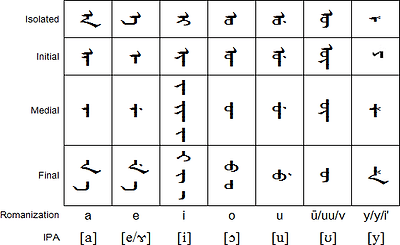
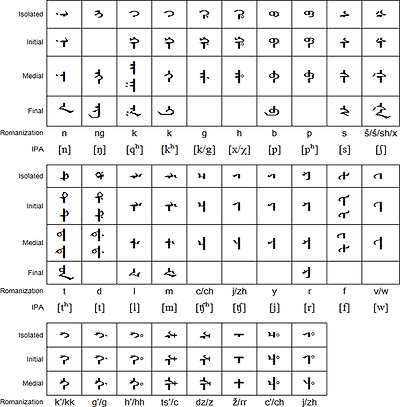
- Most letters have several different forms: initial, medial and final, which are used at the beginning, middle and end of a word respectively. The vowels also have isolated forms.
- Some letters have different shapes depending on which vowel comes before and/or after them.
Used to write
Manchu, a member of the Tungusic group of Altaic languages. There are currently about 9 million Manchus living in north-eastern China, of whom between 70 and 1,000 speak Manchu. Most speak only Mandarin.
In Xinjiang in the west of China there are about 27,000 people known as Sibe, Xibo or Sibo who speak a language closely related to Manchu, though they consider themselves a separte ethnic group. The Sibe were moved to the region in 1764 by the Ch'ing emperor Qianlong.
Manchu alphabet
Vowels
Consonants
Numerals

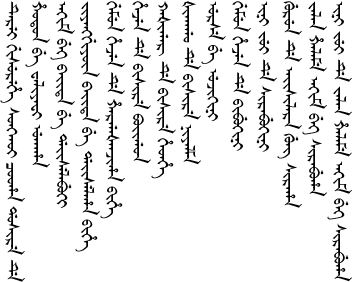
Sample text
Links
Manchu fonts for Mac are available from: Xenotype Technologies
http://www.xenotypetech.com
Manchu in Unicode
http://www.babelstone.co.uk/Test/Manchu.html
=====================================================================================
출처: http://www.omniglot.com/writing