AI 모델에게 엔지니어링 데이터를 미리 학습시키고 자신의 시뮬레이션 결과와 비교해서 AI 모델을 수정하는 식으로 항공기 설계에 쓰는 AI 모델을 만들 수 있다고 하네요.
물리학 방정식을 직접 푸는 것이 아니라 '저렇게 생긴 것의 결과는 저것이었으니 요렇게 생긴 것은 요렇겠지?'하는 듯 합니다.
“There’s no explicit calculation of the physics. They’re not about solving the equations of physics,” Corbo says. Instead, LGM-Aero infers aerodynamic performance, flight stability and structural stresses for a large class of flying shapes.
수많은 텍스트를 읽고 공부하는 LLM도 '5 + 5 = 10'을 계산하는 것이 아니라 읽은 텍스트마다 '5 + 5 = 10'이라고 나오면 사람이 5 + 5는 뭐냐고 물었을 때 10이라고 대답하는 것이죠.

Physics-Based AI Promises To Accelerate Aerospace Design Optimization
Graham Warwick January 08, 2025
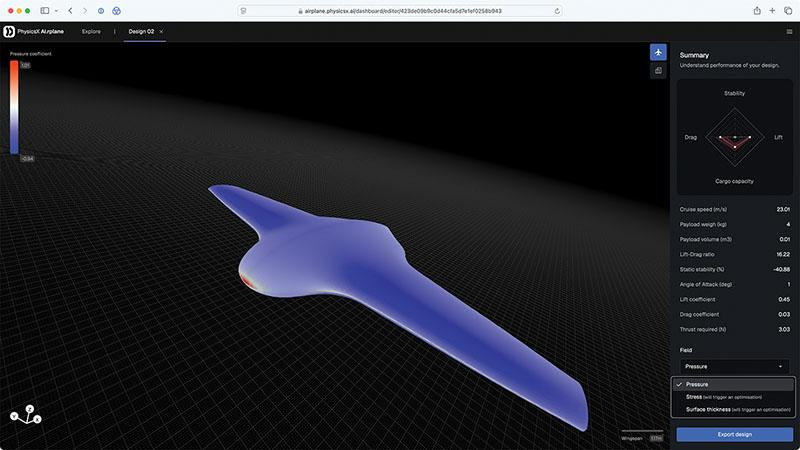
PhysicsX’s LGM-Aero AI-based analysis tool predicts performance of new shapes.
Credit: PhysicsX
Numerical simulation has become an essential part of aircraft design, from aerodynamics and structures to aeroacoustics and thermal analysis. But the escalating use of modeling and simulation comes with a cost—the tens of millions of computational core hours required to develop an aircraft.
Automated and ultrafast numerical simulation via cloud access to thousands of general processing units instead of hundreds of on-premises central processing units is one solution. Physics-based artificial intelligence (AI) is offering another approach.
- AI model is pretrained on computational engineering data
- Users will tune model using their own simulation results
London-based startup PhysicsX has launched a large geometry model, LGM-Aero, pretrained on tens of thousands of computational fluid dynamics (CFD) and finite element analysis (FEA) simulations of generic shapes, generated using tools from Siemens Digital Industries Software.
Rather than performing calculations to solve the mathematical equations governing fluid flow or simulate how a structure will behave under loads, LGM-Aero infers the results using a machine-learning model trained on that CFD and FEA data.
“What we’re setting up to do with PhysicsX is change the way that engineering is practiced, starting with how physics simulation is carried out,” co-founder and CEO Jacomo Corbo says. “The backbone of all of engineering is assessing different designs. And that involves physics simulation of some description.
“All of that involves solving partial differential equations explicitly, at some resolution on some mesh, and a lot of engineering is bottlenecked by these physics simulations,” Corbo continues. “They’re compute-intensive, and that stands in the way of optimization and end-to-end automation.”
Numerical simulation entails the laborious process of generating a mesh of thousands or millions of simple cells that capture a complex geometry, simplify the calculations and allow computational power to be focused on high-resolution areas of interest to produce high-fidelity results.
“We’re trying to change the form factor of that compute by moving to AI models that are very fast,” Corbo says. “All the physics simulation now is a prediction step. It’s happening by inference. That means speed-ups of 104-106, so up to a million times.
“What that allows us to do, in turn, is to optimize things differently to how they’re currently done,” he adds. “So more algorithmically driven optimization, more end-to-end automation and, ultimately, greater creativity imbued in the whole engineering process.”
Work on aeroelastic applications began in 2022. “There’s no explicit calculation of the physics. They’re not about solving the equations of physics,” Corbo says. Instead, LGM-Aero infers aerodynamic performance, flight stability and structural stresses for a large class of flying shapes. It can operate as a zero-shot model, producing results out of the box without being trained on specific examples, PhysicsX says, but the model only needs tuning to capture the fine features required for a specific application like exterior aerodynamics.
The model comes pretrained, but customers can use their own data to further train it and produce a version “that’s in the loop of an optimization process,” Corbo says. “So we can search a large space much more effectively than if we have numerical simulation in the loop every step of the way.”
LGM-Aero can be used in detail design but also, because of its speed, from conceptual design to process control. “[In detail design], we can unlock a lot of value by enabling much better optimization,” he says. “We can also go upstream to concept design, where we are evaluating big architectural choices.”
Computer-aided engineering (CAE) typically is not applied to concept design because of the complexity of building meshes. “We think we can get to CAE levels of accuracy but bring it into concept engineering because we’ve divorced physics simulation from the complexities of the mesh,” Corbo notes.
“We can also go downstream of detailed design,” he adds. “CAE is just too slow at the fidelity required to be in the loop of a control process. Now we can bring it there, and one of the things we’re unlocking is an ability to bring a high-quality physics simulation to the entire product development life cycle.”
PhysicsX is working with OEMs and Tier 1s to integrate physics AI into their tool chains. “We are building a new software stack for complex engineering and manufacturing—a platform and developer tools for our customers to build workflows based on this kind of physics simulation and these kinds of AI models and do optimization they otherwise are not able to,” Corbo says.
댓글
댓글 리스트-
작성자백선호 작성자 본인 여부 작성자 작성시간 25.01.09 “이렇게 생겼으니 얼마가 나오나 계산해볼까~”가 아니라
이런 거 aaa
저런 거 bbb
요런 거 ccc
.
.
.
다 미리 계산해 둔 아주 커다란 테이블을 (학습 결과) 잽싸게 보고 “이러저러하게 생겼으니 ddd겠구나”해서 빠른 것이겠죠? -
답댓글 작성자Black Knights (윤재산) 작성시간 25.01.13 이미 모회사의 ucav과 aap에도 기법들이ㅋ
-
답댓글 작성자백선호 작성자 본인 여부 작성자 작성시간 25.01.13 Black Knights (윤재산) 오오 @.@
-
작성자김용우 작성시간 25.01.11 사실 고전적인 항공기 설계기법은 어느정도 저거 비슷했었습니다. 대략적인 에어로다이나믹스에 대한 개념과 계산은 가능하지만 항공기처럼 복잡한 형상에 적용시킬 능력이 없는 상황에서 대략적인 계산에 그야말로 감각만으로 형상을 만들어서 테스트해보고 그 결과를 바탕으로 계산을 끼워마춰서 계산 기법을 만들기 시작했었죠.
-
답댓글 작성자백선호 작성자 본인 여부 작성자 작성시간 25.01.13 옛날에는 많은 프로젝트들을 쉬지 않고 했던 엔지니어들의 머리 속에 있는 경험이 바로 '설계 데이터베이스'였겠죠?