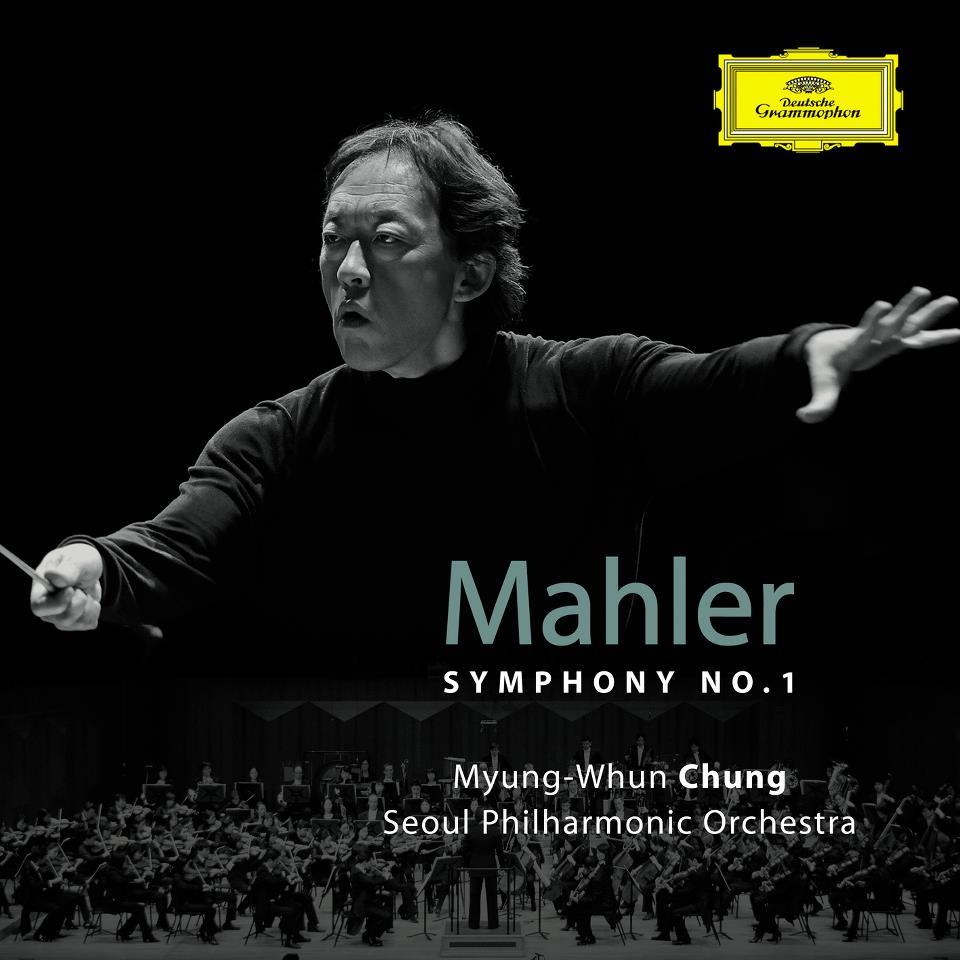
This CD represents the first installment of a potentially full cycle of
Mahler Symphonies by Myung Whun Chung/Seoul Philharmonic Orchestra.
One of the pleasures in listening to classical music occurs when I
unexpectedly find a new dark horse in the repertoire I feel most home
about, such as Mahler, Bruckner, Wagner, and Sibelius. And I am very
happy to report that this is truly an auspicious start from a source
that might be recognized by many as the least familiar of all (well,
except for its music director and conductor, Myung Whun Chung). Indeed,
when the last bar of the music is over it becomes clear that a lot of
efforts, rehearsals, and time had gone into preparing for the live
concert from which this recording originates. More importantly, nothing
sounds routine in this recording.
The playing is not only
idiomatic but also extremely refined and emotionally engaged, the
ensemble always precise, crisp, and synchronized. Based on what I am
hearing, I can conclude that for the past six years Chung has built the
Seoul Philharmonic Orchestra into a world class band (these are not just
my own words!). It is built from bottom to top, with solid bass
instruments, rich strings, prominent woodwinds, and golden brass. The
strings in particular have flexibility in their tone and phrasing, a
rarity in Asian orchestras. The trumpet is impressively rock solid and
never fails to register even in the thickest passages. Ditto the horns
and trombones. We know that all of these are the essential elements in
performing Mahler, don't we?
Top top them all, Chung has a few
surprising but genuine touches in his sleeves, such as the dreamy, slow
introduction in I., the sudden speedup in the coda of I. and II., the
expansive middle passage in III., the slow and long second theme in IV.
Speaking of the tempo shifts and rubatos, Chung applies with such care
and intuition that none of them sound forced or artificial. Just sample
the <Lieder eines fahrenden Gesellen> section in III. Here, the
solo strings have never been enunciated with such a richly expressive
and romantic flair, all aided by Chung's flexible, juicy tempo
adjustment. The beginning of IV. is another case in point. Instead of
dashing through at a hefty speed, Chung adds a slight modification to
the dynamics and main tempo but he does it so sensibly and aptly that what could have
sounded like a fussing around the score actually becomes a drama within
the drama (one can feel a sense of diversification and liberation!).
Needless to say, all these effects work to enhance the drama, energy,
romance, and fantasy in the piece.
Overall, this recording
reminds me of Eschenbach/Boston Symphony Orchestra concert at Tanglewood
from the early 90s, which to this date remains the greatest Mahler
First I've ever heard.
The only downside is that being recorded
in the acoustically inferior Art House Center, Seoul, Korea, the
recording sound lacks somewhat in the bass. It also tends to be hard and
coarse in the loud passages. But otherwise, the DG recording team
headed by the renowned producer Michael Fine captured the concert with a
fine detail, clarity, and a good balance.
So, all things considered, this is a Mahler First to treasure.
Perhaps it will not replace Bernstein, Giulini, Leinsdorf, Horenstein, and
Abbado, to name a few, but it offers an attractive alternative to the
classical recordings through the combination of Chung's unique insights
and the well disciplined yet richly expressive playing by the Seoul
Philharmonic Orchestra.
I suspect this is the version I will turn to most for now.
Highest recommendation.
댓글
댓글 리스트-
작성자Poincare 작성자 본인 여부 작성자 작성시간 11.12.31 This one has quickly become my favorite Mahler First. It's the combination of the crisp, idiomatic playing and Chung's insights that makes it stand out among all other versions. Just sample the <Lieder eines fahrenden Gesellen> section in III. to see my point. Here, aided by Chung's flexible, juicy tempo adjustment, the solo strings have never been enunciated with such a expressive and romantic flair.
-
작성자Poincare 작성자 본인 여부 작성자 작성시간 11.12.31 The beginning of IV. is another case in point. Instead of dashing through the dramatic passage at a hefty speed, Chung applies a tempo shift within the tempo and he does it so sensibly and aptly that what may sound like a fussing around the score is actually a drama within the drama (one may call it a sense of diversification and liberation!). As a matter of fact. Chung's tempo adjustments and rubato throughout are clearly purposeful, rather than incidental and therefore rarely get in the way of the music making. Quite nice.
-
작성자drfluid 작성시간 12.02.03 While I was reading your review, I felt like I had read a very similar review somewhere else! Now I realize that we might have 'met' on the other Mahler board out there. Great to see your postings here, too. 안녕하세요.