Ref)
https://m.cafe.daum.net/uwhkf/JvX3/96?svc=cafeapp

1. What is the ulmate purpose of human life?
The ulmate purpose of human life is spiritual growth, which leads us to live a wise life.
But what does “spiritual growth” mean, and what does leading a wise life entail?
Everything depends on the spirit
The human body is rudimentary, like a machine that sustains itself naturally, consisng of body (esh) + spirit (the essence of a human being) + soul (the seat of wholeness).
If body, spirit, and soul are naturally in harmony with one another, the machine runs smoothly and
without fricon.
But through greed, ignorance, and unawareness, there is a risk that sooner or later we will make wrong decisions.
This will lead to misfortune entering our lives, causing useless and
negave thoughts to create a painful and challenging life.
Such a way of life destabilizes our
energy and throws us obalance.
Disparaging thoughts and prejudices foster narrowmindedness, stubbornness, and ego, making it dicult for us to look beyond the connes of our own lives.
That is why, while living on this planet, people should look beyond their immediate surroundings in order to experience happiness and fulllment.
The tools for this are mindfulness and awareness. They lead people to let go of inner resistance and, in doing so, to adapt to nature by understanding its laws and recognizing its gis.
The natural mind, which is given to humans from birth, returns to the body.
Thus, the energy of nature ows through the body, and happiness and health nd their way into life.
By following this ow of natural
energy we surrender to nature.
Then harmony and balance arise between body, mind, and soul: this is the aainment of enlightenment, the goal of spiritual growth.
Human life itself is pracce; it is Do
To achieve harmony and balance between body, soul, and spirit, we should therefore surrender to the laws of nature.
If we succeed in bringing ourselves into harmony with nature,
it will serve as a guide for proper pracce.
Thus, we will be able to recognize that the foundaon of proper pracce is the ever-changing mind.
Therefore, the most important aspect of the right path is to show the right mindset in every situation.
Through utmost presence we can follow the energy of a clear, pure, and
present mind in every moment of life.
It is said that enlightenment is aained only through the body.
Through a properly trained
body, the soul calms down, useless thoughts are overcome, and we return to the original place of the mind (the realm of nothingness/fullness, or Kong (空) or Mu (無)).
Become aware of the ulmate purpose of maral arts and of life
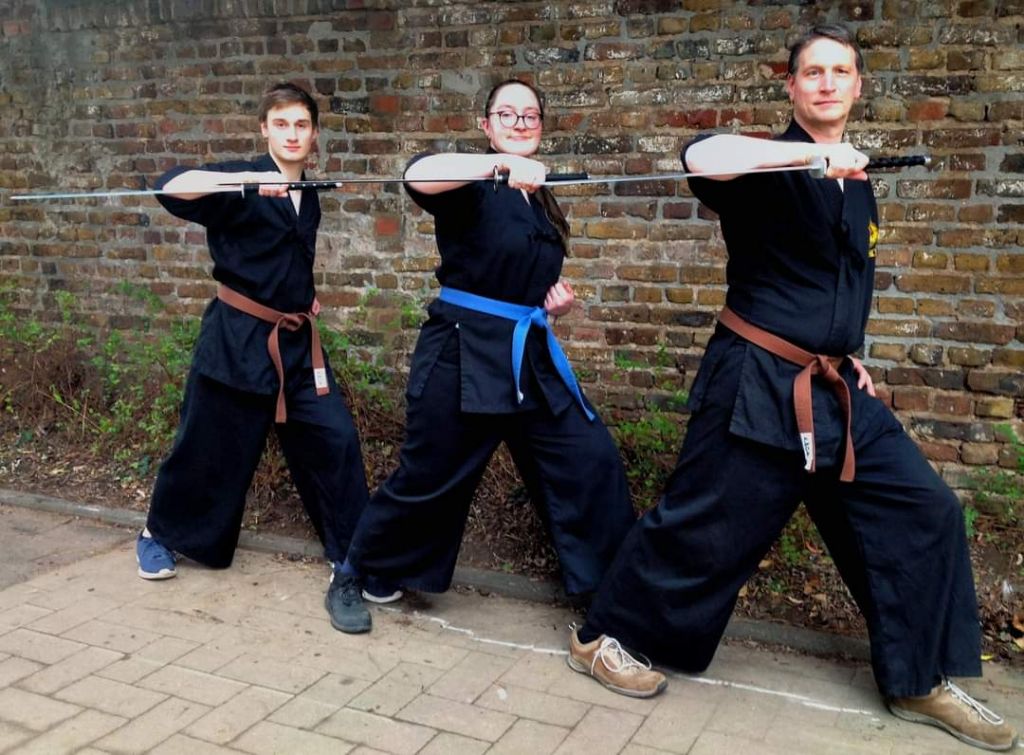
The focus of the sword maral art Haedong Kumdo Jinyoung Ssankum Ryu is on the holisc development of body and mind.
It is a living, constantly evolving maral art that fosters sensivity to inner energy through movement exercises, sword dance, and the training of
energy ow (Ki).
The regular practice of these techniques acts as an interface between body and mind, thereby improving the quality of life in all aspects of life.
The purpose, therefore, lies in connuous self-improvement, the harmonizaon of body and mind, as well as the joy of lifelong learning and the creave unfolding of the human being.
This way of life ulmately leads us back to the original spirit and energy of nature, which is love, and thus to spiritual growth and enlightenment.
2. What is the core philosophy of Jinyoung Ssangkum Ryu?
The core philosophy of Haedong Kumdo Jinyoung Ssankum Ryu lies in the holistic integration of sword training, the development of inner strength, and spiritual growth.
This sword art strives to unite body, mind, and spirit with themselves and nature through the sword, thereby
signicantly improving technical mastery of the sword, but in parcular also enabling a harmonious, more conscious life.
Sword training is based on understanding the core knowledge and theories of Haedong
Kumdo Jinyoung Ssankum Ryu
not through the intellect but through specic sword techniques, breathing exercises, and meditative movements.
On achieving harmony between
inner energy, physical movement, and mental clarity in connecon with nature, thereby also nourishing and strengthening the soul.
Dobeop (Sword Method) - Sinbeop (Body Method) - Simbeop (Mind Method)
The methods of Jinyoung Ssangkum Ryu training are tools for mental and physical training.
The deeper practitioners immerse themselves in their training, the more they realize that their body is not separate, from them but rather a vessel through which own energy.
This understanding leads to a condition in which the body moves insncvely, and practitioners recognize the impermanence of self-identy.
All of the following training methods share the same underlying essence and form a common foundation.
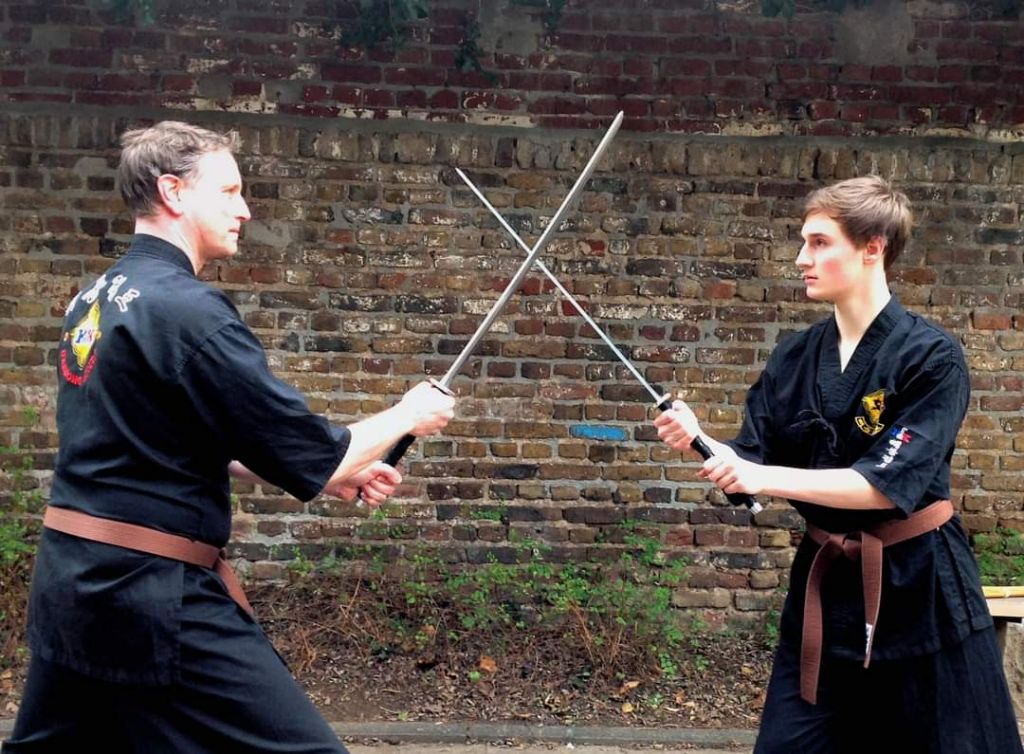
Two-Sword Techniques (Ssangkumdo)
A central focus is on training with two swords to gain a deep understanding of the principle of body movement. Using one or two swords, one strives for mental and physical training that
promotes precision, coordination, and a deep connection between body and mind.
Wielding the swords provides the opportunity to experience how the body moves automacally, the
sword follows the body, and the body, in turn, follows the mind. Through these experiences, which are constantly repeated in training, adjustments occur in maral arts and in life, enabling trainees to make beer decisions.
The purpose of these complex techniques is thus to develop oneself through diverse experiences and to grow not only in maral arts but also
in life.
Sword Training – Harmony and Balance
The sword as an extension of the arm
The movements of the sword follow those of the body.
The body’s movements follow the mind
The mind follows the energy (love) of nature
Developing Inner Strength (Haedong Kimu)
A central aspect is “Ki-Mu training,” a training method that culvates a deep connecon to life energy (Ki), which enhances sensitivity to inner energy and acts as a bridge between body and mind, linking the external and internal worlds.
These meditative movements, performed with mindfulness and awareness, lead to the point
where even the act of breathing and maintaining composure become the foundaon of all training eorts.
Not only physical tness but also mental clarity and balance are culvated.
Regular practice of Ki-Mu techniques should become a lifelong process of self-improvement and growth.
Ki-Mu Training – Even Breathing and a Balanced Mind
Perceiving light energy
Following the ow of energy
Mastering the principle of natural and automac movements
Perceiving the energy at work within the body
Understanding how energy funcons in the individual organs, etc.
Sword Dance (Haedong Kummu)
The Sword Dance is another important component that combines with movement, aesthecs,
creavity, and meditative depth.
It’s a form of moving meditation. Through repeve, precise
movements, the mind is calmed, and the praconer achieves a state of presence and clarity.
Sword Dance – The Sword as a Spiritual Tool
The sword symbolizes inner strength and wisdom
The movements reect the ow of life in harmony with nature
The dance calms the mind and promotes mindfulness
The dance symbolizes puricaon and personal growth
Philosophy and Enlightenment
In Jinyoung Ssankum Ryu, great emphasis is placed on philosophical discussions, spiritual
development, and the pursuit of enlightenment.
It is not merely about physical training, but also about mental discipline and improving the quality of life through self-realization and
energy work.
The core philosophy is not explicitly formulated as a philosophical doctrine or dogma.
Instead, the focus is on the holisc development of body and mind through the processing of personal experiences.
Healing System with Vipassana Acupuncture Practice
This pracce involves idenfying energy blockages and blockages in areas causing discomfort or pain, as well as restoring the ow of energy to regain balance and harmony through the
pracce.
Practice methods include meditation, acupuncture, and the use of stones, swords, and other tools.
In everyday life, the philosophy of Haedong Kumdo Jinyoung Ssankum Ryu can be applied in various ways—not only as physical training, but above all as a way of life.
1. Mindfulness and Presence
Through training, you learn to focus your mind and be present in the here and now.
This helps reduce stress and deal with everyday situaons more mindfully.
The emphasis is on the body
following the mind—that is, not reacng automacally, but acng consciously.
2. Energy Flow and Inner Balance
Kimu training (life energy work) is designed to strengthen inner energy and improve the ow between body and mind.
In everyday life, this means:
Regular exercise, breathing exercises, or short meditaons can help balance your own energy and become more resilient.
3. Adaptability and Growth
Haedong Kumdo emphasizes that through repeated experiences—both in training and in life
—you learn to make beer decisions. In everyday life, you can pracce this by facing new challenges, learning from mistakes, and connuously developing yourself.
4. Creavity and Joy
The sword dance and free sparring demonstrate that Haedong Kumdo also leaves room for
creavity and play.
In everyday life, you can apply this by making me for creave acvies or breaking out of rounes to gain new perspecves.
5. Harmony with the Environment
The philosophy emphasizes training in harmony with nature. This can be put into pracce in daily life through conscious experiences of nature (e.g., walks, gardening) or by being mindful
of one’s surroundings.
In conclusion,
the holistic approach of Jinyoung Ssangkum Ryu Haedong Kumdo training enables practitioners to achieve higher levels of mastery that go beyond the mere mastery of
marrial arts techniques.
Ultimately, training in Jinyoung Ssangkum Ryu guides practitioners toward the proper practice
for better training and, indeed, a better life.
3. What is the mutual interacon between the body and mind within the spirit?
The soul is not a stac construct, but a dynamic process that arises from the constant dialogue between the body (breath, posture) and the mind (thoughts, perception).
The soul is perceived as the place where body and mind come together.
It is not merely passive but
actively involved in the integration of both levels. The soul is the mirror of the integration between physical and mental states.
A harmonious balance between the two fosters a sense of wholeness, meaning, and inner peace.
The interrelaonship between body and mind has profound eects on what we call the “soul.” Here are some aspects that shape this dynamic:
In a holistic understanding of body, mind, and soul, these are closely intertwined, with the body and mind forming a single unit that influences the soul positively or negatively
depending on their state.
What aects the body acts the mind—and vice versa. This interacticon also shapes the soul’s experience—that is, the inner sense of meaning, identity,
and connection.
For example, a chronically stressed mind can lead to physical tension or even illness.
At the same me, physical illnesses (e.g., thyroid problems) can alter mood and thought processes—
and thus also one’s sense of one’s own soul.
Many physical symptoms (e.g., stomach problems, headaches) have no organic cause but are
expressions of unresolved psychological conicts.
Emotions and thoughts acvate specic
areas of the brain and release neurotransmiers that inuence the body (e.g., adrenaline
during fear, serotonin during happiness).
A posive, mindful state of mind can support physical healing processes and promote the well-being of the soul.
If, on the other hand, there is physical and/or psychological trauma, the soul “remembers” the experience, even if
we are oen not consciously aware of it.
Experiences and environmental factors can influence gene acvity—and thus shape the body,
mind, and soul in the long term.
Nature, God, Buddha = Love = Empness = Light
It is important to understand that we benet only when we treat and train our body and mind in a positive way.
In doing so, we prevent the negative processes described above from taking place.
We have a great responsibility toward our body, which is not actually our own, but has been entrusted to us by nature for the duration of our life on Earth.
Through a negative mindset, characterized by selfish behavior full of excess and carelessness, we harm the body and block our own path to a fullled life.
By practicing a sincere discipline free from selfishness, greed, jealousy, etc., we can train the
mind so that our lives are permeated by the love of nature.
The love of nature is a dynamic
force that ows through our bodies and is also described as light or energy.
The love of nature manifests itself in body and mind. This love is present in every living person. With the right
practice, we can cultivate this light and return to our original state of mind, which is given to us by nature.
By practicing specific exercises from Haedong Kumdo Jinyoug Ssangkum Ryu, we can infuence
the state of our body and mind—and thus also the state of our soul.
Through mindfulness exercises and meditation techniques, we connect body and mind, thereby nurturing the well-being of our soul.
Through these techniques, we strengthen our love for nature and even draw it in; we allow ourselves to be ooded by the light of nature and lled with its energy, thereby dissolving the blockages that disturb us and make us ill.
-----------------------
■ Comments
Li Schlüter's essay demonstrates a solid understanding of the purpose of Ki-Mu training, the Love of Nature, and the relationship between the body, mind, and soul within the philosophy of Jinyoung Ssangkum Ryu.
In particular, I highly appreciate her understanding that the purpose of training is not merely the improvement of sword techniques, but the growth and enlightenment of human life as a whole.
Her effort to explain Ki-Mu training, sword dance, and the practical application of training in everyday life is clearly reflected throughout the essay.
Overall, it is a sincere, thoughtful, and well-written work.
However, the concept of the soul is explained somewhat from a Western philosophical perspective.
In addition, I believe that deeper practical experience is still needed regarding the bladder-centered energy structure and the realization that arises through the body, which are important aspects of Jinyoung Ssangkum Ryu training.
True understanding is not completed through knowledge and intellectual thought alone.
It is ultimately realized through direct experience in and through the body.
If she continues her training with the same sincerity and dedication, I am confident that she has the potential to become an excellent instructor in the future.
This essay demonstrates sufficient philosophical understanding and sincerity for the requirements of a 3rd Dan essay examination, and I consider the written essay portion to be of a passing standard.
I hope it will serve as a positive example for many practitioners.
- JS Kim -
■ 논평
Li Schlüter의 에세이는 진영쌍검류 기무수련의 목적과 자연의 사랑, 그리고 몸과 마음, 영혼의 관계를 상당히 깊이 있게 이해하고 있음을 보여준다.
특히 수련의 목적을 단순한 검술의 향상이 아니라 인간 삶 전체의 성장과 깨달음의 과정으로 이해하고 있다는 점을 높이 평가한다.
또한 기무수련과 검무, 그리고 일상생활 속 실천의 중요성을 자신의 언어로 정리하려는 노력이 잘 나타나 있으며, 전반적으로 매우 성실하고 진지하게 작성된 훌륭한 에세이이다.
다만 영혼(Soul)에 대한 설명은 다소 서양 철학적 관점에서 접근한 부분이 있으며, 진영쌍검류에서 강조하는 방광 중심의 에너지 구조와 몸을 통한 깨달음에 대한 실제 체험은 앞으로 더욱 깊어질 필요가 있다고 생각한다.
진정한 이해는 생각과 지식만으로 완성되는 것이 아니라 몸을 통한 직접적인 체험 속에서 완성된다.
앞으로도 꾸준한 수련을 통해 보다 깊은 경험을 축적한다면 훌륭한 지도자로 성장할 수 있을 것이라 확신한다.
이번 에세이는 3단 심사에 요구되는 철학적 이해와 성실성을 충분히 보여주고 있으며, 에세이 심사 부분에 대해서는 통과 가능한 수준이 된다.
많은 수련인들에게 좋은 귀감이 될 것으로 기대된다.